Press release
English
Swedish
French
German

8 October 2001
The Nobel Assembly at Karolinska Institutet has today decided to award
The Nobel Prize in Physiology or Medicine for 2001 jointly to&
Leland H. Hartwell, R. Timothy (Tim) Hunt and Paul M. Nurse
for their discoveries of “key regulators of the cell cycle”
Summary
All organisms consist of cells that multiply through cell division. An adult human being has approximately 100 000 billion cells, all originating from a single cell, the fertilized egg cell. In adults there is also an enormous number of continuously dividing cells replacing those dying. Before a cell can divide it has to grow in size, duplicate its chromosomes and separate the chromosomes for exact distribution between the two daughter cells. These different processes are coordinated in the cell cycle.
This year’s Nobel Laureates in Physiology or Medicine have made seminal discoveries concerning the control of the cell cycle. They have identified key molecules that regulate the cell cycle in all eukaryotic organisms, including yeasts, plants, animals and human. These fundamental discoveries have a great impact on all aspects of cell growth. Defects in cell cycle control may lead to the type of chromosome alterations seen in cancer cells. This may in the long term open new possibilities for cancer treatment.
Leland Hartwell (born 1939), Fred Hutchinson Cancer Research Center, Seattle, USA, is awarded for his discoveries of a specific class of genes that control the cell cycle. One of these genes called “start” was found to have a central role in controlling the first step of each cell cycle. Hartwell also introduced the concept “checkpoint”, a valuable aid to understanding the cell cycle.
Paul Nurse (born 1949), Imperial Cancer Research Fund, London, identified, cloned and characterized with genetic and molecular methods, one of the key regulators of the cell cycle, CDK (cyclin dependent kinase). He showed that the function of CDK was highly conserved during evolution. CDK drives the cell through the cell cycle by chemical modification (phosphorylation) of other proteins.
Timothy Hunt (born 1943), Imperial Cancer Research Fund, London, is awarded for his discovery of cyclins, proteins that regulate the CDK function. He showed that cyclins are degraded periodically at each cell division, a mechanism proved to be of general importance for cell cycle control.
One billion cells per gram tissue
Cells having their chromosomes located in a nucleus and separated from the rest of the cell, so called eukaryotic cells, appeared on earth about two billion years ago. Organisms consisting of such cells can either be unicellular, such as yeasts and amoebas, or multi-cellular such as plants and animals. The human body consists of a huge number of cells, on the average about one billion cells per gram tissue. Each cell nucleus contains our entire hereditary material (DNA), located in 46 chromosomes (23 pairs of chromosomes).
It has been known for over one hundred years that cells multiply through division. It is however only during the last two decades that it has become possible to identify the molecular mechanisms that regulate the cell cycle and thereby cell division. These fundamental mechanisms are highly conserved through evolution and operate in the same manner in all eukaryotic organisms.
The phases of the cell cycle
The cell cycle consists of several phases (see figure). In the first phase (G1) the cell grows and becomes larger. When it has reached a certain size it enters the next phase (S), in which DNA-synthesis takes place. The cell duplicates its hereditary material (DNA-replication) and a copy of each chromosome is formed. During the next phase (G2) the cell checks that DNA-replication is completed and prepares for cell division. The chromosomes are separated (mitosis, M) and the cell divides into two daughter cells. Through this mechanism the daughter cells receive identical chromosome set ups. After division, the cells are back in G1 and the cell cycle is completed.
The duration of the cell cycle varies between different cell types. In most mammalian cells it lasts between 10 and 30 hours. Cells in the first cell cycle phase (G1) do not always continue through the cycle. Instead they can exit from the cell cycle and enter a resting stage (G0).
Cell cycle control
For all living eukaryotic organisms it is essential that the different phases of the cell cycle are precisely coordinated. The phases must follow in correct order, and one phase must be completed before the next phase can begin. Errors in this coordination may lead to chromosomal alterations. Chromosomes or parts of chromosomes may be lost, rearranged or distributed unequally between the two daughter cells. This type of chromosome alteration is often seen in cancer cells.
It is of central importance in the fields of biology and medicine to understand how the cell cycle is controlled. This year’s Nobel Laureates have made seminal discoveries at the molecular level of how the cell is driven from one phase to the next in the cell cycle.
Cell cycle genes in yeast cells
Leland Hartwell realized already at the end of the 1960s the possibility of studying the cell cycle with genetic methods. He used baker’s yeast, Saccharomyces cerevisiae, as a model system, which proved to be highly suitable for cell cycle studies. In an elegant series of experiments 1970-71, he isolated yeast cells in which genes controlling the cell cycle were altered (mutated). By this approach he succeeded to identify more than one hundred genes specifically involved in cell cycle control, so called CDC-genes (cell division cycle genes). One of these genes, designated CDC28 by Hartwell, controls the first step in the progression through the G1-phase of the cell cycle, and was therefore also called “start”.
In addition, Hartwell studied the sensitivity of yeast cells to irradiation. On the basis of his findings he introduced the concept checkpoint, which means that the cell cycle is arrested when DNA is damaged. The purpose of this is to allow time for DNA repair before the cell continues to the next phase of the cycle. Later Hartwell extended the checkpoint concept to include also controls ensuring a correct order between the cell cycle phases.
A general principle
Paul Nurse followed Hartwell’s approach in using genetic methods for cell cycle studies. He used a different type of yeast, Schizosaccharomyces pombe, as a model organism. This yeast is only distantly related to baker’s yeast, since they separated from each other during evolution more than one billion years ago.
In the middle of the 1970s, Paul Nurse discovered the gene cdc2 in S. pombe. He showed that this gene had a key function in the control of cell division (transition from G2 to mitosis, M). Later he found that cdc2 had a more general function. It was identical to the gene (“start”) that Hartwell earlier had identified in baker’s yeast, controlling the transition from G1 to S.
This gene (cdc2) was thus found to regulate different phases of the cell cycle. In 1987 Paul Nurse isolated the corresponding gene in humans, and it was later given the name CDK1 (cyclin dependent kinase 1). The gene encodes a protein that is a member of a family called cyclin dependent kinases, CDK. Nurse showed that activation of CDK is dependent on reversible phosphorylation, i.e. that phosphate groups are linked to or removed from proteins. On the basis of these findings, half a dozen different CDK molecules have been found in humans.
The discovery of the first cyclin
Tim Hunt discovered the first cyclin molecule in the early 1980s. Cyclins are proteins formed and degraded during each cell cycle. They were named cyclins because the levels of these proteins vary periodically during the cell cycle. The cyclins bind to the CDK molecules, thereby regulating the CDK activity and selecting the proteins to be phosphorylated.
The discovery of cyclin, which was made using sea urchins, Arbacia, as a model system, was the result of Hunt’s finding that this protein was degraded periodically in the cell cycle. Periodic protein degradation is an important general control mechanism of the cell cycle. Tim Hunt later discovered cyclins in other species and found that also the cyclins were conserved during evolution. Today around ten different cyclins have been found in humans.
The engine and the gear box of the cell cycle
The three Nobel Laureates have discovered molecular mechanisms that regulate the cell cycle. The amount of CDK-molecules is constant during the cell cycle, but their activities vary because of the regulatory function of the cyclins. CDK and cyclin together drive the cell from one cell cycle phase to the next. The CDK-molecules can be compared with an engine and the cyclins with a gear box controlling whether the engine will run in the idling state or drive the cell forward in the cell cycle.
A great impact of the discoveries
Most biomedical research areas will benefit from these basic discoveries, which may result in broad applications within many different fields. The discoveries are important in understanding how chromosomal instability develops in cancer cells, i.e. how parts of chromosomes are rearranged, lost or distributed unequally between daughter cells. It is likely that such chromosome alterations are the result of defective cell cycle control. It has been shown that genes for CDK-molecules and cyclins can function as oncogenes. CDK-molecules and cyclins also collaborate with the products of tumour suppressor genes (e.g. p53 and Rb) during the cell cycle.
The findings in the cell cycle field are about to be applied to tumour diagnostics. Increased levels of CDK-molecules and cyclins are sometimes found in human tumours, such as breast cancer and brain tumours. The discoveries may in the long term also open new principles for cancer therapy. Already now clinical trials are in progress using inhibitors of CDK-molecules.
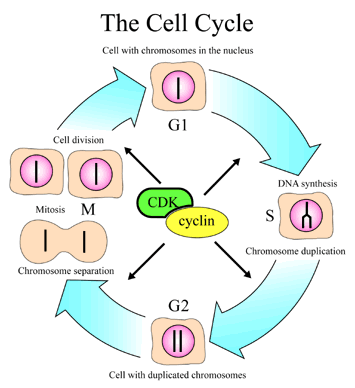 |
| The different phases of the cell cycle. In the first phase (G1) the cell grows. When it has reached a certain size it enters the phase of DNA-synthesis (S) where the chromosomes are duplicated. During the next phase (G2) the cell prepares itself for division. During mitosis (M) the chromosomes are separated and segregated to the daughter cells, which thereby get exactly the same chromosome set up. The cells are then back in G1 and the cell cycle is completed.This year’s Nobel Laureates, using genetic and molecular biology methods, have discovered mechanisms controlling the cell cycle. CDK-molecules and cyclins drive the cell from one phase to the next. The CDK-molecules can be compared with an engine and the cyclins with a gear box controlling whether the engine will run in the idling state or drive the cell forward in the cell cycle. |
See also high resolution images:
Cell cycle, English version
Cellcykel, Swedish version
Leland H. Hartwell »
R. Timothy (Tim) Hunt »
Paul M. Nurse »
Nobel Prizes and laureates
Six prizes were awarded for achievements that have conferred the greatest benefit to humankind. The 14 laureates' work and discoveries range from quantum tunnelling to promoting democratic rights.
See them all presented here.