Theodore Roosevelt
Biographical
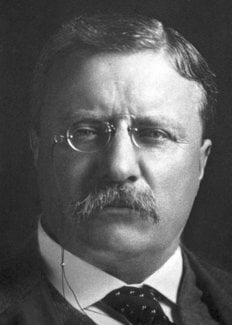
Theodore Roosevelt (October 27, 1858–January 6, 1919) was born in New York into one of the old Dutch families which had settled in America in the seventeenth century. At eighteen he entered Harvard College and spent four years there, dividing his time between books and sport and excelling at both. After leaving Harvard he studied in Germany for almost a year and then immediately entered politics. He was elected to the Assembly of New York State, holding office for three years and distinguishing himself as an ardent reformer.
In 1884, because of ill health and the death of his wife, Roosevelt abandoned his political work for some time. He invested part of the fortune he had inherited from his father in a cattle ranch in the Badlands of Dakota Territory, expecting to remain in the West for many years. He became a passionate hunter, especially of big game, and an ardent believer in the wild outdoor life which brought him health and strength. In 1886 Roosevelt returned to New York, married again, and once more plunged into politics.
President Harrison, after his election in 1889, appointed Roosevelt as a member of the Civil Service Commission of which he later became president. This office he retained until 1895 when he undertook the direction of the Police Department of New York City. In 1897 he joined President McKinley’s administration as assistant secretary of the Navy. While in this office he actively prepared for the Cuban War, which he saw was coming, and when it broke out in 1898, went to Cuba as lieutenant colonel of a regiment of volunteer cavalry, which he himself had raised among the hunters and cowboys of the West. He won great fame as leader of these «Rough-Riders», whose story he told in one of his most popular books.
Elected governor of the state of New York in 1898, he invested his two-year administration with the vigorous and businesslike characteristics which were his hallmark. He would have sought reelection in 1900, since much of his work was only half done, had the Republicans not chosen him as their candidate for the second office of the Union. He held the vice-presidency for less than a year, succeeding to the presidency after the assassination of President McKinley on September 14, 1901. In 1904 Roosevelt was elected to a full term as president.
In 1902 President Roosevelt took the initiative in opening the international Court of Arbitration at The Hague, which, though founded in 1899, had not been called upon by any power in its first three years of existence. The United States and Mexico agreed to lay an old difference of theirs, concerning the Pious Foundations of California, before the Hague Tribunal. When this example was followed by other powers, the arbitration machinery created in 1899 was finally called into operation. Roosevelt also played a prominent part in extending the use of arbitration to international problems in the Western Hemisphere, concluding several arbitration treaties with European powers too, although the Senate refused to ratify them.
In 1904 the Interparliamentary Union, meeting in St. Louis, Missouri, requested Roosevelt to call another international conference to continue the work begun at The Hague in 1899. Roosevelt responded immediately, and in the autumn of 1904 Secretary of State John Hay invited the powers to meet at The Hague. Russia, however, refused to participate in a conference while engaged in hostilities with Japan. After the peace of 1905, the matter was placed in the hands of the Russian government, which had taken the initiative in convening the first Hague Conference.
In June, 1905, President Roosevelt offered his good offices as mediator between Russia and Japan, asking the belligerents to nominate plenipotentiaries to negotiate on the conditions of peace. In August they met at Portsmouth, New Hampshire, and after some weeks of difficult negotiations concluded a peace treaty in September, 1905.
Roosevelt’s candidate for president, William Howard Taft, took office in 1909. Dissatisfied with Taft’s performance, Roosevelt bolted the regular Republican Party in 1912 and accepted the presidential nomination by the Progressive Party. He outpolled Taft, but Woodrow Wilson outpolled each of them. In 1917 Wilson refused his offer to raise and command a division to fight in World War I.
Roosevelt was an historian, a biographer, a statesman, a hunter, a naturalist, an orator. His prodigious literary output includes twenty-six books, over a thousand magazine articles, thousands of speeches and letters.
In 1919, at the age of sixty, he died in his sleep.
| Selected Bibliography |
| The Theodore Roosevelt Collection in the Library of Congress contains some 150,000 Roosevelt letters besides drafts of state papers and speeches. The Roosevelt Memorial Association Collection at Harvard University contains his diaries, some original M S S, microfilms, and most of his publications. |
| Beale, Howard, K., Theodore Roosevelt and the Rise of America to World Power. Baltimore, Johns Hopkins Press, 1956. |
| Beers, Henry A., «Roosevelt as Man of Letters» in Four Americans. New Haven, Yale University Press, 1920. |
| Bradford, Gamaliel, «The Fury of Living: Theodore Roosevelt» in The Quick and the Dead. New York, Houghton Mifflin, 1931. |
| Dennett, Tyler, Roosevelt and the Russo-Japanese War. New York, Doubleday, 1925. |
| Hagedorn, Hermann, ed., The Works of Theodore Roosevelt. 24 vols. Memorial ed. New York, Scribner, 1923-1926. |
| Harbaugh, William H., The Life and Times of Theodore Roosevelt. New York, Straus and Cudahy, 1961. |
| Lorant, Stefan, The Life and Times of Theodore Roosevelt. New York, Doubleday, 1959. |
| Morison, Elting E., ed., The Letters of Theodore Roosevelt. 8 vols. Cambridge, Harvard University Press, 1951-1954. |
| Pringle, Henry F., Theodore Roosevelt: A Biography. New York, Harcourt Brace, 1931. |
| Richardson, James D., ed., Messages and Papers of the Presidents. Washington, D. C., 1908. Volumes X and XI, along with a Supplement (1910), contain texts of all Roosevelt’s state papers. |
| Roosevelt, Theodore, African and European Addresses. New York, Putnam, 1910. |
| Roosevelt, Theodore, African Game Trails. New York, Scribner, 1910. |
| Roosevelt, Theodore, An Autobiography. New York, Scribner, 1913. |
| Roosevelt, Theodore, Oliver Cromwell. New York, Scribner, 1900. |
| Roosevelt, Theodore, The Rough Riders. New York, Scribner, 1898. |
| Roosevelt, Theodore, The Winning of the West. 4 vols. New York, Putnam, 1889-1896. |
| Wagenknecht, Edward C., The Seven Worlds of Theodore Roosevelt. New York, Longmans, Green, 1958. |
This autobiography/biography was written at the time of the award and first published in the book series Les Prix Nobel. It was later edited and republished in Nobel Lectures. To cite this document, always state the source as shown above.
The Nobel Foundation's copyright has expired.Nobel Prizes and laureates
Six prizes were awarded for achievements that have conferred the greatest benefit to humankind. The 14 laureates' work and discoveries range from quantum tunnelling to promoting democratic rights.
See them all presented here.