Paul Henri d'Estournelles de Constant
Biographical
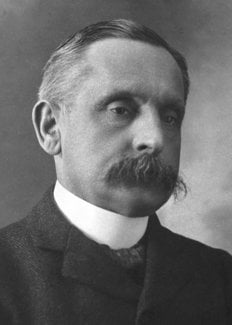
Paul Henri Benjamin Balluet, Baron d’Estournelles de Constant de Rebecque (November 22, 1852 – May 15, 1924), the son of an aristocratic family tracing its ancestry back to the Crusaders, was born at La Flèche in the Sarthe district of the Loire valley. A diplomat and politician, d’Estournelles, immensely energetic, found time to engage in fencing, yachting, and painting, and to pursue a keen interest in the automobile and the airplane after those machines had made their debut.
He attended the Lycée Louis le Grand in Paris, completed his legal studies, received a diploma from the School of Oriental Languages. Entering the diplomatic corps in 1876 as an attaché in the consular department of the Ministry of Foreign Affairs, d’Estournelles represented France in the next six years in Montenegro, Turkey, The Netherlands, England, and Tunis. Recalled to Paris in 1882, he assumed the assistant directorship of the Near Eastern Bureau of the Ministry of Foreign Affairs.
D’Estournelles was named chargé d’affaires in London in 1890 and both there and back in Paris helped to avert a possible war between England and France over a conflict of interests in Siam. Reflecting later on those days, in a speech in Edinburgh in 1906, d’Estournelles said he became convinced of the general impotence of those in the diplomatic service and resolved to abandon the «gilded existence of the diplomatist in order to undertake the real struggle… against ignorance» by obtaining an elective seat in the legislature and attempting to remedy the situation in which «the silent majority allow themselves to be persuaded that they know nothing of ‹Foreign Affairs› »1. And so, on May 19, 1895, he began his political career as deputy from Sarthe, elected by the same constituency that had years earlier elected his famous great-uncle, the author Benjamin Constant de Rebecque. Elected senator from the same region in 1904, he held that seat as an active Radical-Socialist until his death.
From the time that he was chosen to serve on the French delegation to the first Hague Peace Conference in 1899, d’Estournelles devoted himself almost exclusively to working for peace and arbitration. At the Peace Conference he led the successful struggle to strengthen the language dealing with arbitration and the court in Article 27 of Convention I, and in 1902 scored a notable success for arbitration when, during a visit to the United States, he was influential in persuading President Theodore Roosevelt to submit a U.S. dispute with Mexico to the Hague Tribunal.
In 1903, d’Estournelles founded a parliamentary group composed of members of the French Chamber and Senate irrespective of party, dedicated to the advancement of international arbitration, and employing as its chief method, the exchange of visits with foreign parliamentarians. A goodwill mission to London under his chairmanship in 1903 – and a return visit to Paris by British parliamentarians – helped pave the way for the Franco-British Entente Cordiale of 1904; a visit to Munich gave birth to the Franco-German Association in 1903. In 1905 at Paris he founded the Association for International Conciliation, with branches abroad.
D’Estournelles’ long-range solution for European problems was a political one – the formation of a European union. But meanwhile he continued to pursue those of a diplomatic and juridical nature – as an active contributor to the work of the Interparliamentary Union, as a member of the French delegation to the second Hague Peace Conference of 1907, as a member of the Permanent Court of Arbitration, as president of the European Center of the Carnegie Endowment for International Peace.
During the First World War, d’Estournelles supported the French effort, interesting himself particularly in measures against German submarines and turning his home – the Chateau de Clermont-Créans on the Loire – into a hospital for the wounded. In 1918 he denounced the armistice as meaningless as long as German soldiers remained on French soil. At the same time, however, he continued his campaign for international understanding: he joined Léon Bourgeois (Nobel Peace Prizewinner for 1920) in presenting a plan for the League of Nations to Clemenceau in 1918, and in later years he never ceased trying to bring together parliamentarians of various nations, especially those of France and Germany.
Throughout his career d’Estournelles proved a gifted writer and speaker. He published translations from the classical Greek, as well as a book on Grecian times; wrote a play based on the Pygmalion myth; won the French Academy’s Prix Thérouanne in 1891 with a book on French politics in Tunisia; produced speeches, pamphlets, and articles covering topics that ranged from French politics to feminism, from arbitration to aviation. Possessed of an admirable command of English – helped, no doubt, by his marriage to an American, Daisy Sedgwick-Berend – he made a number of lecture tours in the United States and published in 1913 a comprehensive review entitled Les États-Unis d’Amérique [America and Her Problems]. He became, indeed, a leading French authority on the United States.
D’Estournelles died in Paris in 1924 at the age of seventy-two and was interred in the Père-Lachaise cemetery. Two days after his death, his final speech, commemorating the twenty-fifth anniversary of the first Peace Conference, was read by his son Paul at The Hague.
| Selected Bibliography |
| À la Mémoire de son président-directeur, d’Estournelles de Constant, 1852-1924. Paris, Centre Européen de la Dotation Carnegie, 1924. |
| d’Estournelles de Constant, P.H.B., America and Her Problems, translated from the French by George A. Raper. New York, Macmillan, 1915. (Les États-Unis d’Amérique, Paris, Colin, 1913.) |
| d’Estournelles de Constant, P.H.B., La Conciliation internationale: Discours prononcé au Palais de Westminster, à Londres, le 22 juillet 1903. La Flèche, 1904. |
| d’Estournelles de Constant, P.H.B., Le Devoir et l’intérêt des États-Unis: Publications de M. d’Estournelles de Constant aux États-Unis. Paris, Delagrave, 1915. |
| d’Estournelles de Constant, P.H.B., La Politique extérieur de La France: Le Respeet des autres races. Paris, Delagrave, 1910. |
| d’Estournelles de Constant, P.H.B., La Politique française en Tunisie: Le Protectorat et ses origines, 1854-1891. Paris, Plon, 1891. |
| d’Estournelles de Constant, P.H.B., Pour la Société des Nations. La Flèche, Dépot des Publications de la Conciliation, 1921. |
| d’Estournelles de Constant, P.H.B., Pygmalion. Paris, 1907. |
| d’Estournelles de Constant, P.H.B., Vie de D. Coray, traduite du grec. Paris, 1887. |
| d’Estournelles de Constant, P.H.B., La Vie de province en Grèce. Paris, 1878. |
| d’Estournelles de Constant, P.H.B., Woman and the Cause of Peace, translated from the French. New York, American Association for International Conciliation, 1911. (Les Femmes et la paix. Paris, Delagrave, 1910.) |
| d’Estournelles de Constant, P.H.B., and David Jayne Hill, The Result of the Second Hague Conference. New York, American Branch of the Association for International Conciliation, 1907. |
| Schou, August, Histoire de l’internationalisme III: Du Congrès de Vienne jusqu’à la première guerre mondiale (1914), pp. 458-461. Publications de l’Institut Nobel Norvégien, Tome VIII. Oslo, Aschehoug, 1963. |
1. Baron d’Estournelles de Constant and others, International Peace (Edinburgh: Edinburgh Peace and Arbitration Society, 1906), pp. 5 and 6.
This autobiography/biography was written at the time of the award and first published in the book series Les Prix Nobel. It was later edited and republished in Nobel Lectures. To cite this document, always state the source as shown above.
The Nobel Foundation's copyright has expired.Nobel Prizes and laureates
Six prizes were awarded for achievements that have conferred the greatest benefit to humankind. The 14 laureates' work and discoveries range from quantum tunnelling to promoting democratic rights.
See them all presented here.