Frank B. Kellogg
Biographical
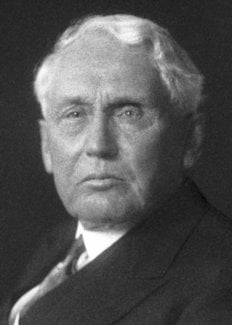
The life of Frank Billings Kellogg (December 22, 1856-December 21, 1937), a farm boy who rose to international preeminence as the co-author of a treaty to outlaw war, is a uniquely American story. Frank Kellogg was born in Potsdam, N.Y., but the Kellogg family, becoming part of the westward movement which gripped the country at the end of the Civil War in 1865, settled eventually on a wheat farm in Elgin, Olmsted County, Minnesota.
Kellogg’s formal education was sketchy. He attended school for a year or two in New York State and from his ninth to his fourteenth year went to a country school in Minnesota. After five years on the farm, he entered a law office in Rochester, Minnesota, supporting himself as a handyman for a Rochester farmer and teaching himself law, history, Latin, and German with the aid of borrowed textbooks. Having passed the state bar examination in 1877, he became the city attorney for Rochester and two years later the attorney for Olmsted County.
A cousin, Cushman Kellogg Davis, the leading lawyer of St. Paul and later a United States senator, recognizing Frank Kellogg’s energy, tenacity, and skill, invited him, in 1887, to join his law firm. In the next twenty years Kellogg earned a substantial fortune. He became counsel for some of the railroads, the iron mining companies, and the steel manufacturing firms that developed the rich Mesabi iron range in Minnesota and, consequently, a friend of some of the great business figures of the day, among them, Andrew Carnegie, John D. Rockefeller, and James J. Hill.
Despite such associations, Kellogg achieved national fame as a «trustbuster». In 1904 he proffered his opinion to a St. Paul newspaper that the General Paper Company, a trust which was the marketing agency for a number of paper companies in Minnesota and Wisconsin, was a combination in restraint of trade. President Theodore Roosevelt, whom Kellogg had come to know and to visit occasionally at the White House, then asked him to prosecute the company as a special attorney of the U.S. government. Kellogg’s legal victory was complete. He won another antitrust victory against E. H. Harriman and the Union Pacific Railroad, and a third in 1911 against John D. Rockefeller and the Standard Oil Company in one of the most dramatic legal battles of the pre-World War I era. In 1912 he was named president of the American Bar Association.
Kellogg was a member of the National Committee of the Republican Party from 1904 to 1912 and a delegate to its national conventions in 1904, 1908, and 1912. In 1916 he was elected to the U.S. Senate, taking his seat on March 4, 1917, in time to vote for America’s entry into World War I on April 6. In the course of his six-year term, he favored agricultural legislation, sought to find a balance between laissez-faire and governmental control of economic life, supported Woodrow Wilson in all of his efforts, and tried hard to obtain senatorial ratification of the Treaty of Versailles and of the Covenant of the League of Nations, although he had some mild reservations about the Covenant.
A poor campaigner, Kellogg lost his try in 1922 for a second term in the Senate. In March, 1923, President Harding sent him on his first diplomatic mission as a delegate to the fifth Pan-American Conference, which was held in Chile, and after his return, President Coolidge, who had succeeded to the presidency after Harding’s death in August, 1923, named him as ambassador to the Court of St. James’s – much to his surprise and that of a grumbling press. The most important diplomatic affair in which he figured in his fourteen months in England was the London Reparations Conference convened to accept the Dawes Committee report.
In 1925 Kellogg succeeded Charles Evans Hughes as secretary of state in Coolidge’s cabinet, holding the position until 1929. His policy toward Mexico on critical problems of oil and land expropriation which were solved by legal rather than military means, toward Nicaragua despite armed intervention at one point, and toward the Caribbean and South American nations has been described as one of «retreat from imperialism»1; his policy toward China with whom relations were troubled by outbreaks against foreigners in Shanghai and Nanking and by problems of tariff autonomy and abolition of extraterritoriality was one of «goodwill»2; and, in general, his policy toward Europe was one of isolationism, in part because there were few significant diplomatic problems with European nations.
In pursuance of his faith in the efficacy of the legal arbitration of international disputes, Kellogg arranged for the signing of bilateral treaties with nineteen foreign nations. Of the eighty treaties of various kinds which he signed while in office – a total breaking the record set by William Jennings Bryan from 1913 to 1915 – none was so important to him as the Pact of Paris, commonly called the Kellogg-Briand Pact.
Negotiations for the pact originated with Aristide Briand, the French foreign minister, who released for publication on April 6, 1927, the tenth anniversary of America’s entry into World War I, an open letter proposing a bilateral Franco-American treaty of perpetual friendship denouncing war between the two nations. Kellogg, at first cool to the proposal, countered on December 28, 1927, by suggesting to Briand the adoption of a multilateral treaty renouncing war as an instrument of national policy. Once he had made the suggestion, Kellogg devoted his prodigious energies to making it a reality. The Pact was signed on August 27, 1928, and proclaimed on July 24, 1929, with sixty-four signatories.
Kellogg did not lose faith in the validity of the Pact in his remaining eight years of life even though it was characterized by one senator as an «international kiss» and was broken by armed conflict in Manchuria within months of its proclamation.
Kellogg returned to St. Paul early in 1929 and during the months that followed traveled extensively in America and in Europe to receive many honors, among them the Nobel Peace Prize, the French Legion of Honor, and honorary degrees from many universities. In 1930 he filled Hughes’s unexpired term on the Permanent Court of International Justice and was then elected to a full term of his own. Because of failing health, however, he was forced to resign from the Court in 1935 and retired to his home in St. Paul where he died in 1937 on the eve of his eighty-first birthday of pneumonia, following a stroke.
| Selected Bibliography |
| Bryn-Jones, David, Frank B. Kellogg: A Biography. New York, Putnam, 1937. |
| Dictionary of American Biography, Vol. XXXII (Supplement Two). |
| Ellis, L. Ethan, Frank B. Kellogg and American Foreign Relations, 1925-1929. New Brunswick, N.J., Rutgers University Press, 1961. Contains a bibliography. |
| Ferrell, Robert H., «Frank B. Kellogg», in The American Secretaries of State and Their Diplomacy, Vol. XI, pp. 1-135. New York, Cooper Square Publishers, 1963. Contains a bibliography. |
| Ferrell, Robert H., Peace in Their Time: The Origins of the Kellogg-Briand Pact. New Haven, Conn., Yale University Press, 1952. |
| Kellogg, Frank B., The Kellogg papers are held by the Minnesota Historical Society, St. Paul, Minnesota. |
| Kellogg, Frank B., «Lincoln and Roosevelt.» An address at the annual banquet of the Lincoln Club. St. Paul, Minn., McGill, Warner, 1908. |
| Kellogg, Frank B., «The Settlement of International Controversies by Pacific Means.» An address delivered before the World Alliance for International Friendship Washington, D.C., Government Printing Office, 1928. |
| Kellogg, Frank B., «Some Objectives of American Foreign Policy.» An address delivered before the Associated Press of New York City. Washington, D. C., Government Printing Office, 1926. |
| Kellogg, Frank B., Standard Oil Company of New Jersey et al., Appellants, v. United States of America, Appellee: Transcript of Stenographer’s Minutes of the Oral Argument of Frank B. Kellogg on Behalf of the United States. Washington, D.C., Government Printing Office, 1911. |
| Kellogg, Frank B., «The War Prevention Policy of the United States», American Journal of International Law, 22 (1928) 253-261. |
| Obituary, the New York Times (December 22, 1937) 1, 26. |
1. Robert H. Ferrell, «Frank B. Kellogg», in The American Secretaries of State and Their Diplomacy, Vol. XI, p. 57.
This autobiography/biography was written at the time of the award and first published in the book series Les Prix Nobel. It was later edited and republished in Nobel Lectures. To cite this document, always state the source as shown above.
The Nobel Foundation's copyright has expired.Nobel Prizes and laureates
Six prizes were awarded for achievements that have conferred the greatest benefit to humankind. The 14 laureates' work and discoveries range from quantum tunnelling to promoting democratic rights.
See them all presented here.