Nathan Söderblom
Biographical
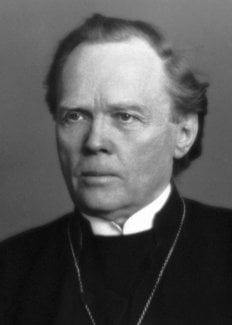
Nathan Söderblom (January 15, 1866-July 12, 1931), near the beginning and near the end of his illustrious career, found his name linked with that of another Swedish citizen of the world, Alfred Nobel. He was called to San Remo in 1897 to conduct the memorial service for Nobel and in 1930 to Oslo to receive the Nobel Peace Prize.
Lars Olof Jonathan (called Nathan) Söderblom was born at Trönö, in the Swedish province of Hälsingland, to Jonas Söderblom, a Pietistic pastor, and Sophia (Blume) Söderblom, among whose ancestors there had once been a bishop of Oslo.
As a student at Uppsala University, Söderblom won respect not only for his intellectual attainments but also for his personal charm, abundant vitality, and talent as a speaker. He took his bachelor’s degree in 1886, with honors in Greek and competency in Hebrew, Arabic, and Latin. This admirable linguistic background equipped him for the exacting scholarship of the School of Theology at Uppsala where, for the next six years, he continued his wide-ranging studies in theology and the history of religion. From its founding in 1888, Söderblom was the editor for five years of Meddelanden, the Student Missionary Association review, in whose pages he published the first piece in what was eventually to become a personal bibliography of 700 items. In 1890 he attended the Christian Student Conference in New England and there, after listening to a lecture by a visiting clergyman, wrote in his diary a sentence that was to prove prophetic, «Lord, give me humility and wisdom to serve the great cause of the free unity of thy church.»1
After being ordained a priest in 1893 and appointed chaplain to a mental hospital in Uppsala, he cast about for a post that would enable him to marry Anna Forsell, a gifted woman student – one of twenty among 1,700 men at Uppsala University – who was later to bear him thirteen children, as well as to collaborate in the preparation of many of his published works. He accepted a call to the Swedish Church in Paris.
For seven years, from 1894 to 1901, Söderblom preached in Paris, where his congregation included Alfred Nobel and August Strindberg, as well as Swedish and Norwegian painters, authors, businessmen, diplomats, and visitors to the city. Summers he spent in Calais in research and writing while also serving as chaplain to Swedish seamen in the area. Meanwhile he pursued graduate studies in theology, history of religions, and in languages predating those of the classical ages, and eventually became the first foreigner ever to earn a Doctor of Theology degree at the Protestant Faculty of the Sorbonne.
Söderblom’s experience in France strengthened his youthful resolve to promote «free unity» among Christian churches. One of his biographers, Charles J. Curtis, points out that fluency in French and understanding of French and Parisian culture gave him an international outlook, that the theological currents of France merging with those from his native land solidified his theological liberalism, and that social work among the Scandinavians in France convinced him that in the life of the church right action was as important as right belief2.
From 1901 to 1914, Söderblom occupied a chair in the School of Theology at Uppsala University and concurrently, from 1912 to 1914, a chair at Leipzig University. In these productive years he wrote a series of books on religious history, religious psychology, and religious philosophy. With a group of brilliant colleagues and students at Uppsala, Söderblom led a theological revival in Sweden, giving stature to the field of comparative religion, pursuing the theme of the uniqueness of Christianity in the historical and personal character of Revelation, incorporating the study of non-Christian religions into the discipline of Christianity, and stimulating intense studies in the life and thought of Martin Luther3.
Söderblom’s election in 1914 as archbishop of Uppsala, and, in consequence, primate of the Church of Sweden, was a surprise. Customarily, the king chose the first name on a slate of the three who topped the list in the voting in the sixteen electoral colleges. In first and second place were two distinguished bishops who split eighty-two percent of the electoral vote almost evenly; in third place was Söderblom, a priest and professor, with eighteen percent of the vote. Not since 1670 had the bishops been passed over.
During the next, and last, seventeen years of his life, Söderblom administered the duties of the head of the ecclesiastical establishment, visiting churches throughout the nation, raising funds to reopen old churches and build new ones, reviving the elaborate ecclesiastical rituals of the past, imbuing the work of the church with evangelistic fervor, directing conferences, advising the administration of Uppsala University as ex officio pro-chancellor – and all the while carrying on with his own research and writing.
Internationally, he is best known, however, as the architect of the ecumenical movement of the twentieth century. He had already begun to move toward intercommunion between the Swedish Church and the Church of England as early as 1909; in 1920 he arranged to have Bishop Woods of Peterborough, England, participate in the consecration of two Swedish bishops; the following year Woods welcomed Söderblom’s «Life and Work» movement to Peterborough. Söderblom found that the ecumenical movement was hampered during this period for various reasons: the French, German, and American church officials were conservative, the Archbishop of Canterbury cautious, the patriarchs of the Eastern Orthodox churches just emerging from isolation, the Roman Catholic Church decidedly opposed, and the proponents usually men without power. Söderblom himself did have power, however, since he was the head of a national church, and he possessed other important attributes, including scholarly prestige and persuasive personal charm.
The Stockholm Conference in 1925, which brought together Anglican, Protestant, and Orthodox Christians, was the culminating event in Söderblom’s ecumenical efforts. Rome was not represented and in his opening address, Söderblom regretted the absence of the «Apostle Peter». The Conference, described in detail in Söderblom’s book Stockholm 1925, laid the basis for a future ecumenical creed, emphasized the need to reconcile the competing philosophies of subjective spirituality and of objective social action, and sought to find unity in appealing for world peace.
Söderblom was proud of his election to the Swedish Academy in 1921, of his Nobel Peace Prize in 1930, and of his invitation to deliver the Gifford Lectures in Edinburgh in 1931. For this famous lectureship he planned a great scholarly effort – one series of lectures to be delivered in 1931 and another in 1932, both series to be published in two volumes. He delivered the first series of ten lectures between May 19 and June 8, 1931. An appropriate title for his book eluded him, but on the last day of his life, July 12, he found it: The Living God4.
| Selected Bibliography |
| Andrae, Tor J.E., Nathan Söderblom. Uppsala, 1931. |
| Aulén, Gustaf, «Nathan Söderblom as a Theologian», Church Quarterly Review, 115 (October, 1932) 15-48. |
| Bell, George K.A., The Stockholm Conference, 1925: The Official Report of the Universal Christian Conference on Life and Work. London, Oxford University Press, 1926. |
| Curtis, Charles J., «Nathan Söderblom: Pope John of Protestant Ecumenism», American Ecclesiastical Review, 156 (January, 1967) 1-9. |
| Curtis, Charles J., Söderblom: Ecumenical Pioneer. Minneapolis, Augsburg Publishing House, 1967. Includes a bibliography. |
| Hoffmann, Jean G.H., Nathan Soederblom: Prophète de l’oecuménisme. Genève,Éditions Labor et Fides, 1948. |
| Katz, Peter, Nathan Söderblom: A Prophet of Christian Unity. London, James Clarke, 1949. |
| Malmeström, Elis, Eklund, Söderblom och Billing. Stockholm, Gummesson, 1969. |
| Rouse, Ruth, and Stephen C. Neill, eds., A History of the Ecumenical Movement, 1517-1948. London, for the Ecumenical Institute by S.P.C.K., 1954. |
| Söderblom, Nathan, Christian Fellowship: The United Life and Work of Christendom. New York, Revell, 1923. |
| Söderblom, Nathan, «The Church and International Good Will», Contemporary Review, 116 (1919) 309-315. |
| Söderblom, Nathan, The Church and Peace. Oxford, Clarendon Press, 1929. |
| Söderblom, Nathan, Kristenhetens möte i Stockholm, augusti nittonhundratjugufem: Historik, aktstycken, grundtankar, personligheter, eftermäle. Stockholm, 1926. |
| Söderblom, Nathan, The Living God: Basal Forms of Personal Religion. The Gifford Lectures. London, Oxford University Press, 1933. |
| Söderblom, Nathan, The Nature of Revelation, ed. by Edgar M. Carlson. Philadelphia, Fortress Press, 1966. |
| Söderblom, Nathan, Tal och skrifter. 5 dl. Stockholm, 1933. |
| Söderblom, Nathan, «The Unity of Christendom», American Scandinavian Review, 8 (1920) 585-592. |
| Söderblom, Nathan, «Why I Am a Lutheran», in Twelve Modern Apostles and Their Creeds, pp. 72-88. New York, 1926. |
| Sundkler, Bengt G.M., Nathan Söderblom: His Life and Work. London, Lutterworth, 1968. |
1. Bengt Sundkler, Nathan Söderblom, p. 38.
2. Charles J. Curtis, Söderblom, pp. 44-46.
4. Sundkler, op.cit., pp. 424-426.
This autobiography/biography was written at the time of the award and first published in the book series Les Prix Nobel. It was later edited and republished in Nobel Lectures. To cite this document, always state the source as shown above.
The Nobel Foundation's copyright has expired.Nobel Prizes and laureates
Six prizes were awarded for achievements that have conferred the greatest benefit to humankind. The 14 laureates' work and discoveries range from quantum tunnelling to promoting democratic rights.
See them all presented here.