Jane Addams
Biographical
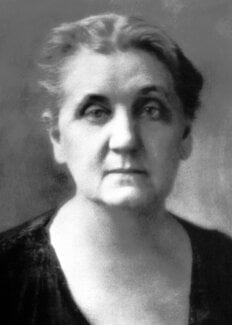
Jane Addams (born Laura Jane Addams, September 6, 1860-May 21, 1935) won worldwide recognition in the first third of the twentieth century as a pioneer social worker in America, as a feminist, and as an internationalist.
She was born in Cedarville, Illinois, the eighth of nine children. Her father was a prosperous miller and local political leader who served for sixteen years as a state senator and fought as an officer in the Civil War; he was a friend of Abraham Lincoln whose letters to him began «My Dear Double D-‘ed Addams». Because of a congenital spinal defect, Jane was not physically vigorous when young nor truly robust even later in life, but her spinal difficulty was remedied by surgery.
In 1881 Jane Addams was graduated from the Rockford Female Seminary, the valedictorian of a class of seventeen, but was granted the bachelor’s degree only after the school became accredited the next year as Rockford College for Women. In the course of the next six years she began the study of medicine but left it because of poor health, was hospitalized intermittently, traveled and studied in Europe for twenty-one months, and then spent almost two years in reading and writing and in considering what her future objectives should be. At the age of twenty-seven, during a second tour to Europe with her friend Ellen G. Starr, she visited a settlement house, Toynbee Hall, in London’s East End. This visit helped to finalize the idea then current in her mind, that of opening a similar house in an underprivileged area of Chicago. In 1889 she and Miss Starr leased a large home built by Charles Hull at the corner of Halsted and Polk Streets. The two friends moved in, their purpose, as expressed later, being «to provide a center for a higher civic and social life; to institute and maintain educational and philanthropic enterprises and to investigate and improve the conditions in the industrial districts of Chicago»1.
Miss Addams and Miss Starr made speeches about the needs of the neighborhood, raised money, convinced young women of well-to-do families to help, took care of children, nursed the sick, listened to outpourings from troubled people. By its second year of existence, Hull-House was host to two thousand people every week. There were kindergarten classes in the morning, club meetings for older children in the afternoon, and for adults in the evening more clubs or courses in what became virtually a night school. The first facility added to Hull-House was an art gallery, the second a public kitchen; then came a coffee house, a gymnasium, a swimming pool, a cooperative boarding club for girls, a book bindery, an art studio, a music school, a drama group, a circulating library, an employment bureau, a labor museum.
As her reputation grew, Miss Addams was drawn into larger fields of civic responsibility. In 1905 she was appointed to Chicago’s Board of Education and subsequently made chairman of the School Management Committee; in 1908 she participated in the founding of the Chicago School of Civics and Philanthropy and in the next year became the first woman president of the National Conference of Charities and Corrections. In her own area of Chicago she led investigations on midwifery, narcotics consumption, milk supplies, and sanitary conditions, even going so far as to accept the official post of garbage inspector of the Nineteenth Ward, at an annual salary of a thousand dollars. In 1910 she received the first honorary degree ever awarded to a woman by Yale University.
Jane Addams was an ardent feminist by philosophy. In those days before women’s suffrage she believed that women should make their voices heard in legislation and therefore should have the right to vote, but more comprehensively, she thought that women should generate aspirations and search out opportunities to realize them.
For her own aspiration to rid the world of war, Jane Addams created opportunities or seized those offered to her to advance the cause. In 1906 she gave a course of lectures at the University of Wisconsin summer session which she published the next year as a book, Newer Ideals of Peace. She spoke for peace in 1913 at a ceremony commemorating the building of the Peace Palace at The Hague and in the next two years, as a lecturer sponsored by the Carnegie Foundation, spoke against America’s entry into the First World War. In January, 1915, she accepted the chairmanship of the Women’s Peace Party, an American organization, and four months later the presidency of the International Congress of Women convened at The Hague largely upon the initiative of Dr. Aletta Jacobs, a Dutch suffragist leader of many and varied talents. When this congress later founded the organization called the Women’s International League for Peace and Freedom, Jane Addams served as president until 1929, as presiding officer of its six international conferences in those years, and as honorary president for the remainder of her life.
Publicly opposed to America’s entry into the war, Miss Addams was attacked in the press and expelled from the Daughters of the American Revolution, but she found an outlet for her humanitarian impulses as an assistant to Herbert Hoover in providing relief supplies of food to the women and children of the enemy nations, the story of which she told in her book Peace and Bread in Time of War (1922).
After sustaining a heart attack in 1926, Miss Addams never fully regained her health. Indeed, she was being admitted to a Baltimore hospital on the very day, December 10, 1931, that the Nobel Peace Prize was being awarded to her in Oslo. She died in 1935 three days after an operation revealed unsuspected cancer. The funeral service was held in the courtyard of Hull-House.
| Selected Bibliography |
| Addams, Jane. An extensive collection of Miss Addams’ papers is deposited in the Swarthmore College Peace Collection, Swarthmore, Pennsylvania. |
| Addams, Jane, A Centennial Reader, ed. by E. C. Johnson, with a prefatory note on Jane Addams’ life by W. L. Neumann and an introduction by William O. Douglas. New York, Macmillan, 1960. |
| Addams, Jane, Democracy and Social Ethics. New York, Macmillan, 1902. Republished with an introductory life of Jane Addams by A. F. Scott. Cambridge, Mass., Harvard University Press, 1964. |
| Addams, Jane, The Excellent Becomes the Permanent. New York, Macmillan, 1932. |
| Addams, Jane, The Long Roal of Woman’s Memory. New York, Macmillan, 1916. |
| Addams, Jane, Newer Ideals of Peace. New York, Macmillan, 1907. |
| Addams, Jane, Peace and Bread in Time of War. New York, Macmillan, 1922. |
| Addams, Jane, The Second Twenty Years at Hull-House: September 1909 to September 1929. New York, Macmillan, 1930. |
| Addams, Jane, The Spirit of Youth and the City Streets. New York, Macmillan, 1909. |
| Addams, Jane, Twenty Years at Hull-House: With Autobiographical Notes. New York Macmillan, 1910. |
| Curti, Merle, «Jane Addams on Human Nature», Journal of the History of Ideas, 22 (April-June, 1961) 240-253. |
| Farrell, John C., Beloved Lady: A History of Jane Addams’ Ideas on Reform and Peace. Baltimore, Johns Hopkins Press, 1967. Contains a major bibliography. |
| Lasch, Christopher, The New Radicalism in America, 1889-1963: The Intellectual as a Social Type. London, Chatto & Windus, 1966. |
| Linn, James W., Jane Addams: A Biography. New York, Appleton-Century, 1935. |
| Tims, Margaret, Jane Addams of Hull House, 1860-1935. London, Allen & Unwin, 1961. |
* Miss Addams did not deliver a Nobel lecture. Hospitalized at the time of the award ceremony in December, 1931, she later notified the Nobel Committee in April of 1932 that her doctors had decided it would be unwise for her to go abroad.
1. Jane Addams, Twenty Years at Hull-House, p. 112.
This autobiography/biography was written at the time of the award and first published in the book series Les Prix Nobel. It was later edited and republished in Nobel Lectures. To cite this document, always state the source as shown above.
The Nobel Foundation's copyright has expired.Nobel Prizes and laureates
Six prizes were awarded for achievements that have conferred the greatest benefit to humankind. The 14 laureates' work and discoveries range from quantum tunnelling to promoting democratic rights.
See them all presented here.