Emily Greene Balch
Biographical
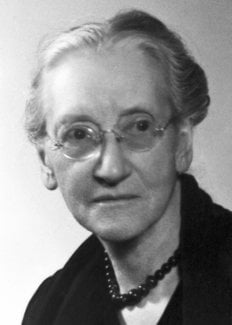
Emily Greene Balch (January 8, 1867-January 9, 1961) was born in Boston, the daughter of Francis V. and Ellen (Noyes) Balch. Hers was a prosperous family, her father being a successful lawyer, at one time secretary to United States Senator Charles Sumner. She went to private schools as a young girl; was graduated from Bryn Mawr College in 1889, a member of its first graduating class; spent the year 1889-1890 in independent study of sociology; used a European Fellowship awarded by Bryn Mawr to study economics in Paris in 1890-1891 under Émile Levasseur and to write Public Assistance of the Poor in France, published in 1893; completed her formal studies with scattered courses at Harvard and the University of Chicago and with a full year of work in economics in 1895-1896 in Berlin.
In 1896 she joined the faculty of Wellesley College, rising to the rank of professor of economics and sociology in 1913. An outstanding teacher, she impressed students by the clarity of her thought, by the breadth of her experience, by her compassion for the underprivileged, by her strong-mindedness, and by her insistence that students could formulate independent judgments only if they combined on-the-spot investigation with their research in the library. During these years she was a member of two municipal boards (one on children and one on urban planning) and of two state commissions (one on industrial education, the other on immigration); she participated in movements for women’s suffrage, for racial justice, for control of child labor, for better wages and conditions of labor; she contributed to knowledge with her research, notably, Our Slavic Felow-Citizens (1910), a study of the main concentrations of Slavs in America and of the areas in Austria and Hungary from which they emigrated.
Although Miss Balch had always been concerned with the problem of peace and had followed carefully the work of the two peace conferences of 1899 and 1907 at The Hague, she became convinced after the outbreak of World War I in 1914 that her lifework lay in furthering humanity’s effort to rid the world of war. As a delegate to the International Congress of Women at The Hague in 1915, she played a prominent role in several important projects: in founding an organization called the Women’s International Committee for Permanent Peace, later named the Women’s International League for Peace and Freedom; in preparing peace proposals for consideration by the warring nations; in serving on a delegation, sponsored by the Congress, to the Scandinavian countries and Russia to urge their governments to initiate mediation offers; and in writing, in collaboration with Jane Addams and Alice Hamilton, Women at The Hague: The International Congress of Women and Its Results (1915). Although Miss Balch was not a member of Henry Ford’s «Peace Ship», in 1915, she was a member of his Neutral Conference for Continuous Mediation, based at Stockholm, for which she drew up a position paper called «International Colonial Administration», proposing a system of administration not unlike that of the mandate system later accepted by the League of Nations.
Returning to the United States, she campaigned actively against America’s entry into the conflict. She asked for an extension of her leave of absence from the faculty of Wellesley College, but the trustees in 1918 decided instead to terminate her contract. She accepted a position on the editorial staff of the liberal weekly, the Nation; wrote Approaches to the Great Settlement, with an introduction by Norman Angell, a future Nobel Peace Prize winner (for 1933); attended the second convention of the International Congress of Women held in Zurich in 1919 and accepted its invitation to become secretary of its operating organization WILPF, The Women’s International League for Peace and Freedom, with headquarters in Geneva. This post she relinquished in 1922, but when the League was hard pressed financially in 1934, she again acted, without salary, as international secretary for a year and a half. It was to this League that Miss Balch donated her share of the Nobel Peace Prize money.
During the period between the wars, Miss Balch put her talents at the disposal of governments, international organizations, and commissions of various types. She helped in one way or another with many projects of the League of Nations – among them, disarmament, the internationalization of aviation, drug control, the participation of the United States in the affairs of the League. In 1926 she served as a member of a WILPF committee appointed to investigate conditions in Haiti, garrisoned then by American marines, and edited, as well as wrote, most of Occupied Haiti, the committee’s report. In the thirties she sought ways and means to help the victims of Nazi persecution.
Indeed, the excesses of nazism caused Emily Balch to change her strong pacifistic views and to defend the «fundamental human rights, sword in hand»1 during WW II. She also concentrated on generating ideas for the peace, most of them characterized by the common denominator of internationalism; for example, the internationalization of important waterways, of aviation, of certain regions of the world.
Even after receiving the Peace Prize in 1946 at the age of seventy-nine, Miss Balch continued, despite frail health, to participate in the cause to which she had given her life. She maintained her association with the WILPF, acting often in an honorary capacity; in 1959 she served as a co-chairman of a committee to mark the centenary of the birth of Jane Addams, a good comrade of days past and herself a winner of the Peace Prize (for 1931).
Throughout her life Miss Balch obeyed the call of the humanitarian in her nature, but she also listened to the promptings of the artist. She liked to paint, and she published a volume of verse, The Miracle of Living.
She died at the age of ninety-four years and one day, demonstrating that she was as persistent physically as she was intellectually.
Selected Bibliography
Balch, Emily Greene, Approaches to the Great Settlement, with an Introduction by Norman Angell. New York, Huebsch, 1918.
Balch, Emily Greene, The Miracle of Living. New York, Island Press, I94I. A book of poems.
Balch, Emily Greene, ed., Occupied Haiti; being the report of a committee of six disinterested Americans representing organizations exclusively American, who, having personally studied conditions in Haiti in 1926, favor the restoration of the independence of the Negro republic. New York, Writer’s Publishing Co., 1927.
Balch, Emily Greene, Our Slavic Fellow-Citizens. New York, Charities Publication Committee, 1910.
Balch, Emily Greene, Public Assistance of the Poor in France. Baltimore, American Economic Association, 1893.
Balch, Emily Greene, with Jane Addams and Alice Hamilton, Women at The Hague: The International Congress of Women and Its Results. New York, Macmillan, I9I5.
Randall, John Herman, Emily Greene Balch of New England: Citizen of the World. Washington, D. C., Women’s International League for Peace and Freedom, 1946.
Randall, Mercedes, «A Great Internationalist: The Passing of Emily Greene Balch», Pax et Libertas, 26 (1961) 6-8.
Women’s International League for Peace and Freedom, 1915-1938: A Venture in Internationalism. Geneva, Maison Internationale, 1938.
1. August Schou in Nobel: The Man and His Prizes (Amsterdam, 1962), p. 597.
This autobiography/biography was written at the time of the award and first published in the book series Les Prix Nobel. It was later edited and republished in Nobel Lectures. To cite this document, always state the source as shown above.
Nobel Prizes and laureates
Six prizes were awarded for achievements that have conferred the greatest benefit to humankind. The 14 laureates' work and discoveries range from quantum tunnelling to promoting democratic rights.
See them all presented here.