Lord Rayleigh
Biographical
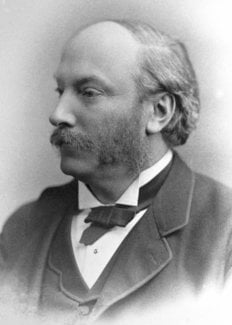
John William Strutt, third Baron Rayleigh, was born on November 12, 1842 at Langford Grove, Maldon, Essex, as the son of John James Strutt, second Baron, and his wife Clara Elizabeth La Touche, eldest daughter of Captain Richard Vicars, R. E. He was one of the very few members of higher nobility who won fame as an outstanding scientist.
Throughout his infancy and youth he was of frail physique; his education was repeatedly interrupted by ill-health, and his prospects of attaining maturity appeared precarious. After a short spell at Eton at the age of 10, mainly spent in the school sanatorium, three years in a private school at Wimbledon, and another short stay at Harrow, he finally spent four years with the Rev. George Townsend Warner (1857) who took pupils at Torquay.
In 1861 he entered Trinity College, Cambridge, where he commenced reading mathematics, not at first equal in attainments to the best of his contemporaries, but his exceptional abilities soon enabled him to overtake his competitors. He graduated in the Mathematical Tripos in 1865 as Senior Wrangler and Smith’s Prizeman. In 1866 he obtained a fellowship at Trinity which he held until 1871, the year of his marriage.
A severe attack of rheumatic fever in 1872 made him spend the winter in Egypt and Greece. Shortly after his return his father died (1873) and he succeeded to the barony, taking up residence in the family seat, Terling Place, at Witham, Essex. He now found himself compelled to devote part of his time to the management of his estates (7000 acres). The combination of general scientific knowledge and acumen with acquired knowledge of agriculture made his practice in estate management in many respects in advance of his time. Nevertheless, in 1876 he left the entire management of the land to his younger brother.
From then on, he could devote his full time to science again. In 1879 he was appointed to follow James Clerk Maxwell as Professor of Experimental Physics and Head of the Cavendish Laboratory at Cambridge. In 1884 he left Cambridge to continue his experimental work at his country seat at Terling, Essex, and from 1887 to 1905 he was Professor of Natural Philosophy in the Royal Institution of Great Britain, being successor of Tyndall.
He served for six years as President of a Government Committee on Explosives, and from 1896 to 1919 he was Scientific Advisor to Trinity House. He was Lord Lieutenant of Essex from 1892 to 1901.
Lord Rayleigh’s first researches were mainly mathematical, concerning optics and vibrating systems, but his later work ranged over almost the whole field of physics, covering sound, wave theory, colour vision, electrodynamics, electromagnetism, light scattering, flow of liquids, hydrodynamics, density of gases, viscosity, capillarity, elasticity, and photography. His patient and delicate experiments led to the establishment of the standards of resistance, current, and electromotive force; and his later work was concentrated on electric and magnetic problems. Lord Rayleigh was an excellent instructor and, under his active supervision, a system of practical instruction in experimental physics was devised at Cambridge, developing from a class of five or six students to an advanced school of some seventy experimental physicists. His Theory of Sound was published in two volumes during 1877-1878, and his other extensive studies are reported in his Scientific Papers – six volumes issued during 1889-1920. He has also contributed to the Encyclopaedia Britannica.
He had a fine sense of literary style; every paper he wrote, even on the most abstruse subject, is a model of clearness and simplicity of diction. The 446 papers reprinted in his collected works clearly show his capacity for understanding everything just a little more deeply than anyone else. Although a member of the House of Lords, he intervened in debate only on rare occasions, never allowing politics to interfere with science. His recreations were travel, tennis, photography and music.
Lord Rayleigh, a former Chancellor of Cambridge University, was a Justice of the Peace and the recipient of honorary science and law degrees. He was a Fellow of the Royal Society (1873) and served as Secretary from 1885 to 1896, and as President from 1905 to 1908. He was an original recipient of the Order of Merit (1902), and in 1905 he was made a Privy Councillor. He was awarded the Copley, Royal, and Rumford Medals of the Royal Society, and the Nobel Prize for 1904.
In 1871 he married Evelyn, sister of the future prime minister, the Earl of Balfour, and daughter of James Maitland Balfour and his wife Blanche, the daughter of the second Marquis of Salisbury. They had three sons, the eldest of whom was to become Professor of Physics at Imperial College of Science and Technology, London.
Lord Rayleigh died on June 30, 1919, at Witham, Essex.
This autobiography/biography was written at the time of the award and first published in the book series Les Prix Nobel. It was later edited and republished in Nobel Lectures. To cite this document, always state the source as shown above.
The Nobel Foundation's copyright has expired.Nobel Prizes and laureates
Six prizes were awarded for achievements that have conferred the greatest benefit to humankind. The 14 laureates' work and discoveries range from quantum tunnelling to promoting democratic rights.
See them all presented here.