William B. Shockley
Biographical
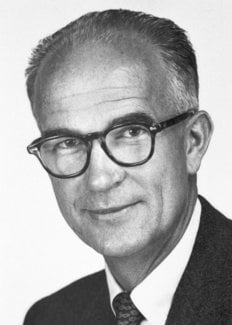
William Shockley was born in London, England, on 13th February, 1910, the son of William Hillman Shockley, a mining engineer born in Massachusetts and his wife, Mary (née Bradford) who had also been engaged in mining, being a deputy mineral surveyor in Nevada.
The family returned to the United States in 1913 and William Jr. was educated in California, taking his B.Sc. degree at the California Institute of Technology in 1932. He studied at Massachusetts Institute of Technology under Professor J.C. Slater and obtained his Ph.D. in 1936, submitting a thesis on the energy band structure of sodium chloride. The same year he joined Bell Telephone Laboratories, working in the group headed by Dr. C.J. Davisson and remained there (with brief absences for war service, etc.) until 1955. He resigned his post of Director of the Transistor Physics Department to become Director of the Shockley Semi-conductor Laboratory of Beckman Instruments, Inc., at Mountain View, California, for research development and production of new transistor and other semiconductor devices. In 1963 he was named first Alexander M. Poniatoff Professor of Engineering Science at Stanford University, where he will act as professor-at-large in engineering and applied sciences.
During World War II he was Research Director of the Anti-submarine Warfare Operations Research Group and he afterwards served as Expert Consultant in the offce of the Secretary for War.
He held two visiting lectureships: in 1946 at Princeton University, and in 1954 at the California Institute of Technology. For one year (1954-1955) he was Deputy Director and Research Director of the Weapons System Evaluation Group in the Defence Department.
Shockley’s research has been centred on energy bands in solids; order and disorder in alloys; theory of vacuum tubes; self-diffusion of copper; theories of dislocations and grain boundaries; experiment and theory on ferromagnetic domains; experiments on photoelectrons in silver chloride; various topics in transistor physics and operations research on the statistics of salary and individual productivity in research laboratories.
His work has been rewarded with many honours. He received the Medal for Merit in 1946, for his work with the War Department; the Morris Leibmann Memorial Prize of the Institute of Radio Engineers in 1952; the following year, the Oliver E. Buckley Solid State Physics Prize of the American Physical Society, and a year later the Cyrus B. Comstock Award of the National Academy of Sciences. The crowning honour – the Nobel Prize for Physics – was bestowed on him in 1956, jointly with his two former colleagues at the Bell Telephone Laboratories, John Bardeen and Walter H. Brattain.
In 1963 he was selected as recipient of the Holley Medal of the American Society of Mechanical Engineers.
Dr. Shockley has been a member of the Scientific Advisory Panel of the U.S. Army since 1951 and he has served on the Air Force Scientific Advisory Board since 1958. In 1962 he was appointed to the President’s Scientific Advisory Committee. He has received honorary science doctorates from the University of Pennsylvania, Rutgers University and Gustavus Adolphus Colleges (Minn.).
In addition to numerous articles in scientific and technical journals, Shockley has written Electrons and Holes in Semiconductors (1950) and has edited Imperfections of Nearly Perfect Crystals (1952). He has taken out more than 50 U.S. patents for his inventions.
Dr. Shockley has been married twice, and has three children by his first marriage to Jean (née Bailey). This union ended in divorce; his second wife is Emmy Lanning.
This autobiography/biography was written at the time of the award and first published in the book series Les Prix Nobel. It was later edited and republished in Nobel Lectures. To cite this document, always state the source as shown above.
William B. Shockley died on August 12, 1989.
Nobel Prizes and laureates
Six prizes were awarded for achievements that have conferred the greatest benefit to humankind. The 14 laureates' work and discoveries range from quantum tunnelling to promoting democratic rights.
See them all presented here.