Press release
English
Swedish

11 October 1995
The Royal Swedish Academy of Sciences has decided to award the 1995 Nobel Prize in Physics for pioneering experimental contributions to lepton physics with one half to Martin L. Perl, Stanford University, Stanford, California, USA for the discovery of the tau lepton
and with one half to Frederick Reines, University of California, Irvine, California, USA for the detection of the neutrino.
Discoveries of two of nature’s sub-atomic particles rewarded
Mankind seeks his place in nature. He endeavours to find answers to philosophical and physical questions alike. The home of mankind, the Universe, was created in a Big Bang. “What does this Universe consist of?” – “What are the smallest constituents of the Universe and what are their properties?” – “What can they tell us of the history of the Universe and of its future?” etc. This year’s laureates have in this search made lasting contributions: They have discovered two of nature’s most remarkable subatomic particles.
Martin L. Perl and his colleagues discovered, through a series of experiments between 1974 and 1977, at the Stanford Linear Accelerator Center (SLAC) in the USA, that the electron has a relative some 3 500 times heavier, which is called the tau.
Frederick Reines made pioneering contributions during the 1950s together with the late Clyde L. Cowan, Jr., which led to their being able to demonstrate experimentally the existence of the antineutrino of the electron.
Martin Perl‘s discovery of the tau was the first sign that a third “family” of fundamental building blocks existed. Some years later a further building block was discovered – one of the family’s two quarks, the bottom quark. Not until 18 years later was its other quark, the top quark, discovered. The existence of the third family is very important for physicists’ confidence in the present theoretical model for understanding the properties of nature’s smallest constituents. This is called the standard model. Without a third family, the model would have been incomplete and unable to admit what is termed the Charge and Parity (CP) violation, a violation of a fundamental principle of symmetry which, among other things, regulates particle decay (Nobel Prize to Cronin and Fitch 1980). If a fourth family of quarks and leptons is discovered, this may mean that the standard model must be revised and more extensive reconstruction within elementary-particle physics commenced.
Frederick Reines‘ and Clyde L. Cowan’s first observation of neutrinos was a pioneering contribution that opened the doors to the region of “impossible” neutrinoexperiments. Nowadays we are attempting to capture neutrinos in cosmic radiation that may originate in the sun or in supernovas (exploding stars). Because of the reluctance of neutrinos to react with atomic nuclei and thus allow themselves to be captured, very large detector volumes are required for these experiments. While Reines and Cowan in the 1950s managed with about half a cubic metre of water in their detector, large-scale experiments in the 1990s use many thousand cubic metres. Some experiments have even used surrounding sea or ice as their detector volume.
Nature’s building blocks and their family structure
The smallest of nature’s structures to have been studied so far are twelve types of matter particles – six quarks and six leptons. They each have their anti-particle, a sort of “mirror image” of the particle. (The name of a particle also includes its anti-particle.) As well as these quarks and leptons, there are other types of subatomic particles called force particles, since they are responsible for three of our known forces, strong force, electromagnetic force and weak force. Gravitational forces operate outside the scope of these. The most essential difference between quarks and leptons is that leptons are not affected by the strong force.
A remarkable property of matter particles is that they exhibit “family affiliation”. They come in three families, each consisting of two quarks and two leptons (Fig. 1). In many ways the three families behave as copies of one another. “Is there a fundamental principle to justify the existence of just three families?” is one of the unanswered questions of physics.
The quarks of the first family are “up quarks” and “‘down quarks”. Its lepton members are the electron and the electron-neutrino. The two quarks build protons and neutrons, which in turn form atomic nuclei and hence over 99% of all the earth’s matter. The small remainder is electrons. The electron-neutrino can be imagined very roughly as an electron deprived of charge and mass. Whether an insignificant amount of mass nevertheless remains, is another unanswered question. It was this electron-neutrino that Reines and his colleague Cowan, both then employed at the Los Alamos Scientific Laboratory, managed to capture.
The discovery of the tau During the 1960s many research groups were carrying out experiments one aim of which was to discover new charged particles, including new leptons. One approach was to search for the new particles in the products of decay of the particles that were available, e.g. kaons. Another way was to attempt to produce them in an accelerator, e.g. in collisions between high-energy electrons and a target. Martin Perl was a member of a team performing such an experiment at SLAC in 1966, but no new charged leptons were found. In 1973 a new machine started operation at SLAC – an electron-positron collider called SPEAR. A collider such as this is a lepton-hunter’s dream since the mechanism for possible production of new charged leptons (X+, X–) is simple and easy to interpret:
electron + positron -> X+ + X–
The SPEAR collider offered Perl an exceptional opportunity to continue his earlier hunt for new leptons, this time in a new and earlier inaccessible energy region of about 5 GeV (5 thousand million electron volts). After only a year came the first hint that something exciting was in the offing – something that could be signalling the production of a new type of lepton. The next year Perl and his co-workers published the first results. But a few more years were to pass before they could be certain that they had in fact discovered a lepton. The new lepton was designated with the Greek letter tau, standing for the first letter of the word triton, third.
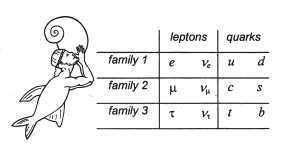 |
| Fig 1. The elementary particles of the standard model – a new periodic system. The figure represents a Triton. |
Perl’s and co-workers’ experiment
The experiment recorded frontal collisions between electrons and their antiparticles, positrons. A large cylindrical detector placed in a magnetic field surrounded the collision area. The detector consisted of many components including a number of wire spark chambers together with shower counters constructed of lead scintillators and a few proportional chambers. The first indication of a possible new phenomenon was that the research team observed 24 events of the type
electron + positron -> electron + antimuon + i.p.
or
electron + positron -> positron + muon + i.p.
where i.p. stands for invisible particles; those that left no trace in the detector. Thus only one electron (or positron) and an antimuon (or muon) with the opposite sign on its charges were detected. Applying the law of conservation of energy, Perl and his co-workers found that they had produced at least two invisible particles.
One possible interpretation of these events was that a pair of heavy leptons, later termed tau particles, had been produced first:
electron + positron -> tau + antitau
But these were expected to decay very rapidly and the observed electrons and muons were therefore interpreted as products of decay from reactions:
tau -> electron (or muon) + neutrinos
antitau -> antimuon (or positron) + neutrinos
The invisible particles were neutrinos, which with their notorious lack of sensitivity to their surroundings disappeared without visible trace (Fig. 2). However they made themselves felt when the energy balance was to be accounted for. They had taken with them a respectable proportion of the energy (cf. below).
Perl’s and co-workers’ hypothesis was tested in a new series of observations over many years. It gradually became clear that the tau had passed the test and thereby met all the possible requirements of a heavier relative to the electron and the muon. Like these, the tau also has its very own neutrino – the tau neutrino.
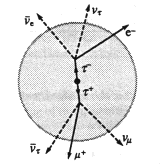
Fig. 2. Interpretation of a typical electron-muon trace from the SPEAR detector. The two heavy leptons decay within millimetres of the point of collision and cannot be seen directly. The neutrinos are also invisible. Only the charged particles e and µ are detected.
Energy conservation law cue for neutrino’s entrance
The neutrino hypothesis is some 40 years older. The neutrino “was born” as a hypothetical particle in a letter written in 1930 by Wolfgang Pauli (Nobel Prize 1945). At that time it was known that many atomic nuclei ended their lives by emitting an electron. This process, termed beta decay, caused researchers many headaches, among others that one of the sacred laws of physics – the law of conservation of energy – appeared not to apply. To restore order in the statute book of physics Pauli offered what he called a “desperate solution” – the nucleus did not emit the electron alone. It was accompanied by another subatomic particle which lacked electrical charge and reacted very little with its environment. The small particle, which came to be called the neutrino, took part of the energy with it and disappeared without trace into nothingness. The energy balance proved to be as expected as long as account was taken of the proportion the neutrino had removed.
Pauli thought he had done “a frightful thing”, as he called it, by proposing a particle that could never be discovered. It took three decades and the ingenuity of Reines and Cowan to bring the neutrino to light.
The discovery of the neutrino
Pauli’s neutrino hypothesis may have been “frightful” but it was also extremely attractive. It saved the energy conservation law and simultaneously solved many other riddles. The neutrino hypothesis was used by Enrico Fermi (Nobel Prize 1938) in a masterly manner to formulate a theory for one of the natural forces, the weak force. This splendid theory lent great credibility to the hypothesis that the neutrino is created simultaneously with the electron every time a nucleus disintegrates through beta decay. But how to produce conclusive proof that the neutrino existed? Researchers Hans Bethe (Nobel Prize 1967) and Rudolf Peierls had evaluated the probability of stopping neutrinos produced in the beta decay of radioactive nuclei and found that it was so minimal that a target several light years thick would be needed to capture these neutrinos efficiently. When the first nuclear reactors were built during the 1940s, Fermi was one of those who realised that the reactors could serve as intensive neutrino sources. It was estimated that the reactors would be able to give a neutrino flow of about 1012-1013 per second and cm2. This was many orders of magnitude greater than what was obtained from radioactive sources.
In 1953 Reines and Cowan proposed a reactor experiment to capture neutrinos. The reaction to be studied was
antineutrino + proton -> neutron + positron.
Despite the great intensity of the neutrinos the reactor delivered, such a low counting speed was expected for this reaction that the attempt appeared to be bordering on the impossible. Reines and Cowan realised the importance of detecting both the neutron and the positron to reduce the risk of erroneous interpretation. After a first trial at the Hanford reactor, Reines and Cowan went to work at the Savannah River Plant.
The target in the Reines-Cowan experiment consisted of approximately 400 litres of water containing cadmium chloride placed between large liquid scintillation detectors. The course of events for the reaction sought is as follows (cf. formula above): The neutrino collides with a proton in the water and creates a positron and a neutron. The positron is slowed down by the water and destroyed together with an electron (matter meets antimatter), whereupon two photons (light particles) are created. These are recorded simultaneously in the two detectors (Fig. 3). The neutron also loses velocity in the water and is eventually captured by a cadmium nucleus, whereupon photons are emitted. These photons reach the detectors a microsecond or so later than those from the destruction of the positron and give proof of neutrino capture.
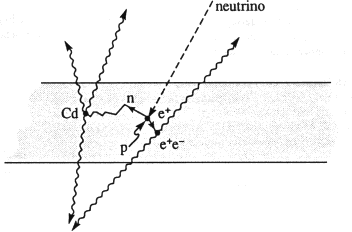 |
| Fig 3. Schematic picture of the neutrino detector of Reines and Cowan (see explanation in text). |
There were struggles with the low counting speed and high background. During the experiment a few events were recorded per hour. Nevertheless Reines and Cowan succeeded in a feat considered to border on the impossible: They had raised the neutrino from its status as a figure of the imagination to an existence as a free particle.
| Further reading |
| Additional background material on the Nobel Prize for Physics 1995, The Royal Swedish Academy of Sciences |
| Heavy Leptons, Martin L. Perl and William T. Kirk, Scientific America, March 1978. |
| Leptons – what are they? Martin L. Perl, New Scientist, 22 February 1979. |
| The Neutrino, Frederick Reines and Clyde L. Cowan, Jr., Nature, 1 September 1956. |
| Neutrino Physics, Frederick Reines and Clyde L. Cowan, Jr., Physics Today, August 1957. |
| Spaceship neutrino, Christine Sutton, Cambridge University Press 1992, p. 37-44, 89-93. |
Martin L. Perl
Born 1927, New York, NY, USA. American citizen. Doctor’s degree in physics 1955, Columbia University. Perl is a member of the National Academy of Sciences, USA.
Martin L. Perl, Professor
Stanford Linear Accelerator Center
Stanford University
Stanford, CA 94305
USA
Frederick Reines
Born 1918 Paterson, New Jersey, USA. American citizen. Doctor’s degree in physics 1944, New York University. Reines is a member of the National Academy of Sciences, USA, and a foreign member of the Russian Academy of Sciences.
Frederick Reines, Professor
Department of Physics
University of California at Irvine
Irvine, CA 92717
USA
Nobel Prizes and laureates
Six prizes were awarded for achievements that have conferred the greatest benefit to humankind. The 14 laureates' work and discoveries range from quantum tunnelling to promoting democratic rights.
See them all presented here.