Ivo Andrić
Biographical
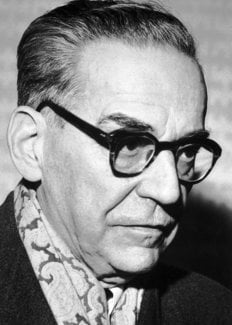
Ivo Andrić was born in the village of Dolac, near Travnik, in 1892. After spending his youth in his native Bosnia, which was at the time part of the Austro-Hungarian Empire, he studied philosophy at the Universities of Zagreb, Vienna, and Cracow. His studies were interrupted by the outbreak of the First World War, at the beginning of which he was jailed for his anti-Austrian activities. After receiving a doctorate in letters from the University of Graz in 1923, he entered the Yugoslav diplomatic service. The last diplomatic post he held was that of Yugoslav minister in Berlin. When Germany invaded Yugoslavia in 1941, Andrić returned to Belgrade and lived there in seclusion throughout the Second World War. He has continued to reside in the Yugoslav capital.
Andrić started his literary career as a poet. In 1914 he was one of the contributors to Hrvatska mlada lirika (Young Croatian Lyrics). At the end of the war he published two books of lyrical prose – one of them entitled Nemiri (Anxieties), 1919 – which, written in the form of a diary, reflect Andrić’s experiences of the war and his imprisonment. There followed a long period in which Andrić concentrated on the writing of short stories. His first novella, Put Alije Djerzeleza (The Trip of Alija Djerzelez), published in 1920, early manifests a dominant trait of his creative process. Andrić takes his material from the life of Bosnia, but through this local material he presents universal human problems. In the period between the two world wars Andrić published three books of short stories under the same title, Pripovetke (Stories), 1924, 1931, 1936.
During the Second World War, in the leisure imposed on him by the circumstances, Andrić wrote his three large works, all of which were published in 1945: Na Drini cuprija (The Bridge on the Drina), Travnicka hronika (Bosnian Story), and Gospodjica (The Woman from Sarajevo).
The first two of these works – both of them chronicles rather than novels in the strict sense – deal, like most of Andrić’s work, with Bosnia and her history. The author describes the life of this region in which East and West have for centuries clashed with their interests and influences, a region whose population is composed of different nationalities and religions. Andrić is at his best when he limits himself to his native Bosnia and her people.
In Gospodjica and Nove pripovetke (New Stories), 1948, Andrić presented present-day people and problems. He dealt with the psychology of the wealthy, with the war and postwar periods, and with the formation of a new society. But in Prokleta avilija (Devil’s Yard), 1954, Andrić returned to his favorite milieu and described the experiences of a Bosnian Franciscan, Fra Peter, who is put in an Istanbul jail, being wrongly accused of plotting against Ottoman rule. In 1960 Andrić published another collection of stories, Lica (Faces). He has also written several essays, prominent among which is Zapisi o Goji, (Notes on Goya), 1961.
This autobiography/biography was written at the time of the award and first published in the book series Les Prix Nobel. It was later edited and republished in Nobel Lectures. To cite this document, always state the source as shown above.
Ivo Andrić died on 13 March 1975.
Nobel Prizes and laureates
Six prizes were awarded for achievements that have conferred the greatest benefit to humankind. The 14 laureates' work and discoveries range from quantum tunnelling to promoting democratic rights.
See them all presented here.