José Saramago
Biographical
Written over the author’s signature and translated into English by Fernando Rodrigues and Tim Crosfield
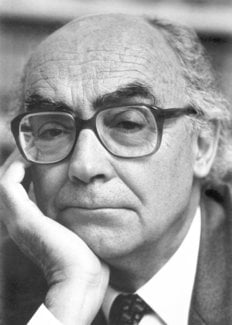
I was born in a family of landless peasants, in Azinhaga, a small village in the province of Ribatejo, on the right bank of the Almonda River, around a hundred kilometres north-east of Lisbon. My parents were José de Sousa and Maria da Piedade. José de Sousa would have been my own name had not the Registrar, on his own inititiave added the nickname by which my father’s family was known in the village: Saramago. I should add that saramago is a wild herbaceous plant, whose leaves in those times served at need as nourishment for the poor. Not until the age of seven, when I had to present an identification document at primary school, was it realised that my full name was José de Sousa Saramago…
This was not, however, the only identity problem to which I was fated at birth. Though I had come into the world on 16 November 1922, my official documents show that I was born two days later, on the 18th. It was thanks to this petty fraud that my family escaped from paying the fine for not having registered my birth at the proper legal time.
Maybe because he had served in World War I, in France as an artillery soldier, and had known other surroundings from those of the village, my father decided in 1924 to leave farm work and move with his family to Lisbon, where he started as a policeman, for which job were required no more “literary qualifications” (a common expression then…) than reading, writing and arithmetic.
A few months after settling in the capital my brother Francisco two years older, died. Though our living conditions had improved a little after moving, we were never going to be well off.
I was already 13 or 14 when we moved, at last, to our own – but very tiny – house: till then we had lived in parts of houses, with other families. During all this time, and until I came of age I spent many, and very often quite long, periods in the village with my mother’s parents Jerónimo Meirinho and Josefa Caixinha.
I was a good pupil at primary school: in the second class I was writing with no spelling mistakes and the third and fourth classes were done in a single year. Then I was moved up to the grammar school where I stayed two years, with excellent marks in the first year, not so good in the second, but was well liked by classmates and teachers, even being elected (I was then 12…) treasurer of the Students’ Union… Meanwhile my parents reached the conclusion that, in the absence of resources, they could not go on keeping me in the grammar school. The only alternative was to go to a technical school. And so it was: for five years I learned to be a mechanic. But surprisingly the syllabus at that time, though obviously technically oriented, included, besides French, a literature subject. As I had no books at home (my own books, bought by myself, however with money borrowed from a friend, I would only have when I was 19) the Portuguese language textbooks, with their “anthological” character, were what opened to me the doors of literary fruition: even today I can recite poetry learnt in that distant era. After finishing the course, I worked for two years as a mechanic at a car repair shop. By that time I had already started to frequent, in its evening opening hours, a public library in Lisbon. And it was there, with no help or guidance except curiosity and the will to learn, that my taste for reading developed and was refined.
When I got married in 1944, I had already changed jobs. I was now working in the Social Welfare Service as an administrative civil servant. My wife, Ilda Reis, then a typist with the Railway Company, was to become, many years later, one of the most important Portuguese engravers. She died in 1998. In 1947, the year of the birth of my only child, Violante, I published my first book, a novel I myself entitled The Widow, but which for editorial reasons appeared as The Land of Sin. I wrote another novel, The Skylight, still unpublished, and started another one, but did not get past the first few pages: its title was to be Honey and Gall, or maybe Louis, son of Tadeus… The matter was settled when I abandoned the project: it was becoming quite clear to me that I had nothing worthwhile to say. For 19 years, till 1966, when I got to publish Possible Poems, I was absent from the Portuguese literary scene, where few people can have noticed my absence.
For political reasons I became unemployed in 1949, but thanks to the goodwill of a former teacher at the technical school, I managed to find work at the metal company where he was a manager.
At the end of the 1950s I started working at a publishing company, Estúdios Cor, as production manager, so returning, but not as an author, to the world of letters I had left some years before. This new activity allowed me acquaintance and friendship with some of the most important Portuguese writers of the time. In 1955, to improve the family budget, but also because I enjoyed it, I started to spend part of my free time in translation, an activity that would continue till 1981: Colette, Pär Lagerkvist, Jean Cassou, Maupassant, André Bonnard, Tolstoi, Baudelaire, Étienne Balibar, Nikos Poulantzas, Henri Focillon, Jacques Roumain, Hegel, Raymond Bayer were some of the authors I translated. Between May 1967 and November 1968, I had another parallel occupation as a literary critic. Meanwhile, in 1966, I had published Possible Poems, a poetry book that marked my return to literature. After that, in 1970, another book of poems, Probably Joy and shortly after, in 1971 and 1973 respectively, under the titles From this World and the Other and The Traveller’s Baggage, two collections of newspaper articles which the critics consider essential to the full understanding of my later work. After my divorce in 1970, I initiated a relationship, which would last till 1986, with the Portuguese writer Isabel da Nóbrega.
After leaving the publisher at the end of 1971, I worked for the following two years at the evening newspaper Diário de Lisboa, as manager of a cultural supplement and as an editor.
Published in 1974 with the title The Opinions the DL Had, those texts represent a very precise “reading” of the last time of the dictatorship, which was to be toppled that April. In April 1975, I became deputy director of the morning paper Diário de Nóticias, a post I filled till that November and from which I was sacked in the aftermath of the changes provoked by the politico-military coup of the 25th November which blocked the revolutionary process. Two books mark this era: The Year of 1993, a long poem published in 1975, which some critics consider a herald of the works that two years later would start to appear with Manual of Painting and Calligraphy, a novel, and, under the title of Notes, the political articles I had published in the newspaper of which I had been a director.
Unemployed again and bearing in mind the political situation we were undergoing, without the faintest possibility of finding a job, I decided to devote myself to literature: it was about time to find out what I was worth as a writer. At the beginning of 1976, I settled for some weeks in Lavre, a country village in Alentejo Province. It was that period of study, observation and note-taking that led, in 1980, to the novel Risen from the Ground, where the way of narrating which characterises my novels was born. Meanwhile, in 1978 I had published a collection of short stories, Quasi Object; in 1979 the play The Night, and after that, a few months before Risen from the Ground, a new play, What shall I do with this Book? With the exception of another play, entitled The Second Life of Francis of Assisi, published in 1987, the 1980s were entirely dedicated to the Novel: Baltazar and Blimunda, 1982, The Year of the Death of Ricardo Reis, 1984, The Stone Raft, 1986, The History of the Siege of Lisbon, 1989. In 1986, I met the Spanish journalist Pilar del Río. We got married in 1988.
In consequence of the Portuguese government censorship of The Gospel According to Jesus Christ (1991), vetoing its presentation for the European Literary Prize under the pretext that the book was offensive to Catholics, my wife and I transferred our residence to the island of Lanzarote in the Canaries. At the beginning of that year I published the play In Nomine Dei, which had been written in Lisbon, from which the libretto for the opera Divara would be taken, with music by the Italian composer Azio Corghi and staged for the first time in Münster, Germany in 1993. This was not the first cooperation with Corghi: his also is the music to the opera Blimunda, from my novel Baltazar and Blimunda, staged in Milan, Italy in 1990. In 1993, I started writing a diary, Cadernos de Lanzarote (Lanzarote Diaries), with five volumes so far. In 1995, I published the novel Blindness and in 1997 All the Names. In 1995, I was awarded the Camões Prize and in 1998 the Nobel Prize for Literature.
This autobiography/biography was written at the time of the award and later published in the book series Les Prix Nobel/ Nobel Lectures/The Nobel Prizes. The information is sometimes updated with an addendum submitted by the Laureate.
José Saramago died on 18 June 2010.
Nobel Prizes and laureates
Six prizes were awarded for achievements that have conferred the greatest benefit to humankind. The 14 laureates' work and discoveries range from quantum tunnelling to promoting democratic rights.
See them all presented here.