Rigoberta Menchú Tum
Biographical
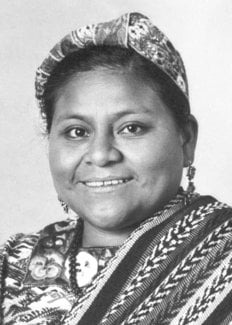
Rigoberta Menchú was born on January 9, 1959 to a poor Indian peasant family and raised in the Quiche branch of the Maya culture. In her early years she helped with the family farm work, either in the northern highlands where her family lived, or on the Pacific coast, where both adults and children went to pick coffee on the big plantations.
Rigoberta Menchú soon became involved in social reform activities through the Catholic Church, and became prominent in the women’s rights movement when still only a teenager. Such reform work aroused considerable opposition in influential circles, especially after a guerilla organization established itself in the area. The Menchú family was accused of taking part in guerrilla activities and Rigoberta’s father, Vicente, was imprisoned and tortured for allegedly having participated in the execution of a local plantation owner. After his release, he joined the recently founded Committee of the Peasant Union (CUC).
In 1979, Rigoberta, too, joined the CUC. That year her brother was arrested, tortured and killed by the army. The following year, her father was killed when security forces in the capital stormed the Spanish Embassy where he and some other peasants were staying. Shortly afterwards, her mother also died after having been arrested, tortured and raped. Rigoberta became increasingly active in the CUC, and taught herself Spanish as well as other Mayan languages than her native Quiche. In 1980, she figured prominently in a strike the CUC organized for better conditions for farm workers on the Pacific coast, and on May 1, 1981, she was active in large demonstrations in the capital. She joined the radical 31st of January Popular Front, in which her contribution chiefly consisted of educating the Indian peasant population in resistance to massive military oppression.
In 1981, Rigoberta Menchú had to go into hiding in Guatemala, and then flee to Mexico. That marked the beginning of a new phase in her life: as the organizer abroad of resistance to oppression in Guatemala and the struggle for Indian peasant peoples’ rights. In 1982, she took part in the founding of the joint opposition body, The United Representation of the Guatemalan Opposition (RUOG). In 1983, she told her life story to Elisabeth Burgos Debray. The resulting book, called in English, I, Rigoberta Menchú, is a gripping human document which attracted considerable international attention. In 1986, Rigoberta Menchú became a member of the National Coordinating Committee of the CUC, and the following year she performed as the narrator in a powerful film called When the Mountains Tremble, about the struggles and sufferings of the Maya people. On at least three occasions, Rigoberta Menchú has returned to Guatemala to plead the cause of the Indian peasants, but death threats have forced her to return into exile.
Over the years, Rigoberta Menchú has become widely known as a leading advocate of Indian rights and ethno-cultural reconciliation, not only in Guatemala but in the Western Hemisphere generally, and her work has earned her several international awards.
This autobiography/biography was written at the time of the award and later published in the book series Les Prix Nobel/ Nobel Lectures/The Nobel Prizes. The information is sometimes updated with an addendum submitted by the Laureate.
| Selected Bibliography |
| By Rigoberta Menchú Tum |
| Crossing Borders: An Autobiography. New York: Verso, 1998. (First published in Italian, October 1997, and in Spanish, April 1998.) |
| I, Rigoberta Menchú. An Indian Woman in Guatemala. Edited and introduced by Elisabeth Burgos-Debray. New York and London: Verso, 1984. (Her life story, based on a week of recorded interviews with the editor, a Latin American anthropologist, who revised and arranged the transcripts. The original Spanish title in 1983 was “My Name is Rigoberta Menchú and This is How My Consciousness Was Raised.” Translated into more than twelve languages and received several international awards. The autobiography became a most influential image internationally of the atrocities committed by the Guatemalan army in peasant villages during the civil war. In 1999 a controversy arose over its credibility, see Stoll below. |
| Other Sources |
| Calvert, Peter. Guatemala. A Nation in Turmoil. Boulder and London: Westview Press, 1985. (Excellent historical introduction to Guatemala’s social and economic problems, with the comparative perspective of other volumes in Westview’s series on the Nations of Contemporary Latin America. By a British scholar.) |
| Hooks, Margaret, ed. Guatemalan Women Speak. Introduction by Rigoberta Menchú Tum. London: Catholic Institute for International Relations, 1991. |
| Perera, Victor. Unfinished Conquest. The Guatemalan Tragedy. Berkeley, Los Angeles and London: Univ. of California Press, 1993. (By a native Guatemalan, whose story of the civil conflict is based on both personal experience and scholarship. With an important bibliographical essay.) |
| Simon, Jean-Marie. Guatemala: Eternal Spring, Eternal Tyranny. New York: W.W. Norton, 1987. |
| Sommer, Doris. “No Secrets: Rigoberta’s Guarded Truth.” Women’s Studies 20 (1991): 51–72. (Analyses I, Rigoberta as an example of women’s testimonial literature and discusses implications of the contrasts between Rigoberta’s mother tongue and Spanish, a hierarchical language with gender concepts very different from Quiché.) |
| Stoll, David. Menchú and the Story of All Poor Guatemalans. Boulder, Colorado: Westview Press, 1999. Stoll’s critical examination of Rigoberta’s autobiography, based on local interviews and documentary sources, shows that parts of her own and her family history are not correct, even when she speaks as an eyewitness of events described. Stoll approves of her Nobel prize and has no question about the picture of army atrocities which she presents. He says that her purpose in telling her story the way she did “enabled her to focus international condemnation on an institution that deserved it, the Guatemalan army”. As an anthropologist who has studied the Maya peasants, however, he feels that by inaccurately portraying the events in her own village as representative of what happened in all such indigenous villages in Guatemala, she gives a misleading interpretation of the relationship of the Mayan peasants to the revolutionary movement. Asked about Stoll’s allegations, Professor Geir Lundestad, the secretary of the Norwegian Nobel Committee, declared that the decision to award the prize to Menchú “was not based exclusively or primarily on the autobiography”, and he dismissed any suggestion that the Committee should consider revoking the prize. |
| Tedlock, Dennis, transl. Popol Vuh: The Definitive Edition of the Mayan Book of the Dawn of Life and the Glories of Gods and Kings. New York: Simon and Schuster, 1985. (The sacred text of the Maya.) |
This autobiography/biography was written at the time of the award and first published in the book series Les Prix Nobel. It was later edited and republished in Nobel Lectures. To cite this document, always state the source as shown above.
Nobel Prizes and laureates
Six prizes were awarded for achievements that have conferred the greatest benefit to humankind. The 14 laureates' work and discoveries range from quantum tunnelling to promoting democratic rights.
See them all presented here.