Leon M. Lederman
Biographical
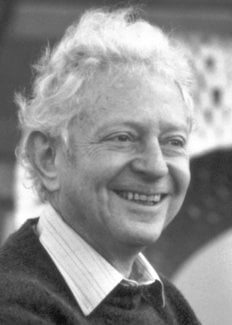
New York City in the period of 1922 to 1979 provided the streets, schools, entertainment, culture and ethnic diversity for many future scientists. I was born in New York on July 15, 1922 of immigrant parents. My father, Morris, operated a hand laundry and venerated learning. Brother Paul, six years older, was a tinkerer of unusual skill. I started my schooling in 1927 at PS 92 on Broadway and 95th Street and received my Ph.D. in 1951 about one mile north, at Columbia University. In between there were neighborhood junior and senior high schools and the City College of New York. There I majored in chemistry but fell under the influence of such future physicists as Isaac Halpern and my high school friend, Martin J. Klein. I graduated in 1943 and proceeded promptly to spend three years in the U.S. Army where I rose to the rank of 2nd Lieutenant in the Signal Corps. In September of 1946 I entered the Graduate School of Physics at Columbia, chaired by I.I. Rabi.
The Columbia Physics Department was constructing a 385 MeV Synchrocyclotron at their NEVIS Laboratory, located in Irvington-on-the-Hudson, New York. Construction was aided by the Offce of Naval Research and “NEVIS” eventually proved to be an extremely productive laboratory, as judged by physics results and students produced.
I joined that project in 1948 and worked with Professor Eugene T. Booth, the director of the-cyclotron project. My thesis assignment was to build a Wilson Cloud Chamber. Rabi invited many experts to Columbia to assist the novice staff in what was, for Columbia, a totally new field. Gilberto Bernardini came from Rome and John Tinlot came from Rossi’s group at MIT. Somewhat later, Jack Steinberger was recruited from Berkeley. After receiving my Ph.D. in 1951 I was invited to stay on, which I did, for the next 28 years. Much of my early work on 1 ions was carried out with Tinlot and Bernardini.
In 1958, I was promoted to Professor and took my first sabbatical at CERN where I organized a group to do the “g-2” experiment. This CERN program would continue for about 19 years and involve many CERN physicists (Picasso, Farley, Charpak, Sens, Zichichi, etc.). It was also the initiation of several collaborations in CERN research which continued through the mid-70s.
I became Director of the Nevis Labs in 1961 and held this position until 1978. I have been a guest scientist at many labs but did the bulk of my research at Nevis, Brookhaven, CERN and Fermilab. During my academic career at Columbia (1951 – 1979) I have had 50 Ph.D. students, 14 are professors of physics, one is a university president and the rest with few exceptions, are physicists at national labs, in government or in industry. None, to my knowledge, is in jail. In 1979, I became Director of the Fermi National Accelerator Laboratory where I supervised the construction and utilization of the first superconducting synchrotron, now the highest energy accelerator in the world.
I have three children with my first wife, Florence Gordon. Daughter Rena is an anthropologist, son Jesse is an investment banker and daughter Rachel a lawyer. I now live with my second wife Ellen at the Fermilab Laboratory in Batavia, Illinois, where we keep horses for riding and chickens for eggs. I have been increasingly involved in development via scientific collaboration with Latin America, with science education for gifted children and with public understanding of science. I helped to found and am on the Board of Trustees of the Illinois Mathematics and Science Academy, a three year residence public school for gifted children in the State of Illinois.
Honors
Leon Lederman is the recipient of fellowships from the Ford, Guggenheim, Ernest Kepton Adams and National Science Foundations. He is a founding member of the High Energy Physics Advisory Panel (to AEC, DOE) and the International Committee on Future Accelerators. He has received the National Medal of Science (1965) and the Wolf Prize for Physics (1982) among many other awards.
Honorary D.Sc’s have been awarded to Leon M. Lederman by City College of New York, University of Chicago, Illinois Institute of Technology, Northern Illinois University, Lake Forest College and Carnegie Mellon University.
This autobiography/biography was written at the time of the award and first published in the book series Les Prix Nobel. It was later edited and republished in Nobel Lectures. To cite this document, always state the source as shown above.
Addendum, 1991
I retired from Fermilab in 1989 to join the faculty of the University of Chicago as Professor of Physics. In 1989 I was appointed Science Adviser to the Governor of Illinois. I helped to organize a Teachers’ Academy for Mathematics and Science, designed to retrain 20,000 teachers in the Chicago Public Schools in the art of teaching science and mathematics. In 1991 I became President of the American Association for the Advancement of Science.
Honors
D.Sc.’s have been awarded among others by the universities at Pisa, Italy and Guanajuarto, Mexico. Elected to the National Academies of Science in Finland and in Argentina. Serves on thirteen (non-paying) Boards of Directors of museums, schools, science organizations and government agencies.
Leon Lederman died on 3 October 2018.
Copyright © The Nobel Foundation 1991Nobel Prizes and laureates
Six prizes were awarded for achievements that have conferred the greatest benefit to humankind. The 14 laureates' work and discoveries range from quantum tunnelling to promoting democratic rights.
See them all presented here.