Award ceremony speech
Presentation Speech by Professor Mats Jonson of the Royal Swedish Academy of Sciences, December 10, 1998.
Translation of the Swedish text.
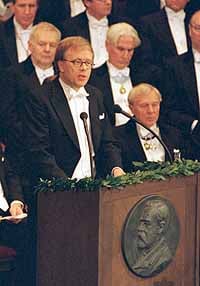
Copyright © Nobel Prize Outreach 1998 Photo: Hans Mehlin
Your Majesties, Your Royal Highness, Ladies and Gentlemen,
For a long time, man has known how to use electricity. At first, he did so without having any knowledge of what an electric current actually is. This did not prevent the invention of the electrical motor, the telegraph and the telephone. But man also has a wonderful quality called curiosity. He wanted to know what it is that forms an electric current. The young physicist Edwin Hall had an idea. He assumed that a current consisted of some kind of particles that he could influence with a magnet. In 1879, he conducted an experiment which demonstrated that his thinking was correct. The Hall effect had been discovered.
But it was not until 1897, that Sir Joseph John Thomson discovered the electron. As it turned out, it is electrons – extremely tiny electrically charged particles – that pour through our electrical wires in large numbers.
We eventually learned how to control these electrons so well that with their aid, we were able to transmit sound and images. The transistor was invented in the late 1940s. Electronics replaced electricity as a force for societal change. The integrated circuit, satellite television, cellular telephones, the Internet – the world has shrunk and we humans have moved closer to each other because we managed to tame the electron.
To achieve this, physicists and engineers have had to work with materials containing many more electrons than there are stars in our Milky Way galaxy. Though all electrons affect each other because of their equal charges, it proved possible to bend the behavior of these electronic galaxies to the will of humans. Why? Nobel Laureate Lev Landau provided us with an explanation. He showed that it is usually enough to understand electrons one by one, then put the parts together and create the whole. The exceptions to this 1 + 1 = 2 rule in electronic physics are so few and spectacular that they have often led to Nobel Prizes. This year’s Prize is all about such an exception, in which all electrons cooperate in a new kind of carefully choreographed dance that must be viewed as something whole and indivisible.
“Zeig mir dein Handy” – show me your cell phone – replied Horst Störmer when a German journalist asked him about the usefulness of his research. This is because cellular phones employ a type of transistor that Störmer and Daniel Tsui helped develop. The miniaturization that is constantly underway in microelectronics has been pushed so far in this case that these transistors are being built atom by atom, with incredible precision, and in such a way that electrons are trapped between two layers of atoms and are unable to move sideways. This is advanced technology. But at the same time, it is a platform for brilliant basic science. If such a transistor is cooled to just above absolute zero, -273 degrees Celsius, and is exposed to a magnetic field a million times stronger than that of the earth, the remarkable phenomenon discovered by Störmer and Tsui sixteen years ago appears.
What did they discover? While Edwin Hall described the results of his measurements with a straight line, Tsui and Störmer found a stepwise curve when they made the same measurement. Their highest step was three times higher than previously observed, and they had the courage and insight to state that this indicated that particles with a charge of only one third that of an electron must be concealed here. But could such a revolutionary concept be taken seriously? The charge of an electron is indivisible, or is it not? Researchers were facing a totally unexpected discovery. How was it to be interpreted?
One person who took a serious look at the hints provided by this experiment was Robert Laughlin. After a year of thinking and calculating, he arrived at an explanation, based on the non-applicability of Lev Landau’s method. He had to describe how perhaps 100 billion electrons interact all at once. It was something of a miracle that Laughlin managed to do this with a few formulas and four pages of text. This was possible because he succeeded in finding a new kind of order among electrons: they form a new type of quantum liquid.
Laughlin’s new, ordered electronic dance explained Störmer and Tsui’s experiments. It also implied that the swirls stirred up in an electronic sea by magnetic and electrical forces behave like particles that have only a fraction of the charge of one electron. Truly remarkable! Is there perhaps a connection with the fractionally charged quarks that hide deep inside atomic nuclei? Perhaps, perhaps not – but it is a sign of the profundity of the discovery now being awarded the Nobel Prize, that the question about such an analogy can be asked.
Technology and science have gone hand in hand during this journey, each one stimulating the development of the other. So will the 1998 Physics Prize lead to new technology? We don’t know, just as a century ago we could not have foreseen the usefulness of discovering the electron. Perhaps some of the young people who are able to watch this ceremony by means of today’s electronics, may some day find the answers to these questions.
Professors Robert Laughlin, Horst Störmer and Daniel Tsui,
your wonderful discovery of a new type of quantum liquid with fractionally charged excitations, has made us look at nature with new eyes. You have proved that there are indeed new secrets to uncover and new discoveries to be made, if one has the courage to look for them. In this way, you have set an example for new generations of scientists.
On behalf of the Royal Swedish Academy of Sciences, I warmly congratulate you, and I ask you to step forward and receive your Nobel Prizes in Physics from the hands of His Majesty the King.
Nobel Prizes and laureates
Six prizes were awarded for achievements that have conferred the greatest benefit to humankind. The 14 laureates' work and discoveries range from quantum tunnelling to promoting democratic rights.
See them all presented here.

