Robert W. Holley
Biographical
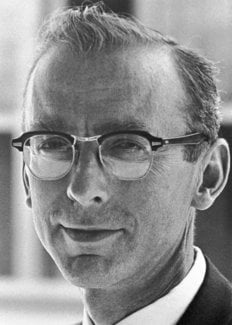
Robert W. Holley was born in Urbana, Illinois, on January 28th, 1922, one of four sons of Charles and Viola Holley. His parents were both educators. He attended public schools in Illinois, California and Idaho, and graduated from Urbana High School in 1938. He studied chemistry at the University of Illinois and received his B. A. degree in 1942. Graduate work was at Cornell University, where the Ph.D. degree in organic chemistry, with Professor Alfred T. Blomquist, was awarded in 1947. Graduate work was interrupted during the war. He spent two years, 1944-1946, with Professor Vincent du Vigneaud at Cornell University Medical College, where he participated in the first chemical synthesis of penicillin.
After completing the Ph. D. degree, Holley spent 1947-1948 as an American Chemical Society Postdoctoral Fellow with Professor Carl M. Stevens at Washington State University. He then returned to Cornell University as Assistant Professor of Organic Chemistry at the Geneva Experiment Station in 1948. He was Associate Professor there from 1950-1957. During a sabbatical year, 1955-1956, he was a Guggenheim Memorial Fellow in the Division of Biology at the California Institute of Technology. In 1958, he returned to Ithaca, New York, as a Research Chemist at the U. S. Plant, Soil and Nutrition Laboratory, a U. S. Department of Agriculture Laboratory on the Cornell University campus. He had an appointment in the University throughout this period and became Professor of Biochemistry in 1962. He rejoined the faculty of Cornell University full time in 1964 as Professor of Biochemistry and Molecular Biology, and was Chairman of the Department from 1965 to 1966. The following year, 1966-1967, was spent at the Salk Institute for Biological Studies and the Scripps Clinic and Research Foundation in La Jolla, California, as a National Science Foundation Postdoctoral Fellow. In 1968, though maintaining an affiliation with Cornell University, he joined the permanent staff of the Salk Institute, where he is a Resident Fellow and an American Cancer Society Professor of Molecular Biology. He is also an Adjunct Professor at the University of California at San Diego.
Holley’s training as a chemist did not alter his basic interest in living things. This interest has influenced his choice of research, which began with the organic chemistry of natural products. There followed a gradual drift toward more biological subjects, with work on amino acids and peptides, and eventually work on the biosynthesis of proteins. During the latter, the alanine transfer RNA was discovered. The following 10 years were spent working with this RNA, first concentrating on the isolation of the RNA, and then working on the determination of the structure of the RNA. The nucleotide sequence was completed at the end of 1964. It was for this work that the Nobel Prize was awarded. More recently, his work has been concerned with factors that control cell division in mammalian cells.
Holley is a member of the National Academy of Sciences, the American Academy of Arts and Sciences, the American Association for the Advancement of Science, The American Society of Biological Chemists and the American Chemical Society. He received the Albert Lasker Award in Basic Medical Research in 1965, the Distinguished Service Award of the U. S. Department of Agriculture in 1965, and the U. S. Steel Foundation Award in Molecular Biology of the National Academy of Sciences in 1967.
Holley was married to Ann Dworkin in 1945. They have one son, Frederick. Mrs. Holley’s professional interests are concerned with the teaching of mathematics. The three of them especially enjoy the ocean and the mountains.
This autobiography/biography was written at the time of the award and later published in the book series Les Prix Nobel/ Nobel Lectures/The Nobel Prizes. The information is sometimes updated with an addendum submitted by the Laureate.
Robert W. Holley died on February 11, 1993.
Nobel Prizes and laureates
Six prizes were awarded for achievements that have conferred the greatest benefit to humankind. The 14 laureates' work and discoveries range from quantum tunnelling to promoting democratic rights.
See them all presented here.