The risk of losing free flow of ideas and people is one of the most pressing challenges for science, says 2018 chemistry laureate Frances Arnold. In this interview, she also elaborates on the importance of enzymes in healthcare, the promises of AI and the uses of “useless” knowledge in science.
How important is basic research in creating better healthcare for all?
“To answer that, we need to look at today’s medicine, which is based on basic scientific discoveries that were made in the past. I would say that we are just scratching the surface of understanding the biological world. We are just at the beginning of that, so there’s a lot more basic research to be done that will undoubtedly lead to better healthcare.”
What needs to be done when it comes to funding of basic research?
“I think that people need to understand that basic research is an investment. It’s an investment in our future, and taxpayers who pay for that have a right to know that their money is being spent wisely on that investment. For me, that means a focus on excellence, perhaps targeting use-inspired basic research in particular areas that we know would be rich for discoveries. It’s also important that the people who receive such funding know that they have an obligation to make the results of that investment available to the public and to other scientists. It’s not a one-way street.”
What can the scientific community do to better explain the benefits of science?
“There’s a lot of improvement to be done. Scientists as a community can try to become better communicators. Often, we are teachers and we communicate to students, but we also need to communicate to the public that pays for the science. We need to lose the idea that a scientist is entitled to funding merely because he or she works hard.”
“We're not entitled to the hard-earned money of the taxpayers, we need to deserve that, which means we need to make the return on the investment available for future discoveries and future development.”
Frances Arnold
What are the most pressing challenges faced by science today?
“In addition to the obvious reduction in the investment in science, especially on the part of the US Federal Government, there’s a significant challenge to the free flow of ideas and people happening now. Science thrives when ideas are exchanged, and international collaborations are critical, which also includes the exchange of researchers. If we silo science in separate countries, then we lose much of this dynamic and the progress it fuels. The connection between international discussion and collaboration is what makes science move forward.”
From your experience, how can we tell what type of research will lead to having an impact on our lives and which won’t?
“It is very hard to tell, because surprises happen. Funders tend to favour some areas over others, because they want to cure a certain disease or they want to have a certain outcome. So, you get this use-inspired basic research. But I think it’s important to have a portfolio of research in areas that we know are important, but also to have some blue-sky research. If you work with a focus on excellence, then some researchers might be able to argue that their blue-sky work is worth supporting.”
Is there any such thing as useless knowledge in science?
“The answer is probably yes, but no one knows which knowledge is useless because we don’t know what the future holds. It’s conceivable that certain knowledge will never have utility other than fulfilling our human need to understand who we are, where we come from and where we’re going. That’s hardly useless, right?”
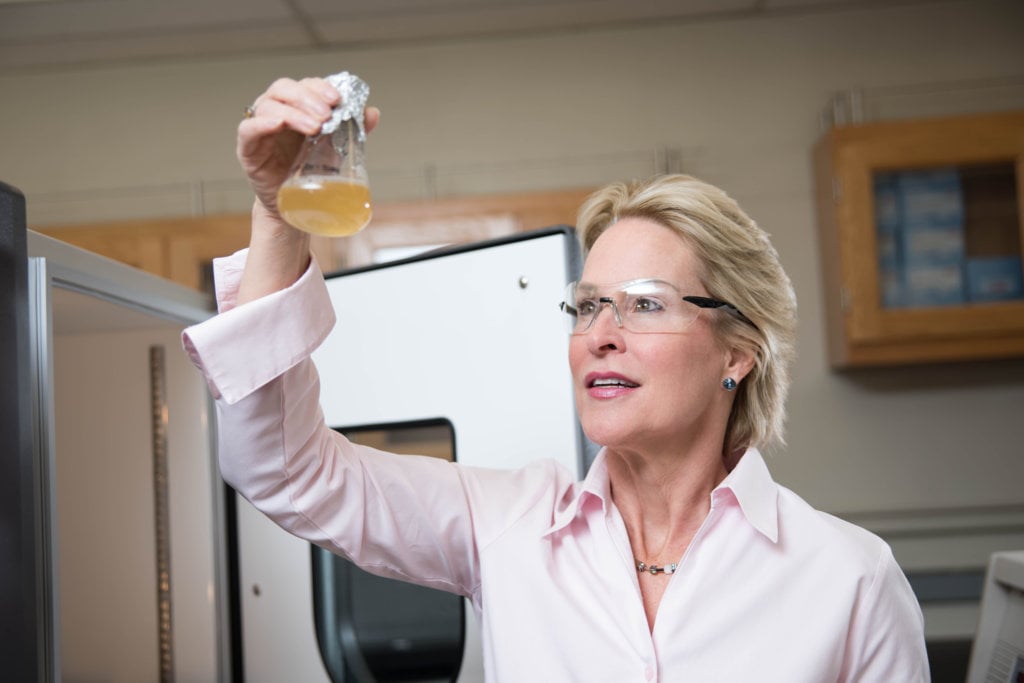
You have used the ideas of evolution to build new enzymes. How can these be used in healthcare and medicine?
“There are probably hundreds of examples where enzymes have been used in healthcare and medicine. Enzymes are used in medical diagnostics like glucose sensors, in DNA sequencing to understand our genomes, our predilection to disease and where we come from. Enzymes are therapeutics to treat disease and to manufacture pharmaceuticals cleanly.”
How do you feel about that something you helped create has impacted people’s lives and health? Is there anything that you are particularly proud of?
“I feel great about it. I think these applications are wonderful. I think when enzymes are used to solve human problems, especially if they’ve been fine-tuned by directed evolution, I’m proud that we are using the treasures of the biological world to make our lives better. In my own research, I use enzymes to manufacture pharmaceuticals, and that reduces waste and our footprint on the planet.”
“I feel very proud of being able to use biology to make what we need in our daily lives and to do it with a much cleaner footprint than we have in the past.”
Frances Arnold
Has AI helped you in your scientific research and do you see it playing a part in making scientific outcomes open to more people?
“Machine learning and AI are big parts of my research programme and have been for more than a decade. I’d say half my group is deeply involved in developing new tools of machine learning and AI and applying those tools to protein design and evolution. That’s not surprising because evolution is an algorithmic process. It’s very similar to active learning and machine learning. So, it was a natural flow to use our data in machine learning algorithms. With the Nobel Prize last year to David Baker, AI is now creating proteins. Those are great starting points for evolution. This all blends very nicely with directed evolution.
When it comes to using AI for communication of results, the large language models make writing and research a lot easier for people. Research a lot easier. So of course, AI is going to help in the communication of results as long as we keep the AI truthful and accurate.”
Frances Arnold is participating at this year’s Nobel Week Dialogue on 9 December in Gothenburg. The event will be live streamed here on nobelprize.org. Read more about the event here.
Published October 2025