J.J. Thomson
Facts
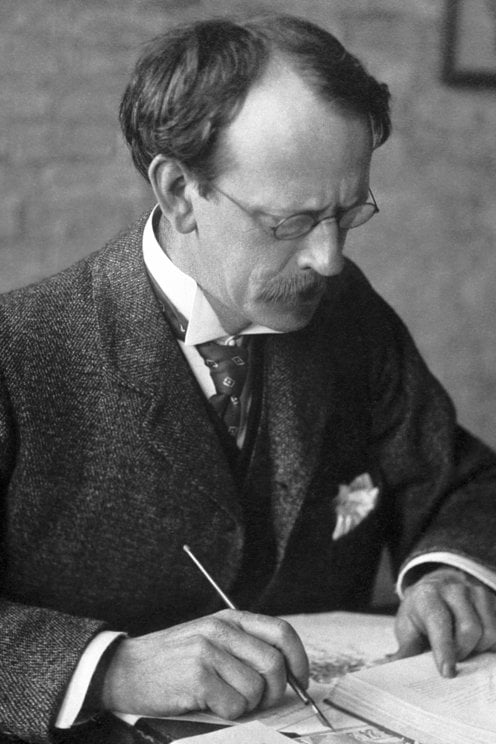
Photo from the Nobel Foundation archive.
Joseph John Thomson
Nobel Prize in Physics 1906
Born: 18 December 1856, Cheetham Hill, United Kingdom
Died: 30 August 1940, Cambridge, United Kingdom
Affiliation at the time of the award: University of Cambridge, Cambridge, United Kingdom
Prize motivation: “in recognition of the great merits of his theoretical and experimental investigations on the conduction of electricity by gases”
Prize share: 1/1
Work
The idea that electricity is transmitted by a tiny particle related to the atom was first forwarded in the 1830s. In the 1890s, J.J. Thomson managed to estimate its magnitude by performing experiments with charged particles in gases. In 1897 he showed that cathode rays (radiation emitted when a voltage is applied between two metal plates inside a glass tube filled with low-pressure gas) consist of particles— electrons—that conduct electricity. Thomson also concluded that electrons are part of atoms.
Nobel Prizes and laureates
Six prizes were awarded for achievements that have conferred the greatest benefit to humankind. The 14 laureates' work and discoveries range from quantum tunnelling to promoting democratic rights.
See them all presented here.