Herbert Simon
Biographical
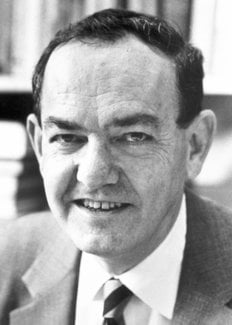
I was born in Milwaukee, Wisconsin, on June 15, 1916. My father, an electrical engineer, had come to the United States in 1903 after earning his engineering diploma at the Technische Hochschule of Darmstadt, Germany. He was an inventor and designer of electrical control gear, later also a patent attorney. An active leader in professional and civic affairs, he received an honorary doctorate from Marquette University for his many activities in the community. My mother, an accomplished pianist, was a third generation American, her forebears having been ’48ers who immigrated from Prague and Köln. Among my European ancestors were piano builders, goldsmiths, and vintners but to the best of my knowledge, no professionals of any kind. The Merkels in Köln were Lutherans, the Goldschmidts in Prague and the Simons in Ebersheim, Jews.
My home nurtured in me an early attachment to books and other things of the intellect, to music, and to the out of doors. I received an excellent general education from the public elementary and high schools in Milwaukee, supplemented by the fine science department of the public library and the many books I found at home. School work was interesting but not difficult, leaving me plenty of time for sandlot baseball and football, for hiking and camping, for reading and for many extracurricular activities during my high school years. A brother, five years my senior, while not a close companion, gave me some anticipatory glimpses of each stage of growing up. Our dinner table at home was a place for discussion and debate – often political, sometimes scientific.
Until well along in my high school years, my interests were quite dispersed, although they were increasingly directed toward science – of what sort I wasn’t sure. For most adolescents, science means physics, mathematics, chemistry, or biology – those are the subjects to which they are exposed in school. The idea that human behavior may be studied scientifically is never hinted until much later in the educational process – it was certainly not conveyed by history or “civics” courses as they were then taught.
My case was different. My mother’s younger brother, Harold Merkel, had studied economics at the University of Wisconsin under John R. Commons. Uncle Harold had died after a brief career with the National Industrial Conference Board, but his memory was always present in our household as an admired model, as were some of his books on economics and psychology. In that way I discovered the social sciences. Uncle Harold having been an ardent formal debater, I followed him in that activity too.
In order to defend free trade, disarmament, the single tax and other unpopular causes in high school debates, I was led to a serious study of Ely’s economics textbook, Norman Angell’s The Great Illusion, Henry George’s Progress and Poverty, and much else of the same sort.
By the time I was ready to enter the University of Chicago, in 1933, I had a general sense of direction. The social sciences, I thought, needed the same kind of rigor and the same mathematical underpinnings that had made the “hard” sciences so brilliantly successful. I would prepare myself to become a mathematical social scientist. By a combination of formal training and self study, the latter continuing systematically well into the 1940s, I was able to gain a broad base of knowledge in economics and political science, together with reasonable skills in advanced mathematics, symbolic logic, and mathematical statistics. My most important mentor at Chicago was the econometrician and mathematical economist, Henry Schultz, but I studied too with Rudolf Carnap in logic, Nicholas Rashevsky in mathematical biophysics, and Harold Lasswell and Charles Merriam in political science. I also made a serious study of graduate-level physics in order to strengthen and practice my mathematical skills and to gain an intimate knowledge of what a “hard” science was like, particularly on the theoretical side. An unexpected by-product of the latter study has been a lifelong interest in the philosophy of physics and several publications on the axiomatization of classical mechanics.
My career was settled at least as much by drift as by choice. An undergraduate field study for a term paper developed an interest in decision-making in organizations. On graduation in 1936, the term paper led to a research assistantship with Clarence E. Ridley in the field of municipal administration, carrying out investigations that would now be classified as operations research. The research assistantship led to the directorship, from 1939 to 1942, of a research group at the University of California, Berkeley, engaged in the same kinds of studies. By arrangement with the University of Chicago, I took my doctoral exams by mail and moonlighted a dissertation on administrative decision-making during my three years at Berkeley.
When our research grant was exhausted, in 1942, jobs were not plentiful and my military obligations were uncertain. I secured a position in political science at Illinois Institute of Technology by the intercession of a friend who was leaving. The return to Chicago had important, but again largely unanticipated, consequences for me. At that time, the Cowles Commission for Research in Economics was located at the University of Chicago. Its staff included Jacob Marschak and Tjalling Koopmans who were then directing the graduate work of such students as Kenneth Arrow, Leo Hurwicz, Lawrence Klein, and Don Patinkin. Oscar Lange, not yet returned to Poland, Milton Friedman, and Franco Modigliani frequently participated in the Cowles staff seminars, and I also became a regular participant.
That started me on a second education in economics, supplementing the Walrasian theory and Neyman-Pearson statistics I had learned earlier from Henry Schultz (and from Jerzy Neyman in Berkeley) with a careful study of Keyne’s General Theory (made comprehensible by the mathematical models proposed by Meade, Hicks, and Modigliani), and the novel econometric techniques being introduced by Frisch and investigated by the Cowles staff. With considerable excitement, too, we examined Samuelson‘s new papers on comparative statics and dynamics.
I was soon co-opted by Marschak into participating in the study he and Sam Schurr were directing of the prospective economic effects of atomic energy. Taking responsibility for the macroeconomic parts of that study, I used as my analytic tools both classical Cobb-Douglas functions, and the new activity analysis being developed by Koopmans. Although I had earlier published papers on tax incidence (1943) and technological development (1947), the atomic energy project was my real baptism in economic analysis. My interest in mathematical economics having been aroused, I continued active work on problems in that domain, mainly in the period from 1950 to 1955. It was during this time that I worked out the relations between causal ordering and identifiability – coming for the first time in contact with the related work of Herman Wold – discovered and proved (with David Hawkins) the Hawkins-Simon theorem on the conditions for the existence of positive solution vectors for input-output matrices, and developed (with Albert Ando) theorems on near-decomposability and aggregation.
In 1949, Carnegie Institute of Technology received an endowment to establish a Graduate School of Industrial Administration. I left Chicago for Pittsburgh to participate with G.L. Bach, William W. Cooper, and others in developing the new school. Our goal was to place business education on a foundation of fundamental studies in economics and behavioral science. We were fortunate to pick a time for launching this venture when the new management science techniques were just appearing on the horizon, together with the electronic computer. As one part of the effort, I engaged with Charles Holt, and later with Franco Modigliani and John Muth, in developing dynamic programming techniques – the so-called “linear decision rules” – for aggregate inventory control and production smoothing. Holt and I derived the rules for optimal decision under certainty, then proved a certainty-equivalence theorem that permitted our technique to be applied under conditions of uncertainty. Modigliani and Muth went on to construct efficient computational algorithms. At this same time, Tinbergen and Theil were independently developing very similar techniques for national planning in the Netherlands.
Meanwhile, however, the descriptive study of organizational decision-making continued as my main occupation, in this case in collaboration with Harold Guetzkow, James March, Richard Cyert and others. Our work led us to feel increasingly the need for a more adequate theory of human problem-solving if we were to understand decisions. Allen Newell, whom I had met at the Rand Corporation in 1952, held similar views. About 1954, he and I conceived the idea that the right way to study problem-solving was to simulate it with computer programs. Gradually, computer simulation of human cognition became my central research interest, an interest that has continued to be absorbing up to the present time.
My research on problem-solving left me relatively little opportunity to do work of a more classical sort in economics. I did, however, continue to develop stochastic models to explain the observed highly-skewed distributions of sizes of business firms. That work, in collaboration with Yuji Ijiri and others, was summarized in a book published just two years ago.
In this sketch, I have said less about my work on decision-making than about my other research in economics because the former is discussed at greater length in my Nobel lecture. I have also left out of this account those very important parts of my life that have been occupied with my family and with non-scientific pursuits. One of my few important decisions, and the best, was to persuade Dorothea Pye to marry me on Christmas Day, 1937. We have been blessed in being able to share a wide range of our experiences, even to publishing together in two widely separate fields: public administration and cognitive psychology. We have shared also the pleasures and responsibilities of raising three children, none of whom seem imitative of their parents’ professional directions, but all of whom have shaped for themselves interesting and challenging lives.
My interests in organizations and administration have extended to participation as well as observation. In addition to three stints as a university department chairman, I have had several modest public assignments. One involved playing a role, in 1948, in the creation of the Economic Cooperation Administration, the agency that administered Marshall Plan aid for the U.S. Government. Another, more frustrating, was service on the President’s Science Advisory Committee during the last year of the Johnson administration and the first three years of the Nixon administration. While serving on PSAC, and during another committee assignment with the National Academy of Sciences, I have had opportunities to take part in studies of environmental protection policies. In all of this work, I have tried – I know not with what success – to apply my scientific knowledge of organizations and decision-making, and, conversely, to use these practical experiences to gain new research ideas and insights.
In the “politics” of science, which these and other activities have entailed, I have had two guiding principles – to work for the “hardening” of the social sciences so that they will be better equipped with the tools they need for their difficult research tasks; and to work for close relations between natural scientists and social scientists so that they can jointly contribute their special knowledge and skills to those many complex questions of public policy that call for both kinds of wisdom.
This autobiography/biography was written at the time of the award and first published in the book series Les Prix Nobel. It was later edited and republished in Nobel Lectures. To cite this document, always state the source as shown above.
Herbert A. Simon died on February 9, 2001.