Kim Dae-jung
Nobel Prize lecture
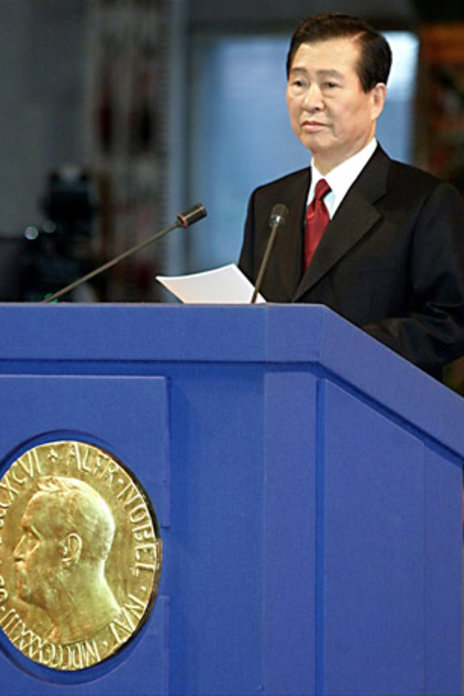
Kim Dae Jung gives his Nobel Lecture.
© Pressens Bild AB 2000, SE-112 88 Stockholm, Sweden, telephone: +46 (0)8 738 38 00. Photo: Lise Aserud
Nobel Lecture, Oslo, December 10, 2000
Your Majesty, Your Royal Highnesses, Members of the Norwegian Nobel Committee, Excellencies, Ladies and Gentlemen,
Human rights and peace have a sacred ground in Norway. The Nobel Peace Prize is a solemn message that inspires all humanity to dedicate ourselves to peace. I am infinitely grateful to be given the honor. But I think of the countless people and colleagues in Korea, who have given themselves willingly to democracy and human rights and the dream of national unification. And I must conclude that the honor should go to them.
I also think of the many countries and friends around the world, who have given generous support to the efforts of my people to achieve democratization and inter-Korean reconciliation. I thank them very sincerely.
I know that the first South-North Korean summit meeting in June and the start of inter-Korean reconciliation is one of the reasons for which I am given the Nobel Peace Prize.
Distinguished guests,
I would like to speak to you about the breakthrough in South-North Korean relations that the Nobel Committee has judged worthy of its commendation. In mid-June, I traveled to Pyongyang for the historic meeting with Chairman Kim Jong-il of the North Korean National Defense Commission. I went with a heavy heart not knowing what to expect, but convinced that I must go for the reconciliation of my people and peace on the Korean peninsula. There was no guarantee that the summit meeting would go well. Divided for half-a-century after a three-year war, South and North Korea have lived in mutual distrust and enmity across the barbed-wire fence of the demilitarized zone.
To replace the dangerous stand-off with peace and cooperation, I proclaimed my sunshine policy upon becoming President in February 1998, and have consistently promoted its message of reconciliation with the North: first, we will never accept unification through communization; second, nor would we attempt to achieve unification by absorbing the North; and third, South and North Korea should seek peaceful coexistence and cooperation. Unification, I believe, can wait until such a time when both sides feel comfortable enough in becoming one again, no matter how long it takes. At first, North Korea resisted, suspecting that the sunshine policy was a deceitful plot to bring it down. But our genuine intent and consistency, together with the broad support for the sunshine policy from around the world, including its moral leaders such as Norway, convinced North Korea that it should respond in kind. Thus, the South-North summit could be held.
I had expected the talks with the North Korean leader to be extremely tough, and they were. However, starting from the shared desire to promote the safety, reconciliation and cooperation of our people, the Chairman and I were able to obtain some important agreements.
First, we agreed that unification must be achieved independently and peacefully, that unification should not be hurried along and for now the two sides should work together to expand peaceful exchanges and cooperation and build peaceful coexistence.
Second, we succeeded in bridging the unification formulas of the two sides, which had remained widely divergent. By proposing a “loose form of federation” this time, North Korea has come closer to our call for a confederation of “one people, two systems, two independent governments” as the pre-unification stage. For the first time in the half-century division, the two sides have found a point of convergence on which the process toward unification can be drawn out.
Third, the two sides concurred that the US military presence on the Korean peninsula should continue for stability on the peninsula and Northeast Asia.
During the past 50 years, North Korea had made the withdrawal of the US troops from the Korean peninsula its primary point of contention. I said to Chairman Kim: “The Korean peninsula is surrounded by the four powers of the United States, Japan, China and Russia. Given the unique geopolitical location not to be found in any other time or place, the continued US military presence on the Korean peninsula is indispensable to our security and peace, not just for now but even after unification. Look at Europe. NATO had been created and American troops stationed in Europe so as to deter the Soviet Union and the East European bloc. But, now, after the fall of the communist bloc, NATO and US troops are still there in Europe, because they continue to be needed for peace and stability in Europe.”
To this explanation of mine, Chairman Kim, to my surprise, had a very positive response. It was a bold switch from North Korea’s long-standing demand, and a very significant move for peace on the Korean peninsula and Northeast Asia.
We also agreed that the humanitarian issue of the separated families should be promptly addressed. Thus, since the summit, the two sides have been taking steps to alleviate their pain. The Chairman and I also agreed to promote economic cooperation. Thus, the two sides have signed an agreement to work out four key legal instruments that would facilitate the expansion of inter-Korean economic cooperation, such as investment protection and double-taxation avoidance agreements. Meanwhile, we have continued with the humanitarian assistance to the North, with 300,000 tons of fertilizer and 500,000 tons of food. Sports, culture and arts, and tourism exchanges have also been activated in the follow-up to the summit.
Furthermore, for tension reduction and the establishment of durable peace, the defense ministers of the two sides have met, pledging never to wage another war against each other. They also agreed to the needed military cooperation in the work to relink the severed railway and road between South and North Korea.
Convinced that improved inter-Korean relations is not enough for peace to fully settle on the Korean peninsula, I have strongly encouraged Chairman Kim to build better ties with the United States and Japan as well as other western countries. After returning from Pyongyang, I urged President Clinton of the United States and Prime Minister Mori of Japan to improve relations with North Korea.
At the 3rd ASEM Leaders’ Meeting in Seoul in late October, I advised our friends in Europe to do the same. Indeed, many advances have recently been made between North Korea and the United States, as well as between North Korea and many countries of Europe. I am confident that these developments will have a decisive influence in the advancement of peace on the Korean peninsula.
Ladies and gentlemen,
In the decades of my struggle for democracy, I was constantly faced with the refutation that western-style democracy was not suitable for Asia, that Asia lacked the roots. This is far from true. In Asia, long before the west, the respect for human dignity was written into systems of thought, and intellectual traditions upholding the concept of “demos” took root. “The people are heaven. The will of the people is the will of heaven. Revere the people, as you would heaven.” This was the central tenet in the political thoughts of China and Korea as early as three thousand years ago. Five centuries later in India, Buddhism rose to preach the supreme importance of one’s dignity and rights as a human being.
There were also ruling ideologies and institutions that placed the people first. Mencius, disciple of Confucius, said: “The king is son of heaven. Heaven sent him to serve the people with just rule. If he fails and oppresses the people, the people have the right, on behalf of heaven, to dispose of him.” And this, 2,000 years before John Locke expounded the theory of the social contract and civic sovereignty.
In China and Korea, feudalism was brought down and replaced with counties and prefectures before the birth of Christ, and civil service exams to recruit government officials are a thousand years-old. The exercise of power by the king and high officials were monitored by robust systems of auditing. In sum, Asia was rich in the intellectual and institutional traditions that would provide fertile grounds for democracy. What Asia did not have was the organizations of representative democracy. The genius of the west was to create the organizations, a remarkable accomplishment that has greatly advanced the history of humankind.
Brought into Asian countries with deep roots in the respect for demos, western democratic institutions have adapted and functioned admirably, as can be seen in the cases of Korea, Japan, the Philippines, Indonesia, Thailand, India, Bangladesh, Nepal, and Sri Lanka. In East Timor, the people went to the polling stations to vote for their independence, despite the threat to their lives from the savage militias. In Myanmar, Madam Aung San Suu Kyi is still leading the struggle for democracy. She retains wide support of the people. I have every confidence that there, too, democracy will prevail and a representative government will be restored.
Distinguished guests,
I believe that democracy is the absolute value that makes for human dignity, as well as the only road to sustained economic development and social justice.
Without democracy the market economy cannot blossom, and without market economics, economic competitiveness and growth cannot be achieved.
A national economy lacking a democratic foundation is a castle built on sand. Therefore, as President of the Republic of Korea, I have made the parallel development of democracy and market economics, supplemented with a system of productive welfare, the basic mission of my government.
To achieve the mission, during the past two-and-a-half years, we have taken steps to actively guarantee the democratic rights of our citizens. We have also been steadfast in implementing bold reforms in the financial, corporate, public and labor sectors. Furthermore, the efforts to promote productive welfare, focusing on human resources development for all citizens, including the low-income classes, have made much headway.
The reforms will continue in Korea. We are committed to the early completion of the current reform measures, as well as to reform as an on-going process of transformation into a first-rate economy of the 21st century. This we hope to achieve by combining the strength of our traditional industries with the endless possibilities that lie in the information and bio-tech fields.
The knowledge and information age of the 21st century promises to be an age of enormous wealth. But it also presents the danger of hugely growing wealth gaps between and within countries. The problem presents itself as a serious threat to human rights and peace. In the new century, we must continue the fight against the forces that suppress democracy and resort to violence. We must also strive to deal with the new challenge to human rights and peace with steps to alleviate the information gap, to help the developing countries and the marginalized sectors of society to catch up with the new age.
Your Majesty, Your Royal Highnesses, ladies and gentlemen,
Allow me to say a few words on a personal note. Five times I faced near death at the hands of dictators, six years I spent in prison, and forty years I lived under house arrest or in exile and under constant surveillance. I could not have endured the hardship without the support of my people and the encouragement of fellow democrats around the world. The strength also came from deep personal beliefs.
I have lived, and continue to live, in the belief that God is always with me. I know this from experience. In August of 1973, while exiled in Japan, I was kidnapped from my hotel room in Tokyo by intelligence agents of the then military government of South Korea. The news of the incident startled the world. The agents took me to their boat at anchor along the seashore. They tied me up, blinded me, and stuffed my mouth. Just when they were about to throw me overboard, Jesus Christ appeared before me with such clarity. I clung to him and begged him to save me. At that very moment, an airplane came down from the sky to rescue me from the moment of death.
Another faith is my belief in the justice of history. In 1980, I was sentenced to death by the military regime. For six months in prison, I awaited the execution day. Often, I shuddered with fear of death. But I would find calm in the fact of history that justice ultimately prevails. I was then, and am still, an avid reader of history. And I knew that in all ages, in all places, he who lives a righteous life dedicated to his people and humanity may not be victorious, may meet a gruesome end in his lifetime, but will be triumphant and honored in history; he who wins by injustice may dominate the present day, but history will always judge him to be a shameful loser. There can be no exception.
Your Majesty, Your Royal Highnesses, ladies and gentlemen,
Accepting the Nobel Peace Prize, the honoree is committed to an endless duty. I humbly pledge before you that, as the great heroes of history have taught us, as Alfred Nobel would expect of us, I shall give the rest of my life to human rights and peace in my country and the world, and to the reconciliation and cooperation of my people. I ask for your encouragement and the abiding support of all who are committed to advancing democracy and peace around the world.
Thank you.
Nobel Prizes and laureates
Six prizes were awarded for achievements that have conferred the greatest benefit to humankind. The 14 laureates' work and discoveries range from quantum tunnelling to promoting democratic rights.
See them all presented here.