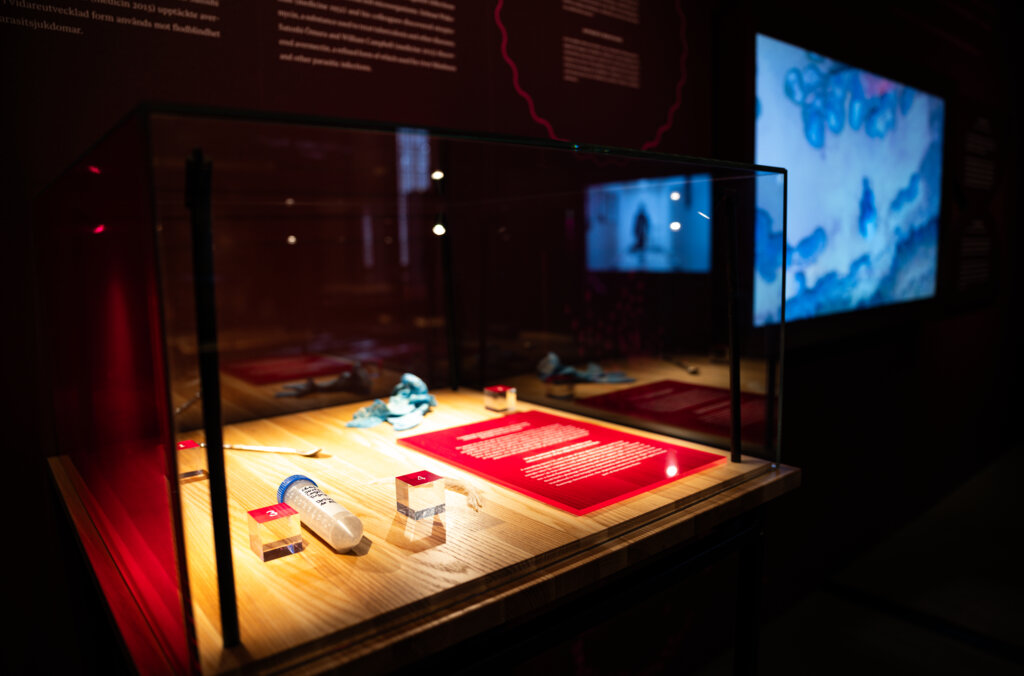
The Nobel Prize Museum’s new exhibition highlights three of the crucial medical discoveries of the 20th century: insulin, polio vaccine and penicillin. Three new documentary films explore how researchers and health care professionals are building on the foundation laid by Nobel Prize laureates in medicine to prevent and treat diseases today. The exhibition opens on 16 May.
Thethree documentary films take us to different corners of the world. In Pakistan, Ishrat Rahim vaccinates children against polio. She faces a lot of suspicion and is escorted daily by armed guards in order to carry out her job. In the Atacama Desert of Chile, we meet researcher Cristina Dorador as she searches for new drugs to combat infectious diseases. And in Mississippi, we follow Dr Foluso Fakorede in his work with diabetes patients in the southern United States.
The exhibition Fighting Disease – Three Stories from the Fields of Medicine shows short versions of the three documentaries, together with artefacts collected on site during the filming.
“With the help of these films and artefacts, the exhibition tells the story of how people work in the footsteps of the laureates on a daily basis to save lives and improve the health of the world’s population,” says Erika Lanner, Director of the Nobel Prize Museum. “The films also touch on some major issues that are being discussed in the world such as antibiotic resistance, vaccine scepticism and unequal access to health care.”
About the films
In the film Shadows in Sunlight (director: Ruhi Hamid) we follow Ishrat Rahim in the city of Peshawar. She is participating in a national effort to vaccinate Pakistan’s 40 million children against polio. In her work, she often encounters suspicion and mistrust, due to cultural and religious reasons. During the working days, she and her female colleagues are constantly protected by armed guards. Despite sometimes threatening situations, she persistently continues her work to convince the city’s residents of the benefits of the vaccine and the potential for eradicating polio.
In the film Life Invisible (directed by Bettina Perut and Iván Osnovikoff), we follow researcher Cristina Dorador, who finds herself in the Atacama Desert of Chile. In this remote environment of mountains, deserts and ponds rich in microbiological diversity, she searches for new drugs to combat infectious diseases. In the desert, there are microorganisms that live under extreme conditions and produce substances that could be used to create new antibiotic drugs. The search is important because of the growing problem of antibiotic-resistant bacteria, which today leads to about 5 million deaths in the world every year.
In the film Bloodlines, Mississippi (director: Crystal Kayiza) we follow Dr Foluso Fakorede in his work with diabetes patients in the southern United States. Patients mainly belong to the African-American population, and the majority have very limited access to health care. Diabetes can be treated with insulin and other drugs, but many people have not had access to treatment and have therefore suffered from cardiovascular diseases resulting from diabetes. Dr Fakourede works to reduce the high number of amputations that occur as a result of unequal health care access. By informing his patients, and by performing minor surgery on blood vessels, he reduces the number of foot and leg amputations.
About the directors
Ruhi Hamid is the director behind the film Shadows in Sunlight. She is a British filmmaker, born in Tanzania, who has made award-winning documentaries for the BBC, Channel 4, Al Jazeera International and other UK, US and European broadcasters. She has made well-regarded films such as Women and Islam (2004), The Rockstar and the Mullahs (2003), and Women, Weddings, War and Me (2010).
The film Life Invisible was directed by Bettina Perut and Iván Osnovikoff. Bettina Perut is a Chilean journalist, film director, producer and screenwriter who has collaborated with director Iván Osnovikoff since 1997. Perut and Osnovikoff have directed and produced documentaries such as Un Hombre Aparte, Welcome to New York, Noticias, Surire, El astuto mono Pinochet contra la moneda de los cerdos and La muerte de Pinochet.
Bloodlines, Mississippi was directed by Brooklyn-based filmmaker Crystal Kayiza.She was named one of Filmmaker magazine’s “25 New Faces of Independent Film”. Her most recent film, Rest Stop, was awarded the Jury Award for Best American Short Film at the 2023 Sundance Film Festival. Rest Stop also won the 2020 Tribeca Through Her Lens grant and premiered at the 2022 Toronto International Film Festival.