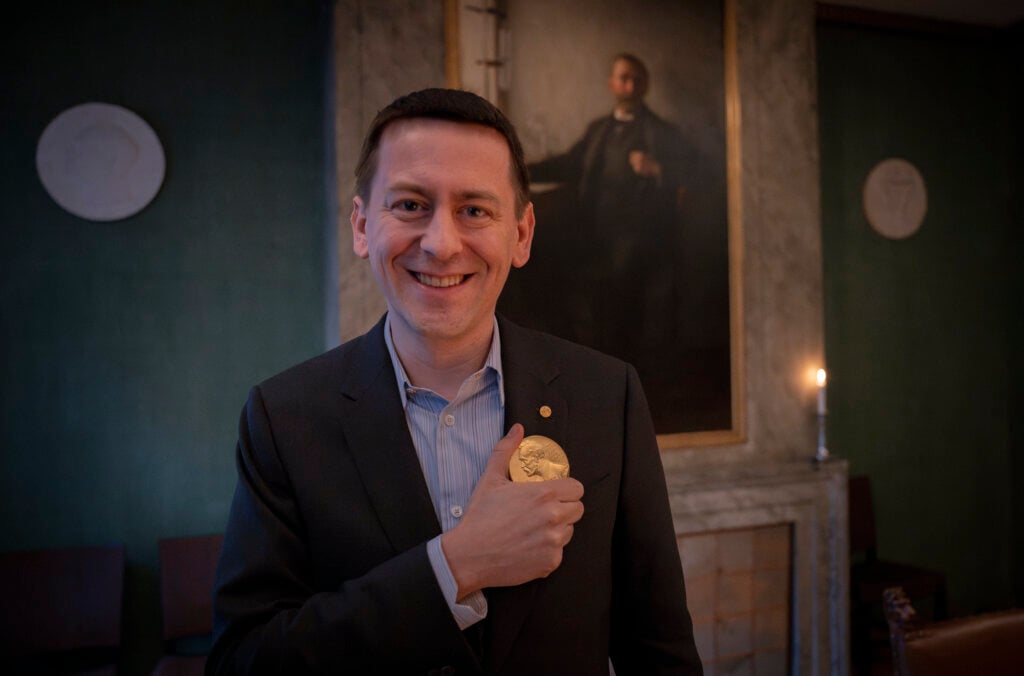
John Jumper
Podcast
Nobel Prize Conversations
“I really love the notion of contributing something to physics.”
Chemistry laureate John Jumper has always been passionate about science and understanding the world. With the AI tool AlphaFold, he and his co-laureate Demis Hassabis have provided a possibility to predict protein structures. In this podcast conversation, Jumper speaks about the excitement of seeing how AI can help us more in the future.
Jumper also shares his scientific journey and how he ended up working with AlphaFold. He describes a special memory from the 2018 CASP conference where AlphaFold was presented for the first time. Another life-changing moment was the announcement of the Nobel Prize in Chemistry in October 2024 – Jumper tells us how his life has changed since then.
This conversation was published on 19 June, 2025. Podcast host Adam Smith is joined by Karin Svensson.
Below you find a transcript of the podcast interview. The transcript was created using speech recognition software. While it has been reviewed by human transcribers, it may contain errors.
MUSIC
John Jumper: The moment you get the Nobel Prize and the moment the Nobel Prize’s announced, you immediately get an email from everyone that you’ve ever interacted with in your life. You find out exactly who you’ve impacted in your life because they all send you a message.
Adam Smith: It sounds slightly overwhelming, doesn’t it? Lucky that John Jumper, who was just 39 when he got the call from Stockholm. So at least being so young, that must have limited to a certain extent the number of people he’d interacted with over the years. But it’s nice that it emphasises the social side of science, which so often comes up in these conversations, dispelling the myth of the scientist as the sort of lone maverick. Rather, there’s a great community around them. Alongside the competition, there’s all this collaboration and communication. Please join me for this conversation and take the chance to become part of that group of people who have got to know John Jumper.
MUSIC
Karin Svensson: This is Nobel Prize Conversations and our guest is John Jumper, recipient of the 2024 Nobel Prize in Chemistry. He was awarded for protein structure prediction. He shared the prize with David Baker and Demis Hassabis. Your host is Adam Smith, Chief Scientific Officer at Nobel Prize Outreach. This podcast was produced in cooperation with Fundacion Ramon Areces. John Jumper is a distinguished scientist at Google DeepMind and leads the Alphafold team. He talks to Adam about how his optimism won him, his job at one of the world’s most coveted workplaces, how he learned chemistry in a week, and how a fresh approach made the same data a hundred times more useful and secured him the Nobel Prize. But first we go back to the moment of the prize announcement when Adam reached John, who was on a conference call with his colleagues.
Audio recording from announcement day:
“…Demis Hassabis and John Jumper…” Glad you guys are all caught up now!
Smith: It was wonderful to see that video of you sharing the moment of the announcement with your team. Thank you for sending it to us!
Jumper: And not realising that you were going to post video so there’s that up the nose shot!
Smith: I think people adored that moment. It was so nice because in a way it’s also mysterious what goes on there. People just love being able to feel that they were somehow coming close to it. Since that moment you’ve had months, but you’ve had Nobel Week in particular. How did you find that trip to Sweden?
Jumper: It was extraordinary. The part about it is the amount to which this is a celebration by the whole country of science, the experiences and just the massive amount. In terms of the pump and the circumstance and the formality. I like to explain to people that I got a little bit of a pull in my shoulder from standing up straight so much. The part that absolutely got me is, we arrive and there are people asking for your autograph, kind of stalking outside the hotel. There’re the beautiful Nobel Prize vehicles and I signed someone’s napkin in a restaurant. There are kind of just moments as a celebrity and you meet all these exceptional people, but it’s just such a part of the Swedish national identity and culture. I thought that was a very beautiful thing.
Smith: You’re sharing it with so many people because you’re sort of sharing it with the Swedish public and you’re also sharing it with your colleagues and your family. There’s a whole mix of people there.
Jumper: Yes, it’s worlds colliding. You invite your family, you invite your friends, you invite your colleagues. We had lots of colleagues and I had someone quite a senior in our company, Google DeepMind, head of a division saying, “Oh, I was talking to your mother last night”. I’m thinking, “Oh, good, my mother’s great”.
Smith: It’s good that you were thinking, “Oh good”. You might be thinking, “Oh no, what did she say? What stories? Help!”
Jumper: Oh yes, apparently one of my teammates ended up sitting next to my mother on the flight and discussing my history. So it’s all these people. The moment you get the Nobel Prize and the moment the Nobel Prize’s announced, you immediately get an email from everyone that you’ve ever interacted with in your life. It takes a couple weeks just to respond thank you to all the emails, messages, chats and texts that you get.
Smith: It’s a nice way of looking at the Nobel Prize, that it’s the social network.
Jumper: Yes. You find out exactly who you’ve impacted in your life because they all send you a message.
Smith: Fascinating. That’s a really nice perspective. Simon Johnson told me that he told you that given how young you were and how much you’ve done already, he wanted to put a bet that you’re going to be the first person to get three or four of these things.
Jumper: He’s very kind. I hope I do the kind of work that, if I get lucky again, puts me in contention. I’d be happy to be in contention a second time for a second prize. Of course there are some incredible people, Marie Curie who’s gotten two, but I think it’s just I want to do good work again. There is this wonderful challenge of the Nobel Prize that you become a public intellectual. There’s so many good things for you to do then you have to think about what is the right thing to do? Do I go to the lab? Do I try and do the next thing? Do I just put my head down and try and shut out the noise? Do I go to this very worthy thing? Do I engage with these young scientists and talk to them and give them what lessons I can give them? Actually, like very recently I went to an event for Marshall Scholars. I had been a Marshall Scholar previously, and I just told them the story of my history and how nothing went the way I expected it to. All these opportunities to tell people this. I don’t know what’s the best use of my time, but I’m trying to figure it out and have some fun along the way.
Smith: But given that you are part of this rather exclusive group of people who got the prize very young, getting the prize before you’re 40 is very unusual, especially in chemistry. How do you feel about that? Is it in a way a relief to get it, if you like, get it out of the way ? Does it exert extra pressure, which you possibly don’t need at this age? What do you think?
Jumper: Not only was I fortunate to get it young, but I was fortunate to get it so close to the discovery. Like if you date from the published paper that was 2021. I remember thinking at the moment, the week before the Nobel Prize, that I’m finally starting to kind of get my time back and AI is having such a huge moment in talking to people. I’m finally kind of getting ready to fully launch into the next research initiative and work. Then this comes and this comes as this kind of wonderful bomb that destroys all the plans that you had before it. If I work out the numbers I’m at about the midpoint of my career in terms of productive years maybe 20 to 60 ish with some bounds. Some people are productive much longer. But I’m at about the halfway moment of my research career. I need to solve the second half. I have both a wonderful platform and all these distractions. I think it’s not hit as many people in the modern age. I’m very fortunate. I look back on Bragg that got it at 25. I think he might be the youngest of the scientific prizes.
Smith: Exactly so.
Jumper: What I really wonder is what will it be like in five years? Will it be something where it’s something that people occasionally notice, it’s a Nobel Prize winner. Will it still be a defining attribute for people meeting me?
Smith: From looking at what happens to others. I think it will be the source of constant invitations and constant demands on your time, which you either accept or refuse. But yes, it’ll be there. I don’t think it’s going to go away.
Jumper: I’ve never taken so many selfies in my life. I cannot, leave an event or whenever I talk to someone, they always sheepishly ask at the end, “Do you mind if we get a selfie?” I always say, “Yes, just be quick”. But it shows you how aspirational the Nobel Prize is. I think it’s a beautiful symbol of what we want science to do for the world. I think it’s earned that distinction, but it’s such an interesting thing. It makes conferences exhausting. I love going to them, but that means I work 16 hours of just talking constantly to people. It’s a different experience. In my personal life it’s kind of easy, friends know I have a Nobel Prize but not like random people I meet on the street. I’m not a TV celebrity, but in terms of my scientific career, I’ve basically met all the scientists I’m going to meet who don’t know I have a Nobel Prize for better or for worse.
Smith: Yes. It does make you sort of public property. You mentioned that it came very close to the discovery and that in a way must be very nice because often one talks to laureates who have been awarded for something they did a long time ago and they like to talk about it. But honestly, I’m a bit more focused on what I’m doing now and in your case it is what you’re doing now. That’s a nice sort of compliment.
Jumper: I remember seeing the Museum of Industry in London and it’s got a wonderful hall of steam engines, as you should in a museum celebrating British science. But they also have on the side what James Watt did after the steam engine, which was a device for copying sculptures. I’m imagining him, everyone wanting to talk to him about the steam engine and he wants to talk about his device for copying sculptures.
Smith: Yes. There have indeed been a couple of those announcement phone calls that I’ve made bringing people who’ve just heard the news and frankly they’ve sounded slightly annoyed that this is interfering in the day’s experiments. It’s integral to who you are and how you work, that you’re focused on what you’re doing now.
Jumper: I also talked to a lot of people who felt like they were never going to get it. It’s nice to get, but I can almost feel, maybe not resentment, but certainly kind of exhaustion. I was thinking myself, I knew that the work had been talked about in the light of the Nobel Prize, but they often come later and I was thinking I was going to hate early October every year. Every year was going to be the time I get disappointed yet again that my 10% chance to get the Nobel Prize in a particular year didn’t come through. I couldn’t imagine having done that for say, 20 years that a lot of really deserving laureates do.
Smith: It reminds me that Jim Rothman, who got the medicine prize, I think in 2013. He sent me a photograph of him getting the call from Stockholm that told him that he’d been awarded the prize. I suppose now everybody has a phone with a camera. But back in 2013 it was a little unusual for somebody to be able to take a photograph of themselves instantaneously. I said, “How come?” He said, “Actually I have a phone on the bedside table every year that night when the medicine prizes announced”. Then he said, “I’m Jewish and in our house we call that night Passover.” He’d been waiting for a while. Yes, it is a pressure.
Jumper: Yes. That resolves it in some way. I think the other nice part of getting this prize so soon to the discovery is it makes it really easy to say, and now I am turning the page. Now I have my post Alphafold career and not post AI. I’m still doing AI, science and others. But I think it’s a nice reason to say this is a beautiful chapter of my life’s book and now I can move on to the next chapter, which is probably called dead ends and failures. But still, I think getting to this next chapter on how you go after the next thing and not be tied. One of the things people always worry about is how these great discoveries tie you to the past, tie you to the questions, the techniques. You were doing the right thing and had this great discovery and how do you let it go and be a great scientist in a different way going forward.
Smith: You talked about lessons, but I guess that is a very important lesson to learn, not to be tied to ideas, but somehow be flexible enough to adapt to whatever’s happening in front of you. That’s not so easy.
Jumper: Yes, it’s not so easy. The Nobel Prize gives you an incredible kind of authority and power to talk about things you know, and things you don’t. It gives you a platform. But I think to use it well, to support your own work, to support the work of others, that’s important. Your voice carries more weight, even in things like policy discussions and all this. I think these are all interesting side aspects of these prizes and kind of has a different kind of character and flavoured to my age. Honestly even Demis’ age, he is not that much older than me.
Smith: Of course. You’ve been very directed so far and I wondered whether you were directed as a child, whether you were a very focused kid?
Jumper: I would say directed is an assumption. I think passionate, competitive, but kind of shoot off in directions and then shoot off in other directions. I think I’ve always been deeply passionate about learning about science, loving this notion of understanding the world, of pulling apart the world with intellect and experiment.
Smith: Where did that come from? Was that part of your upbringing? Was it just innate in you that you had an interest?
Jumper: I’m the son of two engineers. My father’s a mechanical engineer and my mother is a civil engineer. I grew up in kind of semi-rural Arkansas, near the city but not in it. I think innate for me was drive and competitiveness. I was going to be the best. I hated losing from a young age. That was definitely innate. I think from my parents really came a notion of utility to others of doing work that it was kind of meaningful. My wife sometimes calls me or accuses me of being puritanical in my view toward like doing hard work to achieve good things, to kind of contribute to the common good. I think all of these were really probably instilled values into me. I remember actually my parents were less sure about science probably because they weren’t sure it was as practical as engineering. So it was like you have to go to a school that has a good engineering program in case you decide you don’t want to do science. I remember my mom saying reasonably from her understanding, like physics, are you sure you can make money doing that? But I fell in love with the world we didn’t see, the cosmos, quantum mechanics, like all these things that we almost like as humans didn’t have a right to know, didn’t have a right to pull this apart. I loved all those things and I was really driven to learn and understand. I grew up in this wonderful time. I was born in 1985, so really a lot of my formative years around academics in high school were in the nineties and early two thousands. The internet was new, it was wonderful and weird and gave you this connection out to the technical world or out to reading about science, out to computer programming, out to all these things. It gave you all these wonderful connections that I would like look in the books and library and say they’re not nearly at this level of depth and understanding that I can get just by kind of searching the internet.
Smith: How fascinating! What an interesting perspective! Because of course older scientists, maybe some of them, found it more difficult to transition and felt that that somehow this was a dangerous time, that the information maybe wasn’t as good as it should be or whatever. But seeing it in with that perspective that I’m at a moment when things are connecting and you can get access to so much more. That’s really interesting.
Jumper: I very quickly realised that pop science wasn’t really a representation of what the science really was. I think if you grow up in a big city, Arkansas itself is a state, it’s like a couple of million people. I went to a good high school, but I got my best education in writing, politics and these kind of things. But when it comes to advanced mathematics, advanced physics, the access grew so rapidly, access to educational materials, access to nerdy subcultures or people who would write about this grew so rapidly because of the internet. It makes such a difference. My wife grew up in New York and what she had access to in terms of special classes or ability to learn was so differentiated compared to what was the typical experience in Arkansas. Even though I grew up in a a relatively privileged household, it’s just really great for connecting and for making education available.
Smith: Is it special to Arkansas that you came from Arkansas? Are they proud of you?
Jumper: I believe so. Honestly I haven’t been able to go back since the Nobel Prize but they are proud. I’ve received some nice letters from the government and I’m the first laureate from the state.
Smith: Exactly, that’s what I was getting at. Obviously your alma mater will always claim you and the university says yes of course, but where you came from, where you grew up, that also matters.
Jumper: A few days after the Nobel Prize, my high school put up a blog post about the Nobel Prize of course and included my high school yearbook photos. That moment at which your coworkers discover your high school yearbook photos posted on the internet is an interesting moment. I regretted some of my decisions. The other part about being kind of a public celebrity. I don’t know if you saw the BBC posted an article on how Wikipedia is working to fix some of the worst images. Somebody sent me this and I thought “Why did they send me this?” I scroll down and I see my old Wikipedia photo, it was listed by the BBC as one of the worst photos on all Wikipedia. That was replaced with a much better one thanks to the photographer who showed up in Stockholm.
Smith: I think that’s an accolade worth talking about that you should add that to your list of prizes and awards. Alongside maybe an Ignoble prize if you’re going to achieve that but there’s only been one laureate who’s managed to get one of those
Jumper: Andre Geim.
Smith: Exactly. That utilitarian interest that came from your parents is sort of manifested itself in your approach to learning because you, you’ve transitioned between academic environments and private environments and companies. Was that very directed? Did you want to see both worlds or was it just the opportunity that arose?
Jumper: No, I wanted to live forever in academia. I worship the notion of a PhD. I really love the notion of contributing something to physics. I remember very distinctly, I wanted to have one sentence in a textbook, describe what I did for science. I had this belief through undergrad. I did some undergrad research. I enjoyed it at Vanderbilt and toward the end you apply for kind of scholarships to support study because that’s what good students do; they apply for prestigious scholarships. Then I was accepted to the Marshall scholarship, which is given by the British government and thanks for the Marshall program. I remember, okay, well this is a prestigious scholarship so I should do it. I’m going to go to the UK. I kind of applied by email trying to find the right advisor because you have to pick an advisor when you enter Cambridge. I ended up in kind of the wrong area of physics for me. I just didn’t love it. I didn’t grab it. I didn’t see myself doing this for years. About one year into a PhD, which normally takes three or four in the British system, I decided I just loved it so little that I was going to drop out. I walked into my advisor, I talked to my wife and I walked into my advisor’s office and I said that I’ve decided to leave. He said something like, I must say I’m surprised. So I quit my PhD about a year in and took what I call the consolation prize. I wrote an infill thesis and I received an infill.
Smith: This was condensed matter physics that you were looking into.
Jumper: Condensed matter physics at the Cavendish.
Smith: That shows great self-knowledge and in a way self-confidence to say this isn’t for me.
Jumper: It didn’t feel like self-confidence at the time. It felt like being dejected. I was on the rails of my chosen academic path. I shall do this and then I shall do that and I’ll be a professor and I’ll think great thoughts and I’ll do great computational physics. I loved computers, I loved playing with computers and I was doing physics. It felt like a failure. It felt like a real rejection, I had chosen wrong at the beginning. I wasn’t happy and I left. I left in the summer of 2008 I believe and it was much too late to apply to US grad schools because I thought maybe I didn’t like Cambridge and maybe I’d picked the wrong area of physics. I’ll just roll the dice again. But it was too late for that. So I said, “Well, I’ll work a year or two and I’ll make a little money. I don’t want to end up in industry but I can work a year or two and then I’ll go back to grad school.” So I was an unemployed skilled physicist. What does an unemployed skilled physicist do? They apply for quant finance jobs. I applied to a bunch of hedge funds and quant trading shops and had some interviews but of course it was also 2008, the year of the financial crisis. I applied to D.E. Shaw, the second largest hedge fund in the world. They said, “We don’t have anything but do you know about our private biomedical research group who’s designing custom computer chips to simulate how proteins move?” I said “No and do you mean I get to stay in science and get paid a real salary? This sounds great.” That’s how I got into proteins in biology at all was this happenstance of leaving a program and then happening totally at random into this role.
Smith: It’s fabulous. If you’re just open to possibilities, things can happen. That’s an extraordinary way into what turned out to be absolutely the right avenue.
Jumper: It led me directly into AI. It also made me a chemist. That’s another funny story. They hired lots of physicists and I learned a tremendous amount of also computer science there. Because they had like real and proper high performance computing people. I learned how you really do this thing. I worked there for three years. I really enjoyed it. It’s a really wonderful time. They built these custom chips. I said “Okay, I should go back and get a PhD.” My wife Carolyn, who had done an infill in finance said, “I really want to be a geneticist. I want to get into this”. So she starts reading genetics books and so she’s going to apply for a PhD and I’m going to apply for a PhD. We just applied all the same places because we weren’t going to live apart for the whole PhD. That’s just not something we’re going to do. After we applied and we get accepted, she has a really great offer from Chicago human genetics. I had some other great offers, but I had missed the application to Chicago. I applied to the physics department. I had failed to apply because they closed their application at five and I thought it was going to be midnight.
Smith: That sounds very familiar. That sounds like my approach to doing things. If it’s going to be midnight, do it at 11 o’clock at night, not earlier.
Jumper: Exactly. I need that forcing function. I spent like a month trying to convince them, “Hey, can I apply please?” They said, “No, go away. You can apply next year.” I’m telling this story to a colleague, Albert Pan. I’m saying, “I don’t know what I’m going to do”. He goes, “Do you think you could be a chemist? I know this professor in Chicago chemistry, I could refer you to him”. I said, “Sure, I can be a chemist”. I hadn’t taken a chemistry class since high school and he must have said a very nice thing to this professor. I talked to this professor the next day they say we’re gonna open the application for one day. Submit right now. A week later they accept me to become a chemist. That is why I have a PhD in chemistry. But I had to learn general chemistry one week ahead of the students.
Smith: It’s funny, chemistry seems to attract people like that. A lot of people drop it at some point and then they come back to it. There are chemistry laureates out there who are proud of having failed chemistry at high school.
Jumper: The other part is, and that’s how I got into AI. I had worked at this place with these incredible custom computers and enormous amounts of computing resource. I loved working on protein problems and biology problems. But I remember thinking I was doing more simulation in a single day than most people do in their PhDs in kind of protein simulation. I don’t want to go to my PhD and have just a thousand fold list resources than I had before. So I’m going to try to do algorithms and math. I’m going to try and rebuild kind of the ideas using ultimately AI to kind of capture in algorithms what I no longer had in computer hardware. That’s why my PhD was kind of how do we use AI to do protein simulation?
Smith: Right. That’s interesting. It’s kind of resources forcing the approach. Fascinating. I’m getting the distinct impression that my use of the word directed is completely wrong.
Jumper: Yes, I’d agree.
Smith: Okay, so that got you your PhD in chemistry and then back into industry again.
Jumper: Then what happened was, honestly my publication record wasn’t that stellar. I had kind of two papers. I think there were pre-prints, but I was finishing them as papers. The work was good but it was no way it was going to get me a professorship. At that point Carolyn and I had had two children and I wasn’t going to do a postdoc and bounce around the world. Also it was clear that this AI thing has legs and that I really did want to work in it probably more than I wanted to work in computational. If I had the choice between pure computational biology and pure AI work, I was going to go to the AI side. This was about 2017 and I heard this rumour that DeepMind was getting into protein structure prediction. Then I found out I had a friend who knew someone there. That’s how I ended up back in industry. All of this is kind of local optimisation for whatever I needed to do at the moment, whatever seemed interesting. I think what I have had for a long time is somewhere between confidence and a bit of arrogance that whatever the problem was, I could probably do well at it. I was willing to jump into whatever I thought might need clever people.
Smith: It’s a beautiful story and I can quite see why telling that to the Marshall Scholars is inspiring. And it’s a very lovely example of how talent will flourish sort of wherever you put it.
Jumper: Yes or you don’t talk to them.
Smith: It reminds me of a funny story. There was a drug discover called Paul Janssen who started Janssen Pharmaceutical a long time ago. He was possibly the person who put most drugs on the market. It was a long while ago, so maybe it was because it was easier then, but who knows. But he had this policy, he was Belgian and it happened at the Belgian Congo was gaining independence and stopping being the Belgian Congo. So all these Belgians were returning to Belgium from there. A lot of them were very talented and he just picked these talented people up and brought them into his company. Some of them had absolutely no experience in drug discovery, but he just thought they were clever and he wanted clever people around him. Talented people who had some track record in doing something and they turned out to be very good gets, sort of parallel that you just go out and pick up good people and somehow they’ll find their place.
Jumper: Also try and create the kind of place that lets them grow. I do think a lot about the Alphafold work. It was about a team of around 15 and we mostly got physicists, computer scientists, AI researchers, very few. I was considered one of the two real biologists of the group. I’m a different kind of biologist, certainly not classically trained. Very smart people capable of learning and diving into these subjects and then all became kind of very good and understood well enough to then have the ideas and do the work on how do we do Alphafold. I think that getting adaptable people because as fast as this field and world is changing, you really need adaptable people. We should down weight experience because after all the field we’re in, AI keeps changing so fast that nothing from four years ago is all that relevant to today. Like 10 years of AI experience is still only really three years of AI experience in that way.
MUSIC
Svensson: Adam, John Jumper was 39 years old when he received the prize. How common is it to become a Nobel Prize laureate before turning 40?
Smith: First of all, it’s not so common to become a Nobel Prize laureate. They’ve only been a thousand since the prize began. But those below 40 number about 5%. That’s across all categories.
Svensson: Is there a common denominator for them?
Smith: Yes, I suppose there is. That’s that their work has to have made an impact very quickly. Many people who get Nobel Prizes have done that work quite young, but it then takes many years for the true significance of the work to be recognised. In the case of those who get it below 40, things have to have moved pretty fast. There has to be a wide recognition of the importance of the work very fast.
Svensson: But it also says something about the pace of AI research, doesn’t it? That it’s connected to that and that’s also moving very fast.
Smith: Absolutely. I suppose that things become outdated very quickly in artificial intelligence. So if you’re going to have an effect, it’s probably going to be pretty immediate. That was certainly John Jumper’s experience that he came in and he had a big influence on Alphafold, this program from Google DeepMind. The influence was widely recognised quickly.
Svensson: What is Alphafold that he was given the prize for?
Smith: It’s a tool for predicting the structure of a protein from the DNA sequence. Now it’s been a longstanding problem in biology that we know that a DNA code gives rise to a protein of a particular shape. But we haven’t been able to predict the shape of the protein from the code nature does it. It knows that this code means that it’s going to fold this protein up in this way and it’s going to look like this. But working out the rules that govern how the protein’s going to look has been incredibly difficult. Many people have been working on it for a long time, very hard to try and work out how protein folding works. In the end it turns out that Alphafold and its successes Alphafold 2 and now Alphafold 3 are absolutely the best at predicting how a protein will look.
Svensson: How does it do it?
Smith: Somehow it has learnt the rules of protein folding. It’s a machine learning algorithm which was trained on all the known structures of proteins. There has been this marvelous community effort by scientists over many years to deposit all the known structures of proteins in something called the protein data bank. That provided, if you like, a training data set which Alphafold was able to use. It works out somehow the interrelationships between all the residues in those proteins, all the different amino acids and how they position themselves in space. It has come up with its own set of rules for how to fold things up, which very accurately mirrors the way that nature does it.
Svensson: Alphafold 2 had its big moment at the CASP 14 conference. Can you tell me about CASP is?
Smith: Yes. CASP is a competition that’s held every two years to see how different groups in the protein folding community are doing and who’s got the best model. It started back in 1994 and it stands for the critical assessment of structure prediction. They hold a meeting every two years where people come together and they’re given a set of sequences for proteins for which the structure is known but those structures haven’t yet been published. All the different groups would put those DNA sequences into their models, see what kind of structure they got out, and then compare it with the actual structure, which is known to the organisers but isn’t known to all those different groups.
Svensson: So protein folding Olympics.
Smith: Exactly. I think a little bit like the Olympics, healthy competition and a friendly atmosphere. It was at the 13th CASP meeting in 2018, that Alphafold made a big impression by winning the competition. Then two years later in 2020 Alphafold 2 came along and it smashed the competition and was about 90% accurate in structural prediction. That did surprise everybody. Basically the protein folding problem had been largely solved by Alphafold 2. Actually I spoke to John Jumper about how it was at CASP 13 in 2018 that he was given the instruction to really turn the heat up under Alphafold and dramatically improve it.
MUSIC
Jumper: I get on this call with Demis and Cory, and they’re saying, “Okay John, we want to scale up this effort and we want you to be the sole lead and you better go solve this problem”. I was told that from a hotel room in Cancun where the CASP conference was happening. Actually I had some research successes, like personal research successes in the middle that made it more likely we were going to go solve this and this first version of direct structure prediction. But still, I remember sitting there going, “Well crap, it’s all up to me now.”
Smith: In a way that’s more of a moment or at least as much of a moment as being phoned by the Nobel Prize Committee. I mean it’s a life changing event.
Jumper: It starts very mysterious. It’s like, Demis would like to have a call with you at 11:00 PM tonight. I’m like, okay, I guess we’re doing a call at 11:00 PM I remember going back and saying, “What in the world are the ideas that are going to take us from where we are to where we need to be?” Trying to make a list and thinking who am I going to recruit? Who am I going to grab? How am I going to get 15 or 20 people? I got to go find those people. How do I do all this? It’s this almost lowly moment. I remember sitting on this flight making this list, what are the ideas we’re going to try? What’s going to get us there? Thinking no one else knows on this flight how much pressure I’m under trying to figure out how to do this thing. That would’ve been somewhere around 5 December, 2018.
Smith: Turns out that Demis is a good spotter of people.
Jumper: He saw something in me, part of it was an optimism that we could solve it. I had a big research breakthrough in terms of this kind of direct structure prediction, but I remember that kind of came after they told me I was co-leading the group. I felt a little better about it afterwards because I had landed some decent things and some enormous kind of speed ups and simplifications to the CAS 13 system during the middle of CASP. But nothing that fundamentally improved the accuracy by much.
Smith: It all worked out very beautifully
Jumper: Yes, I guess he was right.
MUSIC
Jumper: It’s hard to give outsiders of the field an appreciation of how much computational biology wasn’t that well respected by experimental practitioners before this. There were molecular dynamics and it was used and it sometimes was used very well, but it was not thought of as an incredibly highly predictive technology that you don’t predict. You go solve the structure, you get the answer, you do these things. I think this is really opening the door to, we have these computer tools to predict biology and we’re going to use it for lots of problems. I’m very interested in what’s the radius of this? How much of biology can we get really incredibly predictive tools for?
Smith: One limit there might be the quality of the data I suppose because AlphaFold’s success was in part that the data that went in was very good. Those 200,000 protein structures was solid data. In biology things are a bit messy. People talk a great deal of course about the reproducibility problem in biological research. The fact that you can’t necessarily know whether everything is right. Do you think that that might potentially be a limitation to things in the future?
Jumper: Certainly data is going to be a challenge. I think one illustrative study that was done on Alphafold by the Alqaresi group, they reproduced the Alphafold 2 work and they tried training Alphafold 2 on a tiny fraction of the available data, about 1% of the data. They could show that Alphafold 2 trained on 1% of the protein data bank was as accurate as Alphafold 1 trained on the entire protein data bank.
Smith: Wow.
Jumper: What that tells you is you can say that the kind of innovation methods that we had between Alphafold 1 and 2 was worth pretty close to 100 times more experimental data. That happened to be enough that took us to the threshold of solving the problem or making a really biologically useful system. What we do as machine learners is we’re always limited by the data in some sense. But then the more clever our machine learning, as we refine our methods as we come up with new ideas, it behaves as if we have some multiple of the existing data. I think data is always gonna be a limitation and the skill of machine learners will be pulling evermore knowledge out of it. For which problems in biology will this work is a very interesting question. There are problems, for example, like RNA structure prediction that we worked on in Alphafold 3 among other problems. I think it’s pretty likely that it’s going to be not impossible, but hard with the ideas and the data together that we have. But it’s a really good moment for twofold, fourfold, sixfold the data and that to probably make an enormous difference. We’re probably right on the cusp of doing really well on these problems. Data collection may be the easiest or cheapest way to get there, I think on some other problems we shall see. That’s the fun part, we talked earlier in the conversation, what do I do next? I try and figure out how to find the next problem where people say there isn’t enough data. In fact, you can read blog posts after Alphafold 1 that said it was a very fine engineering advance that the DeepMind team did to build Alphafold 1 (it wasn’t called Alphafold 1 at the time). It’s great to see modern engineering being used here. Talking down it as a scientific accomplishment, but data isn’t growing. They can’t exponentially scale in the data like they could for text or images. We won’t see another big advance going forward unless something really changes. That’s technically true, but it’s just something really changed. As we get better at machine learning things that were impossible in data before become possible and that’s why we go to work every day. That’s the value we bring to this enterprise, not just watching the computers run.
MUSIC
Smith: Something that people love to talk about all around the world is the interplay between the human and the AI in terms of scientific idea generation. People talk about that a great deal, but fewer in your position of being able to really understand where this interplay lies and how it’s develops. Do you see a time when AI will be setting the problems as well as coming to the solutions, identifying questions that scientists haven’t thought of?
Jumper: I remember being asked in one of the lectures after the official Nobel Prize lecture. I gave a lecture in Uppsala after the Nobel and someone asked me, “Will machines ever be creative?” And my response, and I think the response is similar here, that creativity or coming up with ideas or setting problems isn’t a binary, it isn’t a yes or no. If you asked five years ago, will machines ever be creative? People would say they’ll never write poetry. We clearly have machines today that write poems and now people say, these aren’t as good as the best human poems. I agree, I’m not an expert in poetry, but they’re certainly poetry, right? They’re better than some human poems. Are we going to put a stake and say yes but these poems are very derivative? Well, I’ve watched a lot of movies that are also very derivative. There’s a lot of plots of sitcoms that are very derivative. I think creativity is a continuum. Our culture is kind of constantly looking to its past to build its future. Similarly in ideation in science, we remix prior ideas. A lot of grant reviews will say, well this wasn’t very creative, it’s just taking this idea and that idea and putting them together. It’s not that interesting. Sometimes those people are right and sometimes they’re wrong. But I think all of our ideation, creativity is on a continuum and clearly these machines are getting better at it. The question will become twofold. When are they so good at it that a good percentage of the ideas we pursue are created by machines? Will they have taste in which ones they pursue? In what cases can we build on this work and go beyond kind of one step. We build ideas that we build on. We build entire kind of enterprises, disciplines, building on each other’s ideas, testing, refining, kind of the work of scientists. I don’t know how close or far we are from machines doing this kind of higher level, but in the sense of coming up with some idea that someone will find useful. There’s work at Deep Mind, there’s work elsewhere. Of course they will.
MUSIC
Smith: You mentioned that you have two young children.
Jumper: I now have three children.
Smith: Congratulations.
Jumper: Another false premise.
Smith: What a blessing. But balancing your work and your home life is something that everybody’s always interested in with Nobel Prize laureates. It’s just a truth that in order to get things done, you have to work incredibly hard. How do you make it all fit together?
Jumper: Balancing home life, one is I simply could not do it without my wife Carolyn. She’s both an incredible force for me in terms of my career and pushing me forward and helping me make the right decisions. But also helping to take care of the kids. I think the other thing that I found, my kind of secret superpowers is being an incredible night owl. What I would do, and actually I think Demis runs a similar schedule, is that I’d come home from work at a normalish time. I would play with the kids, I would have time with the family, and then when the kids go to bed, I’d open my laptop back up. For a lot of Alphafold, my third child was born three weeks before the CASP 13 conference. I will say I have yet to hear the end of my three weeks of paternity leave when I could have taken much more from Carolyn. But I remember having this tiny baby and trying to build what would get me a Nobel Prize. One of my secrets to this is realising that very young babies are very happy just to sleep in a warm spot. So I put my daughter Katie on my chest and she’d be happy and I’d reach around her with both arms and I could operate the laptop and everyone was getting what they want. So I think one of the things that helps is I really do also enjoy my work. Being at a company, I do have less of the kind of academic committees, I have been more time to focus on my work and the team’s work. I think that helps. But ultimately I think I do work long hours. I have been accused of being a workaholic, but I also enjoy it. In fact, my fun time is when I actually am writing personal code, when I’m doing machine learning myself. I would do that at night and then I just try and do it as a balance. Because ultimately though the kids come first. If I got a Nobel Prize but my kids didn’t get to see their father, that would not be worth it. The only way it works is if my kids are being raised the way they deserve. I brought them into this world, I didn’t ask them. I think it’s just so incredibly important, the duty and the joy of our families.
Smith: That’s lovely. It’s just play all the time. It’s play at work because it’s such fun and play with the kids.
Jumper: Sometimes there’s work at work, but most of the time it’s fun. Sometimes, especially your kids get older, but they’re really fun and they’re wonderful.
Smith: John, thank you very much indeed for taking the time.
Jumper: Thank you. It was a wonderful interview.
Svensson: You just heard Nobel Prize Conversations. If you’d like to learn more about John Jumper, you can go to nobelprize.org where you’ll find a wealth of information about the prizes and the people behind the discoveries. Nobel Prize Conversations is a podcast series with Adam Smith, a co-production of Filt and Nobel Prize Outreach. The producer for this episode was me, Karin Svensson. The editorial team also includes Andrew Hart and Olivia Lundqvist. Music by Epidemic Sound. If you’d like to hear from another laureate who knew early on that a PhD was definitely something special, check out our earlier episode with 2018 physics laureate Donna Strickland. You can find previous seasons and conversations on Acast or wherever you listen to podcasts. Thanks for listening.
Nobel Prize Conversations is produced in cooperation with Fundación Ramón Areces.
Nobel Prizes and laureates
Six prizes were awarded for achievements that have conferred the greatest benefit to humankind. The 14 laureates' work and discoveries range from quantum tunnelling to promoting democratic rights.
See them all presented here.