László Krasznahorkai
Prose
English
Swedish
Excerpt from Herscht 07769
[…] the Boss too was very fond of pork liver, even if he cooked pork liver very rarely himself, he usually pan-fried it, of course for that you had to get up early, because those louse-ridden hags were already standing there when the shop opened, he growled at Florian sometimes, standing around in front of the Netto even before it opened so they could pounce on the fresh pork liver, because it was cheap, so that he had to talk to someone in deliveries, if pork liver comes in, set aside two packages for me; you just call me, Boss, and you stop by for them anytime, the unloader winked at him, usually this happened on Fridays, because if the Boss cooked, it was only on Saturdays, but not immediately after he came home from the rehearsal, because he always needed at least an hour to calm down, he just sat on his bench in front of the television, he didn’t turn it on, he just sat in front of it and he tried to forget what the Kana Symphony had wrought yet again, he simply didn’t understand, in the end, they all knew how to play, everyone at his own level, they all could play, so why wasn’t it coming together?! the Boss had gotten the use of the gym with the agreement that the Symphony would show its gratitude within a year by performing a full-length concert at the Lichtenberg Secondary School—since then almost three years had gone by—we just need a bit more time, the Boss resolutely warded off the principal’s inquiries as to when the concert would be taking place, Johann Sebastian doesn’t give himself up so easily, the Boss explained, and both he and the Kana Symphony wished to only offer their very best, and they would not step up before the public until it could not be clearer than day that they had achieved their very best, they were going to produce a performance worthy of Bach, and the name of the Lichtenberg Secondary School would shine throughout all of Thuringia if the principal could just be a little patient, well, of course everything had its limits, the Boss also realized—sitting on his bench as he tried to calm down after this or that rehearsal in the gym—that the whole thing was such a pile of scandalous shit that he simply had no idea of what to do with his musicians, if they were so good at those fucking Beatles and that other crap, then why weren’t they making any progress with Bach?! if only he could see a bit of uplift, a little improvement, a tiny step forward, but he was seeing no kind of uplift and no kind of improvement and no step forward, but why not?! he hit the armrest on the bench hard, namely he was not calming down but flying into a rage, but the Boss didn’t give up, he started on the pork liver and he decided that on the following Saturday he would beat everything out of them, although on the following Saturday he wasn’t able to beat anything out of them, he had already spoken with Feldmann to ask him if he didn’t have anything a little easier, something they could manage during their rehearsals in the gym, but Feldmann merely answered haughtily: when it comes to Bach, nothing is easy, forget about it, or just quit the whole thing—this was his perpetual advice to the Boss anyway—but the Boss hung on to his self-control and swallowed back what he wanted to say, because he was at the mercy of Feldmann, because this Feldmann could create orchestral arrangements of the works of Bach they were rehearsing commensurate with their skills, namely their skills would have been commensurate, if the Kana Symphony had been at all inclined to make an effort in the direction of Bach, only that the Boss knew that this was precisely the problem: the musicians simply had no desire to exert themselves, although—he explained to them as he jumped up from behind the timpani to once again halt, at a given point, the unbearable cacophony—the peak can never be reached without effort, he said, his gaze ranging over the members of the orchestra as they sat silently with heads bowed, because at times like this they sat silently with their heads bowed, until finally, as always, the Boss waved his hand in resignation and sat down once again behind the timpani for them to take it from the beginning, and the only thing that consoled him a bit was that he had noticed the German patriot awakening in Florian; at last his attendance at the rehearsals was bringing about the desired result, namely it was clear that Bach was having an effect on him—you like him, right?! the Boss looked at him during a cigarette break, I like him, Florian answered, smiling, and he really did like Bach, more and more notes were staying in his head; he felt ever deeper comfort in being carried away by the sudden transition of a melody from a major to a minor key, these transitions stupefied him, because how could there be something so wondrous? he enthused in the Opel to the Boss, who nodded in satisfaction: you see, you wayward child, I told you to come to rehearsals, because you would get something there—fuck it—that you won’t get anywhere else, and it was true that Florian didn’t get what he got at the rehearsals anywhere else, because it was around that time that he began to think about going to Leipzig and listening to a Bach performance in the Thomaskirche, he didn’t say anything to the Boss, because he didn’t know how he would react to this, […]
Excerpt from Herscht 07769 by László Krasznahorkai, translated by Ottilie Mulzet
Copyright ©2021 by László Krasznahorkai
Translation copyright © 2024 by Ottilie Mulzet
First published in the UK by Tuskar Rock, an imprint of Profile Books, in 2024
Reprinted by permission of New Directions Publishing Corp.
English
Swedish
Excerpt from Seiobo There Below
A bird fishing in the water: to an indifferent bystander, if he were to notice, perhaps that is all he would see—he would, however, not just have to notice but would have to know in the widening comprehension of the first glance, at least to know and to see just how much this motionless bird, fishing there in between the grassy islets of the shallow water, how much this bird was accursedly superfluous; indeed he would have to be conscious, immediately conscious, of how much this enormous snow-white dignified creature is defenseless—because it was superfluous and defenseless, yes, and as so often, the one satisfactorily accounted for the other, namely, its superfluity made it defenseless and its defenselessness made it superfluous: a defenseless and superfluous sublimity; this, then, is the Ooshirosagi in the shallow waters of the Kamogawa, but of course the indifferent bystander never turns up; over there on the embankment people are walking, bicycles are rolling by, buses are running, but the Ooshirosagi just stands there imperturbably, its gaze cast beneath the surface of the foaming water, and the enduring value of its own incessant observation never changes, as the act of observation of this defenseless and superfluous artist leaves no doubt that its observation is truly unceasing, all one and the same if a fish, a tiny reptile, a beetle, or a crab comes along, which it will strike down with an unerring, merciless blow in that one single possible moment, just as it is certain that it came here from somewhere upon the dawn sky with the heavy, slow, and noble flapping of its wings, and that it shall return back there if twilight begins to fall, with the same flapping; it is certain as well that there is a nest somewhere back there, namely that there is something behind it, just as there could theoretically be something before it: a story, an event, hence a sequence of occurrences in its life; just that, well, the unceasingness of its observation, its watchfulness, its motionless pose betray that all of this is not even worth mentioning, namely that in its, the Ooshirosagi’s, case, matters such as these have no weight, are nothing—they’re foam, froth, spray, and spume—because for it, there is only its own unceasing observation, only this has weight; its story, which is unique; it is completely solitary, which also means that the motionless watching of this artist is the only thing that made and makes it the Ooshirosagi, without this, it could not even take part in existence, the unreal peak of which it is; that is why it was sent here, and why one day it will be called back.
There is not even the slightest trembling to indicate that at one point it will move from its state of utter motionlessness into that lightning-quick spearing, and that is why up until now this utter stillness decisively creates the impression that here, at the place that it occupies on the Kamogawa, there is not a snow-white great heron, it is nothingness standing there; and yet this nothingness is so intense, this watching, this observation, this unceasingness; this perfect nothingness, with its full potential, is clearly identical with anything that can happen, I can do anything, it suggests as it stands there, at any time and for any reason, but even though what it does will be anything, anywhere, and for any reason, for it, however, this will not mean upheaval but just a sharp instantaneous tilting, so that from this enormous space—the space of possibilities—there will be something; the world tilts, because something will happen out of the absolute character of its motionlessness, from this motionlessness strained to the utmost, it follows that at one point this infinite concentration will burst, and if the direct cause will be a fish—an amago, a kamotsuka, or an unagi—the goal is to swallow it down in one piece, to maintain its own life by spearing it, the entire scene is already far beyond itself; here, before our eyes, whether on the northbound number 3 bus or a battered bike, or strolling down below on the path inscribed into the dust of the banks of the Kamo; we are nonetheless all of us blind: we proceed alongside it having grown used to it, and if we were asked the question how is it possible for it to live, we would say we were beyond all that; there is only the hope now that from time to time there might be someone among us who might glance over there for no reason, completely by chance, and there his gaze would be fixed and for a time he wouldn’t even look away; he would somehow get mixed up in something he did not particularly want to get mixed up in, namely with this gaze—the intensity of his own gaze writhes, of course, in eternal undulations—he looks at it; it is simply not possible to hold a human gaze in such a state of unceasing tension, which however would be very necessary right now—namely, it is virtually impossible to maintain the same peak of intensity, and it follows that at a certain slack point in the trough of the wave of observation, the so-called lowest, perhaps even the absolutely lowest section of the wave of attentiveness—the spear strikes down, so that unfortunately the pair of eyes glancing over there by accident sees nothing, just a motionless bird leaning forward, doing nothing: such a person, with his brain in the trough of observation, would have been the only one among us—and perhaps he will never see anything else ever again and will remain that way for his entire life, and what could have given his life meaning is passed over, and because of that his life will be sad, impoverished, worn, dreary with bitterness: a life without hope, risk, or greatness, without the sense of any higher order—though all he would have had to do would have been to glance over while on the northbound number 3 bus, or on the battered bicycle, or while strolling on the path inscribed into the dust of the banks of the Kamo, to take a glance and see what was over there in the water, to see what the big white bird was doing there, motionlessly, as extending its neck, its head, its beak forward, it fixedly gazes at the foam-tossed surface of the water.
Excerpt from Seiobo There Below by László Krasznahorkai, translated by Ottilie Mulzet
Copyright ©2008 by László Krasznahorkai
Copyright © 2010 by S. Fischer Verlag GmbH, Frankfurt am Main, 2010
Translation copyright © 2013 by Ottilie Mulzet
First published in the UK by Tuskar Rock, an imprint of Profile Books, in 2015
Reprinted by permission of New Directions Publishing Corp.
Book tips
Discover the works of László Krasznahorkai
Curious about 2025 literature laureate László Krasznahorkai but unsure which of his books to pick up first? Here members of the Swedish Academy give their recommendations.
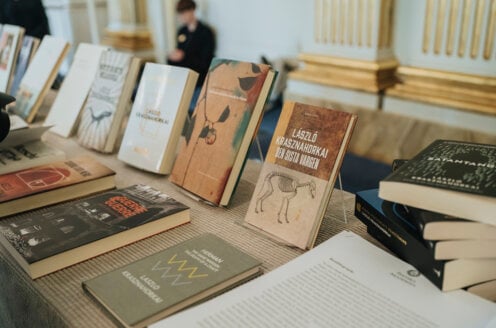
Books by László Krasznahorkai.
Photo: Samuel Unéus.
Nobel Prizes and laureates
Six prizes were awarded for achievements that have conferred the greatest benefit to humankind. The 14 laureates' work and discoveries range from quantum tunnelling to promoting democratic rights.
See them all presented here.