Marie Curie
Photo gallery

1 (of 16) Marie Curie, 1903.
© Musée Curie (coll. ACJC)

2 (of 16) Marie Curie, 1904.
Photo: Cl. Moreau et Kivaliski. © Musée Curie (coll. ACJC)

3 (of 16) Marie Curie, 1911.
© Musée Curie (coll. ACJC)

4 (of 16) Marie Curie, her sisters, Helena Szalay and Bronislawa Dluska and her brother, Joseph Sklodowski, in Poland, 1911.
© Musée Curie (coll. ACJC)

5 (of 16) Marie Curie with Henri Poincaré and Jean Perrin during the first Congrès Solvay, Brussels, October 1911.
Photo: Benjamin Couprie. © Musée Curie (coll. ACJC)

6 (of 16) Portrait of Marie Curie (1934).
Source: Smithsonian Institution Archives Photographer unknown No known copyright restrictions
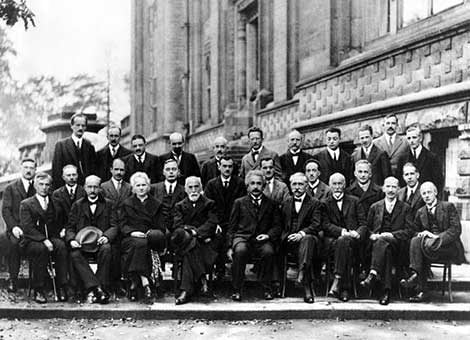
7 (of 16) The fifth Solvay International Conference on Electrons and Photons, was held in October 1927. Prominent physicists from all the world met to discuss the newly formulated quantum theory. 17 of the 29 participants were or became Nobel Laureates. Back row, left to right: Auguste Piccard, Émile Henriot, Paul Ehrenfest, Édouard Herzen, Théophile de Donder, Erwin Schrödinger, Jules-Émile Verschaffelt, Wolfgang Pauli, Werner Heisenberg, Ralph Howard Fowler, Léon Brillouin. Middle row, left to right: Peter Debye, Martin Knudsen, William Lawrence Bragg, Hendrik Anthony Kramers, Paul Dirac, Arthur Compton, Louis de Broglie, Max Born, Niels Bohr. Front row, left to right: Irving Langmuir, Max Planck, Marie Skłodowska Curie, Hendrik Lorentz, Albert Einstein, Paul Langevin, Charles-Eugène Guye, Charles Thomson Rees Wilson, Owen Willans Richardson.
Photo: Benjamin Couprie, Institut International de Physique Solvay, Brussels, Belgium. Public domain via Wikimedia Commons
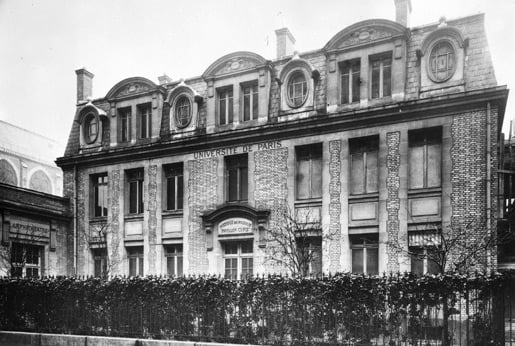
8 (of 16) The Curie Pavillion at the Radium Institute in 1925.
Copyright © Association Curie Joliot-Curie Photographer unknown

9 (of 16) Marie Curie and her daughter Irène in the laboratory at the Radium Institute in Paris, France, 1921.
Copyright © Association Curie Joliot-Curie Photographer unknown

10 (of 16) Marie Curie in her chemistry laboratory at the Radium Institute in France, April 1921.
Source: Nationaal Archief of the Netherlands Photographer unknown No known copyright restrictions

11 (of 16) Marie Curie and her daughter Irène at the Hoogstade Hospital in Belgium, 1915. Radiographic equipment is installed.
Copyright © Association Curie Joliot-Curie Photographer unknown

12 (of 16) Marie Curie and four of her students. (Photo taken between 1910 and 1915.)
Source: Library of Congress Photographer unknown No known copyright restrictions

13 (of 16) Marie Curie and her daughters Irène and Eve sitting on a bench in the garden (1905).
Copyright © Association Curie Joliot-Curie Photographer unknown

14 (of 16) On 25 June 1903 Marie Curie defended her doctoral thesis on radioactive substances at Université de la Sorbonne in Paris, thus becoming the first woman in France to receive a doctoral degree. Image shows the thesis cover: Recherches sur les substances radioactives (Research on Radioactive Substances).
Photo: Public domain, via Wikimedia Commons

15 (of 16) Pierre and Marie Curie in the "hangar" at l'Ecole de physique et chimie industrielles in Paris, France, where they made their discovery. Standing to the left is probably Henri Becquerel. (Photo taken 1898.)
Copyright © Wellcome Library, London Photographer unknown Available under Creative Commons Attr, CC BY 4.0

16 (of 16) Wedding photo of Pierre and Marie Curie, 1895.
Copyright © Association Curie Joliot-Curie Photographer unknown
Nobel Prizes and laureates
Six prizes were awarded for achievements that have conferred the greatest benefit to humankind. The 14 laureates' work and discoveries range from quantum tunnelling to promoting democratic rights.
See them all presented here.