Richard Axel – Curriculum Vitae
| Richard Axel, born July 2, 1946, New York, NY, USA | |
| Address: | Howard Hughes Medical Institute, Columbia University, Hammer Health Sciences Center, 701 West 168th Street, Room 1014, New York, NY 10032, USA |
| Academic Education and Appointments | |
| 1967 | A.B. Columbia University, New York, NY |
| 1970 | M.D. Johns Hopkins University School of Medicine, Baltimore, MD |
| 1978 | Professor, Pathology and Biochemistry, Columbia University |
| 1984- | Investigator, Howard Hughes Medical Institute, Columbia University |
| 1999- | University Professor, Columbia University |
| Selected Honours and Awards | |
| 1969 | The Johns Hopkins Medical Society Research Award |
| 1983 | The Eli Lilly Award |
| 1983 | Member, the National Academy of Sciences |
| 1983 | Member, the American Academy of Arts and Sciences |
| 1984 | The New York Academy of Sciences Award in Biological and Medical Sciences |
| 1989 | The Richard Lounsbery Award, National Academy of Sciences |
| 1996 | The Unilever Science Award, with Dr. Linda Buck |
| 1997 | New York City Mayor’s Award for Excellence in Science and Technology |
| 1998 | Bristol-Myers Squibb Award for Distinguished Achievement in Neuroscience Research |
| 1999 | The Alexander Hamilton Award, Columbia University |
| 2001 | NY Academy of Medicine Medal for Distinguished Contributions in Biomedical Sciences |
| 2003 | The Gairdner Foundation International Award for Achievement in Neuroscience |
| 2003 | The Perl/UNC Neuroscience Prize, with Dr. Linda Buck |
| 2003 | Member, the American Philosophical Society |
The Nobel Assembly at Karolinska Institutet
Richard Axel – Prize presentation
Richard Axel – Nobel Lecture
Richard Axel held his Nobel Lecture December 8, 2004, at Sal Adam, Berzeliuslaboratoriet, Karolinska Institutet.
Lecture Slides
Pdf 7.19 MB
Read the Nobel Lecture
Pdf 1.38 MB
Richard Axel – Nobel diploma
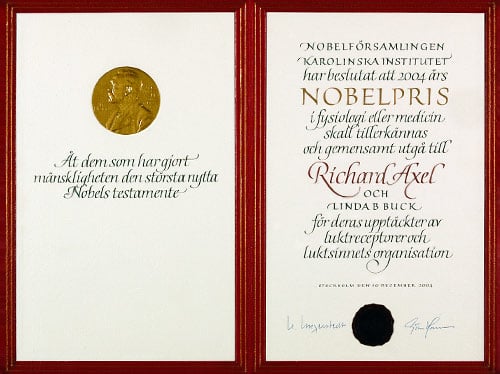
Copyright © The Nobel Foundation 2004
Calligrapher: Susan Duvnäs
Richard Axel – Banquet speech
Richard Axel’s speech at the Nobel Banquet in the Stockholm City Hall, December 10, 2004.
Your Majesties, Your Royal Highnesses, Your Excellencies, honored guests, ladies and gentlemen.
Émile Zola asked in an address to students, “Did science promise happiness? No, I don’t think so,” he replied. “It promised truth and the question is whether truth will ever make us happy.” Last month, science afforded me enormous happiness.
This evening Linda Buck and I received a medal which is inscribed with three words, Creavit et promovit. He created and he promoted. The words do not honor us. They honor the vision of Alfred Nobel, the Nobel Prize that importantly encourages the freedom to acquire knowledge. This freedom cannot be taken lightly. Both myth and history reveal the conflict between intellect and power. With the tasting of the fruit of the Tree of Knowledge of Good and Evil and the expulsion of Adam and Eve from the garden, with Prometheus’ deliverance of fire to mankind and the opening of Pandora’s Box, we observe man’s intellectual curiosity punished by suffering. Ironically, it is this intellectual creativity that allows man to overcome his punishment, his suffering, to allow man to prevail. Indeed, the advancement of knowledge is too often perceived as transgression.
The conflict between intellect and political and religious authority will intensify as we continue to address questions concerning the origin of man, the nature of our genes, and how they define our biological character and most elusively, the relation between genes and behavior, emotion, and cognition. This knowledge too often elicits discord and even fear. This fear has led to the disturbing notion that there is knowledge best left unknown. This thinking undermines the scientific process. We must choose either to have science or not to have it, and if you have it you cannot dictate the kinds of knowledge that will emerge and this knowledge will inevitably have the potential for both good and evil. With this knowledge, our lives and those of our descendants will be inexorably changed and it is our shared responsibility to assure that this change is for the better. As we read in “The Ascent of Man,” “It is not within the business of science to inherit the earth, but to improve it.”
Tonight I speak for Linda and myself in thanking all of you for this honor and this spectacular celebration. This award is made not to me as a man, but for my science and for me science is a joyous obsession. Linda Buck and I have combined molecular genetics with neuroscience to approach the previously tenuous relationship between genes, perception and behavior. We have asked how the brain builds an internal representation of the external sensory world and how the recognition of olfactory stimuli might lead to meaningful thoughts and behaviors. While performing these experiments, in watching the data unfold remarkably before our eyes, it seemed inconceivable that we could experience a moment of greater joy or fulfillment. But tonight we stand with you, with Their Majesties The King and The Queen, with fellow scientists, with honored guests and friends, amidst the lights, the music, the trumpets, the wine and feel an affection that adds a new and very human dimension to our science. In the midst of this joy of these festivities, I raise my glass to celebrate you. Skål!
Copyright © The Nobel Foundation 2004
Richard Axel – Photo gallery
Richard Axel receiving his Nobel Prize from His Majesty the King Carl XVI Gustaf of Sweden at the Stockholm Concert Hall, 10 December 2004.
Copyright © The Nobel Foundation 2004
At the Nobel Prize Award Ceremony at the Stockholm
Concert Hall. Economics Laureates Finn Kydland (right) with Richard Axel (left) who shared the 2004 Nobel Prize in Physiology or Medicine with Linda B. Buck (middle).
Copyright © Pressens Bild AB 2004, S-112
88 Stockholm, Sweden, telephone: +46 (0)8 738 38 00
Photo: Henrik Montgomery
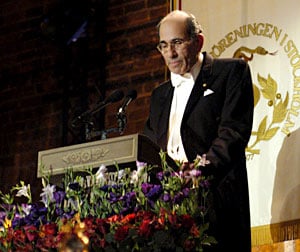
Richard Axel delivering his banquet speech. © Nobel Media AB 2004. Photo: Hans Mehlin
Photo: Hans Mehlin

Richard Axel – Documentary
A short documentary about the lives and work of the 2004 Nobel Laureates in Physiology or Medicine Richard Axel and Linda B. Buck, and their research on the olfactory system.
Richard Axel – Other resources
Links to other sites
Dr. Richard Axel’s page at Howard Hughes Medical Institute
Richard Axel – Interview
Interview with the 2004 Nobel Laureates in Physiology or Medicine, Richard Axel and Linda B. Buck, by science writer Peter Sylwan 11 December 2004.
The Laureates talk about the big event of the Nobel Prize Award Ceremony; the genes of the olfactory system (1:47); the importance of the sensor organ (3:33); the smell of emotions (10:28); the mapping out of the molecules of sense inside the brain (14:43); and challenges for neuroscience in the future (18:29).
Participating in the 2004 edition of Nobel Minds: the Nobel Laureates in Physics, David J. Gross and Frank Wilczek, the Nobel Laureates in Chemistry, Aaron Ciechanover, Avram Hershko and Irwin Rose, the Nobel Laureates in Physiology or Medicine, Richard Axel and Linda B. Buck and the Laureates in Economic Sciences, Finn E. Kydland and Edward C. Prescott. Program host is Nik Gowing.
Telephone interview with Dr. Richard Axel after the announcement of the 2004 Nobel Prize in Physiology or Medicine by science writer Joanna Rose, 4 October 2004.
Interview transcript
– Hello.
– Hello, is this Richard Axel?
– Yes, it is.
– Hello. My name is Joanna Rose. I am calling from Nobelprize.org, which is the official web site of the Nobel Foundation. May I ask you some questions and congratulate to the Prize?
– Yes, I am still a bit shocked …
– You are?
– … and quite surprised and deeply honoured …
– I understand. You didn’t expect the message tonight?
– No, I did not, and I am in California, and received a phone call from my assistant in New York.
– I understand. So did you just go to sleep?
– I just woke up, three o’clock in the morning.
– What was your first reaction when you heard about the Prize?
– My first reaction was one of surprise, and then that was coupled with joy, and I am really very, very pleased that this work was recognised by so … meaningful a group of people in the world. I think it’s a Prize that reflects not my effort alone, but the efforts of a very large group of students and fellows in my laboratory, working with intensity and excitement on a problem.
– What do you think it will mean for your work now, or for you personally?
– I think that it is important to feel that one’s work is viewed by the rest of the world as having a significance and it will hopefully intensify my efforts.
– I understand also that this is going to be a very long day for you. What are you going to do, do you think?
– First I am going to have a cup of coffee.
– You had no time yet?
– No
– OK.
– And then I am going to hug my girlfriend and talk with my family and laboratory. I have not yet heard from the Nobel Committee …
– Oh, I see. Do you think this will influence somehow your future work?
– Oh, it can’t help but not influence your work, because it puts your work in the public arena. But I would hope that whatever values and intensity and excitement I brought to my work will just be enhanced by this recognition.
– I understand that the discovery that you got now the Prize for was made in 1991, and I wonder, was this a surprise for you, then?
– In 1991? Yes, in 1991 we, Linda Buck and I, Linda was a fellow in my laboratory, had been searching for the … that recognised odorous … in the environment, and what Linda was able to demonstrate in a very elegant series of experiments, was that perhaps as much as three or five percent of the genes in the genome were dedicated to this function. So fifteen hundred genes were dedicated to this function, which was a surprise but also gave a significant insight into the process of this perceptual system. So the discovery of all of these genes, including receptors, was a surprise and receiving the Nobel Prize for it was also a surprise.
– Life is full of surprises.
– Life is full of good surprises.
– As I understand you are working in two different laboratories now, are you competitors?
– I would say not. We are interested in similar general problems, but take different approaches to those problems, and so we don’t directly compete now. I have emphasized olfaction in two different systems – one, mammals and the second system that’s been fascinating for us is insects. Linda’s work largely involved mammals, and so I don’t think … I don’t feel competitive at all with Linda, and I am trying not to engage in experiments that elicit competition between former student s and fellows in my lab.
– You mentioned that there is a large group of people that are involved. What would be a message from you to students now, whose greatest wish is maybe to win a Nobel Prize, to make a discovery?
– I think the important message, if I were to talk with students, is that the joy of science is in the process, and not in the end. That science is not a move to an end, rather it is a process of discovery, which onto itself should be a meaningful pleasure.
– Before I thank you, I have just a last question: Have you ever visited the Nobel web site, the official one?
– Yes, I have. Should I visit it now?
– Maybe. Then you’ll be convinced about your Prize.
– I have visited it to read William Faulkner’s Nobel acceptance speech.
– Thank you very much, and please have a nice day today.
– Thank you very much. Bye bye.
Did you find any typos in this text? We would appreciate your assistance in identifying any errors and to let us know. Thank you for taking the time to report the errors by sending us an e-mail.