Wolfgang Paul – Photo gallery

1 (of 5) Wolfgang Paul receiving his Nobel Prize from H.M. King Carl XVI Gustaf of Sweden at the Stockholm Concert Hall on 10 December 1989.
Photo from the Lars Åström archive

2 (of 5) Laureates assembled at the Nobel Prize award ceremony in the Stockholm Concert Hall on 10 December 1989: Physics laureates Norman F. Ramsey, Hans G. Dehmelt and Wolfgang Paul, chemistry laureates Sidney Altman and Thomas R. Cech, medicine laureates J. Michael Bishop and Harold E. Varmus, literature laureate Camilo José Cela and economic sciences laureate Trygve Haavelmo.
Photo from the Lars Åström archive

3 (of 5) Physics laureate Wolfgang Paul examining his Nobel Prize medal during his visit to the Nobel Foundation in December 1989.
Photo from the Lars Åström archive

4 (of 5) Nine of the ten Nobel Prize laureates of 1989 assembled at the Swedish Academy in Stockholm in December 1989. Back row: J. Michael Bishop, Sidney Altman, Harold E. Varmus, Thomas R. Cech, Wolfgang Paul and Hans G. Dehmelt. Front row: Norman F. Ramsey, Camilo José Cela and Trygve Haavelmo.
Photo from the Lars Åström archive

5 (of 5) Portrait of Wolfgang Paul.
Photo from the Lars Åström archive
Wolfgang Pauli – Nobel Lecture
Nobel Lecture, December 13, 1946
Exclusion Principle and Quantum Mechanics
Read the Nobel Lecture
Pdf 78 kB
Wolfgang Pauli – Nominations
Wolfgang Paul – Curriculum Vitae
Born 10 August 1913 in Lorenzkirch, Germany; 1939 Dr.-lng., Technische Hochschule, Charlottenberg; since 1952 Professor of Experimental Physics at the University of Bonn; 1965-1967 Director of the Division of Nuclear Physics at CERN. German citizen.
Address
Physikalisches Institut der Universität Bonn
Nussallee 12
D-5300 Bonn
Federal Republic of Germany tel inst: +49 – (228) 732345 vx
The Royal Swedish Academy of Sciences
Wolfgang Paul died on December 7, 1993.
Wolfgang Paul – Nobel Lecture
Nobel Lecture, December 8, 1989
Electromagnetic Traps for Charged and Neutral Particles
Read the Nobel Lecture
Pdf 342 kB
Wolfgang Pauli – Photo gallery

1 (of 5) Physics laureates Sir Chandrasekhara Venkata Raman (left) and Wolfgang Pauli (right) at the 6th Nobel Laureate meeting in Lindau, June 1956.
Photo: CERN / © Franz Thorbecke, Lindau.

2 (of 5) Telegramme sent on June 14 1956 from physicists Fred Reines and Clyde Cowan to Wolfgang Pauli announcing the detection, for the first time, of neutrinos. The Nobel Prize in Physics 1995 was awarded to Reines for this discovery.
Photo: © 2006-2022 CERN. CERN PhotoLab / Life at CERN. Photograph: Maximiliem Brice.

3 (of 5) The three physics laureates Wolfgang Pauli, Werner Heisenberg and Enrico Fermi on a boat on Lake Como, Italy, in September 1927 .
Photo: CERN / © Franco Rasetti
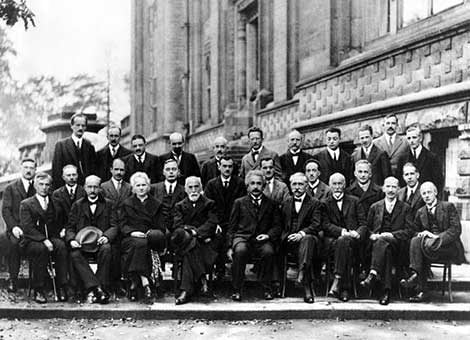
4 (of 5) The fifth Solvay International Conference on Electrons and Photons, was held in October 1927. Prominent physicists from all the world met to discuss the newly formulated quantum theory. 17 of the 29 participants were or became Nobel Laureates. Back row, left to right: Auguste Piccard, Émile Henriot, Paul Ehrenfest, Édouard Herzen, Théophile de Donder, Erwin Schrödinger, Jules-Émile Verschaffelt, Wolfgang Pauli, Werner Heisenberg, Ralph Howard Fowler, Léon Brillouin. Middle row, left to right: Peter Debye, Martin Knudsen, William Lawrence Bragg, Hendrik Anthony Kramers, Paul Dirac, Arthur Compton, Louis de Broglie, Max Born, Niels Bohr. Front row, left to right: Irving Langmuir, Max Planck, Marie Skłodowska Curie, Hendrik Lorentz, Albert Einstein, Paul Langevin, Charles-Eugène Guye, Charles Thomson Rees Wilson, Owen Willans Richardson.
Photo: Benjamin Couprie, Institut International de Physique Solvay, Brussels, Belgium. Public domain via Wikimedia Commons

5 (of 5) Wolfgang Pauli at 2 years and 8 months. The portrait was taken in December 1902.
Photo: CERN / © L Grillich, Wien.
Wolfgang Pauli – Other resources
Links to other sites
On Wolfgang Pauli from National High Magnetic Field Laboratory
Wolfgang Paul – Biographical
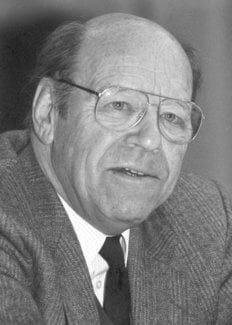
I was born on August 10, 1913 in Lorenzkirch a small village in Saxony, as the forth child of Theodor and Elisabeth Paul nee Ruppel. All in all we were six children. Both parents were descendants from Lutheran ministers in several generations. I grew up in München where my father has been a professor for pharmaceutic chemistry at the university. He had studied chemistry and medicine having been a research student in Leipzig with Wilhelm Ostwald, the Nobel Laureate 1909. So I became familiar with the life of a scientist in a chemical laboratory quite early. Unfortunately, my father died when I was still a school boy at the age of fifteen years. But my interest in sciences was awaken, even my parents were very much in favour of a humanistic education. After finishing the gymnasium in München with 9 years of Latin and 6 years of ancient greek, history and philosophy, I decided to become a physicist. The great theoretical physicist, Arnold Sommerfeld, an University colleague of my late father, advised me to begin with an apprenticeship in precision mechanics. Afterwards, in the fall 1932, I commenced my studies at the Technische Hochschule München. Listening to the very inspiring physics lectures by Jonathan Zenneck with lots of demonstrations – 6 full hours a week – I felt being on the right track.
After my first examination in 1934 I turned to the Technische Hochschule in Berlin. I was lucky in finding in Hans Kopfermann a teacher with a feeling for the essentials in physics but also a very liberal man, who had taken a fatherly interest in me. He, a former Ph.D. student of James Franck, had just returned from a three years stay at the Niels Bohr Institute in Copenhagen, working in the field of hyperfine spectroscopy and nuclear moments. All in all I worked 16 years with him.
As a theorist Richard Becker taught at the TH Berlin whom I met later at the University of Göttingen again. Both men had the strongest influence on my scientific thinking. But it was not only the scientific aspect. In the Germany of these days just as important was the human and the political attitude. And I am still a little bit proud having been accepted by these sensitive men in this respect. Here are the roots for my later engagement in the anti nuclear weapon discussion and for having signed the declaration of the so-called “Göttinger Eighteen” in 1957 with its important consequences in german politics.
In 1937 after my diploma exam with Hans Geiger as examinator I followed Kopfermann to the University of Kiel where he had just been appointed Professor Ordinarius. For my doctor thesis I had chosen the determination of the nuclear moments of Beryllium from the hyperfine spectrum. I developed an atomic beam light source to minimize the Doppler effect. But just before the decisive measurements I was drawn to the air force a few days before the war started. Fortunately, a few month later I got a leave of absence to finish my thesis and to take my doctor exam at the TH Berlin. In 1940 I was exempted from military service. I joined again the group around Kopfermann which 2 years later moved to Gottingen. There in 1944 I became Privatdozent at the University.
In these years I worked in mass spectrometry and isotope separation together with W. Walcher. When we heard of the development of the betatron by D. Kerst in the United States and also of a similar development by Gund at the Siemens company, Kopfermann saw immediately that scattering experiments with high energy electrons would enable the study of the charge structure of nuclei. He convinced me to turn to this new very promising field of physics and I soon participated in the first test measurements at the 6 MeV betatron at the Siemens laboratory. Later after the war we succeeded in getting this accelerator to Gottingen.
But due to the restriction in physics research imposed by the military government I turned for a few years my interest to radiobiology and cancer therapy by electrons in collaboration with my colleague G. Schubert from the medical faculty.
Besides we performed some scattering experiments and studied first the electric disintegration of the deuteron, and not to forget for the first time we measured the Lamb shift in the He-spectrum with optical methods.
In 1952 I was appointed Professor at the University of Bonn and Director of the Physics Institute, with very good students waiting for a thesis advisor. I was very lucky that my best young collaborators followed me 0. Osberghaus, H. Ehrenberg. H.G. Bennewitz, G. Knop and H. Steinwedel as a “house theoretician”. Here we started new activities: molecular beam physics, mass spectrometry and high energy electron physics. It was a scanty period after the war. But in order to become in a few years competitive with the well advanced physics abroad we tried to develop new methods and instruments in all our research.
In this period these focusing methods in molecular beam physics with quadrupole and sextupole lenses having already started in Gottingen with H. Friedburg, were further developed and enabled new types of experiments. The quadrupole mass spectrometer and the ion trap were conceived and studied in many respects by research students. And with the generous support of the Deutsche Forschungsgemeinschaft we have built a 500 MeV electron synchrotron, the first in Europe working according to the new principle of strong focusing. It was followed in 1965 by a synchroton for 2500 MeV. My colleagues H. Ehrenberg, R.H. Althoff and G. Knop were sharing this success with me.
In recent years my interest turned to neutron physics with a new device, a magnetic storage ring for neutrons.
U. Trinks and K.J. Kügler and later my two sons Lorenz and Stephan, joined me in our experiments with stored neutrons at the ILL in Grenoble. My experience in accelerator physics brought me in close contact to CERN. I served there from the very early days on as an advisor. Having spent the year 1959 in Genève I became director of the nuclear physics division for the years 1964 – 67. I was for several years member and later chairman of the Scientific Policy Committee and for many years scientific delegate of Germany in the CERN-Council. For a short period I was chairman of ECFA, the European Committee for Future Accelerators.
Together with my friends W. Jentschke and W. Walcher in 1957 we started the German National Laboratory DESY in Hamburg which I joined as chairman of the directorate 1970 – 73. For several years I was chairman of its scientific council. In the same positions I served in the first years of the Kernforschungsanlage Jülich.
In 1970 I spent some weeks as Morris Loeb lecturer at Harvard University. 1978 I was lecturing as distinguished scientist at the FERMI Institute of the University of Chicago and in a similar position at the University of Tokyo. Since 1981 I am Professur Emeritus at the Bonn University.
In the past decades of recovery of German Universities and Physics research I was engaged in many advisory bodies. I have served as a referee and later as member of senate to the Deutsche Forschungsgemeinschaft. I was member and chairman of several committees: for reforming the university structure and for research planning of the federal government.
Ten years ago I was elected President of the Alexander von Humboldt Foundation which since 130 years fosters the international collaboration among scientists all over the world in the universal spirit of its patron Humboldt.
I was married for 36 years to the late Liselotte Paul, nee Hirsche. She shared with me the depressing period during and after the war and due to her optimistic view of life she gave me strength and independence for my profession. Four children were born to us, two daughters, Jutta and Regine, an historian of art and a pharmacist, and two sons, Lorenz and Stephan, both being physicists. Since 1979 I am married to Dr. Doris Walch-Paul, teaching medieval literature at the University of Bonn.
| Memberships and Distinctions |
| Member |
| Deutsche Akademie der Naturforscher “Leopoldina” |
| Akademie der Wissenschaften in Düsseldorf, Heidelberg und Göttingen |
| Orden Pour le Mérite fur Wissenschaft und Künste, Vice chancelor for the Sciences |
| Honorary member of DESY, Hamburg |
| Honorary member of KFA Jülich |
| Distinctions |
| Grosses Verdienstkreuz mit Stern der Bundesrepublik Deutschland |
| Dr. fil. h.c. University Uppsala |
| Dr.rer.nat.h.c. Technische Hochschule Aachen |
| Robert-Wichard-Pohl-Preis der Deutschen Physikalischen Gesellschaft |
| Goldmedal of the Academy of Sciences in Prague |
This autobiography/biography was written at the time of the award and later published in the book series Les Prix Nobel/ Nobel Lectures/The Nobel Prizes. The information is sometimes updated with an addendum submitted by the Laureate.
Wolfgang Paul died on December 7, 1993.