Francis W. Aston – Nobel Lecture
Nobel Lecture, December 12, 1922
Mass Spectra and Isotopes
Read the Nobel Lecture
Pdf 140 kB
The Nobel Foundation's copyright has expired.
Francis W. Aston – Documentary
Francis W. Aston – Nominations
Francis W. Aston – Facts
Award ceremony speech
Presentation Speech by Professor H. G. Söderbaum, member of the Nobel Committee for Chemistry of the Royal Swedish Academy of Sciences, on December 10, 1922
Your Majesty, Your Royal Highnesses, Ladies and Gentlemen.
As we have just seen, the conception of isotopy has mainly developed out of our knowledge of the radioactive elements, their coming into existence, their transformation, and their other relations. Now the obvious thought presented itself that non-radioactive elements – which, of course, include the majority of our commonest elements – might also in the same way consist of mixtures of isotopes which were inseparable by chemical methods. But it was not easy to demonstrate such a state of things. The radioactive phenomena, which had hitherto formed the guiding star of research, here refused to render service any longer. It was necessary to fall back exclusively on a careful study of such physical properties as could be conceived as being affected, to a greater or lesser extent, by the mass of the atom.
The first attempts in this direction were carried out by the well-known Nobel Prize laureate, Sir J.J.Thomson. In this work he made use of the so-called anode rays, that is to say the positively charged particles of gas which in a vacuum-tube are hurled at a high speed against the negative electrode. If one causes them to pass through an aperture in this electrode and then to be acted upon by an electric and a magnetic field, they are deflected, and the extent of the deflection is determined by the ratio of mass to charge. By measuring this deviation, it should be possible to obtain a measure of the mass of the particles appearing in the rarefied gas and consequently also one should be able to demonstrate the existence of isotopes, in as much as these must be characterized by different values of the mass, or in other words, by different atomic weights.
Thomson’s experiments had not yet led to any decisive result when the outbreak of the World War led to an interruption in the work for several years. In 1919 that work was taken up again by Thomson’s former pupil, Dr. Aston of Cambridge. He now constructed an apparatus, known as the mass spectrograph, which, though in the main founded on the same principles as Thomson’s, yet, in comparison with that, exhibits certain very substantial improvements, calculated to lead to results many times more precise.
This is not the place to enter into the extremely involved design of that instrument, which is as ingenious as it is exact. Suffice it to say that the rays which have a constant ratio between electrical charge and mass are focussed, that is to say caused to converge to a common centre, the situation of which, in relation to other similar focusses, can be exactly determined with the help of a photographic plate. By this means there is attained what is known as a mass spectrogram, that is to say a series of lines in which each line corresponds to a certain atomic weight, and where the numerical value of each atomic weight can be read off from the distance of the line from the line or lines which are produced by any fundamental substance that is chosen as a standard – usually carbon-12 or oxygen-16. The degree of exactitude by which the atomic weights can thus be determined by the mass spectrograph amounts, in favourable cases, to one in a thousand.
Thanks to the substantially increased sharpness and fineness that the analysis of the anode rays has obtained by means of the mass spectrograph, Aston has succeeded in proving that a large number of fundamental elements which have hitherto been regarded as simple are in reality complexes of two or more isotopes. This is the case, within the group of the inactive gases, with neon, krypton, and xenon; within the halogen group, with chlorine and bromine; within the alkali metals, with lithium, potassium, and rubidium; further complexes are boron and silicon, tin and selenium, calcium and mercury, etc. On the other hand, helium, fluorine and iodine, carbon and oxygen, nitrogen, phosphorus and arsenic, sodium and caesium, etc. have been found to possess clear criteria of unity.
This result is in itself extremely remarkable, and, as can easily be seen, it is of fundamental importance for the whole of chemical science; but this is not the most remarkable of the results which have been obtained with the mass spectrograph. It is indeed still more remarkable that all the masses so far measured of the recently enumerated elements and several others, and also the masses of their isotopes, can be expressed by means of whole numbers in relation to oxygen-16. As the number of fundamental substances investigated amounts to over 30, and as the number of demonstrated isotopes rather exceeds than falls short of so, this accordance can scarcely be regarded as merely fortuitous, but must be regarded as the expression of a natural law of general validity. It has indeed been named the whole-number rule.
By this discovery a riddle which for over a hundred years has engaged chemical research has attained its solution, and a surmise which for thousands of years has floated before the human mind has thereby been confirmed.
Long ago, in certain philosophers of ancient Hellas, we find assertions of the unity of matter, of a primitive substance which is common to all substances.
An obscure notion in the same direction undoubtedly floated before the minds of the alchemists of the Middle Ages and of the Renaissance in their incessant endeavours to transmute one metal into another.
The thought was developed more clearly in the seventeenth century by Robert Boyle; according to him, all bodies consist of one and the same primitive material; their varying multiplicity is due to the different size and shape of the small parts or corpuscles, to their different states of rest or movement.
But this way of looking at things did not become of burning importance to scientific chemical research until 1815, when the English physician Prout put forward his hypothesis that the atoms of the elements are all made up of aggregations of a larger or smaller number of atoms of the lightest known element, hydrogen.
If this view were correct, evidently the atomic weights of all elements ought to be exact multiples of that of hydrogen.
So far, however, experience has spoken another language. The greatest masters of chemical science in the sphere of precise determinations – a Berzelius, a Stas, and in our own days a Richards – have one after another established the existence of one and the same state of things, namely that, though the atomic weights of some elements are very nearly whole number multiples of that of hydrogen, yet on the other hand others defy the most persistent efforts to eliminate their inherent fractions, which far exceed the limits of errors of observation. Prout’s hypothesis, therefore, was regarded as disproved more and more definitely as the determinations of atomic weights became worked out with a greater degree of perfection and seemed to yield results incompatible with the hypothesis.
Through Aston’s discoveries this theory has now been restored to life in a trice, although, it is true, in a form different from that which its originator imagined, in as much as, at the present standpoint of science, the simplest small parts of matter must be conceived as consisting of two essentially different kinds, namely of positively and negatively charged small particles protons and electrons.
The broken numbers in the atomic weights of certain fundamental substances, in fact, now appear simply as statistical effects of the internal quantitative relations of their isotopic constituents.
A typical example of an element with such a broken atomic weight is offered by chlorine. Its atomic weight, according to the most exact determinations, is 35.46. Aston now shows that what we have hitherto called chlorine is a mixture of at least two isotopic elements, one with the atomic weight of 35, the other with the atomic weight of 37, combined with one another in such relations that the weight of the mixture is exactly 35.46.
One element, however, forms an exception from the whole-number rule, and this exception is no less interesting than the law itself. It is precisely the atomic weight of hydrogen which has in the mass spectrograph shown itself to be encumbered with a fraction; not large, it is true-it amounts to only o.oo8-but still sufficiently large not to be explained away as an error of observation. The atomic weight of hydrogen has thus been found to be noticeably heavier than the unity which holds good with regard to the other elements in relation to oxygen-16.
But also according to Rutherford’s nucleus theory hydrogen assumes a special position in relation to all other elements. Its atom, indeed, is the only one of which the nucleus is not composed of a number of tightly packed mass units, but consists of one single positive particle of electricity, proton. In view of this fact the divergence of hydrogen from the whole-number rule cannot be said to be entirely unexpected, least of all if one adopts the view that the gulf between mass and energy is less insuperable than had been previously supposed.
Doctor Aston. The Royal Swedish Academy of Sciences has resolved to award you this year’s Nobel Prize in Chemistry for your discovery, made with the help of the mass spectrograph, of the isotopes of a great number of inactive elements and of the whole-number rule, discoveries which are of fundamental importance for the study of nature in general and for chemical science in particular. While expressing a cordial hope that it may be vouchsafed to you in the future to add further scientific successes to those which you have already obtained, I have the honour to convey to you the congratulations of the Academy on the distinction the outward and visible signs of which you are now about to receive.
The Nobel Prize in Chemistry 1922
Francis W. Aston – Biographical
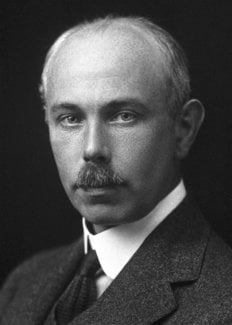
Francis William Aston was born in September 1877 at Harborne, Birmingham, England, the third of a family of seven children. He was educated at Harborne Vicarage School and Malvern College where his interest in science was aroused. In 1894 he entered Mason College, Birmingham (later to become the University of Birmingham) where he studied chemistry under Frankland and Tilden, and Physics under Poynting. His winning of the Forster Scholarship in 1898 enabled him to work on the optical properties of tartaric acid derivatives; the results of this work were published in 1901.
Leaving academic life for a time, he worked for three years as a chemist in the laboratory of a brewery. At about this time, however, his interest in physics, rather than chemistry, began to predominate; his aptitude for mechanical contrivance showed itself in his design and construction of new types of pumps for evacuating vessels. From this stemmed his interest in gas discharge phenomena in evacuated tubes.
In 1903 he obtained a scholarship to Birmingham University (as it had now become) to work on the properties of the Crookes Dark Space in discharge tubes. Within a short time he had discovered the phenomenon which is known as the Aston Dark Space. At the end of 1909 he accepted the invitation of Sir J.J.Thomson to work as his assistant at the Cavendish Laboratory, Cambridge, on studies of positive rays. It was during this period that he obtained definite evidence for the existence of two isotopes of the inert gas neon.
This research was interrupted by the War of 1914-1918, during which time Aston worked at the Royal Aircraft Establishment, Farnborough, where he studied the effect of atmospheric conditions on aeroplane fabrics and dopes (i.e. synthetic coatings).
Returning to the Cavendish Laboratory in 1919, he again attacked the problem of the separation of the isotopes of neon. He quickly achieved success in this by his invention of the mass spectrograph, an apparatus in which the ingenious use of electromagnetic focusing enabled him to utilize the very slight differences in mass of the two isotopes to effect their separation. Extending this principle to other chemical elements, he discovered, in a series of measurements, no less than 212 of the naturally occurring isotopes. From the results of this work he was able to formulate the so-called Whole Number Rule which states that, the mass of the oxygen isotope being defined, all the other isotopes have masses that are very nearly whole numbers.
Aston continued to make measurements, using an improved instrument, with ever-increasing refinement and precision. He observed and was able to measure those deviations from the Whole Number Rule which were to become so important in the field of atomic energy.
The results of his work were published in the Proceedings of the Royal Society and in the Philosophical Magazine. He was also the author of the books Isotopes (1922; revised edition 1941) and of Structural Units of the Material Universe (1923).
Aston was elected to a Fellowship at Trinity College in 1920, in which year he also received the Mackenzie Davidson Medal of the Röntgen Society. In 1921 he was made a Fellow of the Royal Society and was awarded the Society’s Hughes Medal the following year, the same year that he received the Nobel Prize. The John Scott and the Paterno medals were given to him in 1923, the Royal medal in 1938, and he was Duddell medalist of the Physical Society in 1941.
He was an honorary member of the Russian Academy of Sciences and of the Accademia dei Lincei, and held honorary doctorates of the Universities of Birmingham and Dublin.
Aston, a bachelor, was an enthusiastic sportsman; skiing, rock climbing, tennis and swimming were among the sports in which he excelled. He was also keen musician, playing the piano, violin and the cello.
He died at Cambridge on November 20, 1945.
This autobiography/biography was written at the time of the award and first published in the book series Les Prix Nobel. It was later edited and republished in Nobel Lectures. To cite this document, always state the source as shown above.
Francis W. Aston died on 20 November 1945.
The Nobel Foundation's copyright has expired.