Lars Onsager – Nominations
Lars Onsager – Nobel Lecture
Nobel Lecture, December 11, 1968
The Motion of Ions: Principles and Concepts
Read the Nobel Lecture
Pdf 126 kB
Lars Onsager – Other resources
Links to other sites
Guide to the Lars Onsager Papers, Yale University
The Lars Onsager online archive at NTNU
Lars Onsager – Banquet speech
Lars Onsager’s speech at the Nobel Banquet in Stockholm, December 10, 1968
Your Majesty, Your Royal Highnesses, Ladies and Gentlemen,
I have received the greatest honor in my life – and the greatest surprise. Never did I dream that the Nobel Prize could be awarded for the reciprocal relations. Not that I felt bashful about the work, but how does one equate a principle with a discovery? It is not the naked principle but rather the philosophy that goes with it; by and by, that is fruitful.
But a joy it is, so much greater because all those who ever shared anything with me, whether in youthful play or in earnest endeavor, they are so glad, all of them!
Min hjertelige takk!
Award ceremony speech
Presentation Speech by Professor S. Claesson of the Royal Swedish Academy of Sciences
Your Majesty, Your Royal Highnesses, Ladies and Gentlemen.
Professor Lars Onsager has been awarded this year’s Nobel Prize for Chemistry for the discovery of the reciprocal relations, named after him, and basic to irreversible thermodynamics. On hearing this motivation for the award one immediately gets a strong impression that Onsager’s contribution concerns a difficult theoretical field. A closer study shows this indeed to be the case. Onsager’s reciprocal relations can be described as a universal natural law, the scope and importance of which becomes clear only after being put in proper relation to complicated questions in border areas between physics and chemistry. A short historical review emphasizes this.
Onsager presented his fundamental discovery at a Scandinavian scientific meeting in Copenhagen in 1929. It was published in its final form in 1931 in the wellknown journal Physical Review in two parts with the title “Reciprocal relations in irreversible processes”. The elegant presentation meant that the size of the two papers was no more than 22 and 15 pages respectively. Judged from the number of pages this work is thus one of the smallest ever to be rewarded with a Nobel Prize.
One could have expected that the importance of this work would have been immediately obvious to the scientific community. Instead it turned out that Onsager was far ahead of his time.
The reciprocal relations, which were thus published more than a third of a century ago, attracted for a long time almost no attention whatsoever. It was first after the second world war that they became more widely known. During the last decade they have played a dominant role in the rapid development of irreversible thermodynamics with numerous applications not only in physics and chemistry but also in biology and technology. Here we thus have a case to which a special Rule of the Nobel Foundation is of more than usual applicability. It reads: “Work done in the past may be selected for the award only on the supposition that its significance has until recently not been fully appreciated.”
The great importance of irreversible thermodynamics becomes apparent if we realize that almost all common processes are irreversible and cannot by themselves go backwards. As examples can be mentioned conduction of heat from a hot to a cold body and mixing or diffusion. When we dissolve a cold lump of sugar in a cup of hot tea these processes take place simultaneously.
Earlier attempts to treat such processes by means of classical thermodynamics gave little success. Despite its name it was not suited to the treatment of dynamic processes. It is instead a perfect tool for the study of static states and chemical equilibria. This science was developed during the nineteenth and the beginning of this century. In this work many of the most renowned scientists of that time took part. The Three Laws of Thermodynamics gradually emerged and formed the basis of this science. These are among our most generally known laws of nature. The First Law is the Law of Conservation of Energy. The Second and the Third Laws define the important quantity entropy which among other things provides a connection between thermodynamics and statistics. The study of the random motion of molecules by means of statistical methods has been decisive for the development of thermodynamics. The American scientist J. Willard Gibbs (1839-1903) who made so many important contributions to statistical thermodynamics, has his name attached to the special professorship which Onsager now holds.
It can be said that Onsager’s reciprocal relations represent a further law making possible a thermodynamic study of irreversible processes.
In the previously mentioned case with sugar and tea it is the transport of sugar and heat during the dissolution process which is of interest in this connection. When such processes occur simultaneously they influence each other: a temperature difference will not only cause a flow of heat but also a flow of molecules and so on.
Onsager’s great contribution was that he could prove that if the equations governing the flows are written in an appropriate form, then there exist certain simple connections between the coefficients in these equations. These connections – the reciprocal relations – make possible a complete theoretical description of irreversible processes.
The proof of the reciprocal relations was brilliant. Onsager started from a statistical mechanical calculation of the fluctuations in a system, which could be directly based on the simple laws of motion which are symmetrical with regard to time. Furthermore he made the independent assumption that the return of a fluctuation to equilibrium in the mean occurs according to the transport equations mentioned earlier. By means of this combination of macroscopic and microscopic concepts in conjunction with an extremely skilful mathematical analysis he obtained those relationships which are now called Onsager’s Reciprocal Relations.
Professor Lars Onsager. You have made a number of contributions to physics and chemistry which can be regarded as milestones in the development of science. For example, your equation for the conductivity of solutions of strong electrolytes, your famous solution of the Ising problem, making possible a theoretical treatment of phase changes, or your quantisation of vortices in liquid helium. However, your discovery of the reciprocal relations takes a special place. It represents one of the great advances in science during this century.
I have the honour to convey to you the congratulations of the Royal Academy of Sciences and to ask you to receive the Nobel Prize for Chemistry for 1968 from the hands of His Majesty the King.
The Nobel Prize in Chemistry 1968
Lars Onsager – Biographical
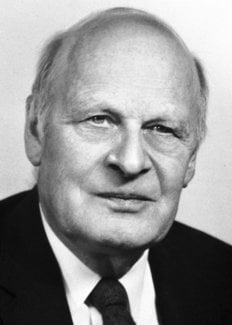
Lars Onsager was born in Oslo, Norway, November 27, 1903 to parents Erling Onsager, Barrister of the Supreme Court of Norway, and Ingrid, née Kirkeby. In 1933 he married Margarethe Arledter, daughter of a well-known pioneer in the art of paper making, in Cologne, Germany. They have sons Erling Frederick, Hans Tanberg, and Christian Carl, and a daughter Inger Marie, married to Kenneth Roy Oldham.
After three years with the experienced educators Inga and Anna Platou in Oslo, one year at a deteriorating private school in the country and a few months of his mother’s tutoring, he entered Frogner School as the family returned to Oslo. There he was soon invited to jump a grade, so that he was able to graduate in 1920.
Admitted to Norges tekniske høgskole in the fall of that year as a student of chemical engineering, he entered a stimulating environment; the department had attracted outstanding students over a period of years. Among the professors particularly O.E. Collenberg and J.P. Holtsmark encouraged his efforts in theory and helped him in the evaluation of background knowledge.
After graduation in 1925 he accompanied Holtsmark on a trip to Denmark and Germany, then proceeded to Zurich, where he remained for a couple of months with Debye and Hückel and returned the following spring, for a stay of nearly two years. There he organized his results in the theory of electrolytes for publication, broadened his knowledge of physics and became acquainted with a good many leading physicists.
In 1928 he went to Baltimore and served for the spring term as Associate in Chemistry at Johns Hopkins University. The appointment was not renewed; but C.A. Kraus at Brown University engaged him as an instructor, and he remained in that position for five years. During this time he gave lectures on statistical mechanics, published the reciprocal relations and made progress on a variety of problems. Some of the results were published at the time, one with the able assistance of R.M. Fuoss; others formed the basis for later publications. In 1933 he accepted a Sterling Fellowship at Yale University, where he remained to serve as Assistant Professor 1934-1940, Associate Professor 1940-1945 and JosiahWillard Gibbs Professor of Theoretical Chemistry 1945-1972. Incidentally, he obtained a Ph.D. degree in Chemistry from Yale in 1935; his dissertation consisted of the mathematical background for his interpretation of deviations from Ohm’s law in weak electrolytes.
Over the years, the subjects of his interest came to include colloids, dielectrics, order-disorder transitions, metals and superfluids, hydrodynamics and fractionation theory. In 1951-1952 he spent a year’s leave of absence as a Fulbright Scholar with David Schoenberg at the Mond Laboratory in Cambridge, England, a leading center for research in low temperature physics. In the Spring of 1961 he served as Visiting Professor of Physics at the University of California in San Diego. Of his sabbatical leave 1967-1968 he spent the first three months as Visiting Professor at Rockefeller University and the last three as Gauss Professor in Göttingen. In 1962, at the suggestion of Manfred Eigen, he joined Neuroscience Associates, a small interdisciplinary group organized by F.O. Schmitt in Cambridge, Massachusetts.
Lars Onsager holds honary degrees of Doctor of Science from Harvard University (1954), Rensselaer Polytechnic Institute (1962), Brown University (1962), Rheinisch-Westfahlische Technische Hochschule (1962), the University of Chicago (1968), Ohio State University (Cleveland, 1969), Cambridge University (1970) and Oxford University (1971), and Doctor technicae from Norges tekniske høgskole (1960).
In 1953 he received the Rumford Medal from the American Academy of Arts and Sciences, in 1958 The Lorentz Medal from The Royal Netherlands Academy of Sciences, in 1966 the Belfer Award in Science from Yeshiva University, in 1965 the Peter Debye Award in Physical Chemistry from the American Chemical Society, in 1962 the Lewis Medal from its California Section, the Kirkwood Medal from the New Haven Section and the Gibbs Medal from the Chicago Section, in 1964 the Richards Medal from the Northeastern Section.
In 1969 he received the National Science Medal, and he became an honorary member of The Bunsen Society for Physical Chemistry. During Spring 1970 he was Lorentz Professor in Leiden (The Netherlands).
Onsager is a Fellow of the American Physical Society and The New York Academy of Sciences, a member of The American Chemical Society, The Connecticut Academy of Arts and Sciences, The National Academy of Sciences, The American Academy of Arts and Sciences and The American Philosophical Society, a Foreign Member of the Norwegian Academy of Sciences, The Royal Norwegian Academy of Sciences, The Norwegian Academy of Technical Sciences, the Royal Swedish Academy of Sciences and The Royal Science Society in Uppsala, and an Honorary Member of The Norwegian Chemical Society.
This autobiography/biography was written at the time of the award and first published in the book series Les Prix Nobel. It was later edited and republished in Nobel Lectures. To cite this document, always state the source as shown above.
Lars Onsager died on October 5, 1976.