Luis Leloir – Nominations
Luis Leloir – Nobel Lecture
Nobel Lecture, December 11, 1970
Two Decades of Research on the Biosynthesis of Saccharides
Read the Nobel Lecture
Pdf 112 kB
Luis Leloir – Banquet speech
Luis Leloir’s speech at the Nobel Banquet in Stockholm, December 10, 1970
Your Majesty, Your Royal Highnesses, Your Excellencies, Ladies and Gentlemen,
The honour which I have received exceeds – by far – my most optimistic expectation.
The prestige of the Nobel Prize is such that one is suddenly promoted to a new status. In this new status I feel rather uneasy on considering that my name will join the list of the giants of chemistry such as van ‘t Hoff, Fischer, Arrhenius, Ramsay, von Baeyer – to name only a few. I also feel uneasy when I think of contemporary chemists that have done great contributions and also when I think on my collaborators who carried out a great part of the work.
In spite of this I am profoundly grateful for having received from Your Majesty this great honour and to the Nobel Committee for Chemistry of the Royal Academy of Sciences for having selected me.
Finally, I might paraphrase Churchill and say: never have I received so much for so little.
Luis Leloir – Other resources
Links to other sites
Autobiography (in Spanish) from Fundación Instituto Leloir
Luis Leloir – Facts
Award ceremony speech
Presentation Speech* by Professor Karl Myrbäck, member of the Nobel Committee for Chemistry of the Royal Swedish Academy of Sciences
Your Majesty, Your Royal Highnesses, Ladies and Gentlemen.
The 1970 Nobel Prize for chemistry has been awarded to Dr. Luis Leloir for work of fundamental importance for biochemistry. Dr. Leloir receives the prize for his discovery of the sugar nucleotides and their function in the biosynthesis of carbohydrates.
Carbohydrates, as everybody knows, form a comprehensive group of naturally occurring substances, which include innumerable sugars and sugar derivatives, as well as high-molecular carbohydrates (polysaccharides) like starch and cellulose in plants and glycogen in animals. A polysaccharide molecule is composed of a large number of sugar or sugar-like units.
Carbohydrates are of great importance in biology. The unique reaction, which makes life possible on Earth, namely the assimilation of the green plants, produces sugar, from which originate, not only all carbohydrates but, indirectly, also all other components of living organisms.
The important role of carbohydrates, especially sugars and starch, in human food and, generally, in the metabolism of living organisms, is well known. The biological break-down of carbohydrates (often spoken of as “combustion”) supplies the principal part of the energy that every organism needs for various vital processes. It is not surprising, therefore, that the carbohydrates and their metabolism have been the subject of comprehensive and in many respects successful biochemical and medical research for a long time. While working on these problems, Leloir made the discoveries for which he has now been awarded the Nobel Prize.
Before these discoveries were made, our knowledge of carbohydrate biochemistry was rather one-sided. The biological processes which break down carbohydrates, including the so-called combustion, have been well known for several decades. Over the years many Nobel Prizes have been awarded for chemistry and still more for physiology or medicine for discoveries about the reactions and catalysts involved. However, our knowledge about the innumerable corresponding synthetic reactions which occur in all organisms, was fragmentary. We had to resort to doubtful hypotheses; it was usually assumed that the syntheses were a direct reversal of the well-known breakdown reactions. The work of Leloir has indeed revolutionized our thinking about these problems.
In 1949 Leloir published the discovery which became the foundation for a remarkable development. He found that in a certain reaction, which results in the transformation of one sugar to another sugar, the participation of a so far unidentified substance was essential. He isolated the substance and determined its chemical nature. It turned out to be a compound of an unknown type, containing a sugar moiety bound to a nucleotide. Compounds of this type are now called sugar nucleotides. Leloir established that the transformation reaction does not occur in the sugars as such, but in the corresponding sugar nucleotides. To put it simply, one may say, that the linking with the nucleotide occasions an activation of the sugar moiety which makes the reaction possible.
The remarkable aspect of the discovery was not the explanation of a single reaction, but Leloir’s quick comprehension that he had found the key which would enable us to unravel an immense number of metabolic reactions. He ingeniously realized that a path had been opened to a field of research containing an accumulation of unsolved problems. In the twenty years that have elapsed since his initial discovery he has carried on his research in this field in an admirable manner.
Other scientists were quick to grasp the fundamental importance of Leloir’s discovery; they realized that a vast field was now accessible to worth-while scientific investigation and started research along the path which he had opened. There can be no doubt that few discoveries have made such an impact on biochemical research as those of Leloir. All over the world, his discoveries initiated research work, the volume of which has grown over since. Leloir has been the forerunner and guide throughout; he made all the primary discoveries which determined the path and the objectives of the ensueing research work.
Leloir soon found that besides the sugar nucleotide first isolated, several others of the same type occur in Nature, and many have also been found by other research workers. Today more than one hundred sugar nucleotides which are essential participants in various reactions are known and well characterized. Some of them have an action similar to that of the first isolated, namely in the transformations of simple sugars to other simple sugars or sugar derivatives.
Still more important was Leloir’s discovery that other sugar nucleotides have another action which occurs in the biological synthesis of compounds which are composed of or contain simple sugars or sugar derivatives. Leloir showed that all these syntheses are essentially transfer reactions. Sugar moieties from sugar nucleotides are transferred to accepting molecules which thereby increase in size. Probably the most sensational discovery made by Leloir was that the synthesis of the high-molecular polysaccharides also functions in this manner. The first example of the fundamental role of the sugar nucleotides in polysaccharide biosynthesis was found by Leloir in 1959 in the case of glycogen. It became clear that the polysaccharide biosynthesis is not a reversal of the biological breakdown, as had doubtfully been assumed earlier. On the contrary, Nature uses different and quite independent processes for synthesis and breakdown. Later on the same extremely important principle was also shown to be valid with other groups of substances, for instance with proteins and nucleic acids.
Through Leloir’s work and the work of others, who were inspired by his discoveries, knowledge of great significance has been gained in wide and important sections of biochemistry, which were previously obscure. It can be readily appreciated that Leloir’s work has also had far-reaching consequences in physiology and medicine.
* The manuscript was read by Professor Arne Tiselius.
The Nobel Prize in Chemistry 1970
Luis Leloir – Biographical
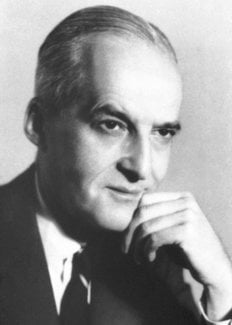
Luis F. Leloir was born in Paris of Argentine parents on September 6, 1906 and has lived in Buenos Aires since he was two years old. He graduated as a Medical Doctor in the University of Buenos Aires in 1932 and started his scientific career at the Institute of Physiology working with Professor Bernardo A. Houssay on the role of the adrenalin carbohydrate metabolism. In 1936 he worked at the Biochemical Laboratory of Cambridge, England, which was directed by Sir Frederick Gowland Hopkins. There he collaborated with Malcom Dixon, N.L. Edson and D.E. Green. On returning to Buenos Aires he worked with J.M. Muñoz on the oxidation of fatty acids in liver, and also together with E. Braun Menéndez, J.C. Fasciolo and A.C. Taquini on the formation of angiotensin. In 1944 he was Research Assistant in Dr. Carl F. Cori’s laboratory in St. Louis, United States and thereafter worked with D.E. Green in the College of Physicians and Surgeons, Columbia University, New York. Since then he has been Director of the Instituto de Investigaciones Bioquímicas, Fundación Campomar. With his early collaborators, Ranwel Caputto, Carlos E. Cardini, Raúl Trucco and Alejandro C. Paladini work was started on the metabolism of galactose which led to the isolation of glucose 1,6-diphosphate and uridine diphosphate glucose. The latter substance was then found to act as glucose donor in the synthesis of trehalose (with Enrico Cabib, 1953 ) and sucrose (with Carlos E. Cardini and J.Chiriboga, 1955). Other sugar nucleotides such as uridine diphosphate acetylglucosamine and guanosine diphosphate mannose were also isolated. Further work showed that uridine diphosphate glucose is involved in glycogen synthesis and adenosine diphosphate glucose in that of starch.
More recent investigations (with Nicolás Behrens) have dealt with the role of a polyprenol, dolichol, in glucose transfer in animal tissues.
Luis Leloir was married in 1943 to Amelia Zuberbuhler and has a daughter, Amelia. At present Leloir is Professor in the Faculty of Sciences, University of Buenos Aires. He is a member of the following academies; National Academy of Sciences, American Academy of Arts and Sciences, Academia Nacional de Medicina, American Philosophical Society, Pontificial Academy of Sciences, and Honorary Member of the Biochemical Society (England). He has received honorary degrees of the following universities: Granada (Spain), Paris (France), Tucuman (Argentina) and La Plata (Argentina). Prof. Leloir has received the following awards: Argentine Scientific Society, Helen Hay Whitney Foundation (United States), Severo Vaccaro Foundation (Argentina), Bunge and Born Foundation (Argentina), Gairdner Foundation (Canada), Louisa Gross Horowitz (United States), Benito Juarez (Mexico); and at present he is President of the Pan-American Association of Biochemical Societies.
This autobiography/biography was written at the time of the award and later published in the book series Les Prix Nobel/ Nobel Lectures/The Nobel Prizes. The information is sometimes updated with an addendum submitted by the Laureate.
Luis Leloir died on December 2, 1987.