Gerhard Herzberg – Nominations
Gerhard Herzberg – Nobel Lecture
Nobel Lecture, December 11, 1971
Spectroscopic Studies of Molecular Structure
Read the Nobel Lecture
Pdf 2.06 MB
Gerhard Herzberg – Banquet speech
Gerhard Herzberg’s speech at the Nobel Banquet in Stockholm, December 10, 1971
Your Royal Highnesses, Distinguished Guests, Ladies and Gentlemen,
It is very difficult to find appropriate words to say “thank you” for an honour like the Nobel Prize. It is the supreme honour that a scientist can receive. Some of the giants in physics and chemistry have received this prize. Rutherford, the founder of nuclear physics, received the prize in chemistry in 1908. A number of those who have taught me either directly or indirectly are on that list: James Franck, Max Born, Peter Debye, Harold Urey and many others. I should also like to pay tribute to two pioneers in molecular spectroscopy from Sweden, Heurlinger and Hulthén, who accomplished the first difficult analyses of molecular spectra in the 1920’s.
In receiving the award this year I think not only of these giants from whom I learned so much but also of my first teacher, Hans Rau, who guided my first steps in research, and to the many collaborators who helped me in my later work. Of them I should like to single out A. E. Douglas, whose quick and critical mind was always ready to help. I also think of my adopted country Canada, which gave a haven to me and my wife when we arrived as refugees. I think of the University of Saskatchewan which supported my work in its early stages and the National Research Council of Canada which provided an atmosphere so conducive to research.
Five years ago I received the great honour of an Honorary Degree from the University of Stockholm here in this building. It was at the same ceremony that His Majesty the King received an Honorary Degree from the Royal Caroline Medico-Chirurgical Institute. I felt doubly honoured that His Majesty was present throughout this ceremony. I could hardly have expected at that time that five years later I would stand here again in this building having received the great and supreme honour of the Nobel Prize from His Majesty’s hands. I shall be forever grateful. Tack så mycket.
Gerhard Herzberg – Other resources
Links to other sites
On Gerhard Hertzberg from Science.ca
About Gerhard Hertzberg from NSERC
On Gerhard Hertzberg from the Lindau Mediatheque
Award ceremony speech
Presentation Speech by Professor Stig Claesson of the the Royal Academy of Sciences
Translation from the Swedish text
Your Majesty, Your Royal Highnesses, Ladies and Gentlemen,
This year’s Nobel Prize winner in Chemistry, Dr. Gerhard Herzberg, is generally considered to be the world’s foremost molecular spectroscopist and his large institute in Ottawa is the indisputed center for such research. It is quite exceptional, in the field of science, that a single individual, however distinguished, in this way can be the leader of a whole area of research of general importance. A noted English chemist has also said that the only institutions that have previously played such a role were the Cavendish laboratory in Cambridge and Bohr’s institute in Copenhagen.
Herzberg began as a physicist and his first contributions to molecular spectroscopy were published at the end of the 1920’s. In such investigations one measures how molecules absorb light-energy – also outside the visible region – i.e. in the ultraviolet and infrared. Since light-energy is packaged as quanta, these measurements can provide accurate information about energy contents in molecules. From this information their size, shape and other properties can be derived. Such calculations must be based on the description of matter given by quantum mechanics. The development of this subject during the 1920’s and 30’s is regarded as one of the most exciting periods in the history of physical science. Herzberg’s elegant experimental investigations combined with his theoretical insight into their interpretation contributed to the progress of quantum mechanics while being decisive for the rapid development of molecular spectroscopy.
One may now ask why Herzberg – originally a physicist and even famous as an astrophysicist – finally was awarded the Nobel Prize in chemistry.
The explanation is that around 1950 molecular spectroscopy had progressed so far that one could begin to study even complicated systems of great chemical interest. This is brilliantly demonstrated by Herzberg’s pioneering investigations of free radicals. Knowledge of their properties is of fundamental importance to our understanding of how chemical reactions proceed.
For a chemical reaction to occur the original molecules must in some way break up into fragments which rearrange to form the new molecules. These fragments, or intermediates, are called free radicals.
Free radicals are very difficult to study due to their short life-times – measured in millionth’s of a second. Herzberg therefore had ample opportunity to repeatedly demonstrate his exceptional experimental skill when the necessary spectroscopic technique was worked out.
Herzberg has so far performed extensive precision determinations of the properties of over thirty free radicals among which are to be found the radicals methyl and methylene – well known from organic chemistry. Among his exciting discoveries may be mentioned that radicals drastically change their shape with increasing energy. For example, methylene is linear in its ground state but bent in states of higher energy. Many of the most important results were only achieved after several years’ work and some of the most exciting as late as at the end of the 1960’s. One can therefore note that this year’s prize is truly an award for contributions of great current interest.
Dr. Herzberg,
I have tried to explain your great contributions to molecular spectroscopy and particularly your pioneering work on free radicals. The ideas and results presented by you – not least regarding the quantum mechanical aspects of the interpretation of molecular properties – have influenced scientific progress in almost all branches of chemistry.
On behalf of the Royal Academy of Sciences I beg you to accept our congratulations and ask you to receive your Nobel Prize from the hands of His Majesty the King.
The Nobel Prize in Chemistry 1971
Gerhard Herzberg – Biographical
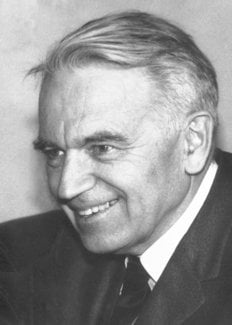
Gerhard Herzberg was born in Hamburg, Germany, on 25 December, 1904. He was married in 1929 to Luise Herzberg neé Oettinger and has two children. He was widowed in 1971.
Herzberg received his early training in Hamburg and subsequently studied physics at the Darmstadt Institute of Technology where in 1928 he obtained his Dr.Ing. degree under H. Rau (a pupil of W. Wien). From 1928 to 1930 he carried out post-doctorate work at the University of Göttingen under James Franck and Max Born and the University of Bristol. In 1930 he was appointed Privatdozent (lecturer) and senior assistant in the Physics Department of the Darmstadt Institute of Technology.
In August 1935 Herzberg was forced to leave Germany as a refugee and took up a guest professorship at the University of Saskatchewan (Saskatoon, Canada), for which funds had been made available by the Carnegie Foundation. A few months later he was appointed research professor of physics, a position he held until 1945. From 1945 to 1948 Herzberg was professor of spectroscopy at the Yerkes Observatory of the University of Chicago. He returned to Canada in 1948 and was made Principal Research Officer and shortly afterwards Director of the Division of Physics at the National Research Council. In 1955, after the Division had been divided into one in pure and one in applied physics, Herzberg remained Director of the Division of Pure Physics, a position which he held until 1969 when he was appointed Distinguished Research Scientist in the recombined Division of Physics.
Herzberg’s main contributions are to the field of atomic and molecular spectroscopy. He and his associates have determined the structures of a large number of diatomic and polyatomic molecules, including the structures of many free radicals difficult to determine in any other way (among others, those of free methyl and methylene). Herzberg has also applied these spectroscopic studies to the identification of certain molecules in planetary atmospheres, in comets, and in interstellar space.
Herzberg has been active as President or Vice President of several international commissions dealing with spectroscopy. He was also Vice President of the International Union of Pure and Applied Physics from 1957 to 1963. He held the offices of President of the Canadian Association of Physicists for the year 1956-57 and President of the Royal Society of Canada for the year 1966-67.
Herzberg was elected a Fellow of the Royal Society of Canada in 1939 and of the Royal Society of London in 1951. He was Bakerian Lecturer of the Royal Society of London in 1960 and received a Royal Medal from the Society in 1971. He was George Fischer Baker Non-Resident Lecturer in Chemistry at Cornell University in 1968, and Faraday Medallist and Lecturer of the Chemical Society of London in 1970. He is Honorary Member or Fellow of a number of scientific societies, including the American Academy of Arts and Sciences, the Optical Society of America and the Chemical Society. He is also a Foreign Associate of the National Academy of Sciences in Washington and a member of the Pontifical Academy of Sciences. He is a Companion of the Order of Canada. He has received many other medals and awards and holds Honorary Degrees from a number of universities in Canada and abroad, including one from the University of Stockholm.
This autobiography/biography was written at the time of the award and later published in the book series Les Prix Nobel/ Nobel Lectures/The Nobel Prizes. The information is sometimes updated with an addendum submitted by the Laureate.
Gerhard Herzberg died on March 3, 1999.