Paul J. Flory – Nominations
Paul J. Flory – Nobel Lecture
Nobel Lecture, December 11, 1974
Spatial Configuration of Macromolecular Chains
Read the Nobel Lecture
Pdf 247 kB
Paul J. Flory – Banquet speech
Paul J. Flory’s speech at the Nobel Banquet, December 10, 1974
Your Majesty, Your Royal Highnesses, Ladies and Gentlemen,
Acknowledgment of the privilege of receiving the Nobel Prize in words commensurate with the distinction it conveys overtaxes the resources of language. It must suffice to say that I am profoundly grateful to the Royal Swedish Academy of Sciences for their gracious decision in my favor. I take genuine pleasure in being afforded the opportunity to express my highest thanks to them and to the Nobel Foundation for this, the ultimate prize in science.
Perhaps I may be permitted to reflect briefly on Alfred Nobel the man vis-à-vis the prizes that bear his name. Lest it seems presumptuous of me to comment on that great but little appreciated man, may I remind you that I too am a chemist. In fact, my researches have touched upon one of the principal ingredients of his epochal discoveries and inventions. I refer to nitrocellulose. To be sure, our interests in this substance differed: his of a scope leading to developments warranting world-wide fame, mine obscure by comparison. Be this as it may, nitrocellulose is a duly respected member of the family of macromolecules, and I take pride in laying claim to scientific kinship to Alfred Nobel through an interest in this substance, however tenuous the connection may be.
The Nobel Prizes have gained universal recognition as pre-eminent symbols of the importance and significance of intellectual achievement. They are much better known than the man who founded them. Yet, that wise but modest man, whose extraordinary vision and perception were obscured by a self-effacing manner, would not be offended, I believe, by the contrast between his own fame in the world of 1974 and that of his prizes. He founded them from the purest of motives, not as a means of memorializing himself. His will does not suggest, much less require, that the prizes bear his name; this was a decision of his executors, a well reasoned one to be sure. Alfred Nobel appears to have been motivated by the conviction that science and learning should be encouraged and more widely appreciated.
And so, on this splendid occasion, I am persuaded to pay tribute to Alfred Nobel, inventive genius, humanitarian and scholar, who had both the foresight and the magnanimity to commit his fortune for the encouragement of future generations to devote themselves to the cause of Peace, to the cultivation of science and to the enrichment of literature, endeavors which the burdens of his other responsibilities allowed him far too little time to pursue and enjoy. To this I should like to add a word in tribute to the executors of his estate and to the Nobel Foundation for implementing Alfred Nobel’s intentions and desires with such remarkable success.
Again, my best thanks!
Paul J. Flory – Other resources
Links to other sites
On Paul J. Flory from Stanford University
On Paul J. Flory from National Academy of Sciences
Paul J. Flory – Biographical
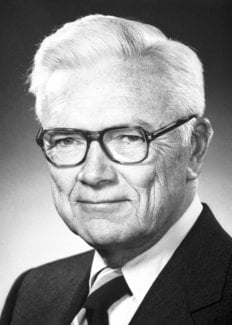
I was born on 19 June, 1910, in Sterling, Illinois, of Huguenot-German parentage, mine being the sixth generation native to America. My father was Ezra Flory, a clergyman-educator; my mother, nee Martha Brumbaugh, had been a schoolteacher. Both were descended from generations of farmers in the New World. They were the first of their families of record to have attended college.
My interest in science, and in chemistry in particular, was kindled by a remarkable teacher, Carl W. Holl, Professor of Chemistry at Manchester College, a liberal arts college in Indiana, where I graduated in 1931. With his encouragement, I entered the Graduate School of The Ohio State University where my interests turned to physical chemistry. Research for my dissertation was in the field of photochemistry and spectroscopy. It was carried out under the guidance of the late Professor Herrick L. Johnston whose boundless zeal for scientific research made a lasting impression on his students.
Upon completion of my Ph.D. in 1934, I joined the Central Research Department of the DuPont Company. There it was my good fortune to be assigned to the small group headed by Dr. Wallace H. Carothers, inventor of nylon and neoprene, and a scientist of extraordinary breadth and originality. It was through the association with him that I first became interested in exploration of the fundamentals of polymerization and polymeric substances. His conviction that polymers are valid objects of scientific inquiry proved contagious. The time was propitious, for the hypothesis that polymers are in fact covalently linked macromolecules had been established by the works of Staudinger and of Carothers only a few years earlier.
A year after the untimely death of Carothers, in 1937, I joined the Basic Science Research Laboratory of the University of Cincinnati for a period of two years. With the outbreak of World War II and the urgency of research and development on synthetic rubber, supply of which was imperiled, I returned to industry, first at the Esso (now Exxon) Laboratories of the Standard Oil Development Company (1940-43) and later at the Research Laboratory of the Goodyear Tire and Rubber Company (1943-48). Provision of opportunities for continuation of basic research by these two industrial laboratories to the limit that the severe pressures of the times would allow, and their liberal policies on publication, permitted continuation of the beginnings of a scientific career which might otherwise have been stifled by the exigencies of those difficult years.
In the Spring of 1948 it was my privilege to hold the George Fisher Baker Non-Resident Lectureship in Chemistry at Cornell University. The invitation on behalf of the Department of Chemistry had been tendered by the late Professor Peter J.W. Debye, then Chairman of that Department. The experience of this lectureship and the stimulating associations with the Cornell faculty led me to accept, without hesitation, their offer of a professorship commencing in the Autumn of 1948. There followed a most productive and satisfying period of research and teaching “Principles of Polymer Chemistry,” published by the Cornell University Press in 1953, was an outgrowth of the Baker Lectures.
It was during the Baker Lectureship that I perceived a way to treat the effect of excluded volume on the configuration of polymer chains. I had long suspected that the effect would be non-asymptotic with the length of the chain; that is, that the perturbation of the configuration by the exclusion of one segment of the chain from the space occupied by another would increase without limit as the chain is lengthened. The treatment of the effect by resort to a relatively simple “smoothed density” model confirmed this expectation and provided an expression relating the perturbation of the configuration to the chain length and the effective volume of a chain segment. It became apparent that the physical properties of dilute solutions of macromolecules could not be properly treated and comprehended without taking account of the perturbation of the macromolecule by these intramolecular interactions. The hydrodynamic theories of dilute polymer solutions developed a year or two earlier by Kirkwood and by Debye were therefore reinterpreted in light of the excluded volume effect. Agreement with a broad range of experimental information on viscosities, diffusion coefficients and sedimentation velocities was demonstrated soon thereafter.
Out of these developments came the formulation of the hydrodynamic constant called theta, and the recognition of the Theta point at which excluded volume interactions are neutralized. Criteria for experimental identification of the Theta point are easily applied. Ideal behavior of polymers, natural and synthetic, under Theta conditions has subsequently received abundant confirmation in many laboratories. These findings are most gratifying. More importantly, they provide the essential basis for rational interpretation of physical measurements on dilute polymer solutions, and hence for the quantitative characterization of macromolecules.
In 1957 my family and I moved to Pittsburgh where I undertook to establish a broad program of basic research at the Mellon Institute. The opportunity to achieve this objective having been subsequently withdrawn, I accepted a professorship in the Department of Chemistry at Stanford University in 1961. In 1966, I was appointed to the J.G. Jackson – C.J. Wood Professorship in Chemistry at Stanford.
The change in situation upon moving to Stanford afforded the opportunity to recast my research efforts in new directions. Two areas have dominated the interests of my co-workers and myself since 1961. The one concerns the spatial configuration of chain molecules and the treatment of their configuration-dependent properties by rigorous mathematical methods; the other constitutes a new approach to an old subject, namely, the thermodynamics of solutions.
Our investigations in the former area have proceeded from foundations laid by Professor M.V. Volkenstein and his collaborators in the Soviet Union, and were supplemented by major contributions of the late Professor Kazuo Nagai in Japan. Theory and methods in their present state of development permit realistic, quantitative correlations of the properties of chain molecules with their chemical constitution and structure. They have been applied to a wide variety of macromolecules, both natural and synthetic, including polypeptides and polynucleotides in the former category. The success of these efforts has been due in no small measure to the outstanding students and research fellows who have collaborated with me at Stanford during the past thirteen years. A book entitled “Statistical Mechanics of Chain Molecules”, published in 1969, summarizes the development of the theory and its applications up to that date.
Mrs. Flory, the former Emily Catherine Tabor, and I were married in 1936. We have three children: Susan, wife of Professor George S. Springer of the Department of Mechanical Engineering at the University of Michigan; Melinda, wife of Professor Donald E. Groom of the Department of Physics at the University of Utah; and Dr. Paul John Flory, Jr., currently a post-doctoral Research Associate at the Medical Nobel Institute in Stockholm. We have four grandchildren: Elizabeth Springer, Mary Springer, Susanna Groom and Jeremy Groom.
This autobiography/biography was written at the time of the award and later published in the book series Les Prix Nobel/ Nobel Lectures/The Nobel Prizes. The information is sometimes updated with an addendum submitted by the Laureate.
Paul J. Flory died on September 8, 1985.
Press release

15 October 1974
The Royal Swedish Academy of Sciences has decided to award the 1974 Nobel Prize in Chemistry to
Professor Paul J. Flory, Stanford University, Stanford, CA, USA
for his fundamental achievements, both theoretical and experimental, in the physical chemistry of macromolecules
THE CHEMISTRY OF PLASTICS
This year’s Nobel Laureate in Chemistry, Paul J. Flory, has done epoch making research in the field of the physical chemistry of macromolecules. Among the substance which are made up of macromolecules we find our most common plastics – polymers – but also a great number of very important biological compounds, e.g. proteins, nucleic acids, cellulose and rubber. Flory’s early research concerned polymers of the nylon type, polystyrene. Their molecules are built up of long chains of atoms and can be compared to strings of beads where the atoms are represented by the beads. These strings can be very long and contain thousands of atoms – beads – in the chain. These chains are also very flexible and can assume the most varying shapes. Stretched molecules – chains – are found in fibres such as nylon. In solid plastics the molecules are rolled into balls. In solvents the molecules assume more or less ballshaped structures.
It was very difficult to find a satisfactory theory of how these molecules behaved. On the one hand, the statistical treatment of the shape of chains is very complicated and, on the other hand, it is difficult theoretically to define quantities so that the properties of polymer chains can be compared with different chemical properties.
The Flory temperature
Flory has solved both these problems. He has introduced a new concept, theta temperature and theta point properties. A simplified description is as follows: If a polymer molecule is dissolved in a good solvent agent then the chain is somewhat stretched out as the attraction forces between the chain and the solvent molecules are stronger than those between the different links in the chain. If the temperature is lowered, the solvent agent deteriorates and the attractive forces between the molecules of the solvent agent and the chain become weaker whereas the attraction forces between the links of the chain strengthen. Consequently, the molecules of the chain draw closer together and it decreases in size. It becomes increasingly compact and finally becomes insoluble. There must then exist a certain intermediate temperature – theta temperature – where both these different attraction forces balance each other. At this temperature, now called the Flory temperature, the polymer molecule assumes a kind of ideal state. The Flory temperature varies for different types of polymers and for different solvent agents, but by using their respective Flory temperatures it is possible to make useful comparisons.
Flory has also succeeded in working out quantitative terms describing the extension of polymer chains when the temperature is raised above the Flory temperature. He has demonstrated that the chain in solid polymers has the same extension as it has in polymers in solution at the Flory temperature. This has been of vital importance for the development of polymer chemistry.
Universal constant
Flory has also demonstrated how quantities used in the theory can be determined experimentally by measurements of viscosity, light dispersion, ultra centrifugation and diffusion. By skilful analysis Flory has shown that it is possible to find a universal constant which quantitatively summarizes all the properties of polymer solutions. This constant is now known as Flory’s Universal Constant. It can be said to be analogous to the universal gas constant.
Flory has done pioneer research in elucidating the formation of polymer molecules. This takes place by the addition or condensation of small molecules which then link up into long chains. Flory was the first scientist to demonstrate the theoretical connection between the lengths of formed chain molecules and reaction conditions. He also discovered a very important, entirely new type of reaction, the so-called chain transmission. A growing chain can transmit its growing power to another molecule and itself stop growing.
Has remained in the lead
In recent years Flory has increasingly turned his attention to polymers of biological origin, both in solutions and in gells. He has carried out important studies – both experimental and theoretical – in this field.
During the nearly 40 years Flory has been active as a research scientist the chemistry of macromolecules has developed from what was, theoretically speaking, a primitive discipline, to the highly advanced science of today. This progress has been made thanks to the great achievements of various groups of research scientists at universities and research laboratories. All this time, Flory has remained the leading researcher in this field and this demonstrates his exceptional standing as a scientist. This is largely due to his ability to find essentially simple solutions to fundamental problems. At the same time he has an outstanding ability to extract the necessary experimental findings from well-planned, but often simple experiments, which he carries out with a comparatively small research team.
Award ceremony speech
Presentation Speech by Professor Stig Claesson of the Royal Academy of Sciences
Translation from the Swedish text
Your Majesty, Your Royal Highnesses, Ladies and Gentlemen,
This year’s Nobel prize in chemistry has been awarded to Professor Paul Flory for his fundamental contributions to the physical chemistry of macromolecules.
Macromolecules include biologically important materials such as cellulose, albumins and nucleic acids, and all of our plastics and synthetic fibers.
Macromolecules are often referred to as chain molecules and can be compared to a pearl necklace. They consist of long chains of atoms which, when magnified one hundred million times, appear as a pearl necklace. The pearls represent the atoms in the chain. One should realize that this chain is much longer than the necklaces being worn here this evening. To obtain a representative model of a macromolecule all of the necklaces here in this hall should be connected together in a single long chain.
One can readily appreciate that the development of a theory for these molecules presented considerable difficulties. The forms of the chain itself, whether extended or coiled, represents a property difficult to rationalize.
A statistical description is of necessity required, and Professor Flory has made major contributions to the development of such a theory. The problem is more difficult, however. How can one compare different molecules in different solvents?
When chain molecules are dissolved in different solvents they become coiled to different degrees, depending on the interaction between repulsive and attractive forces in the solution. In a good solvent the chain molecules are extended. In a poor solvent, in contrast, the chain molecules assume a highly coiled form.
Professor Flory showed that if one takes a solution of extended chain molecules in a good solvent, and slowly cools the solution, then the molecules become progressively more coiled until they are no longer soluble.
Thus, there must be an intermediate temperature where the attractive and repulsive forces are balanced. At this temperature the molecules assume a kind of standard condition that can be used, generally, to characterize their properties.
This temperature Professor Flory named the theta temperature. A corresponding temperature exists for real gases at which they follow the ideal gas law. This temperature is called the Boyle temperature after Robert Boyle who discovered the gas laws. By analogy, the theta temperature for macromolecules is often referred to as the Flory temperature.
Professor Flory showed also that it was possible to define a constant for chain molecules, now called Flory’s universal constant, which can be compared in significance to the gas constant.
When one, in retrospect, reads about an important scientific discovery, one often feels that the work was remarkably simple. This actually indicates, however, that it was brilliant insight in a new and until then unexplored research area. This is highly characteristic of Professor Flory’s scientific discoveries, not only those concerned with the Flory temperature and Flory’s universal constant but also many of his other important research studies. Further examples are found in his investigation of the relationship between the reaction mechanism and the length of the chains formed when chain molecules are prepared synthetically, as well as his important contribution to the theory of crystallization and rubber elasticity. These achievements have been of major importance for technological developments in the plastics industry.
In recent years Professor Flory has investigated, both theoretically and experimentally, the relation between rotational characteristics of the chain links and the form of the chain molecules. This is of fundamental significance for the understanding of both biological macromolecules and synthetic chain molecules.
During the time Professor Flory has been active as a scientist, macromolecular chemistry has been transformed from primitive semi-empirical observations into a highly developed science. This evolution has come about through major contributions by research groups from both universities and many of the world’s largest industrial laboratories. Professor Flory has remained a leading researcher in the area during this entire period, giving further evidence of his unique position as a scientist.
Professor Flory,
I have tried to describe briefly the fundamental importance of your many contributions to macromolecular chemistry and in particular those concepts introduced by you and now referred to as the Flory-temperature and the Flory universal constant.
On behalf of the Royal Academy of Sciences I wish to convey to you our warmest congratulations and I now ask you to receive your prize from the hands of His Majesty the King.