Peter Mitchell – Nobel Lecture
Nobel Lecture, December 8, 1978
David Keilin’s Respiratory Chain Concept and Its Chemiosmotic Consequences
Read the Nobel Lecture
Pdf 1.21 MB
Peter Mitchell – Banquet speech
Peter Mitchell’s speech at the Nobel Banquet, December 10, 1978
Your Majesties, Your Royal Highnesses, Ladies and Gentlemen,
Emile Zola described a work of art as a corner of nature seen through a temperament. The philosopher Karl Popper, the economist F. A. Hayek, and the art historian K. H. Gombrich have shown that the creative process in science and art consists of two main activities: an imaginative jumping forward to a new abstraction or simplified representation, followed by a critical looking back to see how nature appears in the light of the new vision. The imaginative leap forward is a hazardous, unreasonable activity. Reason can be used only when looking critically back. Moreover, in the experimental sciences, the scientific fraternity must test a new theory to destruction, if possible. Meanwhile, the originator of a theory may have a very lonely time, especially if his colleagues find his views of nature unfamiliar, and difficult to appreciate.
The final outcome cannot be known, either to the originator of a new theory, or to his colleagues and critics, who are bent on falsifying it. Thus, the scientific innovator may feel all the more lonely and uncertain.
On the other hand, faced with a new theory, the members of the scientific establishment are often more vulnerable than the lonely innovator. For, if the innovator should happen to be right, the ensuing upheaval of the established order may be very painful and uncongenial to those who have long committed themselves to develop and serve it. Such, I believe, has been the case in the field of knowledge with which my work has been involved.
Naturally, I have been deeply moved, and not a little astonished, by the accidents of fortune that have brought me to this point; and I have counted myself lucky that I have been greatly encouraged by the love and example of the late David Keilin, and that my research associate, Dr. Moyle, has skilfully helped to mitigate my intellectual loneliness at the most difficult times. Now, I am indeed a witness of the benevolent spirit of Alfred Nobel.
Last, but not least, I would like to pay a most heartfelt tribute to my helpers and colleagues generally, and especially to those who were formerly my strongest critics, without whose altruistic and generous impulses, I feel sure that I would not be at this banquet today.
The Nobel Prize in Chemistry 1978
Peter Mitchell – Biographical
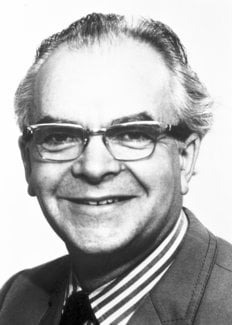
Peter Mitchell was born in Mitcham, in the County of Surrey, England, on September 29, 1920. His parents, Christopher Gibbs Mitchell and Kate Beatrice Dorothy (née) Taplin, were very different from each other temperamentally. His mother was a shy and gentle person of very independent thought and action, with strong artistic perceptiveness. Being a rationalist and an atheist, she taught him that he must accept responsibility for his own destiny, and especially for his failings in life. That early influence may well have led him to adopt the religious atheistic personal philosophy to which he has adhered since the age of about fifteen. His father was a much more conventional person than his mother, and was awarded the O.B.E. for his success as a Civil Servant.
Peter Mitchell was educated at Queens College, Taunton, and at Jesus college, Cambridge. At Queens he benefited particularly from the influence of the Headmaster, C.L. Wiseman, who was an excellent mathematics teacher and an accomplished amateur musician. The result of the scholarship examination that he took to enter Jesus College Cambridge was so dismally bad that he was only admitted to the University at all on the strength of a personal letter written by C.L. Wiseman. He entered Jesus College just after the commencement of war with Germany in 1939. In Part I of the Natural Sciences Tripos he studied physics, chemistry, physiology, mathematics and biochemistry, and obtained a Class III result. In part II, he studied biochemistry, and obtained a II-I result for his Honours Degree.
He accepted a research post in the Department of Biochemistry, Cambridge, in 1942 at the invitation of J.F. Danielli. He was very fortunate to be Danielli’s only Ph.D. student at that time, and greatly enjoyed and benefited from Danielli’s friendly and unauthoritarian style of research supervision. Danielli introduced him to David Keilin, whom he came to love and respect more than any other scientist of his acquaintance.
He received the degree of Ph.D. in early 1951 for work on the mode of action of penicillin, and held the post of Demonstrator at the Department of Biochemistry, Cambridge, from 1950 to 1955. In 1955 he was invited by Professor Michael Swann to set up and direct a biochemical research unit, called the Chemical Biology Unit, in the Department of Zoology, Edinburgh University, where he was appointed to a Senior Lectureship in 1961, to a Readership in 1962, and where he remained until acute gastric ulcers led to his resignation after a period of leave in 1963.
From 1963 to 1965, he withdrew completely from scientific research, and acted as architect and master of works, directly supervising the restoration of an attractive Regency-fronted Mansion, known as Glynn House, in the beautiful wooded Glynn Valley, near Bodmin, Cornwall – adapting and furnishing a major part of it for use as a research labotatory. In this, he was lucky to receive the enthusiastic support of his former research colleague Jennifer Moyle. He and Jennifer Moyle founded a charitable company, known as Glynn Research Ltd., to promote fundamental biological research and finance the work of the Glynn Research Laboratories at Glynn House. The original endowment of about £250,000 was donated about equally by Peter Mitchell and his elder brother Christopher John Mitchell.
In 1965, Peter Mitchell and Jennifer Moyle, with the practical help of one technician, Roy Mitchell (unrelated to Peter Mitchell), and with the administrative help of their company secretary, embarked on the programme of research on chemiosmotic reactions and reaction systems for which the Glynn Research Institute has become known. Since its inception, the Glynn Research Institute has not had sufficient financial resources to employ more than three research workers, including the Research Director, on its permanent staff. He has continued to act as Director of Research at the Glynn Research Institute up to the present time. An acute lack of funds has recently led to the possibility that the Glynn Research Institute may have to close.
Beside his interest in communication between molecules, Peter Mitchell has become more and more interested in the problems of communication between individual people in civilised societies, especially in the context of the spread of violence in the increasingly collectivist societies in most parts of the world. His own experience of small and large organisations in the scientific world has led him to regard the small organisations as being, not only more alive and congenial, but also more effective, for many (although perhaps not all) purposes. He would therefore like to have the opportunity to become more deeply involved in studies of the ways in which sympathetic communication and cooperative activity between free and potentially independent people may be improved. One of his specific interests in this field of knowledge is the use of money as an instrument of personal responsibility and of choice in free societies, and the flagrant abuse and basically dishonest manipulation of the system of monetary units of value practised by the governments of most nations.
| Awards and affiliations |
| CIBA Medal and Prize, British Biochemical Society, 1973 |
| Member, European Molecular Biology Organisation, 1973 |
| Fellowship of the Royal Society, 1974 |
| Warren Triennial Prize, jointly with Efraim Racker, U.S.A., 1974 |
| Louis and Bert Freedman Foundation Award, New York Academy of Sciences, 1974 |
| Honorary Member, American Society of Biological Chemists, 1975 |
| Foreign Honorary Member, American Academy of Arts and Sciences, 1975 |
| Wilhelm Feldberg (Anglo/German) Foundation Prize, 1976 |
| Dr. rerum naturalium honoris cause of the Technische Universität, Berlin, 1976 |
| Lewis S. Rosenstiel Award, U.S.A., 1977 |
| Foreign Associate, National Academy of Sciences, U.S.A., 1977 |
| Honorary Degree of Doctor of Science, Exeter University, U.K., 1977 |
| Sir Hans Krebs Lecture and Medal of the Federation of European Biochemical Societies, 1978 |
| Honorary Degree of Doctor of Science, University of Chicago, 1978 |
This autobiography/biography was written at the time of the award and later published in the book series Les Prix Nobel/ Nobel Lectures/The Nobel Prizes. The information is sometimes updated with an addendum submitted by the Laureate.
Peter Mitchell died on April 10, 1992.
Peter Mitchell – Facts
Press release

17 October 1978
The Royal Swedish Academy of Sciences has decided to award the 1978 Nobel Prize in Chemistry to
Dr Peter Mitchell, Glynn Research Laboratories, Bodmin, Cornwall, UK,
for his contribution to the understanding of biological energy transfer through the formulation of the chemiosmotic theory.
NOBEL PRIZE IN CHEMISTRY FOR BIOLOGICAL ENERGY TRANSFER
Mitchell’s research has been carried out within an area of biochemistry often referred to in recent years as ‘bioenergetics’, which is the study of those chemical processes responsible for the energy supply of living cells. Life processes, as all events that involve work, require energy, and it is quite natural that such activities as muscle contraction, nerve conduction, active transport, growth, reproduction, as well as the synthesis of all the substances that are necessary for carrying out and regulating these activities, could not take place without an adequate supply of energy.
It is now well established that the cell is the smallest biological entity capable of handling energy. Common to all living cells is the ability, by means of suitable enzymes, to derive energy from their environment, to convert it into a biologically useful form, and to utilize it for driving various energy requiring processes. Cells of green plants as well as certain bacteria and algae can capture energy by means of chlorophyll directly from sunlight – the ultimate source of energy for all life on Earth – and utilize it, through photosynthesis, to convert carbon dioxide and water into organic compounds. Other cells, including those of all animals and many bacteria, are entirely dependent for their existence on organic compounds which they take up as nutrients from their environment. Through a process called cell respiration, these compounds are oxidized by atmospheric oxygen to carbon dioxide and water.
During both photosynthesis and respiration, energy is conserved in a compound called adenosine triphosphate, abbreviated as ATP. When ATP is split into adenosine diphosphate (ADP) and inorganic phosphate (Pi), a relatively large amount of energy is liberated, which can be utilized, in the presence of specific enzymes, to drive various energy-requiring processes. Thus, ATP may be regarded as the universal ‘energy currency’ of living cells. The processes by which ATP is formed from ADP and Pi during photosynthesis and respiration are usually called ‘photophosphorylation’ and ‘oxidative phosphorylation’, respectively. The two processes have several features in common, both in their enzyme composition – both involve an interaction between oxidizing (electron-transferring) and phosphorylating enzymes – and in their association with cellular membranes. In higher cells, photophosphorylation and oxidative phosphorylation occur in specific membrane-enclosed organelles, chloroplasts and mitochondria, respectively; in bacteria, both these processes are associated with the cell membrane.
The above concepts had been broadly outlined by about the beginning of the 1960s, but the exact mechanisms by which electron transfer is coupled to ATP synthesis in oxidative phosphorylation and in photophosphorylation remained unknown. Many hypotheses were formulated, especially with regard to the mechanism of oxidative phosphorylation; most of these postulated a direct chemical interaction between oxidizing and phosphorylating enzymes. Despite intensive research in many laboratories, however, no experimental evidence could be obtained for any of these hypotheses. At this stage, in 1961, Mitchell proposed an alternative mechanism for the coupling of electron transfer to ATP synthesis, based on an indirect interaction between oxidizing and phosphorylating enzymes. He suggested that the flow of electrons through the enzymes of the respiratory or photosynthetic electron-transfer chains drives positively charged hydrogen ions, or protons, across the membranes of mitochondria, chloroplasts and bacterial cells. As a result, an electrochemical proton gradient is created across the membrane. The gradient consists of two components: a difference in hydrogen ion concentration, or pH, and a difference in electric potential; the two together form what Mitchell calls the ‘protonmotive force’. The synthesis of ATP is driven by a reverse flow of protons down the gradient. Mitchell’s proposal has been called the ‘chemiosmotic theory’.
This theory was first received with scepticism; but, over the past 15 years, work in both Mitchell’s and many other laboratories have shown that the basic postulates of his theory are correct. Even though important details of the underlying molecular mechanisms are still unclear, the chemiosmotic theory is now generally accepted as a fundamental principle in bioenergetics. This theory provides a rational basis for future work on the detailed mechanisms of oxidative phosphorylation and photophosphorylation. In addition, this concept of biological power transmission by protonmotive force (or ‘proticity’, as Mitchell has recently began to call it in an analogy with electricity) has already been shown to be applicable to other energy-requiring cellular processes. These include the uptake of nutrients by bacterial cells, cellular and intracellular transport of ions and metabolites, biological heat production, bacterial motion, etc. In addition, the chloroplasts of plants, which harvest the light-energy of the sun, and the mitochondria of animal cells, which are the main converters of energy from respiration, are remarkably like miniaturized solar- and fuel-cell systems. Mitchell’s discoveries are therefore both interesting and potentially valuable, not only for the understanding of biological energy-transfer systems but also in relation to the technology of energy conversion.
Award ceremony speech
Presentation Speech by Professor Lars Ernster of the Royal Academy of Sciences
Translation from the Swedish text
Your Majesties, Your Royal Highnesses, Ladies and Gentlemen,
The discoveries for which Peter Mitchell has been awarded this year’s Nobel Prize for Chemistry relate to a field of biochemistry often referred to in recent years as bioenergetics, which is the study of those chemical processes responsible for supplying energy to living cells.
All living organisms need energy to survive. Muscular work, thought processes, growth, and reproduction are all examples of biological activities that require energy. We know today that every living cell is capable, by means of suitable catalysts, of deriving energy from its environment, converting this energy into a biologically useful chemical form, and utilizing it for various energy-requiring processes.
Green plants and other photosynthetic organisms derive energy directly from sunlight – the ultimate source of energy for all life on Earth – and utilize this energy to convert carbon dioxide and water into organic compounds. Other organisms, including all animals and many bacteria, are dependent for their existence on organic compounds which they take up as nutrients from their environment. Through a process called cell respiration these compounds are oxidized by atmospheric oxygen to carbon dioxide and water with a concomitant release of energy.
Both respiration and photosynthesis involve a series of oxidation-reduction (or electron-transport) reactions in which energy is liberated and utilized for the synthesis of adenosine triphosphate (ATP) from adenosine diphosphate (ADP) and inorganic phosphate. These processes are usually called oxidative and photosynthetic phosphorylation. Both processes are typically associated with cellular membranes. In higher cells, they take place in special, membrane-enclosed organelles, called mitochondria and chloroplasts, while, in bacteria, both processes are associated with the cell membrane.
ATP serves as a universal energy currency for living cells. This compound is split by a variety of specific enzymes and the energy released is used for various energy-requiring processes. The regeneration of ATP by way of oxidative and photosynthetic phosphorylation thus plays a fundamental role in the energy supply of living cells.
The above concepts had been broadly outlined by about the middle of the 1950’s, but the exact mechanisms by which electron transport is coupled to ATP synthesis in oxidative and photosynthetic phosphorylation remained unknown. Many hypotheses were formulated, most of which postulated the ocurrence of ‘energy-rich’ chemical compounds of more or less well-defined structures as intermediates between the electron-transport and ATP-synthesizing systems. Despite intensive efforts in many laboratories, however, no experimental evidence could be obtained for these hypotheses. In addition, these hypotheses did not provide a rational explanation for the need for a membrane in oxidative and photosynthetic phosphorylation.
At this stage, in 1961, Peter Mitchell put forward his chemiosmotic hypothesis. The basic idea of this hypothesis is that the enzymes of the electron-transport and ATP-synthesizing systems are localized in the membrane with a well-defined orientation and are functionally linked to a vectorial transfer of positively charged hydrogen ions, or protons, across the membrane. Thus, electron transport will give rise to an electrochemical proton gradient across the membrane which can serve as a driving force for ATP synthesis. A requisite for the establishment of a proton gradient is, of course, that the membrane itself is impermeable to protons, which explains the need for an intact membrane structure in oxidative and photosynthetic phosphorylation.
The chemiosmotic hypothesis was received with reservation by many workers in the field which is, in a way, understandable, since it was unorthodox, fairly provocative, and based on little experimental evidence. Perhaps due to just these features, however, the hypothesis stimulated a great deal of activity; and it can be stated without exaggeration that during the last decade the chemiosmotic hypothesis has been the dominating issue in the field of bioenergetics both in the literature, at scientific meetings and, not least, in laboratories all over the world. As a result, a great deal of experimental data has been accumulated, both from Mitchell’s own laboratory – there mostly in collaboration with Dr. Jennifer Moyle – and from other places, which strongly supports the hypothesis. In fact, the basic postulates of the chemiosmotic hypothesis are today generally regarded as experimentally proven, thus making it a fundamental theory of cellular bioenergetics.
To understand the detailed mechanisms by which protons interact with and are translocated by the electron-transport and ATP-synthesizing systems will require further work. It is already clear, on the other hand, that the principle of power transmission by protonmotive force – or, as Mitchell has recently begun to call it, “proticity” (in analogy with electricity) – will be applicable to a wide range of biological processes beyond those involved in oxidative and photosynthetic phosphorylation. Uptake of neutrients by bacterial cells, intracellular transport of ions and metabolites, generation of reducing power for biosyntheses, biological heat production, bacterial motion and chemotaxis are examples of energy-requiring biological processes already known to be driven by proticity.
Finally, a practical aspect should be mentioned. The discovery that membrane-bound energy-transducing enzymes are so constructed that they can generate an electrochemical potential may be of great practical interest. Chloroplasts, mitochondria and bacteria may be regarded as naturally occurring solar cells and fuel cells, and may as such serve as models, and in the future perhaps also as tools, in energy technology. Obviously, once again, Nature has preceded man in inventiveness and may help him with her millions of years of experience in his daily struggle for life.
Dr. Mitchell,
With ingenuity, courage and persistence you have innovated one of the classical fields of biochemistry. Your chemiosmotic theory has meant a breakthrough that has opened up new insights into the fundamental problems of bioenergetics. The details may need completion and adjustment; but the edifice you have raised will stand.
It is my great pleasure and privilege to convey to you the congratulations of the Royal Swedish Academy of Sciences on your outstanding achievements and to ask you to receive the Nobel Prize for Chemistry of 1978 from the hands of His Majesty the King.