Roderick MacKinnon – Other resources
Links to other sites
Roderick MacKinnon’s page at the Rockefeller University
An interview with Roderick MacKinnon from Vega Science Trust
“Potassium Channels” – a lecture by Roderick MacKinnon from Columbia University
‘Roderick MacKinnon and Ion Channels’ from DOE R&D Accomplishments
Roderick MacKinnon – Photo gallery

Roderick MacKinnon receiving his Nobel
Prize from His Majesty King Carl XVI Gustaf of Sweden at the Stockholm Concert Hall, 10 December 2003.
Copyright © The Nobel Foundation 2003
Photo: Hans Mehlin

Peter Agre (left) and Roderick MacKinnon at the Nobel
Prize Award Ceremony at the Stockholm Concert Hall, 10 December 2003.
Copyright © The Nobel Foundation 2003
Photo: Hans Mehlin

Roderick MacKinnon being interviewed in Stockholm, 9 December 2003.
Copyright © Nobel Media AB 2003
Photo: Hans Mehlin
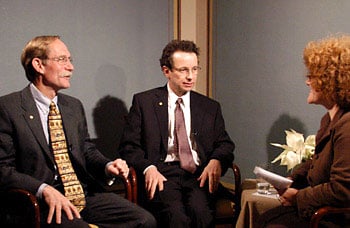
Peter Agre and Roderick MacKinnon during the interview.
Roderick MacKinnon – Prize presentation
Roderick MacKinnon – Nobel Lecture
Roderick MacKinnon held his Nobel Lecture December 8, 2003, at Aula Magna, Stockholm University. He was presented by Professor Bengt Nordén, Chairman of the Nobel Committee for Chemistry.
Roderick MacKinnon held his Nobel Lecture December 8, 2003, at Aula Magna, Stockholm University. He was presented by Professor Bengt Nordén, Chairman of the Nobel Committee for Chemistry.
Read the Nobel Lecture
Pdf 326 kB
Peter Agre – Nobel Symposia
During the Nobel Centennial Symposia ‘Beyond Genes’, held on 7 December 2001, at Karolinska Institutet, Stockholm, Sweden, Peter Agre gave his lecture ‘Aquaporin Water Channels: From Atomic Structure to Clinical Medicine’.
Roderick MacKinnon – Nobel diploma
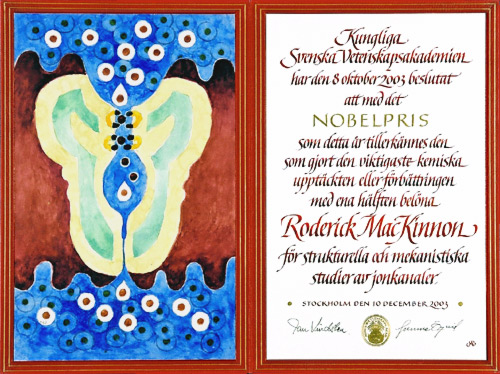
Copyright © The Nobel Foundation 2003
Artist: Nils G. Stenqvist
Calligrapher: Annika Rücker
Peter Agre – Banquet speech
Peter Agre’s speech at the Nobel Banquet, December 10, 2003.
Your Majesties, Your Royal Highnesses, Distinguished Guests:
Written in 1895, Alfred Nobel’s will endowed prizes for scientific research in chemistry, physics, and medicine. At that time, these fields were narrowly defined, and researchers were often classically trained in only one discipline. In the late 19th century, knowledge of science was not a requisite for success in other walks of life. Indeed, the 19th century painter James McNeil Whistler achieved artistic immortality despite failing chemistry at the U.S. Military Academy at West Point, an experience which he remembered with amusement, “Had silicon been a gas, I would have been a major general.”
But the depth of science has increased dramatically, and Alfred Nobel would be astonished by the changes. Now in the 21st century, the boundaries separating chemistry, physics, and medicine have become blurred, and as happened during the Renaissance, scientists are following their curiosities even when they run beyond the formal limits of their training. This year a former physics student shares the Economics Prize, a philosophy student shares the Physics Prize, chemistry and mathematics students share the Medicine Prize, and medical students share the Chemistry Prize. Moreover, the subjects of this years prizes are linked. The discovery of superconduction, the Physics Prize, is the basis for magnetic resonance imaging, the Medicine Prize, that measures the distribution of water in tissues as governed by membrane channels, the Chemistry Prize.
The need for general scientific understanding by the public has never been larger, and the penalty for scientific illiteracy never harsher. In his masterpiece, One Hundred Years of Solitude, Gabriel García Márquez, winner of the 1982 Literature Prize, describes the isolated village of Macondo where the inhabitants suffer from their own naivete, trading their hard-earned gold for what they believe to be amazing inventions – a magnet, a magnifying glass, and even an enormous, transparent crystal that fascinated them being so cold it was painful to touch. What they regarded as the greatest invention of their time was only a block of ice.
In a way, the inhabitants of Macondo resemble contemporary individuals without any background in science. Lack of scientific fundamentals causes people to make foolish decisions about issues such as the toxicity of chemicals, the efficacy of medicines, the changes in the global climate. Our single greatest defense against scientific ignorance is education, and early in the life of every scientist, the child’s first interest was sparked by a teacher.
Ladies and Gentlemen: please join Dr. MacKinnon and me in applauding the individuals that foster the scientific competence of our society and are the heroes behind past, present, and future Nobel Prizes – the men and women who teach science to children in our schools.
Tack så mycket.
Copyright © The Nobel Foundation 2003
Peter Agre – Photo gallery
Peter Agre receiving his Nobel Prize from
His Majesty King Carl XVI Gustaf of Sweden at the Stockholm Concert Hall, 10 December 2003.
Copyright © The Nobel Foundation 2003
Peter Agre (left) and Roderick MacKinnon at the Nobel
Prize Award Ceremony at the Stockholm Concert Hall, 10 December 2003.
Copyright © The Nobel Foundation 2003
Nobel Laureate in Chemistry Peter Agre shows his medal to his wife after the 2003 Nobel Prize Award Ceremony inside the Stockholm Concert Hall.
Photo: Henrik Montgomery Copyright © Pressens Bild 2003, SE-112 88 Stockholm, Sweden, telephone: +46 (0)8 738 38 00
Peter Agre delivering his banquet speech at the Nobel Banquet. © Nobel Media AB 2003.
Photo: Hans Mehlin.
Peter Agre dances with
his wife at the Nobel Banquet, 10 December 2003.
Copyright © Pressens Bild AB, 2003, S-112 88 Stockholm, Sweden
telephone: +46 (0)8 738 38 00
Photo: Ola Torkelsson
Peter Agre delivering his Nobel Lecture at the Aula
Magna, Stockholm University, 8 December 2003.
Copyright © Nobel Media AB 2003
Peter Agre delivering his Nobel Lecture at the Aula
Magna, Stockholm University, 8 December 2003.
Copyright © Nobel Media AB 2003
Peter Agre being interviewed in Stockholm, 9 December 2003.
Copyright © Nobel Media AB 2003
Peter Agre and Roderick MacKinnon during the interview. 
Photo: Hans Mehlin
Photo: Hans Mehlin

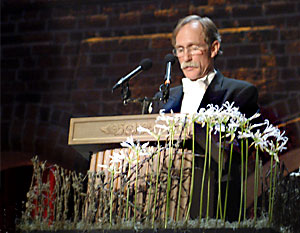


Photo: Hans Mehlin
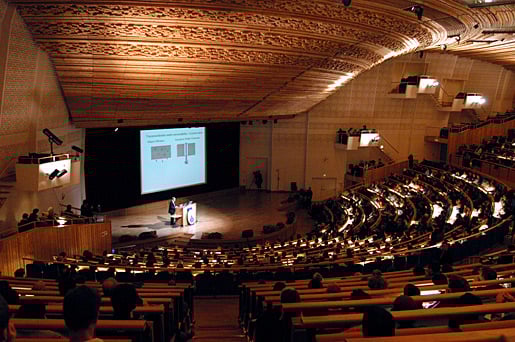
Photo: Hans Mehlin

Photo: Hans Mehlin
Peter Agre – Prize presentation
Watch a video clip of the 2003 Nobel Laureate in Chemistry, Peter Agre, receiving his Nobel Prize medal and diploma during the Nobel Prize Award Ceremony at the Concert Hall in Stockholm, Sweden, on 10 December 2003.
Peter Agre – Nobel Lecture
Peter Agre held his Nobel Lecture December 8, 2003, at Aula Magna, Stockholm University. He was presented by Professor Bengt Nordén, Chairman of the Nobel Committee for Chemistry.
Peter Agre held his Nobel Lecture December 8, 2003, at Aula Magna, Stockholm University. He was presented by Professor Bengt Nordén, Chairman of the Nobel Committee for Chemistry.
Read the Nobel Lecture
Pdf 221 kB