Henryk Sienkiewicz – Nobel Lecture
Henryk Sienkiewicz did not deliver a Nobel Lecture.
Henryk Sienkiewicz – Banquet speech
Henryk Sienkiewicz’s speech at the Nobel Banquet at Grand Hôtel, Stockholm, December 10, 1905
(Translation)
Nations are represented by their poets and their writers in the open competition for the Nobel Prize. Consequently the award of the Prize by the Academy glorifies not only the author but the people whose son he is, and it bears witness that that nation has a share in the universal achievement, that its efforts are fruitful, and that it has the right to live for the profit of mankind. If this honour is premous to all, it is infinitely more so to Poland. It has been said that Poland is dead, exhausted, enslaved, but here is the proof of her life and triumph. Like Galileo, one is forced to think «E pur si muove» when before the eyes of the world homage has been rendered to the importance of Poland’s achievement and her genius.
This homage has been rendered not to me – for the Polish soil is fertile and does not lack better writers than me – but to the Polish achievement, the Polish genius. For this I should like to express my most ardent and most sincere gratitude as a Pole to you gentlemen, the members of the Swedish Academy, and I conclude by borrowing the words of Horace: «Principibus placuisse non ultima laus est».
The Nobel Foundation's copyright has expired.Henryk Sienkiewicz – Bibliography
| Principal works in Polish |
| Na marne. – Warsaw: Przeglad Tygodniowy, 1876 |
| Listy z podrózy po Ameryce. – Warsaw: Gebethner & Wolff, 1880 |
| Stary sŧuga; Hania; Szkice wêglem; Janko Muzykant. – Warsaw: Gebethner & Wolff, 1880 |
| Latarnik; Niewola tatarska; Jamioŧ; Na jedna kartê; Bartek Zwyciêzca. – Warsaw: Gebethner & Wolff, 1882 |
| Ogniem i mieczem. – 4 vol. – Warsaw: Sŧowo, 1883-1884 |
| Potop. – 6 vol. – Warsaw: Sŧowo, 1883-1884 |
| Pan Woŧodyjowski. – 3 vol. – Warsaw: Sŧowo, 1887-1888 |
| Bez dogmatu. – Warsaw: Sŧowo, 1891 |
| Listy z Afryki. – Warsaw: Sŧowo, 1893 |
| Rodzina Poŧanieckich. – Warsaw: Gebethner & Wolff, 1895 |
| Nowele. – Warsaw: Gebethner & Wolff, 1896 |
| Quo vadis. – Warsaw: Gebethner & Wolff, 1896 |
| Krzyzacy. – Warsaw: Gebethner & Wolff, 1900 |
| Chwila obecna. – Warsaw: Redakcya Tygodnika Illustrowanego, 1903 |
| Pisma ulotne : 1869-1873. – Warsaw: Gebethner & Wolff, 1905 |
| Na polu chwaŧy. – Warsaw: S. Orgelbrand, 1906 |
| Wiry. – Warsaw: Gebethner & Wolff, 1912 |
| W pustyni i w puszczy. – Warsaw: Gebethner & Wolff, 1912 |
| Translations into English |
| With Fire and Sword : an Historical Novel of Poland and Russia / translated by Jeremiah Curtin. – 2 vol. – Boston : Little, Brown, 1890. Translation of: Ogniem i mieczem |
| The Deluge : an Historical Novel of Poland, Sweden, and Russia / translated by Jeremiah Curtin. – 2 vol. – Boston : Little, Brown, 1891. – Translation of: Potop |
| Pan Michael : an Historical Novel of Poland, the Ukraine, and Turkey / translated by Jeremiah Curtin. – Boston : Little, Brown, 1893. – Translation of: Pan Woŧodyjowski |
| Without Dogma : a Novel of Modern Poland / translated by Iza Young. – Boston: Little, Brown, 1893 |
| Yanko the Musician and Other Stories / translated by Jeremiah Curtin. – Boston: Little, Brown, 1893 |
| Lillian Morris, and Other Stories / translated by Jeremiah Curtin. – Boston: Little, Brown, 1894 |
| Children of the Soil / translated by Jeremiah Curtin. – Boston: Little, Brown, 1895. – Translation of: Rodzina Poŧanieckich |
| Let Us Follow Him, and Other Stories / translated by Sigmund C. Slupski and Iza Young. – Philadelphia: H. Altemus, 1896 |
| For Daily Bread, and Other Stories / translated by Iza Young. – Philadelphia: H. Altemus, 1896 |
| Quo Vadis : a Narrative of the Time of Nero / translated by Jeremiah Curtin. – Boston: Little, Brown, 1896. – Translation of: Quo vadis |
| After Bread : a Story of Polish Emigrant Life to America / translated by Vatslaf A. Hlasko and Thomas H. Bullick. – New York: R. F. Fenno, 1897 |
| Hania / translated by Jeremiah Curtin. – Boston: Little, Brown, 1897 |
| On the Sunny Shore / translated by S. C. de Soissons. – New York: R. F. Fenno, 1897 |
| Sielanka: a Forest Picture, and Other Stories / translated by Jeremiah Curtin. – New York: Little, Brown, 1898 |
| So Runs the World / translated by S. C. de Soissons. – New York: F. T. Neely, 1898 |
| Dust and Ashes; or, Demolished / translated by J. Christian Bay. – New York: F. T. Neely, 1899 |
| Her Tragic Fate / translated by J. Christian Bay. – New York: F. T. Neely, 1899 |
| In Vain / translated by Jeremiah Curtin.– Boston: Little, Brown, 1899. – Translation of: Na marne |
| The New Soldier; or, Nature and Life / translated by J. Christian Bay. – New York: F. T. Neely, 1899 |
| Tales from Sienkiewicz / translated by S. C. de Soissons. – New York: J. Pott, 1899 |
| Where Worlds Meet / translated by J. Christian Bay. – New York: F. T. Neely, 1899 |
| In Monte Carlo : a Story / translated by S. C. de Soissons. – Philadelphia: D. McKay, 1900 |
| The Irony of Life : the Polanetzki Family / translated by Nathan M. Babad. – New York: R. F. Fenno, 1900 |
| The Judgment of Peter and Paul on Olympus : a Poem in Prose / translated by Jeremiah Curtin. – Boston: Little, Brown, 1900 |
| The Knights of the Cross / translated by Jeremiah Curtin. – 2 vol. – Boston: Little, Brown, 1900. – Translation of: Krzyzacy |
| Tales / translated by S. C. de Soissons. – London: Allen, 1901 |
| Life and Death, and Other Legends and Stories / translated by Jeremiah Curtin. – Boston: Little, Brown, 1904 |
| On the Field of Glory : an Historical Novel of the Time of King John Sobieski / translated by Jeremiah Curtin. – Boston: Little, Brown, 1906. – Translation of: Na polu chwaŧy |
| Whirlpools : a Novel of Modern Poland / translated by Max A. Drezmal. – Boston: Little, Brown, 1910. – Translation of: Wiry |
| In Desert and Wilderness / translated by Max A. Drezmal. – Boston: Little, Brown, 1912. – Translation of: W pustyni i w puszczy |
| Tales from Henryk Sienkiewicz / edited by Monica M. Gardner. – New York: Dutton, 1931 |
| Portrait of America : Letters / edited and translated by Charles Morley. – New York : Columbia University Press, 1959. – Translation of: Listy z podrózy po Ameryce |
| With Fire and Sword / translated by W. S. Kuniczak. – New York: Hippocrene Books, 1991. – Translation of: Ogniem i mieczem |
The Swedish Academy, 2013
Henryk Sienkiewicz – Nominations
Henryk Sienkiewicz – Other resources
Links to other sites
On Henryk Sienkiewicz from Pegasos Author’s Calendar
Henryk Sienkiewicz from Culture.pl
Award ceremony speech
Presentation Speech by C.D. af Wirsén, Permanent Secretary of the Swedish Academy, on December 10, 1905
Wherever the literature of a people is rich and inexhaustible, the existence of that people is assured, for the flower of civilization cannot grow on barren soil. But in every nation there are some rare geniuses who concentrate in themselves the spirit of the nation; they represent the national character to the world. Although they cherish the memories of the past of that people, they do so only to strengthen its hope for the future. Their inspiration is deeply rooted in the past, like the oaktree of Baublis in the desert of Lithuania, but the branches are swayed by the winds of the day. Such a representative of the literature and intellectual culture of a whole people is the man to whom the Swedish Academy has this year awarded the Nobel Prize. He is here and his name is Henryk Sienkiewicz.
He was born in 1846. His youthful work Szkice weglem (1877) [Charcoal Sketches] breathes deep and tender sympathy for the oppressed and disinherited of society. Of his other early works one remembers especially the moving story of Janko muzykant (1879) [Janko the Musician] and the brilliant portrait of the Lighthouse Keeper (Latarnik, 1882). The novella Niewola tatarska (1880) [Tartar Prison] gave a foretaste of Henryk Sienkiewicz’s future performance in the historical novel, in which he did not show his full ability until the appearance of his famous trilogy. Of the three volumes Ogniem i mieczem [With Fire and Sword] appeared in 1884, Potop [The Deluge] in 1886-87, and finally Pan Wolodyjowski [Pan Michael] in 1888-89. The first volume describes the revolt of the Cossacks supported by the Tartars in 1648-49; the second deals with the Polish war against Charles Gustave; and the third with the war against the Turks, during which the fortress of Kamieniec was taken after a heroic defence. The climax of Ogniem i mieczem is the description of the siege of Sbaraz and of the internal struggle of the inflexible Jeremi Wisniowiecki, debating within himself whether his being indubitably the most resourceful general gives him the right to usurp supreme command. The struggle of conscience ends in the hero’s victory over his ambition. Let us mention in passing that in his trilogy the author has described three sieges, that of Sbaraz, that of Czestochowa, and finally that of Kamieniec, without ever repeating himself in his treatment of the theme. Potop contains many excellent tableaux that remain in the reader’s memory. There is Kamicia, at the beginning of the novel hardly more than an outlaw induced to fight against his king, who under the influence of his love for a noble woman regains the esteem that he had lost and accomplishes a series of brilliant exploits in the service of the legal order. Olenka, one of Sienkiewicz’ many beautiful female characters, is ravishing in her religious faith, her incorruptible rigour, and her devout patriotism. Even the villains in this story are interesting. There is the sombre and masterly portrait of Prince Janusz Radziwill, who took up arms against his country, and the description of the banquet at which he tried to inveigle his officers into betraying Poland. Even the traitor has his beauty, and an English critic has drawn attention to the psychological refinement with which Henryk Sienkiewicz shows us the prince debating with his conscience and wilfully deluding himself into believing that his rebellion would serve the cause of Poland. Incapable of persisting for long in this voluntary blindness, the prince dies of remorse vainly repressed. Even in the unreliable and libertine Prince Boguslaw there are certain attractive traits of personal courage, of courtly grace and cheerful insouciance. Henryk Sienkiewicz knows people too well to present them uniformly white or black. Another distinctive trait is Sienkiewicz’ habit of never shutting his eyes to the faults of his compatriots; rather he exposes them mercilessly, while he renders justice to the abilities and courage of the enemies of Poland. Like the old prophets of Israel he often tells his people strong truths. Thus in his historical tableaux he blames the excessive Polish desire for individual liberty, which frequently led to a dissipation of energy and made impossible the sacrifice of private interests to the public good. He upbraids the lords for their quarrels and their unwillingness to adapt themselves to the justifiable needs of the state. But Sienkiewicz is always a patriot who certainly puts the brave chivalry of the Polish people in its proper light and who emphasizes the great role effectively played by Poland, formerly the bulwark of Christendom against the Turks and the Tartars. This high objectivity is above all proof of the wisdom of Sienkiewicz’ mind and his conception of history. As a good Pole he must disapprove the attack of Charles Gustave against Poland, but nonetheless he gives brilliant portraits of the personal courage of the king and of the excellent discipline and cohesion of the Swedish troops.
It has often been said that Pan Wolodyjowski is the weakest part of the trilogy. We find it hard to subscribe to that opinion. One need only remember the moving account of how the wife of Wolodyjowski escapes from the wily Tartar Azya who combines the qualities of serpent and lion, or the admirable portrait of Basia herself, that beautiful and dauntless soldier wife who combines sweetness with gaiety and courage. The last part of the trilogy is especially rich in gentle and purely human features, as in the beautiful and sublime scene of farewell between Basia and Wolodyjowski, who is about to let himself be blown up with his fort. While the victorious Turks surround the fortress of Kamieniec, when all means of rescue have been exhausted and disaster is imminent, husband and wife are united during an August night in a sort of niche formed by a walled-up gate. He comforts her and reminds her how much happiness they had been granted together and that death is merely a transition. The first to begin the journey to the beyond would only prepare for the coming of the other. The episode is marvellous and enchanting. Although it is not sentimental, it contains such a wealth of pure and true feeling that it is difficult to read it without emotion. The description of Wolodyjowski’s burial is equally grandiose, though in a different manner. At the foot of the coffin Basia, stretched out on the tiles of the church, is overcome by grief The chaplain beats the tambourine as if he were giving a signal of alarm and exhorts the dead hero to rise from the catafalque and combat the enemy as before. Then, mastering this outburst of grief, he praises the manly courage and virtues of the dead and prays to God that in this time of extreme danger for the country He may give rise to a liberator. At this moment Sobieski enters the church. All eyes’ turn toward him. Seized by prophetic enthusiasm, the priest exclaims «Salvator» and Sobieski falls to his knees at the side of Wolodyjowski’s bier.
All of these descriptions are distinguished by great historical truthfulness. Because of Sienkiewicz’ extensive researches and his sense of history, his characters speak and act in the style of the period. It is significant that among the many persons who suggested Henryk Sienkiewicz for the Nobel Prize there were eminent historians.
The trilogy abounds in descriptions of nature admirable in their freshness. Where would one find the equivalent of the very short but unforgettable description in Ogniem i mieczem of the steppe as it awakens in the spring, when flowers rise from the soil, insects buzz, wild geese pass over, birds sing, and wild horses with floating manes and dilated nostrils rush away like a whirlwind at the sight of a troop of soldiers?
Another remarkable trait of this grandiose trilogy is its humour. The little knight Wolodyjowski is certainly admirably drawn, but the portrait of the jovial nobleman Zagloba imprints itself perhaps even more firmly in our memory. His vainglory, his girth, and his taste for wine recall Falstaff, but these are their only common traits. Whereas Falstaff is of a dissipated and questionable character, Zagloba has a heart of gold; he is faithful to his friends in times of danger. Zagloba himself pretends to be a sober man, made to be a good priest, but in truth he is much addicted to the pleasures of the table. He loves wine and declares that only traitors renounce it because they are afraid to give away their secrets when drunk; what makes him especially abhor the Turks is the fact that they do not drink wine. Zagloba is a terrible gossip – a quality that he considers necessary in winter because otherwise the tongue might freeze and become numb. He flaunts military decorations and boasts of military exploits in which he never took part. In reality his courage – for he has courage – is of another kind. He trembles before every encounter like a coward, but once the battle has begun he is seized by rage against the enemy who will not let him live in peace and he becomes capable of true feats of courage, as when he defeats the terrible Cossack Burlaj. Moreover, he is wily and resourceful like Odysseus and often finds a way out when the others have come to the end of their tether. He is basically a debonair and emotional man, who sheds tears when some great mishap befalls his friends. He is a good patriot and unlike so many others he does not desert his king. It has been said that the character of Zagloba lacks consistency because in the last volume of the trilogy the grotesque gossip becomes more serious and acquires more social consideration. This opinion is inconsiderate. Sienkiewicz wanted to show us precisely how Zagloba develops and becomes somewhat ennobled while at the same time retaining his old faults. Such a relative improvement is all the more natural as Zagloba despite all his bizarre faults is basically as good as a child. Such as he is, Zagloba belongs forever to the gallery of immortal comic characters of world literature, and he is thoroughly original.
The diversity of Henryk Sienkiewicz’ talent became apparent when in 1890 he passed from the warrior portraits of his trilogy to a modern psychological novel and published Bez dogmatu [Without Dogma], which is considered by many critics his main work. The novel is in the form of a journal, but unlike so many other journals, it is never tiresome. With an art hardly surpassed elsewhere it presents to us the type of a wordly man, a religious and moral sceptic, who becomes unproductive because of his morbid need for self-analysis. Through his perpetual indecision, he prevents his own happiness, sacrifices that of others, and finally succumbs. Ploszowski is a highly gifted man, but he lacks moral bones, so to speak: he is without dogma. He is hyper-aesthetic and extremely sophisticated, but the sophistication cannot replace his lack of faith and spontaneity. There is the figure of Anielka, delightful in her sad melancholy, who watches the best hopes of her life pass away through the egotism of Ploszowski, yet until the end remains faithful to the laws of duty. The author shows us with insight how in a soul that has once been Christian, like that of Ploszowski, the cult of beauty is insufficient to fill the void left by the loss of religious sentiment. Sienkiewicz has portrayed a type which exists in all countries, a brilliant figure marred by intellectual neurasthenia. Bez dogmatu is a profoundly serious book that invites reflection, but at the same time it is an exquisite work of art, delicately chiselled. The inspired account vibrates with controlled melancholy, and if the book appears at times cold, it is the cold of a work of sculpture inherent in many beautiful and noble works of art. We find this frequently, for instance, in the works of Goethe.
Bez dogmatu was followed in 1894 by Rodzina Polanieckich [Children of the Soil], a work less inspired than Bez dogmatu but characterized by great depth in its description of the contrast of a useful country life and hollow cosmopolitanism. Here again we find the figure of a superb woman, the candid, devoted, and tender Marynia. Critics have raised objections to a detail; that is, the sin of passion which Polanieckich commits. Far from defending him, the author has illustrated how a man whose life is neither abnormal nor excessive, let alone perverted, is nonetheless capable of committing a fault, but soon comes to his senses and repents it without soft complacency. The ties between Polanieckich and his wife are re-established even more firmly at the end of the book, and the novel is really a glorification of domestic virtues and of sane and salutary social activity. There is much charm in the delicately drawn portrait of the sick child Litka, who sacrifices her child’s love for Polanieckich in order to reconcile him with Marynia. The episode is sublime and rich in purity and moving poetry.
The same critics who blamed his trilogy for being too long have cavilled at the rapid pace of the short tale Pojdzmy za nim (1892) [Let Us Follow Him], a simple sketch that paints with great poetic beauty how the countess Antea, ill and suffering from painful and dangerous hallucinations, is cured by the dying and resurrected Saviour. In each case the criticism is irrelevant, for the different subjects demand a different treatment. Pojdzmy za nim is admittedly a sketch, but it is a story of deep and moving sensibility. Thus a master’s casual chalk sketch because of its intimate characters is often almost equal in value to his more elaborate works. Pojdzmy za nim is written with noble piety; it is a modest flower growing at the foot of the cross and enclosing in its blossom a drop of the blood of the Saviour.
Religious subjects soon led Sienkiewicz to a vast work that has become universally famous. In 1895-96 he wrote Quo Vadis. This history of the persecutions under Nero had an extraordinary success. The English translation sold 800,000 copies in England and America in one year. Professor Brückner, the historian of Polish literature in Berlin, estimated in 1901 that about two million copies had been sold in these two countries alone.
Quo Vadis has been translated into more than thirty languages. Although one should not overestimate the importance of such a success – bad books also spread easily provided they are seductive – it still points clearly to the value of a work that never addresses itself to the lower instincts of man but treats an elevated subject in an elevated manner. Quo Vadis excellently describes the contrast between the sophisticated but gangrened paganism with its pride, and humble and confident Christianity, between egotism and love, between the insolent luxury of the imperial palace and the silent concentration of the catacombs. The descriptions of the fire at Rome and the bloody scenes in the amphitheatre are without equal. Henryk Sienkiewicz discreetly avoids making Nero a major character, but in a few strokes he has portrayed to us the dilettante crowned with all his vanity and the folly of his grandeur, all his false exaltation, all his cult of superficial art void of moral sense, and all his capricious cruelty. The portrait of Petronius, drawn in greater detail, is even better. The author was able to rely on the inspired sketch in the two short chapters of the sixteenth book of Tacitus’ Annals. Starting from these very brief hints Sienkiewicz has constructed a psychological picture that gives a strong appearance of truthfulness and is extremely penetrating. Petronius, the man of sophisticated culture, arbiter elegantiae, is a bundle of contradictions. Epicurean and above all sceptic, he considers life a deceptive mirage. Pleasures have made him effeminate, but he still has the courage of a man. While free of prejudices, he is at times superstitious. His sense of good and evil is not strongly developed, but his sense of the beautiful is all the more marked. He is a man of the world and in delicate situations he is capable of acquitting himself with skill and sang-froid without compromising his dignity. The sceptic Pyrrhon and the poet of pleasure Anacreon please him more than the uncouth moralists of the Stoa. He despises the Christians, whom he knows little. It seems to him pointless and unworthy of a man to render good for bad according to Christian doctrine. To hope for a life after death, as the Christians do, seems to him as strange as if one were to announce that a new day begins at night. Ruined by the favourite Tigellinus, Petronius dies with the serenity of a death that he had sought himself. The entire description is perfect in its genre. But Quo Vadis contains many other admirable things. Especially beautiful is the episode, lit by the setting sun, in which the apostle Paul goes to his martyrdom repeating to himself the words that he had once written: «I have fought a good fight, I have finished my course, I have kept the faith» (2 Tim., 4: 7).
After this major work Henryk Sienkiewicz returned to the national Polish novel and in 1901 wrote Krzyzacy [The Knights of the Cross]. The task was this time less easy than in the case of the trilogy because there were fewer sources. But Sienkiewicz overcame the difficulties and gave to his version a strong medieval colour. The subject of the novel is the fight of the Polish and Lithuanian nations against the Teutonic Knights who, having long ago finished their original mission, had become an oppressive institution more occupied with power and terrestrial gains than with the cross whose insignia the members of the order bore on their coats. It was the Archduke Jagiello, later King of Poland under the name of Wladislaw II, who broke the dominance of the order. He plays a role in the novel, although he is only sketchily drawn according to Sienkiewicz’ custom of not giving too much prominence to historical characters. The many characters which are entirely the product of the author’s rich fancy attract our attention more strongly and furnish excellent examples of medieval civilization. It was a superstitious epoch and, although the country had been Christianized for a long time, people still put food out at night for vampires and revenants. Each saint had his articular function. Apollonia was invoked for toothaches, Liberius for stones. It is true that God the Father rules the universe, but this very fact proves that he has no time to look after human affairs of minor importance; consequently he has delegated certain functions to saints. That epoch was indeed superstitious, but it was also full of energy. Huge and solid, the castle of the order stands at Marienburg. The Polish and Lithuanian opponents of the monastic knights do not lack force, either. There is Macko, crude, greedy, bent on the interests of his family, but brave. There is the noble Zbyszko, his mind full of chivalrous adventures. Surpassing all the others, colossal, as if cut in granite, there is the redoubtable Jurand, cruel in his hatred of the Teutonic Order and finally the victim of its terrible revenge. In the hour of his humiliation he is more sublime than ever because of his self-victory and the power of his forgiveness. He is one of the most grandiose of Sienkiewicz’ warrior characters. Tableaux of gentleness alternate with those of force. Queen Jadwiga is gentle, but her appearance is elusive. The description of the funeral for the poor, sorely tested Danusia is delicately beautiful like a softly chanted passion service. On the other hand, the fresh and springlike picture of Jagienka is radiant with exuberant health and liveliness. All these creations have their individual life. Among the outstanding minor characters are the irascible and bellicose Abbé, unable to brook any contradiction, and Sanders, the seller of indulgences, who sells a hoof of the donkey on which the flight to Egypt took place, a piece of the ladder of Jacob, the tears of the Egyptian Mary, and a little rust from the keys of St. Peter. The closing episode, the battle of Tannenberg in 1410 in which the squadrons of the Teutonic Order were crushed after a heroic battle, is like the finale of a splendid musical drama.
Henryk Sienkiewicz is certainly the first to recognize his debt to old Polish literature. That literature is indeed rich. Adam Mickiewicz is its true Adam, its ancestor by virtue of the full nature of the poetry that distinguishes his great epic. Brilliant as the stars in the sky of Polish literature are the names of Slowacki, a man of fertile imagination, and of the philosopher Krasinski. The epic art has been successfully practised by men like Korzeniowski, Kraszewski, and Rzewuski. But with Henryk Sienkiewicz that art has reached its full bloom and presents itself in its highest degree of objectivity.
If one surveys Sienkiewicz’ achievement it appears gigantic and vast, and at every point noble and controlled. As for his epic style, it is of absolute artistic perfection. That epic style with its powerful over-all effect and the relative independence of episodes is distinguished by naive and striking metaphors. In this respect, as Geijer has remarked, Homer is the master because he perceives grandeur in simplicity as, for example, when he compares the warriors to flies that swarm around a pail of milk, or when Patroklos, who all in tears asks Achilles to let him fight against the enemies, is compared to a little girl who weeping clings to the dress of her mother and wants to be taken in her arms. A Swedish critic has noticed in Sienkiewicz some similes that have the clarity of Homeric images. Thus the retreat of an army is compared to a retreating wave that leaves mussels and shells on the beach, or the beginning of gunfire is compared to the barking of a village dog who is soon joined in chorus by all the other dogs. The examples could be multiplied. The attack on the front and rear of an army surrounded and subject to fire from both sides is compared to a field that is reaped by two groups of mowers who begin their work at opposite sides of the field with the purpose of meeting in the middle. In Krzyzacy the Samogites rising from furrows attack the German knights like a swarm of wasps whose nest has been damaged by a careless wanderer. In Pan Wolodyjowski we also find admirable images; in order to judge them we should remember that, as often in Homer, the two terms of the comparison converge only in one point, while the rest remains vague. Wolodyjowski with his unique sword kills human lives around him as rapidly as a choir boy after the mass snuffs the candles on the altar one after the other with his long extinguisher. Hussein Pasha, the commander of the Turkish army who vainly tries to leave by the gate that leads to Jassy, returns to the camp to try another exit, just as a poacher who has been tracked in a park tries to escape now on one side and now on the other. The Christian martyrs of Quo Vadis who are prepared for death are already as removed from earthly places as mariners who have pushed off and left the quay. Many more situations equally Homeric and yet equally natural and spontaneous could be cited; thus in Krzyzacy Jagienka at the unexpected sight of Zbyszko, who resembles a young prince, stops short at the gate and nearly drops the jug of wine.
The literary production of Henryk Sienkiewicz is far from over. At the moment he is in the process of publishing a new trilogy entitled Na polu chwaly (1906) [On the Field of Glory ] that deals with the time of Sobieski.
His own poetic career has indeed unfolded on the field of glory. He has received valuable tokens of the devotion of his people, all the more precious since, despite his ardent patriotism, he has never flattered his country. On the occasion of his twenty-fifth anniversary as an author a grand national subscription provided the means to buy the castle that had been the original seat of his family and to offer it to him as a present. He was saluted by delegations, congratulatory messages were sent, and the Warsaw theatre staged a gala performance in his honour.
An homage from the North has now been added to these proofs of admiration, for the Swedish Academy has decided to award the Nobel Prize in Literature of 1905 to Henryk Sienkiewicz.
The Nobel Prize in Literature 1905
Henryk Sienkiewicz – Biographical
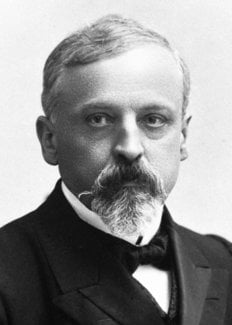
Henryk Sienkiewicz (1846-1916), the most outstanding and prolific Polish writer of the second half of the nineteenth century, was born in Wola Okrzejska, in the Russian part of Poland. His father’s family was actively engaged in the revolutionary struggles for Polish independence, which accounts for the strong patriotic element in Sienkiewicz’ work. Historical scholarship on the other hand ran in his mother’s family.
Sienkiewicz studied in Warsaw, but without any visible results. His talent as a writer was soon discovered. His early works are satirical sketches, betraying a strong social conscience. He made a trip to America in 1876 and travelled as far as California. His impressions were published in Polish newspapers and received very favourably. His travels provided him with material for several works, among them the brilliant short story Latarnik (1882) [The Lighthouse Keeper].
After his return to Poland, Sienkiewicz devoted himself to historical studies, the result of which was his great trilogy about Poland in the midseventeenth century. Ogniem i mieczem [With Fire and Sword], Potop [The Deluge] and Pan Wolodyjowski [Pan Michael] were published in 1884, 1886, and 1888 respectively. The historical novels were followed by works on contemporary subjects: Bez dogmatu (1891) [Without Dogma], a psychological study of a sophisticated decadent man, and Rodzina Polanieckich (1894) [Children of the Soil], a peasant novel. In 1895 Sienkiewicz published his greatest success, Quo Vadis, a novel of Christian persecutions at the time of Nero.
In his later novels he returned again to historical subjects. Krzyzacy (1900) deals with a period of medieval history, the victory of the Poles over the Teutonic Knights; Na polu chwaly ( 1906) [On the Field of Glory] is a sequel to his seventeenth-century trilogy. His last works Wiry (1910) [Whirlpools] and W pustyni i w puszczy (1912) [In Desert and Wilderness] again deal with contemporary subjects.
Sienkiewicz was immensely popular. In 1900, a national subscription raised enough funds to buy for him the castle in which his ancestors had lived. The complete edition of his works, published 1948-55, runs to sixty volumes.
This autobiography/biography was written at the time of the award and first published in the book series Les Prix Nobel. It was later edited and republished in Nobel Lectures. To cite this document, always state the source as shown above.
Henryk Sienkiewicz died on November 15, 1916.
The Nobel Foundation's copyright has expired.