T.S. Eliot – Banquet speech
Thomas Stearns Eliot’s speech at the Nobel Banquet at the City Hall in Stockholm, December 10, 1948
When I began to think of what I should say to you this evening, I wished only to express very simply my appreciation of the high honour which the Swedish Academy has thought fit to confer upon me. But to do this adequately proved no simple task: my business is with words, yet the words were beyond my command. Merely to indicate that I was aware of having received the highest international honour that can be bestowed upon a man of letters, would be only to say what everyone knows already. To profess my own unworthiness would be to cast doubt upon the wisdom of the Academy; to praise the Academy might suggest that I, as a literary critic, approved the recognition given to myself as a poet. May I therefore ask that it be taken for granted, that I experienced, on learning of this award to myself, all the normal emotions of exaltation and vanity that any human being might be expected to feel at such a moment, with enjoyment of the flattery, and exasperation at the inconvenience, of being turned overnight into a public figure? Were the Nobel Award similar in kind to any other award, and merely higher in degree, I might still try to find words of appreciation: but since it is different in kind from any other, the expression of one’s feelings calls for resources which language cannot supply.
I must therefore try to express myself in an indirect way, by putting before you my own interpretation of the significance of the Nobel Prize in Literature. If this were simply the recognition of merit, or of the fact that an author’s reputation has passed the boundaries of his own country and his own language, we could say that hardly any one of us at any time is, more than others, worthy of being so distinguished. But I find in the Nobel Award something more and something different from such recognition. It seems to me more the election of an individual, chosen from time to time from one nation or another, and selected by something like an act of grace, to fill a peculiar role and to become a peculiar symbol. A ceremony takes place, by which a man is suddenly endowed with some function which he did not fill before. So the question is not whether he was worthy to be so singled out, but whether he can perform the function which you have assigned to him: the function of serving as a representative, so far as any man can be of thing of far greater importance than the value of what he himself has written.
Poetry is usually considered the most local of all the arts. Painting, sculpture, architecture, music, can be enjoyed by all who see or hear. But language, especially the language of poetry, is a different matter. Poetry, it might seem, separates peoples instead of uniting them.
But on the other hand we must remember, that while language constitutes a barrier, poetry itself gives us a reason for trying to overcome the barrier. To enjoy poetry belonging to another language, is to enjoy an understanding of the people to whom that language belongs, an understanding we can get in no other way. We may think also of the history of poetry in Europe, and of the great influence that the poetry of one language can exert on another; we must remember the immense debt of every considerable poet to poets of other languages than his own; we may reflect that the poetry of every country and every language would decline and perish, were it not nourished by poetry in foreign tongues. When a poet speaks to his own people, the voices of all the poets of other languages who have influenced him are speaking also. And at the same time he himself is speaking to younger poets of other languages, and these poets will convey something of his vision of life and something of the spirit of his people, to their own. Partly through his influence on other poets, partly through translation, which must be also a kind of recreation of his poems by other poets, partly through readers of his language who are not themselves poets, the poet can contribute toward understanding between peoples.
In the work of every poet there will certainly be much that can only appeal to those who inhabit the same region, or speak the same language, as the poet. But nevertheless there is a meaning to the phrase «the poetry of Europe», and even to the word «poetry» the world over. I think that in poetry people of different countries and different languages – though it be apparently only through a small minority in any one country – acquire an understanding of each other which, however partial, is still essential. And I take the award of the Nobel Prize in Literature, when it is given to a poet, to be primarily an assertion of the supra-national value of poetry. To make that affirmation, it is necessary from time to time to designate a poet: and I stand before you, not on my own merits, but as a symbol, for a time, of the significance of poetry.
Prior to the speech, Gustaf Hellström of the Swedish Academy made these remarks: «Humility is also the characteristic which you, Mr. Eliot, have come to regard as man’s virtue. ‹The only wisdom we can hope to acquire is the wisdom of humility.› At first it did not appear that this would be the final result of your visions and your acuity of thought. Born in the Middle West, where the pioneer mentality was still alive, brought up in Boston, the stronghold of Puritan tradition, you came to 9Europe in your youth and were there confronted with the pre-war type of civilization in the Old World: the Europe of Edward VII, Kaiser Wilhelm, the Third Republic, and The Merry Widow. This contact was a shock to you, the expression of which you brought to perfection in The Waste Land, in which the confusion and vulgarity of the civilization became the object of your scathing criticism. But beneath that criticism there lay profound and painful disillusionment, and out of this disillusionment there grew forth a feeling of sympathy, and out of that sympathy was born a growing urge to rescue from the ruins of the confusion the fragments from which order and stability might be restored. The position you have long held in modern literature provokes a comparison with that occupied by Sigmund Freud, a quarter of a century earlier, within the field of psychic medicine. If a comparison might be permitted, the novelty of the therapy which he introduced with psychoanalysis would match the revolutionary form in which you have clothed your message. But the path of comparison could be followed still further. For Freud the most profound cause of the confusion lay in the Unbehagen in der Kultur of modern man. In his opinion there must be sought a collective and individual balance, which should constantly take into account man’s primitive instincts. You, Mr. Eliot, are of the opposite opinion. For you the salvation of man lies in the preservation of the cultural tradition, which, in our more mature years, lives with greater vigour within us than does primitiveness, and which we must preserve if chaos is to be avoided. Tradition is not a dead load which we drag along with us, and which in our youthful desire for freedom we seek to throw off. It is the soil in which the seeds of coming harvests are to be sown, and from which future harvests will be garnered. As a poet you have, Mr. Eliot, for decades, exercised a greater influence on your contemporaries and younger fellow writers than perhaps anyone else of our time.»
T.S. Eliot – Bibliography
| Works in English |
| Prufrock and Other Observations. – London : Egoist, 1917 |
| Ezra Pound : His Metric and Poetry. – New York : Knopf, 1918 |
| Poems. – Richmond, Surrey : The Hogarth Press, 1919 |
| Ara Vos Prec. – London : Ovid Press, 1920. – Revised as Poems. – New York : Knopf, 1920 |
| The Sacred Wood : Essays on Poetry and Criticism. – London : Methuen, 1920 |
| The Waste Land. – New York : Boni & Liveright, 1922 |
| Homage to John Dryden : Three Essays on Poetry of the Seventeenth Century. – London : The Hogarth Press, 1924 |
| Poems 1909–1925. – London : Faber & Gwyer, 1925 |
| Journey of the Magi. – London : Faber & Gwyer, 1927 |
| Shakespeare and the Stoicism of Seneca. – London : Oxford University Press, 1927 |
| A Song for Simeon. – London : Faber & Gwyer, 1928 |
| For Lancelot Andrewes : Essays on Style and Order. – London : Faber & Gwyer, 1928 |
| Dante. – London : Faber, 1929 |
| Animula. – London : Faber, 1929 |
| Ash-Wednesday. – New York : Fountain Press, 1930 ; London : Faber, 1930 |
| Marina. – London : Faber, 1930 |
| Thoughts After Lambeth. – London : Faber, 1931 |
| Triumphal March. – London : Faber, 1931 |
| Charles Whibley : A Memoir. – London : Oxford University Press, 1931 |
| Selected Essays 1917–1932. – London : Faber, 1932 ; New York : Harcourt, Brace, 1932 |
| John Dryden: The Poet, The Dramatist, The Critic. – New York : Terence & Elsa Holliday, 1932 |
| Sweeney Agonistes : Fragments of an Aristophanic Melodrama. – London : Faber, 1932 |
| The Use of Poetry and The Use of Criticism : Studies in the Relation of Criticism to Poetry in England. – London : Faber, 1933 ; Cambridge, Mass. : Harvard University Press, 1933 |
| After Strange Gods : A Primer of Modern Heresy. – London : Faber, 1934 ; New York : Harcourt, Brace, 1934 |
| The Rock : A Pageant Play. – London : Faber, 1934 ; New York : Harcourt, Brace, 1934 |
| Elizabethan Essays. – London : Faber, 1934. – Revised as Essays on Elizabethan Drama. – New York : Harcourt, Brace, 1956 ; republished as Elizabethan Dramatists. – London : Faber, 1963 |
| Words for Music. – Bryn Mawr, Pa. : Privately printed, 1934 |
| Murder in the Cathedral. – London : Faber, 1935 ; New York : Harcourt, Brace, 1935 |
| Essays Ancient & Modern. – London : Faber, 1936 ; New York : Harcourt, Brace, 1936 |
| Collected Poems 1909–1935. – London : Faber, 1936 ; New York : Harcourt, Brace, 1936 |
| The Family Reunion. – London : Faber, 1939 ; New York : Harcourt, Brace, 1939 |
| Old Possum’s Book of Practical Cats. – London : Faber, 1939 ; New York : Harcourt, Brace, 1939 |
| The Idea of a Christian Society. – London : Faber, 1939 ; New York : Harcourt, Brace, 1940 |
| East Coker. – London : Faber, 1940 |
| Burnt Norton. – London : Faber, 1941 |
| Points of View / edited by John Hayward. – London : Faber, 1941 |
| The Dry Salvages. – London : Faber, 1941 |
| The Classics and the Man of Letters. – London, New York & Toronto : Oxford University Press, 1942 |
| The Music of Poetry. – Glasgow : Jackson, Son, Publishers to the University, 1942 |
| Little Gidding. – London : Faber, 1942 |
| Four Quartets. – New York : Harcourt, Brace, 1943 ; London : Faber, 1944 |
| Reunion by Destruction. – London : Pax House, 1943 |
| What Is a Classic?. – London : Faber, 1945 |
| A Practical Possum. – Cambridge, Mass. : Harvard Printing Office & Department of Graphic Arts, 1947 |
| On Poetry. – Concord, Mass. : Concord Academy, 1947 |
| Milton. – London : Geoffrey Cumberlege, 1947 |
| A Sermon. – Cambridge : Cambridge University Press, 1948 |
| Selected Poems. – Harmondsworth, U.K. : Penguin/Faber, 1948 ; New York : Harcourt, Brace & World, 1967 |
| Notes Towards the Definition of Culture. – London : Faber, 1948 ; New York : Harcourt, Brace, 1949 |
| From Poe to Valéry. – New York : Harcourt, Brace, 1948 |
| The Undergraduate Poems of T. S. Eliot. – Cambridge, Mass., 1949 |
| The Aims of Poetic Drama. – London : Poets’ Theatre Guild, 1949 |
| The Cocktail Party. – London : Faber, 1950 ; New York : Harcourt, Brace, 1950 |
| Poems Written in Early Youth. – Stockholm : Privately printed, 1950 ; London : Faber, 1967 ; New York : Farrar, Straus & Giroux, 1967 |
| Poetry and Drama. – Cambridge, Mass. : Harvard University Press, 1951 ; London : Faber, 1951 |
| The Film of Murder in the Cathedral / T.S. Eliot and George Hoellering. – London : Faber, 1952 ; New York : Harcourt, Brace, 1952 |
| The Value and Use of Cathedrals in England Today. – Chichester : Friends of Chichester Cathedral, 1952 |
| An Address to Members of the London Library. – London : London Library, 1952 ; Providence, R.I. : Providence Athenaeum, 1953 |
| The Complete Poems and Plays. – New York : Harcourt, Brace, 1952 |
| American Literature and the American Language. – St. Louis : Department of English, Washington University, 1953 |
| The Three Voices of Poetry. – Cambridge : Cambridge University Press, 1953 ; New York : Cambridge University Press, 1954 |
| The Confidential Clerk. – London : Faber, 1954 ; New York : Harcourt, Brace, 1954 |
| Religious Drama : Mediaeval and Modern. – New York : House of Books, 1954 |
| The Cultivation of Christmas Trees. – London : Faber, 1954 ; New York : Farrar, Straus & Cudahy, 1956 |
| The Literature of Politics. – London : Conservative Political Centre, 1955 |
| The Frontiers of Criticism. – Minneapolis : University of Minnesota Press, 1956 |
| On Poetry and Poets. – London : Faber, 1957 ; New York : Farrar, Straus & Cudahy, 1957 |
| The Elder Statesman. – London : Faber, 1959 ; New York : Farrar, Straus & Cudahy, 1959 |
| Geoffrey Faber 1889–1961. – London : Faber, 1961 |
| Collected Plays. – London : Faber, 1962 |
| George Herbert. – London : Longmans, 1962 |
| Collected Poems 1909–1962. – London : Faber, 1963 ; New York : Harcourt, Brace & World, 1963 |
| Knowledge and Experience in the Philosophy of F. H. Bradley. – London : Faber, 1964 ; New York : Farrar, Straus, 1964 |
| To Criticize the Critic and Other Writings. – London : Faber, 1965 ; New York : Farrar, Straus & Giroux, 1965 |
| The Waste Land : A Facsimile and Transcript of the Original Drafts Including the Annotations of Ezra Pound / edited by Valerie Eliot. – London : Faber, 1971 ; New York : Harcourt Brace Jovanovich, 1971 |
| Selected Prose of T.S. Eliot / edited by Frank Kermode. – London : Faber, 1975 ; New York : Harcourt Brace Jovanovich, 1975 |
| The Varieties of Metaphysical Poetry : The Clark Lectures at Trinity College, Cambridge, 1926, and the Turnbull Lectures at the Johns Hopkins University, 1933 / edited by Ronald Schuchard. – London : Faber, 1993 ; New York : Harcourt Brace, 1994 |
| Inventions of the March Hare : Poems, 1909–1917 / edited by Christopher Ricks. – London : Faber, 1996 ; New York : Harcourt Brace, 1996 |
| The Waste Land : Authoritative Text, Contexts, Criticism. – Norton Critical Edition / edited by Michael North. – New York : Norton, 2001 |
| The Annotated Waste Land, with T.S. Eliot’s Contemporary Prose / edited by Lawrence Rainey. – New Haven : Yale University Press, 2005 |
| The Letters of T.S. Eliot. Vol. 1, 1898-1922 / edited by Valerie Eliot. – London : Faber. – 1988 |
| The Letters of T.S. Eliot. Vol. 2, 1923-1925 / edited by Valerie Eliot and Hugh Haughton. – London : Faber, 2009 |
| Critical studies (a selection) |
| T.S. Eliot : a Selected Critique / ed. ny Leonard Unger. – New York : Rinehart, 1948 |
| Drew, Elizabeth A., T.S. Eliot : the Design of His Poetry. – New York : Scribner, 1949 |
| Maxwell, Desmond Ernest Stewart, The Poetry of T.S. Eliot. – London : Routledge & Kegan Paul, 1952 |
| Williamson, George, A Reader’s Guide to T.S. Eliot : a Poem-By-Poem Analysis. – New York : Noonday Press, 1953 |
| Smith, Grover Cleveland, jr., T.S. Eliot’s Poetry and Plays : a Study In Sources and Meaning. – Chicago : Univ. Press, 1956 |
| Matthiessen, Francis Otto, The Achievement of T.S. Eliot : an Essay on the Nature of Poetry. – New York, 1958. |
| Jones, David E., The Plays of T.S. Eliot. – Routledge & Kegan Paul, 1960. |
| Bergsten, Staffan, Time and Eternity : a Study in the Structure and Symbolism of T.S. Eliot’s Four Quartets. – Stockholm : Svenska bokförlaget, 1960 |
| Smidt, Kristian, Poetry and Belief in the Work of T. S. Eliot. – London : Routledge and Kegan Paul, 1961 |
| Frye, Northrop, T.S. Eliot. – Edinburgh : Oliver and Boyd, 1963 |
| T. S. Eliot : the Man and His Work / ed. by Allen Tate. – London : Chatto & Windus, 1967 |
| Blamires, Harry, Word Unheard : a Guide Through Eliot’s Four Quartets. – London : Methuen, 1969 |
| Critics on T.S. Eliot : Readings in Literary Criticism / ed. by Sheila Sullivan. – London : Allen and Unwin, 1973 |
| Gardner, Helen, The Composition of Four Quartets. – London : Faber, 1978 |
| T.S. Eliot : the Critical Heritage / ed. by Michael Grant. – London : Routledge & Kegan Paul, 1982 |
| Smith, Grover Cleveland, jr., The Waste Land. – London : Allen & Unwin, 1983 |
| Ackroyd, Peter, T.S. Eliot. – London : Hamilton, 1984 |
| Mayer, John T., T.S. Eliot’s Silent Voices. – New York : Oxford University Press, 1989 |
| T.S. Eliot : Critical Assessments / edited by Graham Clarke. London : Helm, cop. 1990. – 4 vol. |
| Murray, Paul, T.S. Eliot and Mysticism : the Secret History of Four Quartets. – Basingstoke : MacMillan, 1991 |
| Cooper, John Xiros, T.S. Eliot and the Ideology of Four Quartets. – Cambridge : Cambridge University Press, 1995 |
| Gordon, Lyndall, T.S. Eliot : an Imperfect Life. – London : Vintage, 1998 |
| Miller, James Edwin, jr., T.S. Eliot : the Making of an American Poet, 1888–1922. – University Park, Pa. : Pennsylvania State University Press, 2005 |
| Raine, Craig, T.S. Eliot. – Oxford ; New York : Oxford University Press, 2006 |
The Swedish Academy, 2011
T.S. Eliot – Nominations
T.S. Eliot – Other resources
Links to other sites
On T.S. Eliot from Pegasos Author’s Calendar
Selected Poetry of T.S. Eliot from Representative Poetry Online, University of Toronto Libraries
Award ceremony speech
Presentation Speech by Anders Österling, Permanent Secretary of the Swedish Academy
In the impressive succession of Nobel Prize winners in Literature, T.S. Eliot marks a departure from the type of writer that has most frequently gained that distinction. The majority have been representatives of a literature which seeks its natural contacts in the public consciousness, and which, to attain this goal, avails itself of the media lying more or less ready at hand. This year’s Prize winner has chosen to take another path. His career is remarkable in that, from an extremely exclusive and consciously isolated position, he has gradually come to exercise a very far-reaching influence. At the outset he appeared to address himself to but a small circle of initiates, but this circle slowly widened, without his appearing to will it himself. Thus in Eliot’s verse and prose there was quite a special accent, which compelled attention just in our own time, a capacity to cut into the consciousness of our generation with the sharpness of a diamond.
In one of his essays Eliot himself has advanced, as a purely objective and quite uncategorical assumption, that poets in our present civilization have to be difficult to approach. «Our civilization», he says, «comprehends great variety and complexity, and this variety and complexity, playing upon a refined sensibility, must produce various and complex results. The poet must become more and more comprehensive, more allusive, more indirect, in order to force, to dislocate if necessary, language into his meaning.»
Against the background of such a pronouncement, we may test his results and learn to understand the importance of his contribution. The effort is worth-while. Eliot first gained his reputation as the result of his magnificent experiment in poetry, The Waste Land, which appeared in 1922 and then seemed bewildering in several ways, due to its complicated symbolic language, its mosaic-like technique, and its apparatus of erudite allusion. It may be recalled that this work appeared in the same year as another pioneer work, which had a still more sensational effect on modern literature, the much discussed Ulysses, from the hand of an Irishman, James Joyce. The parallel is by no means fortuitous, for these products of the nineteen-twenties are closely akin to one another, in both spirit and mode of composition.
The Waste Land – a title whose terrifying import no one can help feeling, when the difficult and masterly word-pattern has finally yielded up its secrets. The melancholy and sombre rhapsody aims at describing the aridity and impotence of modern civilization, in a series of sometimes realistic and sometimes mythological episodes, whose perspectives impinge on each other with an indescribable total effect. The cycle of poems consists of 436 lines, but actually it contains more than a packed novel of as many pages. The Waste Land now lies a quarter of a century back in time, but unfortunately it has proved that its catastrophic visions still have undiminished actuality in the shadow of the atomic age.
Since then Eliot has passed on to a series of poetic creations of the same brilliant concentration, in pursuance of the agonized, salvation-seeking main theme. The horror vacui of modern man in a secularized world, without order, meaning, or beauty, here stands out with poignant sincerity. In his latest work, Four Quartets (1943), Eliot has arrived at a meditative music of words, with almost liturgical refrains and fine, exact expressions of his spiritual experiences. The transcendental superstructure rises ever clearer in his world picture. At the same time a manifest striving after a positive, guiding message emerges in his dramatic art, especially in the mighty historical play about Thomas of Canterbury, Murder in the Cathedral (1935), but also in The Family Reunion (1939), which is a bold attempt to combine such different conceptions as the Christian dogma of original sin and the classical Greek myths of fate, in an entirely modern environment, with the scene laid in a country house in northern England.
The purely poetical part of Eliot’s work is not quantitatively great, but as it now stands out against the horizon, it rises from the ocean like a rocky peak and indisputably forms a landmark, sometimes assuming the mystic contours of a cathedral. It is poetry impressed with the stamp of strict responsibility and extraordinary self-discipline, remote from all emotional clichés, concentrated entirely on essential things, stark, granitic, and unadorned, but from time to time illuminated by a sudden ray from the timeless space of miracles and revelations.
Insight into Eliot must always present certain problems to be overcome, obstacles which are at the same time stimulating. It may appear to be contradictory to say that this radical pioneer of form, the initiator of a whole revolution in style within present-day poetry, is at the same time a coldly reasoning, logically subtle theorist, who never wearies of defending historical perspectives and the necessity of fixed norms for our existence. As early as the 1940’s, he had become a convinced supporter of the Anglican Church in religion and of classicism in literature. In view of this philosophy of life, which implies a consistent return to ideals standardized by age, it might seem that his modernistic practice would dash with his traditional theory. But this is hardly the case. Rather, in his capacity as an author, he has uninterruptedly and with varying success worked to bridge this chasm, the existence of which he must be fully and perhaps painfully conscious. His earliest poetry, so convulsively disintegrated, so studiously aggressive in its whole technical form, can finally also be apprehended as a negative expression of a mentality which aims at higher and purer realities and must first free itsef of abhorrence and cynicism. In other words, his revolt is that of the Christian poet. It should also be observed in this connection that, on the whole, Eliot is careful not to magnify the power of poetry in relation to that of religion. In one place, where he wishes to point out what poetry can really accomplish for our inner life, he does so with great caution and reserve: «It may make us from time to time a little more aware of the deeper, unnamed feelings which form the substratum of our being, to which we rarely penetrate; for our lives are mostly a constant evasion of ourselves.»
Thus, if it can be said with some justification that Eliot’s philosophical position is based on nothing but tradition, it ought nevertheless to be borne in mind that he constantly points out how generally that word has been misused in today’s debates. The word «tradition» itself implies movement, something which cannot be static, something which is constantly handed on and assimilated. In the poetic tradition, too, this living principle prevails. The existing monuments of literature form an idealistic order, but this is slightly modified every time a new work is added to the series. Proportions and values are unceasingly changing. Just as the old directs the new, this in its turn directs the old, and the poet who realizes this must also realize the scope of his difficulties and his responsibility.
Externally, too, the now sixty-year-old Eliot has also returned to Europe, the ancient and storm-tossed, but still venerable, home of cultural traditions. Born an American, he comes from one of the Puritan families who emigrated from England at the end of the seventeenth century. His years of study as a young man at the Sorbonne, at Marburg, and at Oxford, clearly revealed to him that at bottom he felt akin to the historical milieu of the Old World, and since 1927 Mr. Eliot has been a British subject.
It is not possible in this presentation to indicate more than the most immediate fascinating features in the complicated multiplicity of Eliot’s characteristics as a writer. The predominating one is the high, philosophically schooled intelligence, which has succeeded in enlisting in its service both imagination and learning, both sensitivity and the analysis of ideas. His capacity for stimulating a reconsideration of pressing questions within intellectual and aesthetic opinion is also extraordinary, and however much the appraisement may vary, it can never be denied that in his period he has been an eminent poser of questions, with a masterly gift for finding the apt wording, both in the language of poetry and in the defence of ideas in essay form.
Nor is it due only to chance that he has written one of the finest studies of Dante’s work and personality. In his bitter moral pathos, in his metaphysical line of thought, and in his burning longing for a world order inspired by religion, a civitas dei, Eliot has indeed certain points of contact with the great Florentine poet. It redounds to his honour that, amidst the varied conditions of his milieu, he can be justly characterized as one of Dante’s latest-born successors. In his message we hear solemn echoes from other times, but that message does not by any means therefore become less real when it is given to our own time and to us who are now living.
Mr. Eliot – According to the diploma, the award is made chiefly in appreciation of your remarkable achievements as a pioneer within modern poetry. I have here tried to give a brief survey of this very important work of yours, which is admired by many ardent readers in this country.
Exactly twenty-five years ago, there stood where you are now standing another famous poet who wrote in the English tongue, William Butler Yeats. The honour now passes to you as being a leader and a champion of a new period in the long history of the world’s poetry.
With the felicitations of the Swedish Academy, I now ask you to receive your Prize from the hands of His Royal Highness the Crown Prince.
The Nobel Prize in Literature 1948
T.S. Eliot – Biographical
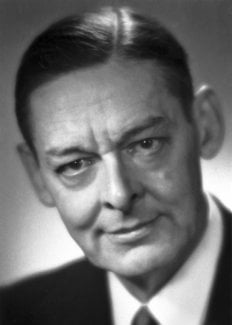
Thomas Stearns Eliot (1888-1965) was born in St. Louis, Missouri, of an old New England family. He was educated at Harvard and did graduate work in philosophy at the Sorbonne, Harvard, and Merton College, Oxford. He settled in England, where he was for a time a schoolmaster and a bank clerk, and eventually literary editor for the publishing house Faber & Faber, of which he later became a director. He founded and, during the seventeen years of its publication (1922-1939), edited the exclusive and influential literary journal Criterion. In 1927, Eliot became a British citizen and about the same time entered the Anglican Church.
Eliot has been one of the most daring innovators of twentieth-century poetry. Never compromising either with the public or indeed with language itself, he has followed his belief that poetry should aim at a representation of the complexities of modern civilization in language and that such representation necessarily leads to difficult poetry. Despite this difficulty his influence on modern poetic diction has been immense. Eliot’s poetry from Prufrock (1917) to the Four Quartets (1943) reflects the development of a Christian writer: the early work, especially The Waste Land (1922), is essentially negative, the expression of that horror from which the search for a higher world arises. In Ash Wednesday (1930) and the Four Quartets this higher world becomes more visible; nonetheless Eliot has always taken care not to become a «religious poet». and often belittled the power of poetry as a religious force. However, his dramas Murder in the Cathedral (1935) and The Family Reunion (1939) are more openly Christian apologies. In his essays, especially the later ones, Eliot advocates a traditionalism in religion, society, and literature that seems at odds with his pioneer activity as a poet. But although the Eliot of Notes towards the Definition of Culture (1948) is an older man than the poet of The Waste Land, it should not be forgotten that for Eliot tradition is a living organism comprising past and present in constant mutual interaction. Eliot’s plays Murder in the Cathedral (1935), The Family Reunion (1939), The Cocktail Party (1949), The Confidential Clerk (1954), and TheElderStatesman(1959) were published in one volume in 1962; Collected Poems 1909-62 appeared in 1963.
This autobiography/biography was written at the time of the award and first published in the book series Les Prix Nobel. It was later edited and republished in Nobel Lectures. To cite this document, always state the source as shown above.
T.S. Eliot died on January 4, 1965.