Saul Bellow – Nominations
Saul Bellow – Other resources
Links to other sites
On Saul Bellow from Pegasos Author’s Calendar
Guide to the Saul Bellow Papers 1926-2015 at the University of Chicago Library
Saul Bellow – Banquet speech
Saul Bellow’s speech at the Nobel Banquet, December 10, 1976
Your Majesties, Your Royal Highnesses, Ladies and Gentlemen,
There are not many things on which the world agrees but everyone I think acknowledges the importance of a Nobel Prize. I myself take most seriously the Nobel Committee’s recognition of the highest excellence in several fields and I accept the honor of this award with profound gratitude.
I have no very distinct sense of personal achievement. I loved books and I wrote some. For some reason they were taken seriously. I am glad of that, of course. No one can bear to be ignored. I would, however, have been satisfied with a smaller measure of attention and praise. For when I am praised on all sides I worry a bit. I remember the scriptural warning, “Woe unto you when all men shall speak well of you.” Universal agreement seems to open the door to dismissal. We know how often our contemporaries are mistaken. They are not invariably wrong, but it is not at all a bad idea to remember that they can’t confer immortality on you. Immortality – a chilling thought. I feel that I have scarcely begun to master my trade.
But I need not worry too much that all men will speak well of me. The civilized community agrees that there is no higher distinction than the Nobel Prize but it agrees on little else, so I need not fear that the doom of universal approval is hanging over me. When I publish a book I am often soundly walloped by reviewers – a disagreeable but necessary corrective to selfinflation.
When the Committee’s choice was announced and the press rushed at me (a terrifying phenomenon!) and asked how I felt about winning the Nobel Prize in literature, I said that the child in me (for despite appearances there is a child within) was delighted, the adult skeptical. Tonight is the child’s night entirely. On Sunday I will have some earnest things to say from the pulpit. Sunday is the best day for dark reflections but the child’s claim to this Friday night will not be disputed.
Saul Bellow – Prose
Excerpt from Herzog
If I am out of my mind, it’s all right with me, thought Moses Herzog.
Some people thought he was cracked and for a time he himself had doubted that he was all there. But now, though he still behaved oddly, he felt confident, cheerful, clairvoyant, and strong. He had fallen under a spell and was writing letters to everyone under the sun. He was so stirred by these letters that from the end of June he moved from place to place with a valise full of papers. He had carried this valise from New York to Martha’s Vineyard, but returned from the Vineyard immediately; two days later he flew to Chicago, and from Chicago he went to a village in western Massachusetts. Hidden in the country, he wrote endlessly, fanatically, to the newspapers, to people in public life, to friends and relatives and at last to the dead, his own obscure dead, and finally the famous dead.
It was the peak of summer in the Berkshires. Herzog was alone in the big old house. Normally particular about food, he now ate Silvercup bread from the paper package, beans from the can, and American cheese. Now and then he picked raspberries in the overgrown garden, lifting up the thorny canes with absent-minded caution. As for sleep, he slept on a mattress without sheets – it was his abandoned marriage bed – or in the hammock, covered by his coat. Tall bearded grass and locust and maple seedlings surrounded him in the yard. When he opened his eyes in the night, the stars were near like spiritual bodies. Fires, of course; gases – minerals, heat, atoms, but eloquent at five in the morning to a man lying in a hammock, wrapped in his overcoat.
When some new thought gripped his heart he went to the kitchen, his headquarters, to write it down. The white paint was scaling from the brick walls and Herzog sometimes wiped mouse droppings from the table with his sleeve, calmly wondering why field mice should have such a passion for wax and paraffin. They made holes in paraffin-sealed preserves; they gnawed birthday candles down to the wicks. A rat chewed into a package of bread, leaving the shape of its body in the layers of slices. Herzog ate the other half of the loaf spread with jam. He could share with rats too.
All the while, one corner of his mind remained open to the external world. He heard the crows in the morning. Their harsh call was delicious. He heard the thrushes at dusk. At night there was a barn owl. When he walked in the garden, excited by a mental letter, he saw roses winding about the rain spout; or mulberries – birds gorging in the mulberry tree. The days were hot, the evenings flushed and dusty. He looked keenly at everything but he felt half blind.
His friend, his former friend, Valentine, and his wife, his ex-wife Madeleine, had spread the rumor that his sanity had collapsed. Was it true?
He was taking a turn around the empty house and saw the shadow of his face in a gray, webby window. He looked weirdly tranquil. A radiant line went from mid-forehead over his straight nose and full, silent lips.
Late in spring Herzog had been overcome by the need to explain, to have it out, to justify, to put in perspective, to clarify, to make amends.
At that time he had been giving adult-education lectures in a New York night school. He was clear enough in April but by the end of May he began to ramble. It became apparent to his students that they would never learn much about The Roots of Romanticism but that they would see and hear odd things. One after another, the academic formalities dropped away. Professor Herzog had the unconscious frankness of a man deeply preoccupied. And toward the end of the term there were long pauses in his lectures. He would stop, muttering “Excuse me,” reaching inside his coat for his pen. The table creaking, he wrote on scraps of paper with a great pressure of eagerness in his hand; he was absorbed, his eyes darkly circled. His white face showed everything – everything. He was reasoning, arguing, he was suffering, he had thought of a brilliant alternative – he was wide-open, he was narrow; his eyes, his mouth made everything silently clear – longing, bigotry, bitter anger. One could see it all. The class waited three minutes, five minutes, utterly silent.
Excerpt from Herzog by Saul Bellow
Copyright © 1961, 1963, 1964, Saul Bellow
Copyright renewed: 1989, 1991, 1992, Saul Bellow
Published by permission of the Wylie Agency
Excerpt selected by the Nobel Library of the Swedish Academy.
Saul Bellow – Photo gallery

Saul Bellow, Nobel Laureate in Literature 1976.
Copyright © University of Chicago

Saul Bellow autographing his books.
Copyright © University of Chicago

Left-to-right: 1966 Nobel Laureate in Chemistry Robert S. Mulliken, 1966 Nobel Laureate in Physiology or Medicine Charles B. Huggins, 1976 Economics Laureate Milton Friedman and his wife Rose, and Saul Bellow with his wife Alexandra Ionescu Tulcea at a Nobel Ceremony at the University of Chicago, 1977.
Copyright © University of Chicago
Saul Bellow – Documentary
Saul Bellow – Bibliography
| Original |
| Dangling Man. – New York: Vanguard, 1944 |
| The Victim. – New York: Vanguard, 1947 |
| The Adventures of Augie March: a novel. – New York: Viking, 1953 |
| Seize the Day. – New York: Viking, 1956 |
| Henderson the Rain King. – New York: Viking, 1959 |
| Herzog. – New York: Viking, 1964 |
| The Last Analysis: a play. – New York: Viking, 1965 |
| Mosby’s Memoirs and Other Stories. – New York: Viking, 1968. |
| Mr Sammler’s Planet. – New York: Viking, 1970 |
| Humboldt’s Gift. – New York: Viking, 1975 |
| To Jerusalem and Back: A Personal Account. – New York: Viking, 1976 |
| Nobel Lecture: [Stockholm, December 12, 1976]. – Stockholm: United States information service, 1977 |
| The Dean’s December: a novel. – New York: Harper & Row, 1982 |
| Him with His Foot in His Mouth and Other Stories. – New York: Harper & Row, 1984 |
| More Die of Heartbreak. – New York: Morrow, 1987 |
| A Theft. – New York : Penguin, 1989 |
| The Bellarosa Connection. – New York: Penguin, 1989 |
| Something to Remember Me By: three tales. – New York: Viking, 1991 |
| It All Adds Up: From the Dim Past to the Uncertain Future: a nonfiction collection. – New York: Viking, 1994 |
| The Actual. – New York: Viking, 1997 |
| Ravelstein. – New York: Viking, 2000 |
| Collected Stories. – New York: Viking, 2001 |
| Critical studies (selected) |
| Tanner, Tony, Saul Bellow. – Edinburgh: Barnes & Noble, 1965 |
| Clayton, John Jacob, Saul Bellow: In Defense of Man. – Bloomington: Indiana Univ. Press, 1968 |
| Malin, Irving, Saul Bellow’s Fiction. – Carbondale: Southern Illinois Univ. Press, cop. 1969 |
| Dutton, Robert R., Saul Bellow. – New York: Twayae, 1971 |
| Scheer–Schäzler, Brigitte, Saul Bellow. – New York: Unger, cop. 1972 |
| Cohen, Sarah Blacher, Saul Bellow’s Enigmatic Laughter. – Urbana: Univ. of Illinois Press, 1974 |
| Schroeter, James, Saul Bellow and Individualism. – Lausanne: Faculté des Lettres de l’Université, 1978 |
| Wilson, Jonathan, On Bellow’s Planet: Readings from the Dark Side. – Farleigh Dickinson Univ. Press, cop. 1985 |
| Saul Bellow at Seventy-Five: A Collection of Critical Essays/edited by Gerhard Bach; in cooperation with Jakob J. Köllhofer. – Tübingen: Narr, 1991 |
| Hyland, Peter, Saul Bellow. – Basingstoke: Macmillan, 1992 |
| Conversations with Saul Bellow/edited by Gloria L. Cronin and Ben Siegel. – Jackson: Univ. Press of Mississippi, 1994 |
| Bigler, Walter, Figures of Madness in Saul Bellow’s Longer Fiction. – Bern: Lang, cop. 1998 |
| Atlas, James, Bellow: A Biography. – London: Faber and Faber, 2000 |
The Swedish Academy, 2006
Saul Bellow – Nobel diploma
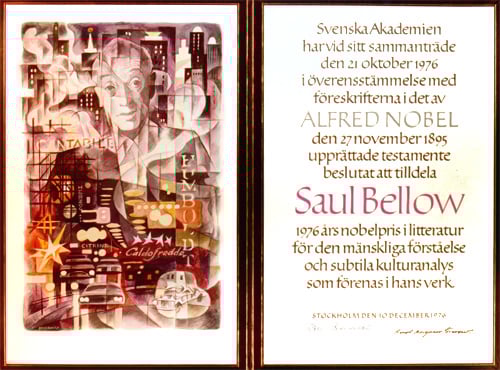
Copyright © The Nobel Foundation 1976
Artist: Gunnar Brusewitz
Calligrapher: Kerstin Anckers
Saul Bellow – Nobel Lecture
December 12, 1976
I was a very contrary undergraduate more than 40 years ago. It was my habit to register for a course and then to do most of my reading in another field of study. So that when I should have been grinding away at “Money and Banking” I was reading the novels of Joseph Conrad. I have never had reason to regret this. Perhaps Conrad appealed to me because he was like an American – he was an uprooted Pole sailing exotic seas, speaking French and writing English with extraordinary power and beauty. Nothing could be more natural to me, the child of immigrants who grew up in one of Chicago’s immigrant neighborhoods of course! – a Slav who was a British sea captain and knew his way around Marseilles and wrote an Oriental sort of English. But Conrad’s real life had little oddity in it. His themes were straightforward – fidelity, command, the traditions of the sea, hierarchy, the fragile rules sailors follow when they are struck by a typhoon. He believed in the strength of these fragile-seeming rules, and in his art. His views on art were simply stated in the preface to The Nigger of the Narcissus. There he said that art was an attempt to render the highest justice to the visible universe: that it tried to find in that universe, in matter as well as in the facts of life, what was fundamental, enduring, essential. The writer’s method of attaining the essential was different from that of the thinker or the scientist. These, said Conrad, knew the world by systematic examination. To begin with the artist had only himself; he descended within himself and in the lonely regions to which he descended, he found “the terms of his appeal”. He appealed, said Conrad, “to that part of our being which is a gift, not an acquisition, to the capacity for delight and wonder… our sense of pity and pain, to the latent feeling of fellowship with all creation – and to the subtle but invincible conviction of solidarity that knits together the loneliness of innumerable hearts… which binds together all humanity – the dead to the living and the living to the unborn.”
This fervent statement was written some 80 years ago and we may want to take it with a few grains of contemporary salt. I belong to a generation of readers that knew the long list of noble or noble-sounding words, words like “invincible conviction” or “humanity” rejected by writers like Ernest Hemingway. Hemingway spoke for the soldiers who fought in the First World War under the inspiration of Woodrow Wilson and other rotund statesmen whose big words had to be measured against the frozen corpses of young men paving the trenches. Hemingway’s youthful readers were convinced that the horrors of the 20th Century had sickened and killed humanistic beliefs with their deadly radiations. I told myself, therefore, that Conrad’s rhetoric must be resisted. But I never thought him mistaken. He spoke directly to me. The feeling individual appeared weak – he felt nothing but his own weakness. But if he accepted his weakness and his separateness and descended into himself intensifying his loneliness, he discovered his solidarity with other isolated creatures.
I feel no need now to sprinkle Conrad’s sentences with skeptical salt. But there are writers for whom the Conradian novel – all novels of that sort – are gone forever. Finished. There is, for instance, M. Alain Robbe-Grillet, one of the leaders of French literature, a spokesman for “thingism” – choseisme. He writes that in great contemporary works, Sartre’s Nausea, Camus’ The Stranger, or Kafka’s The Castle, there are no characters; you find in such books not individuals but – well, entities. “The novel of characters,” he says, “belongs entirely in the past. It describes a period: that which marked the apogee of the individual.” This is not necessarily an improvement; that Robbe-Grillet admits. But it is the truth. Individuals have been wiped out. “The present period is rather one of administrative numbers. The world’s destiny has ceased, for us, to be identified with the rise and fall of certain men of certain families.” He goes on to say that in the days of Balzac’s bourgeoisie it was important to have a name and a character; character was a weapon in the struggle for survival and success. In that time, “It was something to have a face in a universe where personality represented both the means and the end of all exploration.” But our world, he concludes, is more modest. It has renounced the omnipotence of the person. But it is more ambitious as well, “since it looks beyond. The exclusive cult of the ‘human’ has given way to a larger consciousness, one that is less anthropocentric.” However, he comforts us, a new course and the promise of new discoveries lie before us.
On an occasion like this I have no appetite for polemics. We all know what it is to be tired of “characters”. Human types have become false and boring. D.H. Lawrence put it early in this century that we human beings, our instincts damaged by Puritanism, no longer care for, were physically repulsive to one another. “The sympathetic heart is broken,” he said. He went further, “We stink in each other’s nostrils.” Besides, in Europe the power of the classics has for centuries been so great that every country has its “identifiable personalities” derived from Molière, Racine, Dickens or Balzac. An awful phenomenon. Perhaps this is connected with the wonderful French saying. “Sil y a un caractère, il est mauvais.” It leads one to think that the unoriginal human race tends to borrow what it needs from convenient sources, much as new cities have often been made out of the rubble of old ones. Then, too, the psychoanalytic conception of character is that it is an ugly rigid formation – something we must resign ourselves to, not a thing we can embrace with joy. Totalitarian ideologies, too, have attacked bourgeois individualism, sometimes identifying character with property. There is a hint of this in M. Robbe-Grillet’s argument. Dislike of personality, bad masks, false being have had political results.
But I am interested here in the question of the artist’s priorities. Is it necessary, or good, that he should begin with historical analysis, with ideas or systems? Proust speaks in Time Regained of a growing preference among young and intelligent readers for works of an elevated analytical, moral or sociological tendency. He says that they prefer to Bergotte (the novelist in Remembrance of Things Past) writers who seem to them more profound. “But,” says Proust, “from the moment that works of art are judged by reasoning, nothing is stable or certain, one can prove anything one likes.”
The message of Robbe-Grillet is not new. It tells us that we must purge ourselves of bourgeois anthropocentricism and do the classy things that our advanced culture requires. Character? “Fifty years of disease, the death notice signed many times over by the serious essayists,” says Robbe-Grillet, “yet nothing has managed to knock it off the pedestal on which the 19th century had placed it. It is a mummy now, but one still enthroned with the same phony majesty, among the values revered by traditional criticism.”
The title of Robbe-Grillet’s essay is On Several Obsolete Notions. I myself am tired of obsolete notions and of mummies of all kinds but I never tire of reading the master novelists. And what is one to do about the characters in their books? Is it necessary to discontinue the investigation of character? Can anything so vivid in them now be utterly dead? Can it be that human beings are at a dead end? Is individuality really so dependent on historical and cultural conditions? Can we accept the account of those conditions we are so “authoritatively” given? I suggest that it is not in the intrinsic interest of human beings but in these ideas and accounts that the problem lies. The staleness, the inadequacy of these repels us. To find the source of trouble we must look into our own heads.
The fact that the death notice of character “has been signed by the most serious essayists” means only that another group of mummies, the most respectable leaders of the intellectual community, has laid down the law. It amuses me that these serious essayists should be allowed to sign the death notices of literary forms. Should art follow culture? Something has gone wrong.
There is no reason why a novelist should not drop “character” if the strategy stimulates him. But it is nonsense to do it on the theoretical ground that the period which marked the apogee of the individual, and so on, has ended. We must not make bosses of our intellectuals. And we do them no good by letting them run the arts. Should they, when they read novels, find nothing in them but the endorsement of their own opinions? Are we here on earth to play such games?
Characters, Elizabeth Bowen once said, are not created by writers. They pre-exist and they have to be found. If we do not find them, if we fail to represent them, the fault is ours. It must be admitted, however, that finding them is not easy. The condition of human beings has perhaps never been more difficult to define. Those who tell us that we are in an early stage of universal history must be right. We are being lavishly poured together and seem to be experiencing the anguish of new states of consciousness. In America many millions of people have in the last forty years received a “higher education” – in many cases a dubious blessing. In the upheavals of the Sixties we felt for the first time the effects of up-to-date teachings, concepts, sensitivities, the pervasiveness of psychological, pedagogical, political ideas.
Every year we see scores of books and articles which tell the Americans what a state they are in – which make intelligent or simpleminded or extravagant or lurid or demented statements. All reflect the crises we are in while telling us what we must do about them; these analysts are produced by the very disorder and confusion they prescribe for. It is as a writer that I am considering their extreme moral sensitivity, their desire for perfection, their intolerance of the defects of society, the touching, the comical boundlessness of their demands, their anxiety, their irritability, their sensitivity, their tendermindedness, their goodness, their convulsiveness, the recklessness with which they experiment with drugs and touch-therapies and bombs. The ex-Jesuit Malachi Martin in his book on the Church compares the modern American to Michelangelo’s sculpture, The Captive. He sees “an unfinished struggle to emerge whole” from a block of matter. The American “captive” is beset in his struggle by “interpretations, admonitions, forewarnings and descriptions of himself by the self-appointed prophets, priests, judges and prefabricators of his travail,” says Martin.
Let me take a little time to look more closely at this travail. In private life, disorder or near-panic. In families – for husbands, wives, parents, children – confusion; in civic behavior, in personal loyalities, in sexual practices (I will not recite the whole list; we are tired of hearing it) – further confusion. And with this private disorder goes public bewilderment. In the papers we read what used to amuse us in science fiction – The New York Times speaks of death rays and of Russian and American satellites at war in space. In the November Encounter so sober and responsible an economist as my colleague, Milton Friedman, declares that Great Britain by its public spending will soon go the way of poor countries like Chile. He is appalled by his own forecast. What – the source of that noble tradition of freedom and democratic rights that began with Magna Carta ending in dictatorship? “It is almost impossible for anyone brought up in that tradition to utter the word that Britain is in danger of losing freedom and democracy; and yet it is a fact!”
It is with these facts that knock us to the ground that we try to live. If I were debating with Professor Friedman I might ask him to take into account the resistance of institutions, the cultural differences between Great Britain and Chile, differences in national character and traditions, but my purpose is not to get into debates I can’t win but to direct your attention to the terrible predictions we have to live with, the background of disorder, the visions of ruin.
You would think that one such article would be enough for a single number of a magazine but on another page of Encounter Professor Hugh Seton-Watson discusses George Kennan’s recent survey of American degeneracy and its dire meaning for the world. Describing America’s failure, Kennan speaks of crime, urban decay, drug-addiction, pornography, frivolity, deteriorated educational standards and concludes that our immense power counts for nothing. We cannot lead the world and, undermined by sinfulness, we may not be able to defend ourselves. Professor Seton-Watson writes, “Nothing can defend a society if its upper 100,000 men and women, both the decision-makers and those who help to mould the thinking of the decision-makers, are resolved to capitulate.”
So much for the capitalist superpower. Now what about its ideological adversaries? I turn the pages of Encounter to a short study by Mr. George Watson, Lecturer in English at Cambridge, on the racialism of the Left. He tells us that Hyndman, the founder of the Social Democratic Federation, called the South African war the Jews’ war; that the Webbs at times expressed racialist views (as did Ruskin, Carlyle and T. H. Huxley before them); he relates that Engels denounced the smaller Slav peoples of Eastern Europe as counter-revolutionary ethnic trash; and Mr. Watson in conclusion cites a public statement by Ulrike Meinhof of the West German “Red Army Faction” made at a judicial hearing in 1972 approving of “revolutionary extermination”. For her, German anti-semitism of the Hitler period was essentially anticapitalist. “Auschwitz,” she is quoted as saying, “meant that six million Jews were killed and thrown on the waste heap of Europe for what they were: money Jews (Geldjuden).”
I mention these racialists of the Left to show that for us there is no simple choice between the children of light and the children of darkness. Good and evil are not symmetrically distributed along political lines. But I have made my point; we stand open to all anxieties. The decline and fall of everything is our daily dread, we are agitated in private life and tormented by public questions.
And art and literature – what of them? Well, there is a violent uproar but we are not absolutely dominated by it. We are still able to think, to discriminate, and to feel. The purer, subtler, higher activities have not succumbed to fury or to nonsense. Not yet. Books continue to be written and read. It may be more difficult to reach the whirling mind of a modern reader but it is possible to cut through the noise and reach the quiet zone. In the quiet zone we may find that he is devoutly waiting for us. When complications increase, the desire for essentials increases too. The unending cycle of crises that began with the First World War has formed a kind of person, one who has lived through terrible, strange things, and in whom there is an observable shrinkage of prejudices, a casting off of disappointing ideologies, an ability to live with many kinds of madness, an immense desire for certain durable human goods – truth, for instance, or freedom, or wisdom. I don’t think I am exaggerating; there is plenty of evidence for this. Disintegration? Well, yes. Much is disintegrating but we are experiencing also an odd kind of refining process. And this has been going on for a long time. Looking into Proust’s Time Regained I find that he was clearly aware of it. His novel, describing French society during the Great War, tests the strength of his art. Without art, he insists, shirking no personal or collective horrors, we do not know ourselves or anyone else. Only art penetrates what pride, passion, intelligence and habit erect on all sides – the seeming realities of this world. There is another reality, the genuine one, which we lose sight of. This other reality is always sending us hints, which, without art, we can’t receive. Proust calls these hints our “true impressions.” The true impressions, our persistent intuitions, will, without art, be hidden from us and we will be left with nothing but a “terminology for practical ends which we falsely call life.” Tolstoy put the matter in much the same way. A book like his Ivan Ilyitch also describes these same “practical ends” which conceal both life and death from us. In his final sufferings Ivan Ilyitch becomes an individual, a “character”, by tearing down the concealments, by seeing through the “practical ends.”
Proust was still able to keep a balance between art and destruction, insisting that art was a necessity of life, a great independent reality, a magical power. But for a long time art has not been connected, as it was in the past, with the main enterprise. The historian Edgar Wind tells us in Art and Anarchy that Hegel long ago observed that art no longer engaged the central energies of man. These energies were now engaged by science – a “relentless spirit of rational inquiry.” Art had moved to the margins. There it formed “a wide and splendidly varied horizon.” In an age of science people still painted and wrote poetry but, said Hegel, however splendid the gods looked in modern works of art and whatever dignity and perfection we might find “in the images of God the Father and the Virgin Mary” it was of no use: we no longer bent our knees. It is a long time since the knees were bent in piety. Ingenuity, daring exploration, freshness of invention replaced the art of “direct relevance.” The most significant achievement of this pure art, in Hegel’s view, was that, freed from its former responsibilities, it was no longer “serious.” Instead it raised the soul through the “serenity of form above any painful involvement in the limitations of reality.” I don’t know who would make such a claim today for an art that raises the soul above painful involvements with reality. Nor am I sure that at this moment, it is the spirit of rational inquiry in pure science that engages the central energies of man. The center seems (temporarily perhaps) to be filled up with the crises I have been describing.
There were European writers in the 19th Century who would not give up the connection of literature with the main human enterprise. The very suggestion would have shocked Tolstoy and Dostoevski. But in the West a separation between great artists and the general public took place. They developed a marked contempt for the average reader and the bourgeois mass. The best of them saw clearly enough what sort of civilization Europe had produced, brilliant but unstable, vulnerable, fated to be overtaken by catastrophe, the historian Erich Auerbach tells us. Some of these writers, he says, produced “strange and vaguely terrifying works, or shocked the public by paradoxical and extreme opinions. Many of them took no trouble to facilitate the understanding of what they wrote – whether out of contempt for the public, the cult of their own inspiration, or a certain tragic weakness which prevented them from being at once simple and true.”
In the 20th Century, theirs is still the main influence, for despite a show of radicalism and innovation our contemporaries are really very conservative. They follow their 19th-Century leaders and hold to the old standard, interpreting history and society much as they were interpreted in the last century. What would writers do today if it would occur to them that literature might once again engage those “central energies”, if they were to recognize that an immense desire had arisen for a return from the periphery, for what was simple and true?
Of course we can’t come back to the center simply because we want to; but the fact that we are wanted might matter to us and the force of the crisis is so great that it may summon us back to such a center. But prescriptions are futile. One can’t tell writers what to do. The imagination must find its own path. But one can fervently wish that they – that we – would come back from the periphery. We do not, we writers, represent mankind adequately. What account do Americans give of themselves, what accounts of them are given by psychologists, sociologists, historians, journalists, and writers? In a kind of contractual daylight they see themselves in the ways with which we are so desperately familiar. These images of contractual daylight, so boring to Robbe-Grillet and to me, originate in the contemporary world view: We put into our books the consumer, civil servant, football fan, lover, television viewer. And in the contractual daylight version their life is a kind of death. There is another life coming from an insistent sense of what we are which denies these daylight formulations and the false life – the death in life – they make for us. For it is false, and we know it, and our secret and incoherent resistance to it cannot stop, for that resistance arises from persistent intuitions. Perhaps humankind cannot bear too much reality, but neither can it bear too much unreality, too much abuse of the truth.
We do not think well of ourselves; we do not think amply about what we are. Our collective achievements have so greatly “exceeded” us that we “justify” ourselves by pointing to them. It is the jet plane in which we commonplace human beings have crossed the Atlantic in four hours that embodies such value as we can claim. Then we hear that this is closing time in the gardens of the West, that the end of our capitalist civilization is at hand. Some years ago Cyril Connolly wrote that we were about to undergo “a complete mutation, not merely to be defined as the collapse of the capitalist system, but such a sea-change in the nature of reality as could not have been envisaged by Karl Marx or Sigmund Freud.” This means that we are not yet sufficiently shrunken; we must prepare to be smaller still. I am not sure whether this should be called intellectual analysis or analysis by an intellectual. The disasters are disasters. It would be worse than stupid to call them victories as some statesmen have tried to do. But I am drawing attention to the fact that there is in the intellectual community a sizeable inventory of attitudes that have become respectable – notions about society, human nature, class, politics, sex, about mind, about the physical universe, the evolution of life. Few writers, even among the best, have taken the trouble to re-examine these attitudes or orthodoxies. Such attitudes only glow more powerfully in Joyce or D.H. Lawrence than in the books of lesser men; they are everywhere and no one challenges them seriously. Since the Twenties, how many novelists have taken a second look at D.H. Lawrence, or argued a different view of sexual potency or the effects of industrial civilization on the instincts? Literature has for nearly a century used the same stock of ideas, myths, strategies. “The most serious essayists of the last fifty years,” says Robbe-Grillet. Yes, indeed. Essay after essay, book after book, confirm the most serious thoughts – Baudelairian, Nietzschean, Marxian, Psychoanalytic, etcetera, etcetera – of these most serious essayists. What Robbe-Grillet says about character can be said also about these ideas, maintaining all the usual things about mass society, dehumanization and the rest. How weary we are of them. How poorly they represent us. The pictures they offer no more resemble us than we resemble the reconstructed reptiles and other monsters in a museum of paleontology. We are much more limber, versatile, better articulated, there is much more to us, we all feel it.
What is at the center now? At the moment, neither art nor science but mankind determining, in confusion and obscurity, whether it will endure or go under. The whole species – everybody – has gotten into the act. At such a time it is essential to lighten ourselves, to dump encumbrances, including the encumbrances of education and all organized platitudes, to make judgments of our own, to perform acts of our own. Conrad was right to appeal to that part of our being which is a gift. We must hunt for that under the wreckage of many systems. The failure of those systems may bring a blessed and necessary release from formulations, from an over-defined and misleading consciousness. With increasing frequency I dismiss as merely respectable opinions I have long held – or thought I held – and try to discern what I have really lived by, and what others live by. As for Hegel’s art freed from “seriousness” and glowing on the margins, raising the soul above painful involvement in the limitations of reality through the serenity of form, that can exist nowhere now, during this struggle for survival. However, it is not as though the people who engaged in this struggle had only a rudimentary humanity, without culture, and knew nothing of art. Our very vices, our mutilations, show how rich we are in thought and culture. How much we know. How much we even feel. The struggle that convulses us makes us want to simplify, to reconsider, to eliminate the tragic weakness which prevented writers – and readers – from being at once simple and true.
Writers are greatly respected. The intelligent public is wonderfully patient with them, continues to read them and endures disappointment after disappointment, waiting to hear from art what it does not hear from theology, philosophy, social theory, and what it cannot hear from pure science. Out of the struggle at the center has come an immense, painful longing for a broader, more flexible, fuller, more coherent, more comprehensive account of what we human beings are, who we are, and what this life is for. At the center humankind struggles with collective powers for its freedom, the individual struggles with dehumanization for the possession of his soul. If writers do not come again into the center it will not be because the center is pre-empted. It is not. They are free to enter. If they so wish.
The essence of our real condition, the complexity, the confusion, the pain of it is shown to us in glimpses, in what Proust and Tolstoy thought of as “true impressions”. This essence reveals, and then conceals itself. When it goes away it leaves us again in doubt. But we never seem to lose our connection with the depths from which these glimpses come. The sense of our real powers, powers we seem to derive from the universe itself, also comes and goes. We are reluctant to talk about this because there is nothing we can prove, because our language is inadequate and because few people are willing to risk talking about it. They would have to say, “There is a spirit” and that is taboo. So almost everyone keeps quiet about it, although almost everyone is aware of it.
The value of literature lies in these intermittent “true impressions”. A novel moves back and forth between the world of objects, of actions, of appearances, and that other world from which these “true impressions” come and which moves us to believe that the good we hang onto so tenaciously – in the face of evil, so obstinately – is no illusion.
No one who has spent years in the writing of novels can be unaware of this. The novel can’t be compared to the epic, or to the monuments of poetic drama. But it is the best we can do just now. It is a sort of latter-day lean-to, a hovel in which the spirit takes shelter. A novel is balanced between a few true impressions and the multitude of false ones that make up most of what we call life. It tells us that for every human being there is a diversity of existences, that the single existence is itself an illusion in part, that these many existences signify something, tend to something, fulfill something; it promises us meaning, harmony and even justice. What Conrad said was true, art attempts to find in the universe, in matter as well as in the facts of life, what is fundamental, enduring, essential.
* Disclaimer
Every effort has been made by the publisher to credit organizations and individuals with regard to the supply of audio files. Please notify the publishers regarding corrections.