Czesław Miłosz – Other resources
Links to other sites
On Czesław Miłosz from The Poetry Foundation
On Czesław Miłosz from Pegasos Author’s Calendar
On Czesław Miłosz from The Academy of American Poets
On Czesław Miłosz from Culture.pl
Czesław Miłosz – Poetry
English
Polish
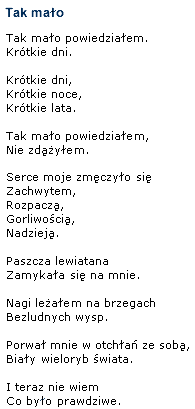
Czeslaw Milosz
Poezje, 1981
Copyright © Czeslaw Milosz
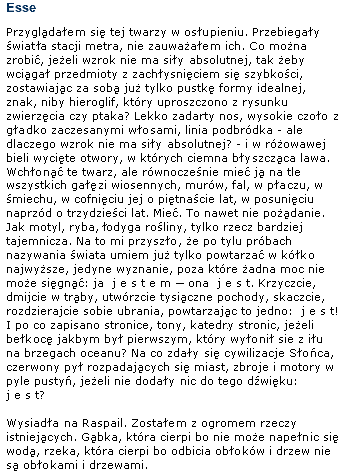
Brie-Comte-Robert, 1954
Czeslaw Milosz
Poezje, 1981
Copyright © Czeslaw Milosz
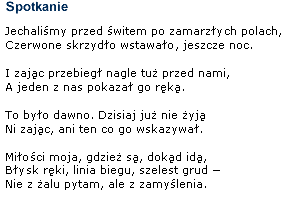
Wilno, 1937
Czeslaw Milosz
Poezje, 1981
Copyright © Czeslaw Milosz
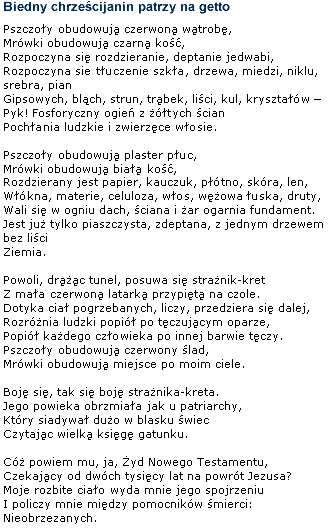
Czeslaw Milosz
Poezje, 198
Copyright © Czeslaw Milosz
Czesław Miłosz – Interview
Interview with Czesław Miłosz by Professor Malgorzata Anna Packalén in Cracow, 10 December 2003.*
I came to Cracow on a foggy day just before Christmas 2003 to interview Czesław Miłosz, winner of the Nobel Prize in Literature, for the Swedish newspaper Göteborgs-Posten. After having lived most of his life in exile, it is no surprise that Miłosz chose to spend his final years in Cracow – no other Polish city offers such a fascinating fusion of culture, tradition and modernity.
Miłosz was born in 1911 in Lithuania, at that time a part of Russia. He studied in Vilnius and made his debut as a poet in 1933. He was considered to be one of the most promising young Polish poets in the years between the First and Second World Wars. After the Second World War Czeslaw Miłosz served as diplomat for the People’s Poland. In 1951 he left the post and sought political asylum in France. In 1961 he accepted an offer of a professorship at the University of California in Berkeley, where he lectured for over 20 years, devoting his time simultaneously to academic duties, writing and translating.
Although his works were banned in Poland during his exile in Europe and the US, they reached Polish readers by different clandestine routes, even long before he won the Nobel Prize. Winning the prize in 1980 however, made it possible for him to return to Poland after 30 years’ absence and it also made it possible for his works to be officially published in his home country again. In a formal ceremony in the middle of the 1990s Miłosz was given a symbolic key to the city of Cracow and a newly renovated flat, which he accepted with gratitude. Having settled down in Poland, he spent his time between Cracow and Berkeley, two cities with great significance for his life and career.
Czesław Miłosz received me with a somewhat old-fashioned yet graceful Polish chivalry. Warmed up by coffee and his charm, I began asking questions and very soon our conversation turned to Sweden, a country with a special relation to Miłosz not only because of the Nobel Prize. This became apparent when I asked what books had influenced him most as a child. He gave me a broad smile and explained:
CM: One was actually Selma Lagerlöf‘s The Wonderful Adventures of Nils. I’m still convinced that it formed my feeling for literature and taught me the double perspective, of being able to see things both from above and on a more earthly plane.
MAP: I suspect you must also have applied the double perspective when you taught the history of Polish literature at the University of California. My experience has taught me that you never see your own culture so clearly as when it’s reflected in another culture. How, in your opinion, does Polish literature differ from the literature of other cultures? What is its most distinctive feature?
CM: Without doubt Polish literature’s constant struggle with history. There is simply no other country in Europe that suddenly disappeared from the map for over 100 years as Poland did in 1795, when it was partitioned between Russia, Prussia and Austria. After a brief respite between the First and Second World Wars, Poland lost its statehood again in 1939 when it was divided in an agreement between Hitler and Stalin. All of this is complicated, of course, and it isn’t easy to explain to foreigners the martyrdom of Polish literature and its struggle for liberation, especially if you want to avoid unnecessary pathos. But we Poles are all too aware of the heavy burden that history has forced upon us. Polish writers were thrown into all this against their will, and these historically difficult situations also meant that they were forced to take a political stand.
MAP: I can’t help thinking of one of your poems that became very well known due to its controversial Polish-Jewish theme. I mean “Campo dei Fiori”, which you wrote in Warsaw in 1943. You compare Giordano Bruno’s death on a pyre and the people’s indifference to it with the doomed Jews’ struggle in the Warsaw ghetto. Poles would like to think that this poem rescued the conscience of Polish war literature. What is your feeling about that?
CM: There are people who say that what I described was just a literary metaphor. But in fact, I passed the ghetto as I was riding the tram and saw all that horror with my own eyes… The main theme of the poem is the vulnerability and aloneness of the dying person, and for that reason the comparison with Giordano Bruno was appropriate; the death of each and every individual can be compared with this. The poem was born out of a sort of moral obligation, when you feel that you must react.
MAP: You said that Polish writers were often forced to take a political stand. You were also repeatedly forced to take such a stand, for instance in 1980 when you gave your undivided support to the Solidarity Movement. Even much earlier, in the 1950s, you described the spiritual oppression behind the Iron Curtain in your book The Captive Mind. People reacted very strongly to that book and it helped many readers in the Western world to understand the mechanisms of the totalitarian state. But isn’t it so that your having been on the safe side of the Iron Curtain was turned against you? …
CM: I wrote that book under great inner conflict, it was meant primarily for readers in the West. Today we face an entirely different problem: that the book – which deals with the dark sides of the communistic system, with propaganda, interrogations, censorship etc., is completely incomprehensible to the young generation in Poland. Probably because Marxism and the communistic ideology in Poland were forced upon the people from above. Their roots quite simply don’t go very deep. It was never taken very seriously in Polish intellectual circles. And, because of censorship, it was hardly widespread in the country. What’s interesting now about The Captive Mind is that it recently came out for the first time in Russia. Why, we can ask. Perhaps because it’s become topical again now, as we start again to see certain totalitarian tendencies in Russian society. The book is still also very widely read and discussed in American universities and colleges since it’s considered to portray an important part of the history of the 1900s. But that isn’t the case in Poland …
MAP: In other words, one of the Polish paradoxes… But let’s return to your writing: you often bring up the theme of living in exile and of not being able to step into the same river twice, and yet you returned to your native Lithuania after 52 years and described the experience in your autobiographical novel The Issa Valley. What were your feelings about that return?
CM: Writing about exile was a way for me to seek distance just exactly by that distance in time and space. My return to Lithuania was primarily a return to my maternal grandparents’ home in Szetejnie. I have to confess that it was a completely unexpected experience, the meeting with all that lush greenery, exactly as I remembered it from my childhood! Everything else was changed, though, of course, because I saw it then through the eyes of a small child, so that everything that surrounded me had completely different proportions. My return to my childhood home, or more accurately my non-home, because nothing of it remained, was in fact a kind of shock. But in Vilnius, where I spent my school and university years, I had a strange, almost physical, feeling of being surrounded by ghosts, naturally because none of the people I knew before were there any longer, not even their children or their grandchildren. The Jewish population had been murdered during the war and the Poles had largely been deported or had emigrated.
MAP: You once said that Lithuania’s spirit had never left you completely and – what at first surprised me – you compared the Poles in Lithuania with Finno-Swedes in Finland.
CM: Yes, with the difference that the concept “Lithuanian Pole” doesn’t exist in the general Polish consciousness. But if history had developed in another way we would surely have been able to create that label.
MAP: As it is now, there is hardly any environment or national and cultural kinship for people with a background like yours.
CM: That’s true. I feel that very strongly and look for soul mates, but it’s too late. I see myself as one of the last Lithuanian Poles, the “last Mohican”… [laughing]
MAP: How did it feel to come back to Poland after having being considered for so many years an exile writer? Did you identify yourself with that term?
CM: No, in fact I didn’t. Especially considering that I was not in any of the Polish emigrant environments, with the exception of those around the editor Jerzy Giedroyc and his journal/publishing company “Kultura” in Paris. My work was banned in Poland, and Giedroyc published many of my books, so it was in that sense that I was a writer in exile. However, I always felt a great affinity with the intellectual and literary group in Poland and saw myself as one of them, but one who paradoxically enough had wound up in the West.
MAP: What do you think will happen now to the Polish “free” culture? Will it be able to claim a place in the new Europe?
CM: In my youth I was thrown between two totalitarian ideologies: communism on the one hand and nationalism on the other. And I struggled desperately to be able to find a way to approach these two strong currents. Today Polish writers have no points of reference at all, that’s the great difference. It was without a doubt the political factor that characterised Polish literature, both in Poland and abroad. Replacing the old “Polish code” with the “European” is obviously not easy, especially since – which my Irish friend Seamus Heaney pointed out – what gave Polish poetry its special distinction was this unique connection between the political and the personal situation. It’s my opinion however that the most specific Polish factor is probably the Catholic religion. At the same time, Poland is an incomprehensible country to me: Poles worship the Pope but many also act as though the Catholic religion never existed. I believe nevertheless that it is exactly its religious thinking that is one of the most valuable Polish dimensions.
MAP: The “eternal values” that survive all other political events, in other words …?
CM: Absolutely!
MAP: You discussed the concept of “two Europes” – that is, Western and Eastern Europe – early on, in your autobiographical book Native Realm: A Search for Self-Definition that was published in Paris in 1958. What are your thoughts on that now? Is Poland still a part of the second Europe or is it finally beginning to come closer to the first?
CM: That division probably still holds. I mean, that for many years in the general French, German or English consciousness there was a line on the map of Europe behind which no one expected to see anything other than white bears! [laughing] For that reason we have to let time go by, it’s still too early to be able to erase that line completely. I understand that writers today probably have a difficult time finding their way in the new “McDonaldised” reality. But they’re perhaps not aware of one important thing – that Poland is not a “normal” European state, not yet and not with so many historical knots. There are still altogether too many historical complications to take a stand on. That means that writers who now completely ignore political reality are perhaps making a false conclusion.
MAP: You said in your Nobel Lecture that we all, both those who speak and those who listen, are no more than links between the past and the future …
CM: Yes, and I can only add here something that my good friend Joseph Brodsky said – that it isn’t at all that we write for those who come after us. We write to gain the sanction of our forefathers!
MAP: Is there anything that you still carry inside you that for some reason you haven’t yet been able to write about?
CM: My poor vision unfortunately stops me from writing. I was forced to dictate my last books. It’s a burden that also makes certain literary projects impossible. So even if I do probably have a few thoughts it’s getting more and more difficult to accomplish anything …
He gave a melancholy laugh and I joined in. It was easy to do that in his company. Just then his housekeeper walked past the room with a scowl. “Yes, indeed, here you sit and talk and talk while your food gets cold,” she muttered with a displeased look in my direction. Miłosz smiled, obviously amused at her words, but he looked tired and I began to pick up my things. I thought of what the Swedish poet Artur Lundkvist wrote about him in 1979: “His life holds many moments, /…/ they belong to very different times, to very different places. And his words look for and find them from the most different directions.”
Czesław Miłosz passed away on August 14, 2004, at the age of 93. He was buried in Cracow, in the crypt of the Pauline Church, a place of high honour where some of the greatest Polish names rest. With his death Polish literature lost one of its most accomplished writers and most unique twentieth-century literary personalities.
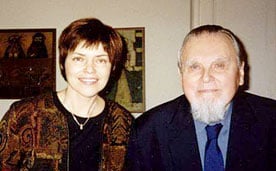
Malgorzata Anna Packalén and Czesław Miłosz (right) photographed in the Laureate’s home on the day of the interview, 10 December 2003.
* A shorter version of the interview was originally published in Göteborgs-Posten 18 January 2004.
Malgorzata Anna Packalén (neé Szulc) was born in Poznan, Poland. She obtained her Bachelor Degree in Polish and Swedish Philology at Adam-Mickiewicz University, Poznan, where she also received her Masters Degree in 1977. She was a recipient of the Swedish Institute’s scholarship program in Sweden in 1975-76.
Packalén has been affiliated to the Department of Modern Languages at Uppsala University since 1979. Here she did research studies in Slavic languages in 1982-87 and received her Ph.D. in Slavic languages in 1987. She was holder of Postdoctoral Fellowships at the Department of Slavic Languages at Uppsala University in 1989-91, Research Fellow at The Swedish Research Council (HSFR) in 1991-92 and has been a researcher and Senior Lecturer in Polish since 1993. She became an Associate Professor at Uppsala University in 1997 and Professor in Polish in 2000.
M.A. Packalén has published a monograph on contemporary Polish poetry Pokolenie 68. Studium o poezji polskiej lat siedemdziesiatych (The Generation of ’68, Studies in Polish Poetry of the 70s., 1987, second ed. 1997), a comparative study of nineteenth- and twentieth-century Polish and Swedish literature Under två kulturers ok (Under the Yoke of Two Cultures, 2001). She is co-editor of an anthology Swedish-Polish Modernism. Literature – Language Culture (2003). Her publications include articles on Polish language, poetry and prose, as well as cultural and gender studies. She was also author of numerous articles on Polish literature for the Swedish National Encyclopedia, Nationalencyklopedin (1990-1999).
Czesław Miłosz – Poetry
English
Polish
So Little
I said so little.
Days were short.
Short days.
Short nights.
Short years.
I said so little.
I couldn’t keep up.
My heart grew weary
From joy,
Despair,
Ardor,
Hope.
The jaws of Leviathan
Were closing upon me.
Naked, I lay on the shores
Of desert islands.
The white whale of the world
Hauled me down to its pit.
And now I don’t know
What in all that was real.
Berkeley, 1969
By Czeslaw Milosz from “The Collected Poems 1931-1987”, 1988
Translated by Czeslaw Milosz and Lillian Vallee
Copyright © Czeslaw Milosz and Lillian Vallee
Esse
I looked at that face, dumbfounded. The lights of métro stations flew by; I didn’t notice them. What can be done, if our sight lacks absolute power to devour objects ecstatically, in an instant, leaving nothing more than the void of an ideal form, a sign like a hieroglyph simplified from the drawing of an animal or bird? A slightly snub nose, a high brow with sleekly brushed-back hair, the line of the chin – but why isn’t the power of sight absolute? – and in a whiteness tinged with pink two sculpted holes, containing a dark, lustrous lava. To absorb that face but to have it simultaneously against the background of all spring boughs, walls, waves, in its weeping, its laughter, moving it back fifteen years, or ahead thirty. To have. It is not even a desire. Like a butterfly, a fish, the stem of a plant, only more mysterious. And so it befell me that after so many attempts at naming the world, I am able only to repeat, harping on one string, the highest, the unique avowal beyond which no power can attain: I am, she is. Shout, blow the trumpets, make thousands-strong marches, leap, rend your clothing, repeating only: is!
She got out at Raspail. I was left behind with the immensity of existing things. A sponge, suffering because it cannot saturate itself; a river, suffering because reflections of clouds and trees are not clouds and trees.
Brie-Comte-Robert, 1954
By Czeslaw Milosz from “The Collected Poems 1931-1987”, 1988
Translated by Czeslaw Milosz and Robert Pinsky
Copyright © Czeslaw Milosz and Robert Pinsky
Encounter
We were riding through frozen fields in a wagon at dawn.
A red wing rose in the darkness.
And suddenly a hare ran across the road.
One of us pointed to it with his hand.
That was long ago. Today neither of them is alive,
Not the hare, nor the man who made the gesture.
O my love, where are they, where are they going
The flash of a hand, streak of movement, rustle of pebbles.
I ask not out of sorrow, but in wonder.
Wilno, 1936
By Czeslaw Milosz from “The Collected Poems 1931-1987”, 1988
Translated by Czeslaw Milosz and Lillian Vallee
Copyright © Czeslaw Milosz and Lillian Vallee
A Poor Christian Looks at the Ghetto
Bees build around red liver,
Ants build around black bone.
It has begun: the tearing, the trampling on silks,
It has begun: the breaking of glass, wood, copper, nickel, silver, foam
Of gypsum, iron sheets, violin strings, trumpets, leaves, balls, crystals.
Poof! Phosphorescent fire from yellow walls
Engulfs animal and human hair.
Bees build around the honeycomb of lungs,
Ants build around white bone.
Torn is paper, rubber, linen, leather, flax,
Fiber, fabrics, cellulose, snakeskin, wire.
The roof and the wall collapse in flame and heat seizes the foundations.
Now there is only the earth, sandy, trodden down,
With one leafless tree.
Slowly, boring a tunnel, a guardian mole makes his way,
With a small red lamp fastened to his forehead.
He touches buried bodies, counts them, pushes on,
He distinguishes human ashes by their luminous vapor,
The ashes of each man by a different part of the spectrum.
Bees build around a red trace.
Ants build around the place left by my body.
I am afraid, so afraid of the guardian mole.
He has swollen eyelids, like a Patriarch
Who has sat much in the light of candles
Reading the great book of the species.
What will I tell him, I, a Jew of the New Testament,
Waiting two thousand years for the second coming of Jesus?
My broken body will deliver me to his sight
And he will count me among the helpers of death:
The uncircumcised.
Warsaw, 1943
By Czeslaw Milosz from “Selected Poems”, 1973
Translated by Czeslaw Milosz
Copyright © Czeslaw Milosz
Poems selected by the Nobel Library of the Swedish Academy, and Michal Bron.
Czesław Miłosz – Banquet speech
Czesław Miłosz’ speech at the Nobel Banquet, December 10, 1980
Your Majesty, Your Royal Highnesses, Ladies and Gentlemen,
I accept this highest honor on behalf of all men and women for whom I am not so much an individual as a voice, and someone who belongs to them. They should be invoked here, and they come from more than one country. First of all, I think of those who cherish the Polish language and literature, wherever they live, in Poland or abroad; I also think of my part of Europe, the nations situated between Germany and Russia, the nations in whose future of freedom and dignity I believe; and particularly my thoughts go to a country where I was born, Lithuania. Moreover, since I have lived a long time in exile, I may be legitimately claimed by all those who had to leave their native villages and provinces because of misery of persecution and to adapt themselves to new ways of life; we are millions all over the Earth, for this is a century of exile. Neither should I bypass here my new home country, America, where not only I found, as many before me, hospitality and well-rewarded work, but also the friendship of American poets. And though the University of California, where for twenty years I have been teaching Slavic Literatures, counts among its professors several Nobel Prize winners in science, today it is particularly pleased being able to add to their number its first Nobel laureate in humanities.
There is a paradox inherent in the poet’s calling. Savagely individualistic, pursuing goals which are visible only to his few intimate friends, he grows accustomed to be branded as difficult and obscure, only to discover one day that his poems constitute a link between people and that he must assume, whether he wants it or not, a symbolic role. Living a long time abroad, I gradually became a poet of the young generations in Poland, and, as I guess, my adventure has some auspicious features of a general import. Poets and their readers may be separated by distance but if a spiritual unity between them is preserved, borders and barriers, thatever their nature, have not power. I think that we, both in Poland and outside, accomplished an important thing by refusing to recognize a division of Polish literature into two separate bodies, depending on where a given writer lives. Credit should here be given to those of my colleagues who have not been swayed by absurd doctrines, and to the young who have promoted free exchange of ideas, whether through lectures, periodicals or books. Volumes of my poetry published by their independent presses are most precious items on my bookshelves. No lesser homage is due to the astonishing energy and perseverance of a few persons who founded abroad institutions dedicated to publishing books and periodicals in Polish, such as the Literary Institute in France, that has been active without interruption since the end of the war and has been engaged in issuing books both of authors in exile and of those from Poland. Such a continuity and unity of a culture, maintained in most unfavorable circumstances, speaks against romantic moods of irrevocability and nostalgia, attached by the nineteenth century to the notion of exile.
I am a part of Polish literature which is relatively little known in the world as it is hardly translatable. Comparing it with other literatures, I have been able to appreciate its rich oddity. It is a kind of a secret brotherhood with its own rites of communion with the dead, where weeping and laughter, pathos and irony coexist on an equal footing, history-oriented, always allusive, in this century, as before, it faithfully accompanied the people in their hard trials. Lines of Polish verse circulated underground, were written in barracks of concentration camps and in soldiers’ tents in Asia, Africa, and Europe. To represent here such a literature is to feel humble before testimonies of love and heroic selfsacrifice left by those who are no more. It is my hope that the distinction kindly granted to me by the Swedish Academy indirectly rewards all who guided my hand and whose invisible presence sustained me in difficult moments.
Czesław Miłosz – Bibliography
| Works in Polish |
| Poemat o czasie zastygłym. – Wilno: Kolo Polonistów Sluchaczy Uniwersytetu Stefana Batorego, 1933 |
| Trzy zimy. – Wilno: Zwiazek Zawodowy Literatów Polskich, 1936 |
| Wiersze. – Lwów, 1939 |
| Ocalenie. – Warsaw: Czytelnik, 1945 |
| Swiatlo dzienne. – Paris: Instytut Literacki, 1953 |
| Zniewolony umysł. – Paris: Instytut Literacki, 1953 |
| Zdobycie władzy. – Paris: Instytut Literacki, 1955 |
| Dolina Issy. – Paris: Instytut Literacki, 1955 |
| Traktat poetycki. – Paris: Instytut Literacki, 1957 |
| Kontynenty. – Paris: Instytut Literacki, 1958 |
| Rodzinna Europa. – Paris: Instytut Literacki, 1959 |
| Człowiek wśród skorpionów : studium o Stanislawie Brzozowskim. – Paris: Instytut Literacki, 1962 |
| Król Popiel i inne wiersze. – Paris: Instytut Literacki, 1962 |
| Gucio zaczarowany. – Paris: Instytut Literacki, 1965 |
| Miasto bez imienia. – Paris: Instytut Literacki, 1969 |
| Widzenia nad zatoką San Francisco. – Paris: Instytut Literacki, 1969 |
| Prywatne obowiązki. – Paris: Instytut Literacki, 1972 |
| Gdzie wschodzi słoñce i kêdy zapada i inne wiersze. – Paris: Instytut Literacki, 1974 |
| Utwory poetyckie. – Ann Arbor: Michigan Slavic Publications, 1976 |
| Ziemia Ulro. – Paris: Instytut Literacki, 1977 |
| Ogród nauk. – Paris: Instytut Literacki, 1979 |
| Dziela zbiorowe. – 12 vol. – Paris: Instytut Literacki, 1980-1985 |
| Wiersze zebrane. – 2 vol. – Warsaw: Krag, 1980 |
| Wybór wierszy. – Warsaw: Pañstwowy Instytut Wydawniczy, 1980 |
| Poezje. – Warsaw: Czytelnik, 1981 |
| Hymn o Perele. – Paris: Instytut Literacki, 1982 |
| Piesñ obywatela. – Kraków: Wydawnictwo Swit, 1983 |
| Dialog o Wilnie. – Warsaw: Spoleczny Instytut Wydawniczy “Mlynek,” 1984 |
| Nieobjêta ziemia. – Paris: Instytut Literacki, 1984 |
| Świadectwo poezji. – Kraków: Oficyna Literacka, 1985 |
| Poszukiwania : wybór publicystyki rozproszonej 1931-1983. – Warsaw: Wydawnictwo CDN, 1985 |
| Zaczynajac od moich ulic. – Paris: Instytut Literacki, 1985 |
| Kroniki. – Paris: Instytut Literacki, 1987 |
| Metafizyczna pauza. – Kraków: Znak, 1989 |
| Poematy. – Wroclaw: Wydawnictwo Dolnoslaskie, 1989 |
| Swiat = The World. – San Francisco: Arion Press, 1989 |
| Kolysanka. – Warsaw: Varsovia, 1990 |
| Rok mysliwego. – Paris: Instytut Literacki, 1990 |
| Dalsze okolice. – Kraków: Znak, 1991 |
| Szukanie ojczyzny. – Kraków: Znak, 1992 |
| Wiersze. – 3 vol. – Kraków: Znak, 1993 |
| Na brzegu rzeki. – Kraków: Znak, 1994 |
| Polskie Kontrasty = On Contrasts in Poland. – Kraków: Universitas, 1995 |
| Jakiegoż to gościa mieliśmy. O Annie Świrszczyńskiej. – Kraków: Znak, 1996 |
| Legendy nowoczesności. Eseje okupacyjne. Listy-eseje Jerzego Andrzejewskiego i Czesława Miłosza. – Kraków: Wydawnictwo Literackie, 1996 |
| Poezje wybrane = Selected Poems. – Kraków: Wydawnictwo Literackie, 1996 |
| Abecadło Miłosza. – Kraków: Wydawnictwo Literackie, 1997 |
| Piesek przydrozny. – Kraków: Znak, 1997 |
| Zycie na wyspach. – Kraków : Znak, 1997 |
| Antologia osobista : wiersze, poematy, przeklady. – Warszawa : Znak, 1998 |
| Dar = Gabe. – Kraków : Wydawn. Literackie, 1998 |
| Inne abecadło. – Kraków: Wydawnictwo Literackie, 1998 |
| Zaraz po wojnie : korespondencja z pisarzami 1945-1950. – Kraków: Znak, 1998 |
| Swiat : poema naiwne. – Kraków : Wydawn. Literackie, 1999 |
| Wyprawa w Dwudziestolecie. – Kraków : Wyd. Literackie, 1999 |
| To. – Kraków : Znak, 2000 |
| Wypisy z ksiag uzytecznych. – Kraków : Wydawn. Znak, 2000 |
| Wiersze. T. 1 -. – Kraków : Znak, 2001 – |
| Orfeusz i Eurydyke. – Krakow: Wydwn. Literackie, 2003 |
| Przygody młodego umysłu : publicystyka i proza 1931-1939. – Kraków : Znak, 2003 |
| Spi¿arnia literacka. – Krakow : Wydwn. Literackie , 2004 |
| Jasności promieniste i inne wiersze. – Warszawa : Zeszyty, 2005 |
| Works in English and Translations into English |
| The Captive Mind / translated from the Polish by Jane Zielonko. – New York: Vintage, 1953 |
| The Usurpe / Translated from the Polish by Celina Wieniewska. – London: Faber, 1955 |
| The Seizure of Power / translated from the Polish by Celina Wieniewska. – New York: Criterion Books, 1955 |
| Native Realm: a Search for Self-Definition / translated from the Polish by Catherine S. Leach. – Garden City, N.Y.: Doubleday, 1968 |
| Selected Poems / translated by Czesław Miłosz and Peter Dale Scott. – Harmondsworth: Penguin, 1968 |
| The History of Polish Literature. – London: Macmillan, 1969 |
| Selected Poems / translated by several hands ; introduction by Kenneth Rexroth. – New York: Seabury, 1973 |
| Emperor of the Earth : Modes of Eccentric Vision. – Berkeley: Univ. of Calif. P., cop. 1977 |
| Bells in Winter / translated by the author and Lillian Vallee. – New York: Ecco Press, 1978 |
| Nobel Lecture. – New York: Farrar, Straus and Giroux, cop. 1980 |
| The Issa Valley / translated from the Polish by Louis Iribarne. – New York: Farrar, 1981 |
| Visions from San Francisco Bay / translated by Richard Lourie. – Manchester: Carcanet, 1982 |
| The Witness of Poetry. – Cambridge, Mass.: Harvard University Press, 1983 |
| The Separate Notebooks / translated by Robert Hass and Robert Pinsky with the author and Renata Gorczynski. – New York: Ecco Press, 1984 |
| The Land of Ulro / translated by Louis Iribarne. – New York: Farrar, Straus, Giroux, 1984 |
| The View. – New York: Whitney Museum of American Art, cop. 1985 |
| Unattainable Earth / translated by the author and Robert Hass. – New York: Ecco Press, 1986 |
| The Collected Poems 1931-1987. – New York: Ecco Press, 1988 |
| Exiles / photographs by Josef Koudelka ; essays by Czeslaw Milosz. – New York: Aperture Foundation, cop. 1988 |
| Swiat = The World : a Sequence of Twenty Poems in Polish / translated into English by the poet, with an introduction by Helen Vendler and a portrait of the poet in dry-point engraving by Jim Dine. – San Francisco: Arion Press, 1989 |
| Provinces / translated by the author and Robert Hass. – Hopewell, N.J.: Ecco Press, cop. 1991 |
| Beginning With My Streets : Essays and Recollections / translated by Madeline G. Levine. – New York: Farrar, Straus, Giroux, 1992 |
| A Year of the Hunter / translated by Madeline G. Levine. – New York: Farrar, Straus and Giroux, 1994 |
| Facing the River : New Poems / translated by the author and Robert Hass. – Hopewell, N.J.: Ecco Press, 1995 |
| Polskie Kontrasty = On Contrasts in Poland. – Kraków: Universitas, 1995 |
| Poezje wybrane = Selected Poems. – Kraków: Wydawnictwo Literackie, 1996 |
| Striving Towards Being : the Letters of Thomas Merton and Czeslaw Milosz / edited by Robert Faggen. – New York: Farrar, Straus and Giroux, 1997 |
| Road-Side Dog / translated by the author and Robert Hass. – New York: Farrar, Straus and Giroux, cop. 1998 |
| Aleksander Hertz. – Cracow: The Judaica Foundation Center for Jewish Culture, 2000 |
| A Treatise on Poetry / translated by the author and Robert Hass. – New York Ecco Press, 2001 |
| To Begin Where I Am : Selected Essays / edited and with an introduction by Bogdana Carpenter and Madeline G. Levine. – New York: Farrar, Straus and Giroux, 2001 |
| New and Collected poems 1931-2001. – London Allen Lane ; Penguin Press, 2001 |
| Milosz’s ABCs / translated from the Polish by Madeline G. Levine. – New York : Farrar, Straus and Giroux, 2001 |
| Second Space : New Poems / translated by the author and Robert Hass. – New York: Ecco, 2004 |
| Legends of Modernity : Essays and Letters from Occupied Poland, 1942-43 / translated from the Polish by Madeline G. Levine. – New York Farrar, Straus and Giroux, 2005 |
| Selected Poems, 1931-2004 / foreword by Seamus Heaney. – New York: Ecco, 2006 |
| Critical studies (a selection) |
| Volynska-Bogert, Rimma, Czeslaw Miłosz: an International Bibliography 1930-1980. – Ann Arbor, cop. 1983 |
| Davie, Donald, Czeslaw Miłosz and the Insufficiency of Lyric. – Cambridge : Cambridge University Press, 1986 |
| Between Anxiety and Hope : the Poetry and Writing of Czeslaw Miłosz / edited by Edward Mo¿ejko. – Edmonton : Alta, 1988. |
| Dompkowski, Judith A., “Down a Spiral Staircase, Never-Ending” : Motion as Design in the Writing of Czeslaw Miłosz. – New York: Lang, 1990 |
| Czeslav Miłosz: a Stockholm Conference : September 9-11, 1991 / editor: Nils Ake Nilsson. – Stockholm : Kungl. Vitterhets-, historie- och antikvitetsakad, 1992 |
| Malinowska, Barbara, Dynamics of Being, Space, and Time in the Poetry of Czeslaw Milosz and John Ashbery. – New York: Lang, 2000 |
The Swedish Academy, 2006
Czesław Miłosz – Nobel Lecture
English
Polish
8 December 1980
I
My presence here, on this tribune, should be an argument for all those who praise life’s God-given, marvelously complex, unpredictability. In my school years I used to read volumes of a series then published in Poland – “The Library of the Nobel Laureates”. I remember the shape of the letters and the color of the paper. I imagined then that the Nobel laureates were writers, namely persons who write thick works in prose, and even when I learned that there were also poets among them, for a long time I could not get rid of that notion. And certainly, when, in 1930, I published my first poems in our university review, Alma Mater Vilnensis, I did not aspire to the title of a writer. Also much later, by choosing solitude and giving myself to a strange occupation, that is, to writing poems in Polish while living in France or America, I tried to maintain a certain ideal image of a poet, who, if he wants fame, he wants to be famous only in the village or the town of his birth.
One of the Nobel laureates whom I read in childhood influenced to a large extent, I believe, my notions of poetry. That was Selma Lagerlöf. Her Wonderful Adventures of Nils, a book I loved, places the hero in a double role. He is the one who flies above the Earth and looks at it from above but at the same time sees it in every detail. This double vision may be a metaphor of the poet’s vocation. I found a similar metaphor in a Latin ode of a Seventeenth-Century poet, Maciej Sarbiewski, who was once known all over Europe under the pen-name of Casimire. He taught poetics at my university. In that ode he describes his voyage – on the back of Pegasus – from Vilno to Antwerp, where he is going to visit his poet-friends. Like Nils Holgersson he beholds under him rivers, lakes, forests, that is, a map, both distant and yet concrete. Hence, two attributes of the poet: avidity of the eye and the desire to describe that which he sees. Yet, whoever considers poetry as “to see and to describe” should be aware that he engages in a quarrel with modernity, fascinated as it is with innumerable theories of a specific poetic language.
Every poet depends upon generations who wrote in his native tongue; he inherits styles and forms elaborated by those who lived before him. At the same time, though, he feels that those old means of expression are not adequate to his own experience. When adapting himself, he hears an internal voice that warns him against mask and disguise. But when rebelling, he falls in turn into dependence upon his contemporaries, various movements of the avant-garde. Alas, it is enough for him to publish his first volume of poems, to find himself entrapped. For hardly has the print dried, when that work, which seemed to him the most personal, appears to be enmeshed in the style of another. The only way to counter an obscure remorse is to continue searching and to publish a new book, but then everything repeats itself, so there is no end to that chase. And it may happen that leaving books behind as if they were dry snake skins, in a constant escape forward from what has been done in the past, he receives the Nobel Prize.
What is this enigmatic impulse that does not allow one to settle down in the achieved, the finished? I think it is a quest for reality. I give to this word its naive and solemn meaning, a meaning having nothing to do with philosophical debates of the last few centuries. It is the Earth as seen by Nils from the back of the gander and by the author of the Latin ode from the back of Pegasus. Undoubtedly, that Earth is and her riches cannot be exhausted by any description. To make such an assertion means to reject in advance a question we often hear today: “What is reality?”, for it is the same as the question of Pontius Pilate: “What is truth?” If among pairs of opposites which we use every day, the opposition of life and death has such an importance, no less importance should be ascribed to the oppositions of truth and falsehood, of reality and illusion.
II
Simone Weil, to whose writings I am profoundly indebted, says: “Distance is the soul of beauty.” Yet sometimes keeping distance is nearly impossible. I am A Child of Europe, as the title of one of the my poems admits, but that is a bitter, sarcastic admission. I am also the author of an autobiographical book which in the French translation bears the title Une autre Europe. Undoubtedly, there exist two Europes and it happens that we, inhabitants of the second one, were destined to descend into “the heart of darkness of the Twentieth Century.” I wouldn’t know how to speak about poetry in general. I must speak of poetry in its encounter with peculiar circumstances of time and place. Today, from a perspective, we are able to distinguish outlines of the events which by their death-bearing range surpassed all natural disasters known to us, but poetry, mine and my contemporaries’, whether of inherited or avant-garde style, was not prepared to cope with those catastrophes. Like blind men we groped our way and were exposed to all the temptations the mind deluded itself with in our time.
It is not easy to distinguish reality from illusion, especially when one lives in a period of the great upheaval that begun a couple of centuries ago on a small western peninsula of the Euro-Asiatic continent, only to encompass the whole planet during one man’s lifetime with the uniform worship of science and technology. And it was particularly difficult to oppose multiple intellectual temptations in those areas of Europe where degenerate ideas of dominion over men, akin to the ideas of dominion over Nature, led to paroxysms of revolution and war at the expense of millions of human beings destroyed physically or spiritually. And yet perhaps our most precious acquisition is not an understanding of those ideas, which we touched in their most tangible shape, but respect and gratitude for certain things which protect people from internal disintegration and from yielding to tyranny. Precisely for that reason some ways of life, some institutions became a target for the fury of evil forces, above all, the bonds between people that exist organically, as if by themselves, sustained by family, religion, neighborhood, common heritage. In other words, all that disorderly, illogical humanity, so often branded as ridiculous because of its parochial attachments and loyalties. In many countries traditional bonds of civitas have been subject to a gradual erosion and their inhabitants become disinherited without realizing it. It is not the same, however, in those areas where suddenly, in a situation of utter peril, a protective, life-giving value of such bonds reveals itself. That is the case of my native land. And I feel this is a proper place to mention gifts received by myself and by my friends in our part of Europe and to pronounce words of blessing.
It is good to be born in a small country where Nature was on a human scale, where various languages and religions cohabited for centuries. I have in mind Lithuania, a country of myths and of poetry. My family already in the Sixteenth Century spoke Polish, just as many families in Finland spoke Swedish and in Ireland – English; so I am a Polish, not a Lithuanian, poet. But the landscapes and perhaps the spirits of Lithuania have never abandoned me. It is good in childhood to hear words of Latin liturgy, to translate Ovid in high school, to receive a good training in Roman Catholic dogmatics and apologetics. It is a blessing if one receives from fate school and university studies in such a city as Vilno. A bizarre city of baroque architecture transplanted to northern forests and of history fixed in every stone, a city of forty Roman Catholic churches and of numerous synagogues. In those days the Jews called it a Jerusalem of the North. Only when teaching in America did I fully realize how much I had absorbed from the thick walls of our ancient university, from formulas of Roman law learned by heart, from history and literature of old Poland, both of which surprise young Americans by their specific features: an indulgent anarchy, a humor disarming fierce quarrels, a sense of organic community, a mistrust of any centralized authority.
A poet who grew up in such a world should have been a seeker for reality through contemplation. A patriarchal order should have been dear to him, a sound of bells, an isolation from pressures and the persistent demands of his fellow men, silence of a cloister cell. If books were to linger on a table, then they should be those which deal with the most incomprehensible quality of God-created things, namely being, the esse. But suddenly all this is negated by demoniac doings of History which acquires the traits of a bloodthirsty Deity. The Earth which the poet viewed in his flight calls with a cry, indeed, out of the abyss and doesn’t allow itself to be viewed from above. An insoluble contradiction appears, a terribly real one, giving no peace of mind either day or night, whatever we call it, it is the contradiction between being and action, or, on another level, a contradiction between art and solidarity with one’s fellow men. Reality calls for a name, for words, but it is unbearable and if it is touched, if it draws very close, the poet’s mouth cannot even utter a complaint of Job: all art proves to be nothing compared with action. Yet, to embrace reality in such a manner that it is preserved in all its old tangle of good and evil, of despair and hope, is possible only thanks to a distance, only by soaring above it – but this in turn seems then a moral treason.
Such was the contradiction at the very core of conflicts engendered by the Twentieth Century and discovered by poets of an Earth polluted by the crime of genocide. What are the thoughts of one of them, who wrote a certain number of poems which remain as a memorial, as a testimony? He thinks that they were born out of a painful contradiction and that he would prefer to have been able to resolve it while leaving them unwritten.
III
A patron saint of all poets in exile, who visit their towns and provinces only in remembrance, is always Dante. But how has the number of Florences increased! The exile of a poet is today a simple function of a relatively recent discovery: that whoever wields power is also able to control language and not only with the prohibitions of censorship, but also by changing the meaning of words. A peculiar phenomenon makes its appearance: the language of a captive community acquires certain durable habits; whole zones of reality cease to exist simply because they have no name. There is, it seems, a hidden link between theories of literature as Écriture, of speech feeding on itself, and the growth of the totalitarian state. In any case, there is no reason why the state should not tolerate an activity that consists of creating «experimental» poems and prose, if these are conceived as autonomous systems of reference, enclosed within their own boundaries. Only if we assume that a poet constantly strives to liberate himself from borrowed styles in search for reality, is he dangerous. In a room where people unanimously maintain a conspiracy of silence, one word of truth sounds like a pistol shot. And, alas, a temptation to pronounce it, similar to an acute itching, becomes an obsession which doesn’t allow one to think of anything else. That is why a poet chooses internal or external exile. It is not certain, however, that he is motivated exclusively by his concern with actuality. He may also desire to free himself from it and elsewhere, in other countries, on other shores, to recover, at least for short moments, his true vocation – which is to contemplate Being.
That hope is illusory, for those who come from the “other Europe”, wherever they find themselves, notice to what extent their experiences isolate them from their new milieu – and this may become the source of a new obsession. Our planet that gets smaller every year, with its fantastic proliferation of mass media, is witnessing a process that escapes definition, characterized by a refusal to remember. Certainly, the illiterates of past centuries, then an enormous majority of mankind, knew little of the history of their respective countries and of their civilization. In the minds of modern illiterates, however, who know how to read and write and even teach in schools and at universities, history is present but blurred, in a state of strange confusion; Molière becomes a contemporary of Napoleon, Voltaire, a contemporary of Lenin. Also, events of the last decades, of such primary importance that knowledge or ignorance of them will be decisive for the future of mankind, move away, grow pale, lose all consistency as if Frederic Nietzsche’s prediction of European nihilism found a literal fulfillment. “The eye of a nihilist” – he wrote in 1887 – “is unfaithful to his memories: it allows them to drop, to lose their leaves;… And what he does not do for himself, he also does not do for the whole past of mankind: he lets it drop”. We are surrounded today by fictions about the past, contrary to common sense and to an elementary perception of good and evil. As “The Los Angeles Times” recently stated, the number of books in various languages which deny that the Holocaust ever took place, that it was invented by Jewish propaganda, has exceeded one hundred. If such an insanity is possible, is a complete loss of memory as a permanent state of mind improbable? And would it not present a danger more grave than genetic engineering or poisoning of the natural environment?
For the poet of the “other Europe” the events embraced by the name of the Holocaust are a reality, so close in time that he cannot hope to liberate himself from their remembrance unless, perhaps, by translating the Psalms of David. He feels anxiety, though, when the meaning of the word Holocaust undergoes gradual modifications, so that the word begins to belong to the history of the Jews exclusively, as if among the victims there were not also millions of Poles, Russians, Ukrainians and prisoners of other nationalities. He feels anxiety, for he senses in this a foreboding of a not distant future when history will be reduced to what appears on television, while the truth, as it is too complicated, will be buried in the archives, if not totally annihilated. Other facts as well, facts for him quite close but distant for the West, add in his mind to the credibility of H. G. Wells’ vision in The Time Machine: the Earth inhabited by a tribe of children of the day, carefree, deprived of memory and, by the same token, of history, without defense when confronted with dwellers of subterranean caves, cannibalistic children of the night.
Carried forward, as we are, by the movement of technological change, we realize that the unification of our planet is in the making and we attach importance to the notion of international community. The days when the League of Nations and the United Nations were founded deserve to be remembered. Unfortunately, those dates lose their significance in comparison with another date which should be invoked every year as a day of mourning, while it is hardly known to younger generations. It is the date of 23 August 1939. Two dictators then concluded an agreement provided with a secret clause by the virtue of which they divided between themselves neighboring countries possessing their own capitals, governments and parliaments. That pact not only unleashed a terrible war; it re-established a colonial principle, according to which nations are not more than cattle, bought, sold, completely dependent upon the will of their instant masters. Their borders, their right to self-determination, their passports ceased to exist. And it should be a source of wonder that today people speak in a whisper, with a finger to their lips, about how that principle was applied by the dictators forty years ago.
Crimes against human rights, never confessed and never publicly denounced, are a poison which destroys the possibility of a friendship between nations. Anthologies of Polish poetry publish poems of my late friends – Wladyslaw Sebyla and Lech Piwowar, and give the date of their deaths: 1940. It is absurd not to be able to write how they perished, though everybody in Poland knows the truth: they shared the fate of several thousand Polish officers disarmed and interned by the then accomplices of Hitler, and they repose in a mass grave. And should not the young generations of the West, if they study history at all, hear about the 200,000 people killed in 1944 in Warsaw, a city sentenced to annihilation by those two accomplices?
The two genocidal dictators are no more and yet, who knows whether they did not gain a victory more durable than those of their armies. In spite of the Atlantic Charter, the principle that nations are objects of trade, if not chips in games of cards or dice, has been confirmed by the division of Europe into two zones. The absence of the three Baltic states from the United Nations is a permanent reminder of the two dictators’ legacy. Before the war those states belonged to the League of Nations but they disappeared from the map of Europe as a result of the secret clause in the agreement of 1939.
I hope you forgive my laying bare a memory like a wound. This subject is not unconnected with my meditation on the word “reality”, so often misused but always deserving esteem. Complaints of peoples, pacts more treacherous than those we read about in Thucydides, the shape of a maple leaf, sunrises and sunsets over the ocean, the whole fabric of causes and effects, whether we call it Nature or History, points towards, I believe, another hidden reality, impenetrable, though exerting a powerful attraction that is the central driving force of all art and science. There are moments when it seems to me that I decipher the meaning of afflictions which befell the nations of the “other Europe” and that meaning is to make them the bearers of memory – at the time when Europe, without an adjective, and America possess it less and less with every generation.
It is possible that there is no other memory than the memory of wounds. At least we are so taught by the Bible, a book of the tribulations of Israel. That book for a long time enabled European nations to preserve a sense of continuity – a word not to be mistaken for the fashionable term, historicity.
During the thirty years I have spent abroad I have felt I was more privileged than my Western colleagues, whether writers or teachers of literature, for events both recent and long past took in my mind a sharply delineated, precise form. Western audiences confronted with poems or novels written in Poland, Czechoslovakia or Hungary, or with films produced there, possibly intuit a similarly sharpened consciousness, in a constant struggle against limitations imposed by censorship. Memory thus is our force, it protects us against a speech entwining upon itself like the ivy when it does not find a support on a tree or a wall.
A few minutes ago I expressed my longing for the end of a contradiction which opposes the poet’s need of distance to his feeling of solidarity with his fellow men. And yet, if we take a flight above the Earth as a metaphor of the poet’s vocation, it is not difficult to notice that a kind of contradiction is implied, even in those epochs when the poet is relatively free from the snares of History. For how to be above and simultaneously to see the Earth in every detail? And yet, in a precarious balance of opposites, a certain equilibrium can be achieved thanks to a distance introduced by the flow of time. “To see” means not only to have before one’s eyes. It may mean also to preserve in memory. “To see and to describe” may also mean to reconstruct in imagination. A distance achieved, thanks to the mystery of time, must not change events, landscapes, human figures into a tangle of shadows growing paler and paler. On the contrary, it can show them in full light, so that every event, every date becomes expressive and persists as an eternal reminder of human depravity and human greatness. Those who are alive receive a mandate from those who are silent forever. They can fulfill their duties only by trying to reconstruct precisely things as they were, and by wresting the past from fictions and legends.
Thus both – the Earth seen from above in an eternal now and the Earth that endures in a recovered time – may serve as material for poetry.
IV
I would not like to create the impression that my mind is turned toward the past, for that would not be true. Like all my contemporaries I have felt the pull of despair, of impending doom, and reproached myself for succumbing to a nihilistic temptation. Yet on a deeper level, I believe, my poetry remained sane and, in a dark age, expressed a longing for the Kingdom of Peace and Justice. The name of a man who taught me not to despair should be invoked here. We receive gifts not only from our native land, its lakes and rivers, its traditions, but also from people, especially if we meet a powerful personality in our early youth. It was my good fortune to be treated nearly as a son by my relative Oscar Milosz, a Parisian recluse and a visionary. Why he was a French poet, could be elucidated by the intricate story of a family as well as of a country once called the Grand Duchy of Lithuania. Be that as it may, it was possible to read recently in the Parisian press words of regret that the highest international distinction had not been awarded half a century earlier to a poet bearing the same family name as my own.
I learned much from him. He gave me a deeper insight into the religion of the Old and New Testament and inculcated a need for a strict, ascetic hierarchy in all matters of mind, including everything that pertains to art, where as a major sin he considered putting the second-rate on the same level with the first-rate. Primarily, though, I listened to him as a prophet who loved people, as he says, “with old love worn out by pity, loneliness and anger” and for that reason tried to address a warning to a crazy world rushing towards a catastrophe. That a catastrophe was imminent, I heard from him, but also I heard from him that the great conflagration he predicted would be merely a part of a larger drama to be played to the end.
He saw deeper causes in an erroneous direction taken by science in the Eighteenth Century, a direction which provoked landslide effects. Not unlike William Blake before him, he announced a New Age, a second renaissance of imagination now polluted by a certain type of scientific knowledge, but, as he believed, not by all scientific knowledge, least of all by science that would be discovered by men of the future. And it does not matter to what extent I took his predictions literally: a general orientation was enough.
Oscar Milosz, like William Blake, drew inspirations from the writings of Emanuel Swedenborg, a scientist who, earlier than anyone else, foresaw the defeat of man, hidden in the Newtonian model of the Universe. When, thanks to my relative, I became an attentive reader of Swedenborg, interpreting him not, it is true, as was common in the Romantic era, I did not imagine I would visit his country for the first time on such an occasion as the present one.
Our century draws to its close, and largely thanks to those influences I would not dare to curse it, for it has also been a century of faith and hope. A profound transformation, of which we are hardly aware, because we are a part of it, has been taking place, coming to the surface from time to time in phenomena that provoke general astonishment. That transformation has to do, and I use here words of Oscar Milosz, with “the deepest secret of toiling masses, more than ever alive, vibrant and tormented”. Their secret, an unavowed need of true values, finds no language to express itself and here not only the mass media but also intellectuals bear a heavy responsibility. But transformation has been going on, defying short term predictions, and it is probable that in spite of all horrors and perils, our time will be judged as a necessary phase of travail before mankind ascends to a new awareness. Then a new hierarchy of merits will emerge, and I am convinced that Simone Weil and Oscar Milosz, writers in whose school I obediently studied, will receive their due. I feel we should publicly confess our attachment to certain names because in that way we define our position more forcefully than by pronouncing the names of those to whom we would like to address a violent “no”. My hope is that in this lecture, in spite of my meandering thought, which is a professional bad habit of poets, my “yes” and “no” are clearly stated, at least as to the choice of succession. For we all who are here, both the speaker and you who listen, are no more than links between the past and the future.
* Disclaimer
Every effort has been made by the publisher to credit organizations and individuals with regard to the supply of audio files. Please notify the publishers regarding corrections.
Czesław Miłosz – Nobel Lecture
English
Polish
8 grudnia 1980
Odczyt z okazji otrzymania Nagrody Nobla
I.
Moje znalezienie się na tej trybunie powinno być argumentem dla tych wszystkich, którzy sławią daną nam od Boga, cudownie złożoną, nieobliczalność życia. W moich latach szkolnych czytałem tomy wydawanej w Polsce serii “Biblioteka Laureatów Nobla”, pamiętam kształt liter i kolor papieru. Myślałem wtedy, że laureaci Nobla to pisarze czyli ludzie produkujący grube dzieła prozą i nawet kiedy już wiedziałem, że są wśród nich i poeci, długo nic mogłem się pozbyć tego myślowego nawyku. A drukując w roku 1930 pierwsze wiersze w naszym piśmie uniwersyteckim pod tytułem “Alma Mater Vilnensis” nie aspirowałem przecie do tytułu pisarza. Tak samo dużo później, wybierając samotność i oddając się dziwacznemu zajęciu jakim jest pisanie wierszy po polsku, choć mieszka się we Francji czy w Ameryce, podtrzymywałem pewien idealny obraz poety, który jeżeli chce być sławny, to tylko w swojej wiosce czy w swoim mieście.
Jeden z laureatów nagrody Nobla czytany w dzieciństwie w znacznym stopniu, myślę, wpłynął na moje pojęcia o poezji i rad jestem, że mogę tutaj o tym powiedzieć. Była to Selma Lagerlöf. Jej Cudowna podroż, książka, którą uwielbiałem, umieszcza bohatera w podwójnej roli. Jest on tym, który leci nad ziemią i ogarniają z góry, a zarazem widzi ją w każdym szczególe, co może być metaforą powołania poety. Podobną metaforę znalazłem później w łacińskiej odzie poety XVII wieku, Macieja Sarbiewskiego, który znany był w Europie pod pseudonimem Casimire. Na moim uniwersytecie wykładał poetykę. W tej odzie opisuje swoją podróż z Wilna do Antwerpii, gdzie ma przyjaciół-poetów — na grzbiecie Pegaza. Tak jak Nils Holgersson, ogląda w dole rzeki, jeziora, lasy, czyli mapę zarówno odległą i ukonkretnioną.
Tak więc dwa atrybuty poety: chciwość oczu i chęć opisu. Ktokolwiek jednak pojmuje poezję jako “widzieć i opisywać”, musi być świadomy, że wkracza w poważny spór z nowoczesnością zafascynowaną niezliczonymi teoriami specyficznego poetyckiego języka.
Każdy poeta zależy od pokoleń, które pisały w jego rodzinnym języku, dziedziczy style i formy wypracowane przez tych, co żyli przed nim. Równocześnie jednak czujc, że te dawne sposoby wypowiedzi nie są dostosowane do jego własnego doświadczenia. Adaptując się, słyszy w sobie głos, który go ostrzega przed maską i przebraniem. Buntując się, popada z kolei w zależność od swoich rówieśników, od przeróżnych kierunków awangardy. Niestety, wystarczy, że wyda pierwszy tom wierszy, a jest już schwytany. Gdyż ledwo obeschnie farba drukarska, to dzieło które wydawało mu się czymś najbardziej własnym, ukazuje mu się jako uwikłanie w styl, jako zależność. Jedynym sposobem na niejasny wyrzut sumienia jest szukać dalej i wydać nową książkę, po czym wszystko się powtarza i nic ma końca tej pogoni. A może się nawet zdarzyć, że zostawiając tak za sobą książki niby zeschłą skórę węża, po to żeby uciekać w przód od tego co zrobiło się dawniej, dostaje się Nagrodę Nobla.
Czym jest ten zagadkowy impuls, który nie pozwala zadomowić się w tym co dokonane, skończone? Myślę, że jest to poszukiwanie rzeczywistości. Słowu temu nadaję znaczenie naiwne i dostojne, nie mające nic wspólnego z filozoficznymi sporami ostatnich stuleci. Jest to Ziemia widziana przez Nilsa z grzbietu gąsiora i przez autora łacińskiej ody z grzbietu Pegaza. Niewątpliwie ta Ziemia jest i bogactw jej żaden opis nie potrafi wyczerpać. Podtrzymywać takie twierdzenie znaczy odrzucić z góry słyszane dzisiaj często pytanie: “Cóż jest rzeczywistość?”, bo jest ono tym samym co pytanie Poncjusza Piłata: “Cóż jest prawda?” Jeżeli pośród par przeciwieństw, którymi się co dzień posługujemy tak ważne jest przeciwieństwo życia i śmierci, to nie mniej ważne jest przeciwieństwo prawdy i fałszu, rzeczywistości i iluzji.
II.
Simone Weil, której pismom wiele zawdzięczam, powiada: “Dystans jest duszą piękna”. Bywa jednak, że jego uzyskanie jest niemal niemożliwością. Jestem “Dzieckiem Europy”, jak wskazuje tytuł jednego z moich wierszy, ale jest to gorzkie, sarkastyczne stwierdzenie. Jestem też autorem książki autobiograficznej, która w przekładzie francuskim została nazwana Une autre Europę. Niewątpliwie, istnieją dwie Europy i zdarzyło się tak, że nam, mieszkańcom tej drugiej, dane było zstąpić w “jądro ciemności” XX wieku. I nie umiałbym mówić o poezji w ogóle, muszę mówić o poezji w jej spotkaniu ze szczególnymi okolicznościami miejsca i czasu. Teraz, z perspektywy, widać ogólne zarysy wydarzeń, które śmiercionośnym zasięgiem przewyższyły wszelkie znane nam żywiołowe katastrofy, ale poezja moja i moich rówieśników, czy posługująca się stylem awangardowym, czy odziedziczonym, nie była do przyjęcia tych wydarzeń przygotowana. Niby ślepcy, poruszaliśmy się po omacku, narażeni na wszelkie pokusy na jakie w tym naszym stuleciu wystawia sam siebie umysł. Nie jest łatwo odróżnić rzeczywistość od iluzji kiedy żyje się w okresie wielkiego przewrotu, który zaczął się paręset lat temu na małym zachodnim półwyspie euroazjatyckiego lądu, po to żeby za jednego ludzkiego życia objąć całą planetę jednym kultem — nauki i techniki. A szczególnie trudno było opierać się rozlicznym pokusom na tych obszarach Europy, gdzie zwyrodniałe idee panowania nad ludźmi niby nad Naturą doprowadziły do paroksyzmów rewolucji i wojny, kosztujących niezliczone miliony ludzkich istnień, zabijanych fizycznie czy duchowo. Być może jednak nie refleksja nad tymi ideami jest najcenniejszą naszą zdobyczą, nas, to jest tych, którzy zetknęli się z nimi w ich aż nadto dotykalnym kozłałcie, ale szacunek i wdzięczność dla tego wszystkiego co chroni ludzi od wewnętrznej dezintegracji i uległości wobec przemocy. To właśnie było przedmiotem furii złowrogich sił: pewne obyczaje, pewne instytucje, w pierwszym rzędzie wszelkie związki między ludźmi istniejące organicznie, niejako same z siebie, podtrzymywane przez rodzinę, religię, sąsiedztwo, wspólne dziedzictwo, jednym słowem cała ludzkość nieporządna, nielogiczna, tak często określana jako śmieszna w swoich prowincjonalnych przywiązaniach i lojalnościach. W wielu krajach tradycyjne więzi asntas ulegają dzisiaj stopniowo erozji i ich mieszkańcy zostają wydziedziczeni, nie zdając sobie z tego sprawy. Co innego jednak tam, gdzie nagle, w sytuacji zagrożenia, ukazuje się tych więzi chroniąca, życiodajna wartość. Tak było na ziemiach, z których pochodzę.
Sądzę że tutaj jest właściwe miejsce aby wspomnieć o darach otrzymanych przeze mnie i moich przyjaciół w naszej części Europy, wymówić słowa błogosławieństw.
Dobrze jest urodzić się w małym kraju, gdzie przyroda jest ludzka, na miarę człowieka, gdzie w ciągu stuleci współżyły ze sobą różne języki i różne religie. Mam na myśli Litwę, ziemię mitów i poezji. I chociaż moja rodzina już od XVI wieku posługiwała się językiem polskim, tak jak wiele rodzin w Finlandii szwedzkim, a w Irlandii angielskim, wskutek czego jestem polskim, nie litewskim, poetą, krajobrazy i być może duchy Litwy nigdy mnie nie opuściły. Dobrze jest słyszeć od dziecka słowa łacińskiej liturgii, tłumaczyć w szkole Owidiusza, uczyć się katolickiej dogmatyki i apologctyki. Jest błogosławieństwem jeżeli ktoś otrzymał od losu takie miasto studiów szkolnych i uniwersyteckich jakim było Wilno, miasto dziwaczne, barokowej i włoskiej architektury przeniesionej w północne lasy i historii utrwalonej w każdym kamieniu, miasto czterdziestu katolickich kościołów, ale i licznych synagog; w owych czasach Żydzi nazywali je Jerozolimą Północy. Dopiero też wykładając w Ameryce zrozumiałem jak wiele przeniknęło we mnie z grubych murów naszego starego uniwersytetu, z zapamiętanych formuł prawa rzymskiego, z historii i literatury dawnej Polski, które dziwią młodych Amerykanów swoimi szczególnymi cechami: pobłażliwą anarchią, rozbrajającym zaciekłe spory humorem, zmysłem organicznej wspólnoty, nieufnością wobec wszelkiej władzy scentralizowanej.
Poeta, który wyrósł w takim świecie powinien być poszukiwaczem rzeczywistości przez kontemplację. Drogi powinien mu być pewien ład patriarchalny, dźwięk dzwonów, oddzielenie się od nacisków i uporczywych żądań naszych bliźnich, cisza klasztornej celi, jeżeli księgi na stole to traktujące o tej niepojętej właściwości rzeczy stworzonych, jaką jest ich esse. I nagle wszystko to zostaje zaprzeczone przez demoniczne działania Historii, mającej wszelkie cechy krwiożerczego bóstwa. Ziemia, na którą poeta patrzył w swoim locie wzywa krzykiem zaiste z otchłani i nie pozwala się oglądać £ wysoka. Powstaje niepo- konalna sprzeczność, realna, nie dająca spokoju w dzień i w nocy, jakkolwiek ją nazwiemy, sprzecznością pomiędzy bytem i działaniem czy sprzecznością pomiędzy sztuką i solidarnością z ludźmi. Rzeczywistość domaga się, żeby ją zamknąć w słowach ale jest nie do zniesienia i jeżeli dotykamy jej, jeżeli jest tuż, nie wydobywa się z ust poety nawet skarga Hioba, wszelka sztuka okazuje się niczym w porównaniu z czynem. Natomiast ogarnąć rzeczywistość tak, żeby zachować ją w całym jej odwiecznym powikłaniu zła i dobra, rozpaczy i nadziei, można tylko dzięki dystansowi, tylko wznosząc się nad nią — ale to z kolei wydaje się moralną zdradą.
Taka była sprzeczność sięgająca w samo sedno konfliktów XX wieku, odkryta przez poetów na ziemi skażonej zbrodnią ludobójstwa. Co myśli autor pewnej liczby wierszy które pozostają jako pamiątka tamtego czasu, jako świadectwo? Myśli, że zrodziły się z bolesnej sprzeczności i że byłoby lepiej, gdyby umiał ją rozwiązać, a one nie zostały napisane.
III.
Patronem wszystkich poetów wygnanych, odwiedzających rodzinne okolice tylko we wspomnieniu, pozostaje Dante, ale jakże wzrosła ilość Florencji od tamtego czasu! Wygnanie poety jest dziś prostą funkcją względnie niedawnego odkrycia: że kto posiada władzę, może też kontrolować język, i to nie tylko przez zakazy cenzury ale przez zmienianie sensu słów. Osobliwym zjawiskiem jest język społeczności nie-wolnej nabywającej pewnych stałych przyzwyczajeń: całe strefy rzeczywistości przestają istnieć po prostu dlatego, że nie mają nazwy. Jak się zdaje, istnieje ukryta więź pomiędzy teoriami literatury jako ecriture, mowy żywiącej się sama sobą, i wzrostem totalitarnego państwa. W każdym razie nie ma powodu, żeby państwo nie tolerowało działalności polegającej na tworzeniu wierszy i prozy pojmowanych jako autonomiczne systemy odniesień, zamknięte w swoich granicach. Tylko jeżeli przyjmiemy, że poeta stale dąży do wyzwalania się od stylów zapożyczonych bo szuka rzeczywistości, jest niebezpieczny. W sali, gdy wszyscy zgromadzeni zgodnie podtrzymują zmowę przemilczeń, jedno słowo prawdy brzmi jak strzał z pistoletu i, co gorsza, pokusa żeby je wypowiedzieć, podobna do gwałtownego świerzbienia, staje się obsesją, która nie pozwala myśleć o niczym innym. Taki jest powód dla którego poeci wybierają wygnanie. Nie jest jednak pewne czy chodzi tu głównie o przejęcie się aktualnością czy o pragnienie żeby się od niej wyzwolić i w innych krajach, na innych brzegach, móc choćby chwilami odzyskać swoje prawdziwe powołanie, którym jest kontemplacja Bytu.
Ta nadzieja jest jednak dość złudna, bo przybysz z naszej “innej Europy” wszędzie, gdziekolwiek się znajdzie, spostrzega, że od nowego środowiska dzieli go jego zasób doświadczeń, co z kolei może się stać źródłem obsesji. Na planecie, która maleje z każdym rokiem, przy fantastycznym rozwoju środków przekazu, odbywa się proces dotychczas wymykający się określeniom, a który można nazwać odmową pamięci. Z pewnością analfabeci ubiegłych wieków — czyli ogromna większość ludzkości — niewiele wiedzieli o historii swoich krajów czy swojej cywilizacji. Natomiast w umysłach nowoczesnych analfabetów, umiejących czytać i pisać, nawet uczących młodzież w szkołach i na uniwersytetach, historia jest obecna, ale w dziwnym pomieszaniu i zamgleniu: Moliere staje się współczesnym Napoleona, Voltaire-Lenina. Również wydarzenia ostatnich dekad o znaczeniu tak zasadniczym, żc wiedza albo niewiedza o nich przesądzi o losach naszego gatunku, oddalają się, bledną, tracą wszelką konsystencję, jakby dosłownie spełniała się przepowiednia Nietzschego o nihilizmie europejskim. “Oko nihilisty — pisał Nietzsche w 1887 roku — jest niewierne wobec wspomnień: pozwala im obnażyć się, stracić liście; … A czego nihilista nie umie zrobić dla siebie, nie umie też zrobić dla całej przeszłości ludzkiego gatunku: pozwala jej przepaść”. Pełno też już zmyśleń o przeszłości sprzecznych z najprostszym zdrowym rozsądkiem i elementarnym poczuciem zła i dobra. Jak doniósł niedawno “The Los Angeles Times”, ukazało się w rożnych krajach około sto książek dowodzących, że the Holocaust nigdy nie było, że wynalazła to żydowska propaganda. Jeżeli taki obłęd jest możliwy, czyż zupełnie nieprawdopodobna jest powszechna utrata pamięci jako stan permanentny i czy nic byłoby to groźbą większą niż manipulacja genami albo zatrucie naturalnego środowiska?
Dla poety z “innej Europy” wydarzenia obejmowane nazwą the Holocaust są rzeczywistością tak bliską w czasie, że może on próbować uwolnić się od ich stałej obecności w jego wyobraźni chyba tyko tłumacząc Psalmy Dawida. Czuje jednak lęk, kiedy znaczenie tego wyrazu ulega stopniowo przekształceniom, tak że wyraz ten zaczyna należeć tylko do historii Żydów, tak jakby ofiarą zbrodni nie padły także miliony Polaków, Rosjan, Ukraińców i więźniów innych narodowości. Czuje lęk dlatego, że jest w tym jakby zapowiedź być może niedalekiego jutra, kiedy z historii zostanie to tylko, co ukaże się na ekranie telewizji, natomiast prawda, jako zbyt skomplikowana, zostanie pogrzebana w archiwach, jeżeli w ogóle nie zostanie unicestwiona. Również inne fakty, dla niego bliskie, dla ludzi Zachodu odległe, sprawiają, że nabiera dla niego wiarygodności wizja H. G. Wellsa w Wehikule czasu: Ziemia zamieszkała przez plemię dzieci dnia, beztroskie, pozbawione pamięci i tym samym historii, bezbronne wobec mieszkańców podziemnych pieczar, ludożerczych dzieci nocy.
Unoszeni przez ruch technologicznej przemiany, wiemy, że zaczęło się jednoczenie naszej planety i przywiązujemy wagę do pojęcia międzynarodowej wspólnoty. Daty utworzenia Ligi Narodów i następnie Organizacji Narodów Zjednoczonych zasługują na to żeby je pamiętać. Niestety, tracą wagę w porównaniu z inną datą, która powinna być obchodzona co roku jako dzień żałoby, podczas gdy młode pokolenia o niej nie słyszą. Jest to dzień 23 sierpnia 1939 roku. Dwaj dyktatorzy zawarli wtedy umowę zaopatrzoną w tajną klauzulę o podziale między siebie sąsiednich krajów, mających własne stolice, rządy i parlamenty. Oznaczało to nie tylko rozpętanie straszliwej wojny. Wprowadzona znów została kolonialna zasada w myśl której narody nie są niczym innym niż trzodą, kupowaną, sprzedawaną, całkowicie zależną od woli każdorazowego właściciela. Ich granice, ich prawo do samostanowienia, ich paszporty przestały istnieć. I można się tylko zdumiewać jeżeli dzisiaj mówi się szeptem, kładąc palec na ustach, o zastosowaniu tej zasady przez dyktatorów czterdzieści lat temu. A przecie nie wyznane i nie potępione publicznie występki przeciwko prawom ludzkim są trucizną, która działa powoli i zamiast przyjaźni stwarza nienawiść między narodami.
Antologie poezji polskiej podają nazwiska moich przyjaciół, Władysława Sebyły i Lecha Piwowara oraz datę ich śmierci, 1940. Jest absurdem, że nie wolno napisać jak zginęli, chociaż każdy w Polsce zna prawdę: podzielili los wielu tysięcy oficerów polskich, rozbrojonych i internowanych przez ówczesnego wspólnika Hitlera i są pochowani w masowym grobie. I czyż młode pokolenia na Zachodzie, jeżeli w ogóle uczą się historii, nic powinny wiedzieć o dwustu tysiącach ludzi poległych w 1944 roku w Warszawie, mieście skazanym na zagładę przez obu wspólników?
Dwaj dyktatorzy-ludobójcy dawno nie żyją, kto wic jednak czy nie odnieśli zwycięstwa o trwalszych skutkach niż zwycięstwa czy klęski ich armii. Wbrew oświadczeniom Karty Atlantyckiej zasada, że kraje są przedmiotem handlu albo nawet gry w karty czy w kości została zatwierdzona przez podział Europy na dwie strefy. A stałym przypomnieniem o spadku po dwóch dyktatorach jest nieobecność trzech państw bałtyckich wśród członków Organizacji Narodów Zjednoczonych. Przed wojną te państwa należały do Ligi Narodów ale znikły z mapy Europy w wyniku tajnych klauzul do układu z 1939 roku.
Niech mi będzie wybaczone obnażanie pamięci jako rany. Przedmiot ten nie jest bez związku z moją medytacją nad źle czeęto używanym, a przecie godnym szacunku słowem rzeczywistość. Skarga ludów, pakty bardziej zdradzieckie niż te, o jakich czytamy u Tukydydesa, kształt liścia klonu, wschody i zachody słońca nad oceanem, cała ta tkanina przyczyn i skutków, czy nazywamy ją Naturą czy Historią wskazuje, jak wierzę, na rzeeczywistość inną, dla nas nie do przeniknięcia, choć nieskończone dążenie do niej jest napędem wszelkiej nauki i sztuki. Chwilami wydaje mi się, że odcyfrowuję sens nieszczęść, jakimi zostały dotknięte narody “innej Europy” i że jest nim zachowanie pamięci, wtedy kiedy Europa bez przymiotnika i Ameryka zdają się mieć jej coraz mniej z każdym pokoleniem. Być może jest tak, że nie ma innej pamieęi niż pamięć ran, jak tego dowodzi Biblia, kronika ciężkich prób Izraela. Księga ta długo pozwalała narodom europejskim zachować zmysł ciągłości, który nic jest tym samym co modny dziś termin historyzm.
W ciągu trzydziestu lat spędzonych przeze mnie za granicą czułem się bardziej uprzywilejowany niż moi zachodni koledzy, czy piszący czy wykładający literaturę, bo wydarzenia i niedawne i bardzo dawne, sprzed wieków, przybierały w moim umyśle kształt ostry, precyzyjny. Zagraniczna publiczność stykająca się z wierszami czy powieściami pisanymi w Polsce, w Czechosłowacji, na Węgrzech, albo oglądająca produkowane tam filmy, zapewne odgaduje podobnie wyostrzoną świadomość w ciągłej walce z ograniczeniami cenzury. Pamięć jest więc tą naszą, nas wszystkich z “innej Europy” siłą, ona to chroni nas od mowy owijającej się sama o siebie, jak bluszcz owija się o siebie kiedy nie znajduje oparcia w murze albo pniu drzewa.
Przed chwilą wyraziłem tutaj tęsknotę do pozbycia się sprzeczności jaka zachodzi pomiędzy potrzebą dystansu i poczuciem solidarności z ludźmi. Jeżeli jednak uznamy lot nad ziemią, czy na grzbiecie gąsiora czy Pegaza, za metaforę powołania poety, nietrudno zauważyć, że już w niej zawiera się sprzeczność, bo jak być ponad i równocześnie widzieć ziemię w każdym szczególe? A jednak, przy chwiejnej równowadze przeciwieństw, pewna harmonia może być osiągnięta dzięki dystansowi, jaki wprowadza sam upływ czasu. “Widzieć” znaczy nie tylko mieć przed oczami, także przechować w pamięci, “widzieć i opisywać” znaczy odtwarzać w wyobraźni. Dystans, jaki stwarza tajemnica czasu nie musi zmieniać wydarzeń, krajobrazów, twarzy ludzkich, w gmatwaninę coraz bardziej blednących cieni. Przeciwnie, może je ukazywać w pełnym świetle, tak, że każdy fakt, że każda data nabiera wyrazu i trwa na wieczne przypomnienie ludzkiego znieprawienia, ale i ludzkiej wielkości. Ci, którzy żyją, otrzymują mandat od tych wszystkich, którzy umilkli na zawsze. Wywiązać się ze swego obowiązku mogą tylko starając się odtworzyć dokładnie to co było, wydzierając przeszłość zmyśleniom i legendom. Tak ziemia widziana z wysoka, w wiecznym teraz, i ziemia trwająca w odzyskanym czasie stają się na równi materiałem poezji.
IV.
Nie chciałbym stwarzać wrażenia, że mój umyst zwrócony jest ku przeszłości, bo nie byłoby to prawdą. Jak wszyscy moi współcześni byłem skłonny do rozpaczy, do przewidywania bliskiej zagłady, i wyrzucałem sobie uleganie nihilistycznej pokusie. Na głębszym jednak poziomie poezja moja, jak mi się zdaje, pozostała zdrowa i wyrażała tęsknotę do Królestwa Prawdy i Sprawiedliwości. Nazwisko człowieka, który nauczył mnie, że nie trzeba poddawać się rozpaczy, powinno być tutaj wspomniane. Otrzymujemy dary nie tylko od naszego rodzinnego kraju, jego rzek i jezior, jego tradycji, ale także od ludzi, zwłaszcza jeżeli silną osobowość spotkamy wc wczesnej młodości. Miałem to szczęście, że traktował mnie prawie jak syna mój krewny Oskar Miłosz, paryski samotnik i wizjoner. Jak się stało, że był francuskim poetą, wyjaśnić mogłyby zawiłe dzieje rodziny i kraju zwanego niegdyś Wielkim Księstwem Litewskim. Jakiekolwiek są przyczyny, można było niedawno czytać w prasie paryskiej wyrazy żalu, że najwyższe międzynarodowe odznaczenie pół wieku wcześniej nie przypadło poecie tego samego co moje nazwiska.
Wiele nauczyłem się od niego. Dał mi głębsze zrozumienie religii Starego i Nowego Testamentu i narzucił potrzebę ścisłej, ascetycznej hierarchii we wszystkich sprawach umysłu, łącznie ze wszystkim co dotyczy sztuki. Tutaj za największy grzech uważał stawianie tego co drugorzędne na równi z pierwszorzędnym. Przede wszystkim jednak słuchałem go jak się słucha proroka, który, jak sam mówił, kochał ludzi “starą miłością zużytą przez litość, samotność i gniew” i dlatego rzucał ostrzeżenie szalonemu światu pędzącemu ku katastrofie. Dowiadywałem się od niego, że katastrofa jest nieunikniona, ale też dowiadywałem się, że wielki pożar wróżony przez niego będzie tylko częścią szerszego dramatu, który musi być dograny do końca.
Głębsze przyczyny widział w błędnym kierunku obranym przez naukę XVIII wieku, co spowodowało lawinowe skutki. Nie inaczej niż William Blake przed nim, zapowiadał Wiek Nowy, powtórny renesans wyobraźni dzisiaj skażonej przez pewien typ naukowej wiedzy, ale, jak wierzył, nie przez każdą naukową wiedzę, napewno nie tę jaką odkryją ludzie przyszłości. Nie ma znaczenia w jakim stopniu brałem jego przepowiednie dosłownie, ważna była ogólna orientacja.
Oskar Miłosz, tak jak William Blake, czerpał inspirację z pism Emanuela Swedenborga, uczonego, który wcześniej niż ktokolwiek przewidział klęskę człowieka czającą się w newtonowskim modelu wszechświata. Kiedy, dzięki memu krewnemu, stałem się uważnym czytelnikiem Swedenborga, interpretując go zresztą nie tak jak to było przyjęte w erze romantyzmu, nie spodziewałem się, że odwiedzę jego kraj po raz pierwszy przy takiej jak obecna okazji.
Nasze stulecie dobiega końca i głównie dzięki takim wpływom nie odważyłbym się mu złorzeczyć, bo było to także stulecie wiary i nadziei. Odbywa się głęboka przemiana, której nie jesteśmy prawie świadomi, bo sami jesteśmy jej częścią, i od czasu do czasu daje znać o sobie w zjawiskach, które budzą powszechne zdumienie. Przemiana ta ma związek z tym co, że użyję słów Oskara Miłosza, stanowi “najgłębszy sekret mas pracujących, bardziej niż kiedykolwiek żywych, chłonnych i pełnych wewnętrznej udręki”. Ich sekret, nie wyznana potrzeba prawdziwych wartości, nie znajduje języka w jakim mogłaby się wyrazić i tutaj nie tylko środki masowego przekazu, także intelektualiści ponoszą ciężką odpowiedzialność. A jednak przemiana dalej się odbywa, wbrew przewidywaniom na krótką metę i jest prawdopodobne, że mimo horrorów i niebezpieczeństw, nasz czas będzie oceniony jako nieunikniona faza porodowych bólów, zanim ludzkość nie wstąpi na nowy próg świadomości. Wtedy pojawi się nowa hierarchia zasług i jestem przekonany, że Simone Weil i Oskar Miłosz, pisarze w których szkole byłem posłusznym uczniem, otrzymają co im się należy. Wydaje mi się, że powinniśmy publicznie oświadczać o naszym przywiązaniu do pewnych nazwisk, bo w ten sposób jaśniej określamy naszą pozycję, niż wymieniając nazwiska, którym przeciwstawiamy się gwałtownie. Mam nadzieję, że ten odczyt, mimo meandrów myśli, co jest zawodowym nałogiem poetów, pokazuje wyraźnie moje “tak” i “nie”, w każdym razie tam gdzie chodzi o sukcesję. Bo wszyscy którzy tu jesteśmy, i mówca i słuchacze, stanowimy jedynie ogniwa pomiędzy przeszłością i przyszłością.
Press release

Swedish Academy
The Permanent Secretary
Press release
The Nobel Prize in Literature 1980
Czeslaw Milosz
Czeslaw Milosz was born in Lithuania, in 1911, to a family with a background of ancient lineage and in an environment in which primitive folk traditions lived on together with a complex historical heritage. Industrialization had not made itself felt in earnest. People lived in close contact with a still primitive nature. This country and this culture, and most of its people, no longer exist. The Nazi terror and genocide, the war, and later, the Stalinistic tyranny, have wiped them out, in hardships exceeding what Poland and the Baltic States have suffered many times before.
Milosz grew up in the Polish town of Vilna and was educated there. He took an early interest in literature and became one of the leading writers in the young generation who wanted to regenerate poetry and who, with danger to their lives, took an active part in underground freedom movements against the Nazi oppression. As a convinced socialist he was attached to the new Poland’s political and intellectual elite, becoming in time a trusted official and cultural person who represented his country abroad. However, the political climate changed during the cold war in a Stalinistic direction. Nor was the free socialistic Poland, which the young had hoped for, allowed to exist. With his uncompromising demand for artistic integrity and human freedom, Milosz could no longer support the regime. In 1951 he left Poland and settled in Paris as a “free writer” – a term not without ironic overtones. In 1960 he moved to USA as a lecturer on Polish literature at Berkeley University in California. His roots in Poland and his connections with its intellectual life have, however, never been broken.
Disruption and schism between incompatible loyalties, and the abandonment of shattered cultural and social patterns, have marked Milosz’s life from the very beginning. In both an outward and an inward sense, he is an exiled writer – a stranger for whom the physical exile is really a reflection of a metaphysical, or even religious, spiritual exile applying to humanity in general. The world that Milosz depicts in his poetry and prose works and essays is the world in which man lives after having been driven out of paradise. But the paradise from which he has been banished is not any bleating idyll, but a genuine Old Testament eden, for better or worse, with the serpent as a rival for supremacy. The destructive and treacherous forces are mingled with the good and creative ones – both are equally true and present. The tensions and contrasts are typical of Milosz’s art and outlook on life. There has often been mention of a Manichaean streak in him, and he himself had admitted it. According to him, one of the writer’s most important tasks is, in fact, ouvrir à celui qui le lit une dimension qui rend l’affaire de vivre plus passionante. “From galactic silence protect us” and show us “how difficult it is to remain just one person”. There is much of the preacher’s or Pascal’s fervour in him – a passionate striving to make us intensely aware that we actually have been driven out of a paradise and are living scattered abroad, and that there is no paradise but that evil and havoc are forces to combat. To look reality in the face is not to see everything in darkness and give up in gloom and despair, nor is it to see everything in light and to lapse into escapism and delusion. Still less is it to blur the contours and the focus in favour of convenience or compromise. Tension, discord, passion, contrast – the living exile and the diaspora, at once freely acknowledged and enforced, are the true meaning of our human condition.
Milosz’s partly autobiographical novel (in which “the hero”, typically enough, is called Thomas – the doubter, the split personality) and his many political, literary and cultural-analytical works form the background of his life and philosophy. They are invaluable to the understanding of his large lyrical production, which, only to a limited extent, is available in translation. In them the vivid experiences of nature from his childhood and youth are illuminated, as well as the ties to the bloody history, complex culture and prolific literary production of Lithuania and Poland. The political analyses, which first made him internationally known, bear the stamp of a rare psychological acuity and intensity.
Milosz is a very intellectual writer – philosophically and ideohistorically schooled, not least, familiar with Catholic thought in a way reminiscent of the erudition and keen mind of his compatriot and kindred soul, Leszek Kolakowski. His writing is learned and dialectic – full of voices and references, pastiches and ironies, breaches of style and roles, polyphonic in its structure. But he is also a very sensual writer. He has the name of being a great linguistic artist, so that his poetry can only be fully appreciated by those who can read it in Polish. One cannot hope to find the musical and rhythmical qualities, the linguistic sensuousness, justly reproduced in translation. But the innate sensuality is there in full measure. His imagery has the character of surprise that only experience can give – that which is experienced in the imagination or memory. The intellectual, at times sophisticated, trait in Milosz has a direct opposite in this talent for lucidity and this requited love of the sensuous. The exiled Milosz is nevertheless not entirely exiled. In proximity to concrete reality and in human traditions and fellowship, he seeks a resting place and a reconciliation as a defence against the destructive forces that hold sway in the world to which we are delivered against our will. Distance and presence characterize him in like degree. The same applies to his relationship to his new country, where, after twenty years, he is still an alien with a strange language and strange roots – but is also recognized and incorporated into a new and living fellowship; a writer who must be translated to be understood, and who is understood and valued, though perhaps in a roundabout way and in incomplete reproductions. He holds that, in fact, this is something that concerns us all, writers or not.
Multiplicity and tensions mark Milosz’s work – strong passions, but also strict discipline and unerring perspicacity. A youthful, implacable fervour never lets him reconcile himself to man’s powerlessness, the tendency of language towards tricks of illusion and the failures of sympathy, to “remorse that we did not love the poor ashes in Sachsenhausen with absolute love, beyond human power”. This fervour of his combines with a mature, experienced and sorely tried man’s broadmindedness and with a striving for self-control and a stoic or even Epicurean heroism. One comes across outbursts of defiance and rage – violent polarizations, almost Nietzechean in their frenzy against the conditions of creation which compel man to be nothing but a man, unable – as the gods can – to change what is mean and cruel. Against this are contrasted ironies, linguistic reductions and moments of calmly clarified repose in what is merely simple and present – miraculously present. His writing is many-voiced and dramatic, insistent and provocative. This is true not only of his poetry but also of his prose – the novels, the analyses and, in every sense of the word, the many-sided essays which perhaps have been overlooked in favour of his poetry.
Czeslaw Milosz is a difficult writer, in the best sense of the word – complex and erudite, challenging and demanding, changing between different moods and levels, from the elegiac to the furious, and from the abstract to the extremely concrete. He is an author of great importance – captivating and arresting, not least because of his complications.
Award ceremony speech
Presentation Speech by Professor Lars Gyllensten, of the Swedish Academy
Translation from the Swedish text
Your Majesty, Your Royal Highnesses, Ladies and Gentlemen,
Czeslaw Milosz was born in Lithuania and grew up in an environment in which primitive folk traditions lived on together with a complex historical heritage. Industrialization had not made itself felt in earnest. People lived in close contact with a still unspoilt nature. This culture and most of its people no longer exist. The Nazi terror and genocide, war and oppression have wreaked devastation.
Milosz took an early interest in literature and became one of the leading writers in the young generation who wanted to renew poetry and who took an active part in underground freedom movements against the Nazi tyranny. As a socialist he was attached to the new Poland’s intellectual elite, becoming in time a trusted cultural person who represented his country abroad. However, the political climate changed during the cold war in a Stalinistic direction. With his uncompromising demand for artistic integrity and human freedom Milosz could no longer support the regime. In 1951 he left Poland and settled in Paris as a “free writer” – a term not without ironic overtones. In 1960 he moved to USA as a lecturer on Polish literature at Berkeley University. His roots in Poland and his connections with its intellectual life have, however, never been broken.
Disruption and breaking up have marked Milosz’s life from the very beginning. In both an outward and an inward sense he is an exiled writer – a stranger for whom the physical exile is really a reflection of a metaphysical or even religious exile applying to humanity in general. The world that Milosz depicts in his poetry and prose, works and essays is the world in which man lives after having been driven out of paradise. But the paradise from which he has been banished is not any bleating idyll but a genuine Old Testament Eden for better or worse, with the Serpent as a rival for supremacy. The destructive and treacherous forces are mingled with the good and creative ones – both are equally true and present.
The tensions and contrasts are typical of Milosz’s art and outlook on life. According to him one of the writer’s most important tasks is “ouvrir à celui qui le lit une dimension qui rend l’affaire de vivre plus passionnante” – “from galactic silence protect us” and show us “how difficult it is to remain just one person.” There is much of the Preacher’s or Pascal’s fervour in him – a passionate striving to make us intensely aware that we are living scattered abroad and that there is no paradise but that evil and havoc are forces to combat. To look reality in the face is not to see everything in darkness and give up in gloom and despair, nor is it to see everything in light and to lapse into escapism and delusion. Still less is it to blur the contours and the focus in favour of convenience or compromise. The tensions, the passion, the contrasts – the diaspora at once freely acknowledged and enforced – are the true meaning of our human condition.
Milosz is a very intellectual writer, trained in philosophy and literature. His writing is full of voices and references, pastiches and ironies, breaches of style and roles. It is polyphonic in its structure.
But he is also a very sensual writer. One cannot hope to find the rhythmical qualities and the linguistic sensuousness justly reproduced in translation. But the inherent sensuality is there in full measure. His imagery has the character of surprise that only experience can give – that which is experienced in the empirical world, the imagination or memory. The intellectual trait in Milosz has a direct counterpart in this talent for lucidity and this requited love of the sensuous. In proximity to concrete reality and in human traditions and fellowship he seeks a defence against the destructive forces that hold sway in the world to which we are delivered against our will. Distance and presence characterize him in like degree. The same applies to his relationship to his new country, where he is a writer who must be translated to be understood and who is understood and valued, though perhaps in a roundabout way and in incomplete reproductions. He holds that in fact this is something that concerns us all, writers or not.
Strong passions but also strict discipline and unerring perspicacity mark Milosz’s work. An implacable fervour never lets him reconcile himself to man’s powerlessness, to the tendency of language towards tricks of illusion and the failures of sympathy, to “remorse that we did not love the poor ashes in Sachsenhausen with absolute love, beyond human power.” This fervour of his combines with a mature and sorely tried man’s broadmindedness and with a striving for self-control and a stoic or even Epicurean heroism. One comes across outbursts of defiance and rage – almost Nietzschean in their frenzy against the conditions of creation which compel man to be nothing but a man, unable – as the gods can – to change what is mean and cruel. Against this are contrasted moments of calmly clarified repose in what is merely simple and present – miraculously present. His writing is many-voiced and dramatic, insistent and provocative, changing between different moods and levels, from the elegiac to the furious and from the abstract to the extremely concrete.
Czeslaw Milosz is a difficult writer, in the best sense of the word-challenging and demanding, captivating not least because of his complications.
Dear Mr. Milosz! You have sometimes spoken of your language, Polish, as a small language of a rather small people, unknown to most of the world. I have tried to comment upon your life, views and experiences, documented in Polish and nourished on Polish traditions and culture. I have spoken in a still smaller language, still less known to the rest of the world and rather alien from Polish traditions. And I have had a very short time at my disposal to try to describe some of the experiences when reading you. Now I will conclude in English – a language which is neither yours nor mine – and in a still shorter time. Of course I am not able to do justice to you – not at all.
There is a certain irony in the situation – an irony not out of place in this connection. You have often pictured human conditions as basically alienated – we are foreigners in this world and foreigners to one another. But not only foreigners. The Nobel Prize to you is also a token and a proof of the fact that borders may be crossed, understanding and sympathy fostered, and animating, living contacts or correspondences created. To read your writings and be confronted with their challenges, means to become enriched with important, new experiences – in spite of all alienation.
It is my great pleasure to express the heartfelt congratulations of the Swedish Academy and to ask you to receive this year’s Nobel Prize for Literature from the hands of His Majesty the King.