Theodor Kocher – Other resources
Links to other sites
On Theodor Kocher from National Library of Medicine
Theodor Kocher – Nobel Lecture
Nobel Lecture, December 11, 1909
Concerning Pathological Manifestations in Low-Grade Thyroid Diseases
Read the Nobel Lecture
Pdf 371 kB
The Nobel Foundation's copyright has expired.
Theodor Kocher – Banquet speech
Theodor Kocher’s speech at the Nobel Banquet in Stockholm, December 10, 1909 (in German)
Er freut sich, seinen Dank für die prächtigen Festlichkeiten ausdrücken zu können, die durch die herzliche Teilnahme aller Kreise bis zum Königshaus hinauf ihre Weihe erhalten. Er ist voll Bewunderung für die Uneigennützigkeit, die sich in der ganzen Nobelstiftung und der Verwaltung und Anwendung derselben äussert. Gewiss hätte der Stifter kein anderes Volk wählen können, in welchem mit mehr Selbstlosigkeit die Wahl der Nobelpreiskandidaten stattgefunden hätte unter den würdigscheinenden der ganzen Welt. Es existiert keine idealere Stiftung, die unter Aufhebung der Landesgrenzen und Beseitigung nationaler Eifersucht und Beschränktheit in so grossartiger Weise den Blick den Interessen der ganzen Welt zukehrt.
Aber diese Denkungsart und Gesinnung ist Erbstück in Schwedischen Landen. Als Gustaf Adolf nach seiner Überzeugung der Menschheit das Gut religiöser Freiheit erhalten wollte, fragte er nicht nach Bequemlichkeit und Vorteil für sein eigenes Land, sondern nach der Aufgabe, die es für die idealen Güter aller Völker zu erfüllen hatte. Diese zu retten, mutete er seinem Volk jedes Opfer zu.
Ihre Sprache, vielleicht auch Sitten und Gebräuche trennen Sie von anderen Völkern und bekunden, dass Sie an Ihren eigenen Traditionen festhalten wollen als kräftige und selbständige Männer und Frauen, aber die übrige Welt versteht Sie doch; Ihr Geist und Gemüt gleicht der Nordlandsonne, die einen Lichtglanz verbreitet, der in seiner Eigenartigkeit nur von ihr ausgehen kann.
Die Arbeiten Ihrer wissenschaftlichen Anstalten und gelehrten Akademien haben grundlegend gewirkt für die Erkenntnis der Natur auf vielen Gebieten, die Erzeugnisse Ihrer Schriftsteller und Dichter, speziell auch der Schriftstellerinnen, deren eine Sie heute mit besonderem Jubel feiern, sind auf dem ganzen Erdenrund ob ihrer Originalität geschätzt wie kostbare Edelsteine.
Möge rückwirkend in der Anerkennung und Hochschätzung Ihrer Mitmenschen die Frucht Ihres selbstbewussten und uneigennützigen Schaffens Ihnen selber stetsfort reiche Förderung bringen!
The Nobel Foundation's copyright has expired.Theodor Kocher – Nominations
Theodor Kocher – Biographical
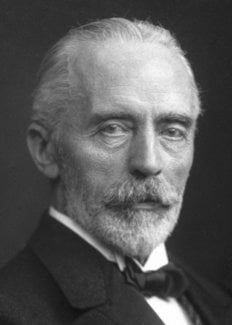
Theodor Kocher was born on August 25, 1841, at Berne. His father, a Chief-Engineer, was a very keen worker and kept him constantly at work. The influence of a devoted mother and later the loving care of a selfsacrificing wife enabled him to pass without interruption through the continuous strait of secondary school and University, and he obtained his doctorate in 1865. His teachers of surgery were Demme, Lücke, Billroth, and Langenbeck. On the warm recommendation of both the latter he followed Lücke (who had been called to Strassburg) as Ordinary Professor of Surgery and Director of the University Surgical Clinic at Berne in 1872 and remained in this post in spite of several invitations to foreign universities. As Lücke’s assistant and as «Privat-dozent» from 1866 onwards he published experimental work on haemostasis (by torsion of the arteries) in Langenbeck’s Archiv, Vol. II, with which Billroth was especially pleased; and by anatomical investigations and studies of pathological anatomy he discovered a new method for the reduction of dislocations of the shoulder, which was soon accepted and used as the simplest and surest method of rectifying not only recent, but also old dislocations.
When Kocher began his surgical activities the transition from the septic to the antiseptic treatment of wounds had been completed and Kocher worked for the latter with all his energies because of its great importance. Then arose a series of works on the antiseptic treatment of wounds with weak chlorine solutions, the Listerian treatment of ovariotomies (1875), the preparation of antiseptic catgut and the simplest method of obtaining healing of wounds without drainage tubes, on conditions governing healing by first intention, and on Lister’s wound dressings.
The surgical clinic in Berne was for a long time the centre of attraction for medical men who favoured the antiseptic treatment of wounds and wished to follow it. Later Kocher was one of the first to go over to pure asepsis about which he had the best opportunities to learn through his collaboration with Tavel, whose bacteriological studies on infective processes he sought to advance. From this work proceeded the second edition of Vorlesungen über chirurgische Infektionshrankheiten (Lectures on surgical infectious diseases ) by Kocher and Tavel, Basel, 1892, and Jena, 1900.
Because Kocher had also to give courses of instruction to military doctors, it was necessary to work experimentally on gunshot wounds. Investigation of this subject produced significant contributions to the theory of the explosive effect of missiles, and Kocher with von Schjering produced the most extensive research on and the basis of the modern ideas of the mode of action of small calibre missiles with high initial velocity. These investigations led to numerous small contributions to the journals for Swiss physicians, a lecture to the general session of the International Medical Congress in Rome in April 1874 on the improvement of projectiles from the humane point of view, and two larger works: Über Schusswunden (On gunshot wounds), 1880, and Die Lehre von den Schusswunden durch Kleinkalibergeschosse (The theory of gunshot wounds due to projectiles of small calibre), 1895.
Among Kocher’s other more important works those on acute osteomyelitis (1878) and the theory of strangulated hernia (an experimental and clinical study, 1877) may be mentioned. In this study, on the basis of a large number of experiments, a new theory of strangulation of hernia was founded called the «dilation theory» which also had great significance for ileus. He published his method for the radical operation for hernia. A larger work was on hernia in infancy in Gerhardt’s Handbook (1880). Apart from hernias, Kocher busied himself very much with the surgery of the abdominal organs. In Magenresektion (Resection of the stomach) he described a new procedure: pylorectomy with subsequent gastroduodenostomy. In Excisio recti(Excision of the rectum) preparatory excision of the coccyx was introduced, which had been initiated by Kraske, and Kocher took this step further and also removed a piece of the sacrum (1874). Other works were on the radical cure of cancer, the surgical treatment of gastric complaints (1909). In Choledocho-Duodenostomia interna (Internal choledocho-duodenostomy) he established the procedure for excision of gall stones from the lowest part of the bile duct. In Mobilisierung des Duodenum (Mobilization of the duodenum) he greatly advanced all the operations affecting the duodenum. With Dr. Matti he wrote Hundert Operationen an den Gallenwegen (A hundred operations on the bile ducts): this improved earlier surgical treatment of gall stones and simplified them in the form of ideal cholecystotomy. Other larger works dealt with ileus and with diseases of the male sexual organs, injuries of the vertebral column and fractures. Then followed Zur Kenntnis der traumatischen Epilepsie (On our knowledge of traumatic epilepsies ) and Über einige Bedingungen zur Operativen Heilung der Epilepsie (On some conditions for the operative cure of epilepsy), and papers on injuries and concussion of the brain and trepanning. He devised a new treatment for «pes varus» and published a well-illustrated work on phosphorus necrosis and another on coxa vara.
His Chirurgische Operationslehre (Theory on surgical operations) reached six editions and was translated into most modern languages. It described many operations, mostly in abdominal surgery and the surgery of joints. His book Erkrankungen der Schilddrüse (Diseases of the thyroid gland ) discussed the etiology, symptology and treatment of goitres. His new ideas on the physiology and pathology of the thyroid gland caused controversy.
He and his pupils also wrote several papers on various aspects of cretinism and various aspects of goitre.
Kocher was an honorary member of numerous academies and medical societies, e.g. the German Surgical Society. He was an Honorary Fellow of the Royal College of Surgeons; Ll.D. Edinburgh University; Honorary Member of the Royal Society of Sciences, Uppsala; Honorary Member of the American Surgical Society; of the New York Academy of Medicine and the College of Physicians, Philadelphia; the Imperial Military Medical Academy, St. Petersburg; the Academy of Medicine, Turin; the Imperial Medical Society of Constantinople; the Royal Medical Society of Vienna; Royal Medico-Surgical Society, London; the London Medical Society; the London Chemical Society; the Medical Society of Finland; and various societies in Milwaukee, Dresden, Leipzig and Erlangen. He was a Corresponding Member of the Surgical Society of Paris and of the Royal Society of Medical and Natural Sciences of Brussels; of the Belgian Academy of Medicine; the German Society of Neurologists and of the Hufeland Society of Berlin; Honorary M.D. of the Free University of Brussels. In 1902 he was President of the German Society of Surgeons in Berlin and President of the First International Surgical Congress, 1905, in Brussels.
In 1909 he was awarded the Nobel Prize for his work on the thyroid gland. Three years later he donated to his University the sum of 200,000 Swiss francs for a Research Institute in Biology.
Kocher married Marie Witchi (1851-1921). They had three sons, the eldest of whom, Albert (1872-1941) became Assistant Professor of Surgery and gave his father considerable help in his work.
Theodor Kocher died at Berne on July 27, 1917.
This autobiography/biography was written at the time of the award and first published in the book series Les Prix Nobel. It was later edited and republished in Nobel Lectures. To cite this document, always state the source as shown above.
The Nobel Foundation's copyright has expired.Emil Theodor Kocher – Article

Emil Theodor Kocher
by Bertil Hamberger
This article was published on 23 July 1997.
Theodor Kocher was born in Berne, Switzerland in 1841. He finished his medical studies in 1865 and went into surgery, where he had teachers like Demme, Lycke, Billroth and Langenbeck. In 1872, only 31 years old he was appointed professor of Surgery and Head of the University Clinic in Berne. He held this position until retirement. He was one of the first surgeons to apply the aseptic principles of Lister. Kocher was very early scientifically active and published a large number of experimental and clinical work in various surgical fields. He had a particular interest in infections, especially how to prevent surgical infections. He made early and important contributions to the condition of osteomyelitis and its relation
Contributions to General Surgery
Theodor Kocher made tremendous contributions to a wide variety of surgical fields including hernias, abdominal surgery from all parts of the gastro-intestinal tract as well as various orthopedic fields including hereditary malformations and fracture treatment. Also, new surgical areas were covered by Kocher who wrote scientific articles on traumatic epilepsy, brain damages and trepanation. In this field he cooperated with Harvey Cushing, particularly on the effects of increased intra-cranial pressure. A special contribution known to all surgeons today is Kocher’s study of the mobilization of duodenum for exploration of the inferior caval vein and the head of the pancreas, today called the “Kocher mobilization”. He published this study in 1902. His surgical textbook on procedures was published in many different languages including German, English, French, Spanish, Russian and Japanese. In this textbook he described the abdominal and orthopedic surgery with a general principle of atraumatic technique. There he also made a foundation for the new ideas of how to select surgical incisions.
One of Kocher’s contributions was to report his statistics regularly. This has made it possible to follow the development of the results which improved so tremendously at the end of 19th century.
Prize Awarded Work
Theodor Kocher received the Nobel Prize in 1909 for his work on the physiology, pathology and surgery of the thyroid gland. In the years around 1850 thyroid surgery was performed on vital indications only. The mortality was often high, up to 40%. The reason for death was usually uncontrollable bleeding or infection. With this background a few European surgeons, including Kocher and Billroth, started to improve surgery and report their results. In 1883 Kocher’s mortality was 13%.
Also, at this time other complications were recognized, particularly damage to the recurrent laryngeal nerve, causing hoarseness. It was soon known that it was important to preserve this nerve. The complications of tetany and hypoparathyroidism were not understood. However, Kocher in contrast to Billroth had a very neat and precise operating technique and worked in a relatively bloodless field. Probably because of this he had less problems with postoperative tetany. Also well-known to all thyroid surgeons is the “Kocher incision”, a transverse, slightly curved incision about 2 cm above the sternoclavicular joints.
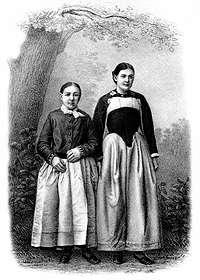
Kocher’s studies on one of his patients, who was operated on in 1874, led to an early discovery. This eleven year old girl had a successful removal of her thyroid, but afterwards she became very tired, showed no signs of initiative and became cretinoid. She remained small and had an ugly and idiotic appearance in contrast to her sister.
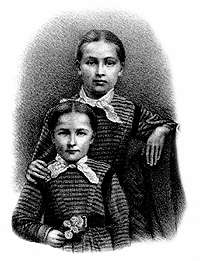
The Kocher patient together with her sister before the operation. The patient was then taller than her little sister.
Photo: from Kocher, T. Arch Klin Chir 29:254-337,1883
 |
|
Nine years after the operation she stopped growing and became cretinoid. |
This prompted Kocher to reinvestigate all his thyroid patients. Almost all of them, particularly the children, had evident symptoms of hypothyroidism which he named “Cachexia Strumipriva”. However, at this time Kocher did not understand that this was due to the removal of the thyroid gland but ascribed it to tracheal injury. These data made Kocher decide not to remove the whole gland in his future patients. After description of the myxedema condition, transplantation and injection of extracts of thyroid tissue was tried. In 1892 also oral therapy was introduced.
The number of thyroid operations increased rapidly and 2,000 operations had been performed by Kocher in 1901. When he died in 1917 more than 7,000 thyroid operations had been done in his clinic; three quarters by himself. The mortality decreased steadily from 14% in 1884 to 2.4% in 1889 and 0.18% in 1898.
Concluding Remarks
Theodor Kocher was a world leader in the surgical revolution in the last third of the nineteenth century. His major discoveries were in the fields of physiology and pathology of the thyroid gland. The contributions of Theodor Kocher still today have a great impact on thyroid surgery.
Reference
Richard B. Welbourn: The history of endocrine surgery. Praegel, New York 1990.
First published 23 July 1997
Theodor Kocher – Facts
Award ceremony speech
Presentation Speech by Professor the Count K.A.H. Mörner, Rector of the Royal Caroline Institute, on December 10, 1909
Your Majesty, Your Royal Highnesses, Ladies and Gentlemen.
The Nobel Medical Prize has been awarded this year to the famous surgeon, Professor Theodor Kocher of Bern, in recognition of his work concerning the physiology, pathology and surgery of the thyroid gland.
The thyroid gland, thyroidea, is one of the structures in the organism whose significance has only been made clear during the last few decades. At the close of the 1870’s it was still stated in the physiology text-books that the function of this gland was a complete mystery. It was even questioned that it had an actual physiological significance, for the adult organism at least. On the other hand it was a common experience that it could be the site of pathological changes; in the course of these, considerable trouble could result, as, for example, when the pathologically enlarged gland exerted pressure on neighbouring parts, especially on the trachea.
Yet it was hardly right that this gland should have been undervalued, not to say disdained, for so long. Astley Cooper, who was working about a hundred years ago, had already observed disturbances in animals after removal of the thyroid. These were specified with greater precision by J. M. Schiff in Bern. He found that animals in which the thyroid had been extirpated, often died in circumstances which suggested that this gland might be of great importance to the organism; however, he did not gain any deeper insight into the gland’s function. Unfortunately, these observations did not receive the necessary attention and development. It was only after similar results had been obtained with human beings that the question of the thyroid’s significance was analysed successfully. Observations made by surgeons were the cause of this.
The disturbances which occur with a pathological enlargement of the thyroid are often so grave that people had already for many years been extirpating the thyroid occasionally to relieve them, despite the difficulty and dangers which the operation then presented. Indeed, in the days before the introduction of antisepsis it often happened that the patients died of the immediate results of the operation. After the introduction of antisepsis a significant improvement took place in this respect. As a result, the number of operations of this kind, in which the whole gland was removed, increased considerably. In the meantime it was gradually noticed that the position was by no means satisfactory, even if the operation itself and the subsequent healing had gone well. Not infrequently, after a period of apparent health, significant disturbances in the general health made their appearance. The conscientious investigation of these cases of illness resulted in the establishment of a new syndrome called «cachexia strumipriva», which was characterized by muscular weakness, swelling of the extremities and of the face, anaemia, decline in intelligence, and finally death from exhaustion. Once attention had been drawn to this condition, enthusiastic and productive research into the significance of the thyroid followed in many different centres. In this, reliance was placed on clinical observations on humans as well as on animal experiments. From this research an understanding of the physiology of the thyroid has evolved which is comprehensive, even if not complete in all respects.
We now know that this gland is a vital organ, whose total removal in experimental animals infallibly causes death within the course of a few days or weeks. The gland is of great importance in the general nutrition of the adult, and especially in individuals still undergoing development. The loss of thyroid function results in serious disturbances in this nutrition. Metabolism is significantly diminished; growth ceases; the skin and the subcutaneous tissues are the site of mucous infiltration; degenerative processes occur in internal organs; serious disturbances make their appearance in the functions of the nervous system and muscles. It became clear that the gland acts by elaborating a secretion, which reaches the various parts of the body. It is, as the expression goes, an internal «secretion». Later it became evident that such processes of internal secretion are of exceptionally great importance. Not only the thyroid, but also various other glands such as the adrenals and the pancreas play a characteristic part in the processes within the organism by elaborating a secretion peculiar to each gland, which is not excreted, but is diffused throughout the organism and is of the greatest importance to it.
The knowledge of the physiology of the thyroid has brought a valuable increase in our understanding within the field of pathology. Through it new light has been thrown on hitherto mysterious morbid conditions. Pathological changes in the gland can lead to suppression or decrease of its function. Various morbid conditions are explained by this, among which are cretinism and myxoedema. On the other hand one looks for the explanation of various other disturbances such as those in morbus Basedowi in abnormally increased or possibly qualitatively abnormal activity of this gland.
This briefly outlined important and momentous development, which has benefited medicine during the past 25 years, was brought into being, as I mentioned before, as a result of observations which have been made by surgeons. In this respect, the first public utterance was made in September, 1882, by Professor J. L. Reverdin in Geneva. At this time his colleague in Bern, Professor Kocher, had also turned his attention to the same subject, and in April, 1883, the latter gave a comprehensive exposition, which has been of fundamental importance to the later development of thyroid surgery as well as to other important areas of our knowledge of this gland. Through Kocher’s exposition it became quite clear that complete extirpation of the thyroid is reprehensible. A portion of the gland which is capable of functioning, must be left behind at operation. This very important principle of surgical intervention has always been observed from that time onwards. With regard to the surgery of the thyroid, Kocher has subsequently continued to occupy a leading position. It should be possible to omit on this occasion a report concerning the development of the methods of operation and the suitability of the various types of intervention in different cases. It should suffice to recall that there are now several thousand people who owe their regained, lasting health directly to him after a goitre operation which he has successfully performed. A far greater number, which cannot be estimated, owes him a debt of gratitude indirectly for similar results. Fatal cases or secondary illnesses have become more and more of a rarity in goitre operations.
However, it is not only the treatment of the goitre which has been the subject of Kocher’s research on the goitre. He has also carried out extensive investigations into the causes of the endemic occurrence of goitre in certain regions and into the cretinism connected with disturbances in thyroid function.
In the thyroid, as already indicated, other diseases can occur in addition to those which arise with the ordinary goitre. To these as well Kocher has devoted successful work, as a result of which it has been possible to define with more and more certainty the method of treatment best suited to each case; in addition, on the basis of Kocher’s work a broader, deeper knowledge of the pathology of the thyroid has been achieved.
Through his research, which we have briefly described here, Kocher has carried out pioneering work of an enduring nature which is of the greatest importance to medical science and of the greatest value in the service of suffering humanity. It is this work which the Staff of Professors of the Caroline Institute has wished to honour by awarding him this year the Nobel Prize in Physiology or Medicine.