Daniel Bovet – Photo gallery

1 (of 1) The 1957 Nobel Prize laureates assembled onstage for the Nobel Prize award ceremony on 10 December. From left: Physics laureates Chen Ning Yang and Tsung-Dao Lee, chemistry laureate Lord Todd, medicine laureate Daniel Bovet and literature laureate Albert Camus.
Photo credit: The Chinese University of Hong Kong
Daniel Bovet – Nobel Lecture
Nobel Lecture, December 11, 1957
The Relationships between Isosterism and Competitive Phenomena in the Field of Drug Therapy of the Autonomic Nervous System and that of the Neuromuscular Transmission
Read the Nobel Lecture
Pdf 373 kB
Daniel Bovet – Banquet speech
Daniel Bovet’s speech at the Nobel Banquet in Stockholm, December 10, 1957 (in French)
Maestà, Signori Accademici, Eccellenze, Signore e Signori,
E’ per me ragione di gioia profonda trovarmi nouvamente in Svezia, questo grande paese legato per tanti motivi all’Italia e con cui io stcsso ho così profondi vincoli di amicizia e, oggi, di riconoscenza.
La très haute distinction dont j’ai été l’objet de la part du Karolinska Institutet me remplit en effet de gratitude, de fierté et de joie, mais fait également naître en moi quelque perplexité. En tant qu’homme de science accoutumé à établir des liens logiques entre les événements, je cherche en vain le lien qui a pu transformer ce qui a été toujours la vie quotidienne au laboratoire pour ma femme et pour moi, les petits incidents de l’expérimentation, la recherche minutieuse et objective de chaque jour, la collaboration avec mes assistants, parfois l’ennui d’une correction d’épreuves, par un coup de baguette magique de l’Académie, dans les heures inoubliables et lumineuses que nous vivons ce soir.
Peut être, et c’est la seule explication plausible, a-t-on voulu primer dans ma personne et dans mes travaux la recherche scientifique poursuivie avec confiance et avec amour: les drapeaux de vos rues, les lumières de ce soir, au delà de nos personnalités, saluent une fois de plus l’effort vers la connaissance et le grand idéal de culture et de paix qu’Alfred Nobel a indiqué en mourant. Dès lors la magnificence de cette soirée se justifie et, dans mon émotion, je ne puis manquer avant tout d’évoquer tous les savants illustres qui m’ont précédé dans la glorieuse famille des Prix Nobel, et dont plusieurs ont été spirituellement mes maîtres et mes guides les plus sûrs.
Je voudrais dire aussi quelle joie profonde représente pour moi le fait que grâce à la confiance que m’a témoignée le Karolinska Institutet, j’ai vu aujourd’hui dans la salle bleue de l’Hôtel de Ville, la pharmacologie a l’honneur.
Cette jeune science qui n’a pas partout droit de cité relève à la fois de la physiologie et de la médecine; d’aucuns lui reprochent de n’être ni l’une ni l’autre. En réalité elle a à nos yeux l’immense mérite d’être une véritable science et des plus subtiles, et en outre de forger les armes les plus pacifiques du monde, celles qui servent à soigner les blessures et à guérir la plupart des maladies et sans lesquelles les médecins seraient comme des soldats sans fusil.
Ce qui guide notre travail et lui donne son aspect particulier c’est que le caractère de la recherche va de pair avec l’application clinique, le résultat théorique avec l’action immédiate dans l’organisme. Je voudrais dire que le pharmacologue est un peu comme un poète dont la recherche de la rime constitue la joie la plus subtile: et en effet pour nous aucun résultat théorique n’est satisfaisant s’il ne s’accompagne de la vérification du clinicien.
Je songe ce soir non seulement aux savants illustres qui m’ont précédé mais aussi à notre maître Ernest Fourneau qui nous a tracé la voie, aux amis tels que Domenico Marotta qui nous ont fait confiance et nous ont permis, à ma femme et à moi, d’aller de l’avant.
Il me semble en ce moment représenter tous mes collègues pharmacologues dont le travail dans les Instituts de recherche et dans les Universités a engendré une ère thérapeutique nouvelle et c’est avec fierté et au nom d’eux tous et non seulement au mien propre que je remercie le Comité Nobel de la confiance témoignée et de l’encouragement qu’il vient ainsi de donner à des recherches dont l’avenir montrera les grandes possibilités pour la compréhension de certains phénomènes biologiques et pour la préservation de la vie humaine.
Daniel Bovet – Nominations
Award ceremony speech
Presentation Speech by Professor B. Uvnäs, member of the Staff of Professors of the Royal Caroline Institute
Your Majesties, Your Royal Highnesses, Ladies and Gentlemen.
The work of Daniel Bovet should be considered in its context, bearing in mind what had been found out about biological amines between about 1920 and 1930. It had been thought that nerve impulses reached peripheral organs rather in the way that signals are transmitted along a telegraph wire to a receiver. However, Otto Loewi and Henry Dale demonstrated, in work gaining them a Nobel Prize, that nerve impulses released small amounts of highly active substances at the nerve endings. Amines such as acetylcholine, adrenaline, and, as Ulf von Euler has shown more recently in Stockholm, noradrenaline, are substances of this type which transmit the peripheral effects of nerve impulses. It was also discovered that another amine, histamine, was released in much larger quantities than normal in allergic reactions. The well-known symptoms of such allergies as hay-fever, eczema, asthma, etc., appear depending upon the site of histamine production.
The discovery of the role played by biological amines, so far as chemical transmitters were concerned, opened up new paths for research. Pharmacologists and chemists could see the possibility of producing substances whose actions would reproduce or inhibit those of the biological amines. It was becoming possible, thanks to these products, not only to interfere in experimental physiological phenomena, but even in the pathological processes of illness in clinical medicine. Daniel Bovet concentrated his research on the problem of pharmacologically blocking the amines mentioned above, and he succeeded in producing substances which specifically inhibited their effects.
As early as 1937, Bovet and Staub succeeded in producing the first antihistamine, thymoxidiethylamine, capable of preventing anaphylactic shock in animals which, unneutralized, was fatal. This first histamine antagonist was, it is true, too toxic to be used clinically, but virtually every antihistamine that is used throughout the world today to oppose symptoms of allergy is derived from it.
From what we know at present, no antihistamines exist in Nature. But, on the other hand, there do exist substances which can prevent nerve impulses taking effect. Venetian ladies of the sixteenth century knew they could make themselves more seductive by bathing their eyes with a lotion of belladonna. The characteristic dilation of the pupil is produced by the alkaloid of belladonna, atropine, which blocks the effects of acetylcholine released at nerve endings in the musculature of the iris. The nerve impulses lose their effect and the pupil is paralysed. In the same era the South American Indians knew a vegetable preparation, curare, which they used – if I dare express myself thus – on slightly different hunting grounds. Curare is a poison which suited the use they made of it – on the tip of an arrow – extremely well. It paralyses its prey by blocking, in the way that atropine does, the transmitter substance – here again acetylcholine – which links the motor nerve to the muscle fibres. Given orally, curare is completely inactive. Nature has equally produced substances which can inhibit the effects of adrenaline and noradrenaline, these two amines which are released at the nerve endings of sympathetic fibres. The most important of these so-called sympathicolytic substances are the alkaloids which are found in ergot.
The alkaloids of ergot, as well as those of curare, have extremely complicated chemical structures and do not lend themselves to synthesis. They are little used for experiment and still less used in the field of clinical medicine on account of their toxicity and the unpredictable character of their effects.
For a number of years, Bovet and his co-workers studied in animals the relationships between chemical structure and biological effect, as could be observed in the alkaloids of curare and ergot. Proceeding by systematic variations and successive simplifications of chemical structure, work which involved the elaboration of new methods of biological testing and the production of hundreds of new synthetic chemical compounds, they succeeded, by degrees, in obtaining simple chemical compounds which proved themselves, from the point of view of specificity and the absence of undesirable side-effects, much more useful than naturally occurring substances.
The interest which the appearance of products capable of paralysing muscle presents in practical medicine is bound to the evolution of modern surgery, which has made it possible to perform more and more complicated surgical procedures. Operations of this type often require complete muscular relaxation. Anaesthesia must therefore be deep and long, and for this reason it carries risks which can be more dangerous than the surgery itself. We owe to Bovet’s research the general muscle relaxants which we use today. We can, in this way, use a light level of anaesthetic and reduce the hazards to which the patient is subjected. Sympatholytic compounds have not yet found any application in general medicine. The future will tell whether the hopes placed in them will be fulfilled and whether they will be of value in the treatment of hypertension and other vascular conditions for which we think a reduction in nervous control would be desirable.
Apart from the importance of Bovet’s work in experimental neuropharmacology, his observations have exerted a very stimulating influence in one rapidly growing branch of pharmacology: I speak of psychopharmacology. Biological amines are the transmitters of nerve impulses in the different tracts of the brain, just as they are the chemical agents which link nerve fibres to peripheral organs. In other words, it should be possible to find drugs which specifically affect brain function. Already, in fact, we posses a number of compounds of this type. Lysergic acid is one of the active components of the ergot alkaloids. A compound closely related to lysergic acid, namely lysergic acid diethylamide (LSD), has a really dramatic effect on mental activity, as one Swiss chemist quite accidently verified. The absorption of a fraction of a milligram of this compound is enough to produce gross distortion of both visual and auditory perception, and mental states resembling those seen in the acute psychoses and certain other mental illnesses. It is fascinating, and at the same time frightening, to know that we can, with minute quantities of simple chemicals, modify the mental state, the soul of a human being. But there is another side to this picture. It allows us to cherish the well-founded hope that in the near future we shall have effective means at our disposal for fighting mental illness which at present is one of the most terrible scourges of mankind.
Professor Bovet. The Caroline Institute has conferred on you this year’s Nobel Prize for Physiology or Medicine for your work in blocking by pharmacological means the effects of the biologically active amines. We add to our congratulations our warmest wishes for the future success of the work in the psychopharmacological field now being carried out in your laboratory.
I ask you now, Professor, to accept the prize which is your due, from the hands of His Majesty the King.
The Nobel Prize in Physiology or Medicine 1957
Daniel Bovet – Biographical
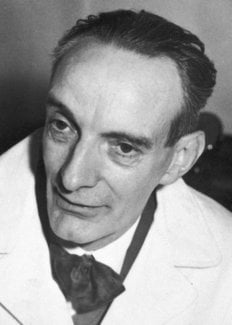
Daniel Bovet was born at Neuchâtel, Switzerland, on March 23, 1907. He was the son of Pierre Bovet, Professor of Pedagogy in the University of Geneva and his wife Amy Babut.
After completing his secondary education at Geneva, Bovet graduated at the University of Geneva in 1927. He then spent some years as Assistant in Physiology to Professor F. Batelli. He then worked under Professor Guyenot, preparing a thesis on zoology and comparative anatomy for which he was awarded the degree of D.Sc. in 1929.
From 1929 until 1947 he worked at the Pasteur Institute in Paris then under the direction of Professor E. Roux. Here he worked first as assistant and later as Chief of the Laboratory of Therapeutic Chemistry. This Department was directed by Professor Ernest Fourneau and daily contact with him determined the course of Bovet’s future researches.
In 1947 he accepted the invitation of Professor Domenico Marotta, Director of the Istituto Superiore di Sanità in Rome, to go to Italy and to organize a Laboratory of Therapeutic Chemistry. He then became Chief of the Laboratory of Therapeutic Chemistry of the Istituto Superiore di Sanità, Rome.
Bovet has published more than 300 papers on biology, general pharmacology, chemotherapy, the sulphonamide drugs, the pharmacology of the sympathetic nervous system, the therapy of allergic conditions, the synthesis of antihistamines, on curare and curare-like drugs and the use of curare as an adjuvant to anaesthesia, on various modifications of hormonal equilibrium, and on various aspects of the pharmacology of the central nervous system (drugs used for the treatment of Parkinsonism, strychnine and tranquillizers). Important aspects of these researches are embodied in a book by Bovet and his wife, published in 1948 and entitled Structure chimique et activité pharmacodynamique des médicaments du système nerveux végétatif (The chemical structure and pharmacodynamic activity of drugs of the vegetative nervous system), and in the book by Bovet, his wife, and G. B. Marini-Bettòlo, published in 1959 and entitled Curare and Curare-like Agents. In 1957 he was awarded the Nobel Prize for Physiology or Medicine for his discovery relating to synthetic compounds for the blocking of the effects of certain substances occurring in the body, especially in its blood vessels and skeletal muscles.
Bovet has received honorary degrees of the Universities of Palermo, Rio de Janeiro, Geneva, Montpellier, Paris, Nancy, Prague and Strasbourg.
In 1946, he was elected a Chevalier of the Legion of Honour of France, and in 1959 a Grand Official of the Order of Merit of the Italian Republic.
Apart from the Nobel Prize in 1957, Bovet has received the following awards: Plantamour Prize of the Faculty of Science of the University of Geneva (1934), Martin Damourette Prize of the Academy of Sciences of the Institute of France (1936), General Muteau Prize of the Italian Academy of Science (1941), Cameron Prize of the University of Edinburgh, Scotland (1949), Bürgi Prize of the Faculty of Medicine, Berne, Switzerland (1949), «E. Paterno» Prize, jointly with his wife, F. Bovet-Nitti (1949), the Scientific Illustration Prize of the Italian National Research Council, jointly with his wife (1951), and the Addingham Gold Medal, University of Leeds (1952). He is a member of several learned societies in Italy, France, Great Britain, the USA, Brazil, Argentine, and India.
Bovet married Filomena Nitti, sister of the bacteriologist F. Nitti, who has closely and continuously collaborated with him in his work.
This autobiography/biography was written at the time of the award and first published in the book series Les Prix Nobel. It was later edited and republished in Nobel Lectures. To cite this document, always state the source as shown above.
Daniel Bovet died on April 8, 1992.