Ulf von Euler – Nominations
Speed read: Passing the message on
Cmmunicating information between nerve cells occurs at breathtaking speed. To allow an electrical impulse to pass from one cell to another, chemical neurotransmitters are released at the nerve end, cross the narrow gap, or synapse, that separates the cells, pass on the message to the next cell – be it a nerve cell, muscle cell or gland cell – and disappear, all within a fraction of a second.
The story of how neurotransmitters are stored, released and inactivated within such a short space of time is told by the achievements rewarded with the 1970 Nobel Prize in Physiology or Medicine. Sir Bernard Katz used microscopic recording electrodes to measure the electrical changes that occur when the chemical transmitter acetylcholine is released by nerve cells. From a series of measurements, he deduced that acetylcholine is released in highly defined amounts, and that acetylcholine molecules are stored in small bubble-like compartments, or synaptic vesicles, in nerve endings. When an impulse arrives, millions of acetylcholine molecules are released together into the synapse almost immediately, and Katz showed that calcium plays a key role in triggering this so-called “quantal release” of acetylcholine.
Ulf von Euler discovered another neurotransmitter, noradrenaline, and he established how it works. He found that nerve cells rich in noradrenaline were linked to many mammalian tissues and organs, and he showed that noradrenaline release correlates directly with muscular work and activity, such as an immediate rise after standing. Von Euler also showed that this neurotransmitter is stored and synthesised within the nerve fibres themselves. Julius Axelrod’s work completed the cycle, revealing what happens to noradrenaline after it has finished transmitting a nerve impulse. By radioactively tracking noradrenaline’s movements in cat nerves, Axelrod discovered that, unlike acetylcholine, which is inactivated by enzymes, much of the noradrenaline is absorbed back into storage sites within the nerve ending that had just released it. Further studies made it evident that this recycling system is the rule rather than the exception for neurotransmitters. Axelrod also discovered drugs that inhibit the re-uptake process, and his discovery that antidepressants work in this manner stimulated the search for a much needed new generation of treatments for depression.
By Sophie Petit-Zeman, for Nobelprize.org
This Speed read is an element of the multimedia production “Nerve Signaling”. “Nerve Signaling” is a part of the AstraZeneca Nobel Medicine Initiative.
Sir Bernard Katz – Nobel Lecture
Nobel Lecture, December 12, 1970
On the Quantal Mechanism of Neural Transmitter Release
Read the Nobel Lecture
Pdf 59 kB
Ulf von Euler – Nobel Lecuture
Nobel Lecture, December 12, 1970
Adrenergic Neurotransmitter Functions
Read the Nobel Lecture
Pdf 167 kB
Julius Axelrod – Nobel Lecture
Nobel Lecture, December 12, 1970
Noradrenaline: Fate and Control of Its Biosynthesis
Read the Nobel Lecture
Pdf 239 kB
Julius Axelrod – Other resources
Links to other sites
The Julius Axelrod Papers at the U.S. National Library of Medicine
Julius Axelrod – Banquet speech
Julius Axelrod’s speech at the Nobel Banquet in Stockholm, December 10, 1970
Your Majesty, Your Royal Highnesses, Your Excellencies, Ladies and Gentlemen,
I am overjoyed in receiving this great honor. It is a special privilege for me to share this distinction with Professor Ulf von Euler and Sir Bernard Katz.
This award comes at a time when our young and many of our most influential people believe that basic research is irrelevant or is put to evil uses. The selection of chemical neurotransmission for a Nobel Prize this year, makes our work highly visible to the general public and gives us an opportunity to show how misinformed and mistaken they are. I think we can easily demonstrate that although our work is of a fundamental nature, it also gives us insight in explaining such illnesses as mental depression, Parkinson’s disease, hypertension and drug abuse. It can also lead the way to the treatment of these terrible afflictions.
I thank the Nobel Prize Committee for bringing the adrenergic and cholinergic nervous system together again. They have been apart for too long. I also want to offer my gratitude for the hospitality you have shown to my family and myself. Thank you.
Sir Bernard Katz – Banquet speech
Sir Bernard Katz’ speech at the Nobel Banquet in Stockholm, December 10, 1970
Your Majesty, Your Royal Highnesses, Ladies and Gentlemen,
I am much obliged to you for allowing me to say a few words in response to the toast. I find the honours which we have received today at the hands of Your Majesty, and the acclamation by a gathering of such distinction, so overwhelming that no words of mine could adequately express my feelings of gratitude.
If you will permit me, let me therefore be a little unorthodox and try at least to express my humble thanks to those distinguished colleagues of ours who every year devotedly and most unselfishly give of their time and spare no effort in preparing for this event, and who make what strikes me as a heavy sacrifice in the laborious and even tedious task of finding out all about us.
Any foreign guest who comes to your fine city to be presented with this award finds himself at a considerable disadvantage. In other situations he might hope that at some future date he would perhaps be able – to some extent – to reciprocate the kindness and hospitality which he has received. But we all know that the tradition and prestige of today’s ceremony is so unique in the whole world, that no matter how hard we might try, we should never be able to repay, even in part, our debt of gratitude. But I must also say, and please forgive me if this is an expression of a more serious thought, that the very uniqueness of the great prestige which surrounds the Nobel Prize and the tremendous public attention which precedes and follows it, is apt inevitably to diminish the recognition due to those who have been our equal partners, but who have not had the good fortune of being singled out for this great occasion. I am speaking for myself – although l think most scientists are in a similar position – if I say that I must hand it to our highly esteemed though most unfortunately absent friend who was awarded the prize for literature, because – unlike myself – he can truly say that, what he has done, he has done entirely by himself! No collaborators for him! I apologize again: I must not let my sombre thoughts intrude upon what is a brilliant and festive occasion. And let me assure you, I am most grateful to be allowed to participate in this splendid week of your traditional festivities. In fact, I enjoy it enormously, and particularly because, even after all the honours that have been bestowed on us today, there is something great and even more sustaining that we may look forward to, namely when the fun and festivities are over, that we may try and return to our work. On this optimistic note, once again, my heartfelt thanks to you all!
Sir Bernard Katz – Other resources
Links to other sites
Obituary from Biographical Memoirs of the Fellows of the Royal Society
Ulf von Euler – Photo gallery

Medicine laureates Julius Axelrod, Sir Bernard Katz and Ulf Von Euler, receiving their cheques for the prize amount from Nils Ståhle (far left), Executive Director of the Nobel Foundation, during their visit to the foundation during Nobel Week in Stockholm, 11 December 1970.
Photo: Keystone/Hulton Archive/Getty Images
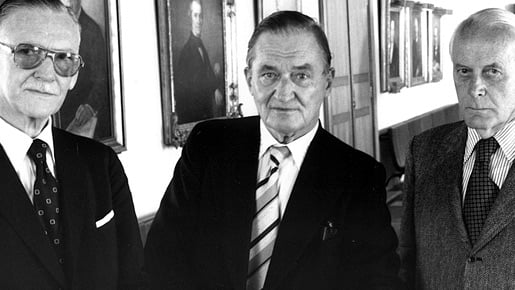
Nobel Laureates in Physiology or Medicine at Karolinska Institutet. From left: Ulf von Euler, Hugo Theorell and Ragnar Granit.
Copyright © Lennart Nilsson
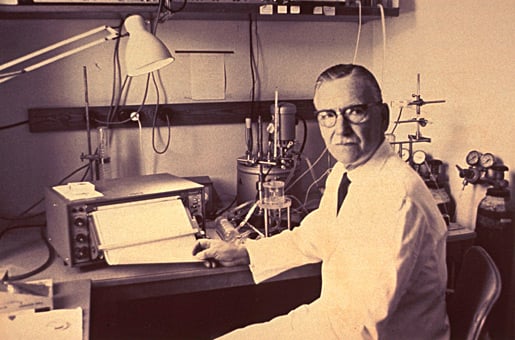
Ulf von Euler at Karolinska Institutet, April 1971.
Source: U.S National Library of Medicine, Images from the History of Medicine Collection Photographer unknown

Portrait of Ulf von Euler.
Source: U.S National Library of Medicine, Images from the History of Medicine Collection Photographer unknown

Ulf von Euler at Karolinska Institutet.
Copyright © Karolinska Institutet Photographer unknown