GERTRUDE B. ELION
Nobel Prize in Physiology or Medicine 1988
With the drugs that she created, Gertrude Elion fulfilled her life’s mission: to alleviate human suffering. Beyond the individual drugs she discovered, she pioneered a new, more scientific approach to drug development that forever altered – and accelerated – medical research.
Born in 1918, Gertrude Elion had a happy childhood in New York City, with her brother, her Eastern European Jewish parents, and her grandfather.

Gertrude Elion, aged 5.
Photo courtesy of Gertrude B. Elion Foundation

Photo of Gertrude Elion’s grandfather with his daughters, including Gertrudes mother.
Photo courtesy of Gertrude B. Elion Foundation

Gertrude Elion as a child on a miniature horse, ca. 1921.
Photo courtesy of Gertrude B. Elion Foundation
She was particularly close to her grandfather, who arrived from Russia when she was three. When she was 15, she witnessed his painful death from stomach cancer. The experience decided her career path.
“I was highly motivated to do something that might eventually lead to a cure for this terrible disease.”
Gertrude Elion
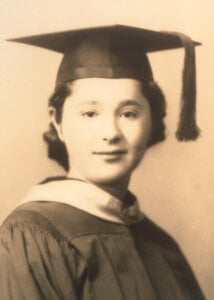
The stock market crash of 1929 bankrupted Elion’s family, casting a pall on her prospects. With her high grades, she got into Hunter College, which was free, but after college Elion simply did not have the money to go on to graduate school. She needed a fellowship, but those didn’t often go to women, especially not during the Depression.
“I think perhaps it was my mother who influenced me the most. She was a housewife. She had no higher education, but had the most common sense of anyone I knew, and she wanted me to have a career.”
Gertrude Elion

Gertrude Elion as student at Hunter College, which she attended from 1933 to 1937.
Photo courtesy of Gertrude B. Elion Foundation

Gertrude Elion, aged 3, next to her mother, Bertha Cohen Elion, 1922.
Photo courtesy of Gertrude B. Elion Foundation
At age 19, with a degree in chemistry, she looked for work. She took jobs as a secretary, a chemistry teacher, and an unpaid worker in a lab. Finally, when World War II diminished the ranks of male chemists, Elion got her break.
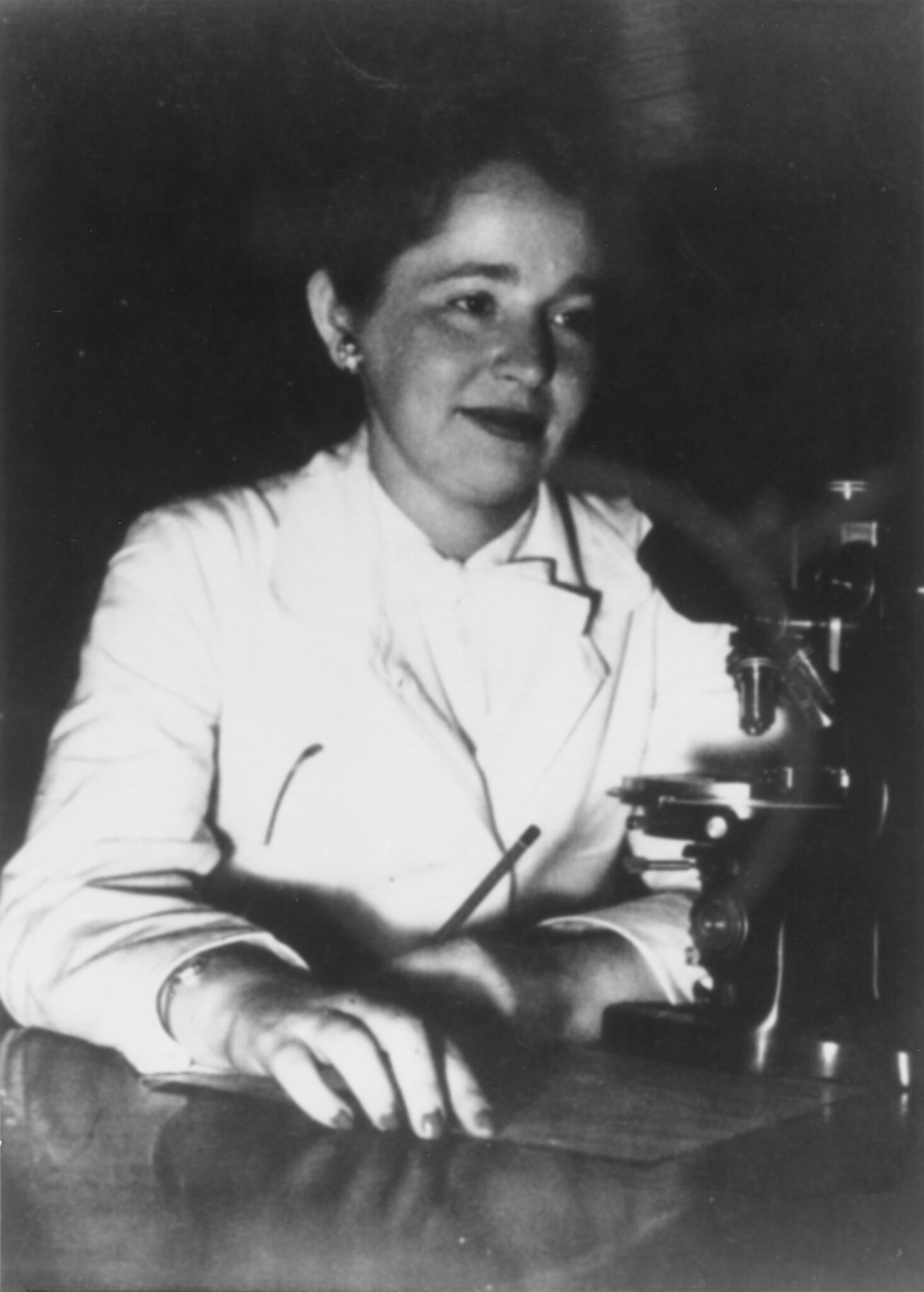
“In my day I was told women didn’t go into chemistry. I saw no reason why we couldn’t.”
Gertrude Elion
In 1944, Elion found the job of her dreams, assisting George Hitchings at Burroughs Wellcome, the American outpost of a British pharmaceutical firm operated by a charitable trust. It would ultimately become the drug giant GlaxoSmithKline.

Gertrude Elion and George Hitchings in front of the Burroughs Wellcome building, ca. 1988.
Photo courtesy of GSK. Reproduced with permission.

Joseph Murray (far right) with Roy Calne (second from left), Gertrude Elion and George Hitchings (third and fourth from left, respectively), and surviving transplant dogs on the Harvard Medical School Quad, 1961.
Photo courtesy of Center for the History of Medicine, Countway Library of Medicine, Harvard Medical School
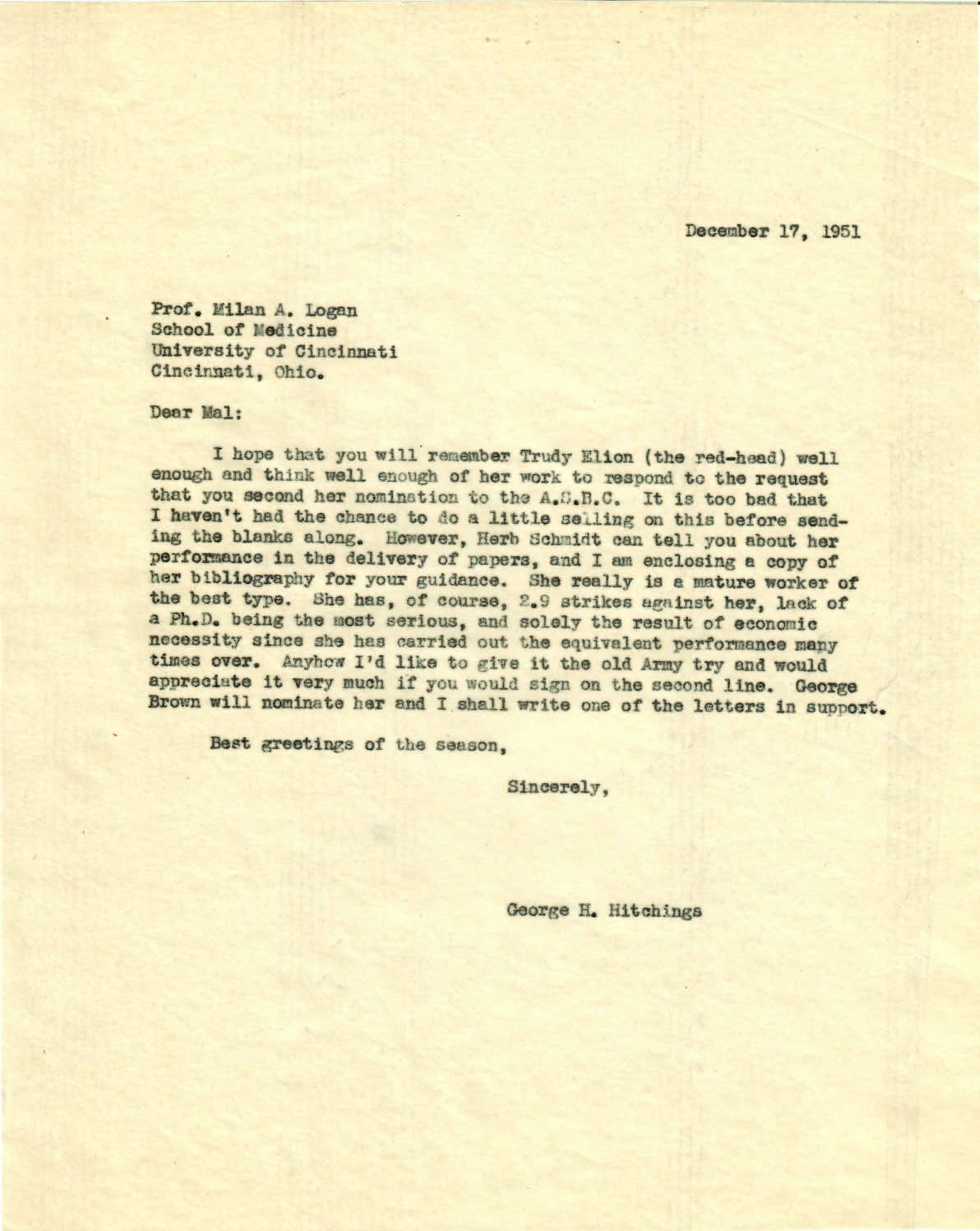
Letter from George Hitchings to Professor Milan Logan of the University of Cincinnati recommending Gertrude Elion for membership in the ASBC (American Society of Biological Chemists, now the American Society for Biochemistry and Molecular Biology), 1951.
Courtesy of Gertrude B. Elion Foundation
Hitchings and Elion discarded the traditional trial-and-error approach to drug development, in favour of a rational, scientific approach. Starting from the understanding that all cells require nucleic acid to reproduce, they reasoned that rapidly growing bacteria and tumours require even more to sustain the pace of growth. Find a way to disrupt their lifecycle, and you find a way to stop disease.

Gertrude Elion, ca. 1960.
Photo courtesy of GSK. Reproduced with permission.

Gertrude Elion, George Hitchings and Burroughs Wellcome president C. W. Creasy in a laboratory at the Tuckahoe, New York, campus in the early 1950s.
Photo courtesy of GSK. Reproduced with permission.

Gertrude Elion, seated, with three colleagues at Burroughs Wellcome, 1981.
Photo courtesy of GSK. Reproduced with permission.

Stan Bushby (left) and George Hitchings (right) watch as Gertrude Elion works with a pipette and test tube in a lab at the Research Triangle Park facility in North Carolina, 1972.
Photo courtesy of GSK. Reproduced with permission.
Elion’s first major discovery, in 1950, when she was 32, was a purine compound that interfered with the formation of leukaemia cells: 6-mercaptopurine, 6-MP for short. The drug was rushed to release because it put acute leukaemia patients – often, children fated to die within months of diagnosis – into complete remission. But the effect was temporary; eventually many relapsed. When children got well, Elion was elated; when they died, she was despondent, but determined to find a way to make the effects of her drug last longer.
One of the relatives of 6-MP yielded another bombshell drug for Elion: azathioprine, marketed as Imuran. Imuran suppresses immune response, making organ transplants possible for the first time. That was in 1961. In 1963, Elion, still searching for ways to make 6-MP’s effects last longer, made another discovery: allopurinol, which reduces the body’s production of uric acid. An excess of uric acid causes gout, which can be fatal for cancer patients.
Elion’s final major breakthrough was in the development of the antiviral drug acyclovir, approved in 1977. Scientists doubted that drugs could be invented to fight viruses; any substance that would kill a virus would be too toxic for the body to endure.
But Elion persisted, and the drug her team developed both attacked herpes and could be used to fight Epstein-Barr, chickenpox, and shingles. It also ushered in a new era of antiviral therapy, opening the door to the development of the first drug to treat AIDS: AZT.
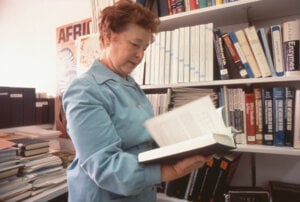
Elion’s name appears on 45 patents for life-saving and life-changing drugs. Many of the people those drugs affected took the time to express their gratitude.
She kept a file of letters from patients or relatives of patients who had benefited from her work: the recipient of a kidney transplant, a shingles sufferer whose eyesight was saved, the parents of children diagnosed with leukaemia, herpes encephalitis, and a “terminal” sarcoma. Elion said that being able to help these people was a reward greater than the Nobel Prize.

Letter from kidney transplant patient Sharyn Cohn to Gertrude Elion, 3 March 1998. She writes: “My life is full of joy because of your discoveries.” Elion developed Imuran, an immunosuppressant that makes such transplants possible.
Photo courtesy of Gertrude B. Elion Foundation

Gertrude Elion, Research Triangle Park, North Carolina, 1983.
Photo courtesy of GSK. Reproduced with permission.
“What we were aiming at was getting people well, and the satisfaction of that is much greater than any prize you can get.”
Gertrude Elion

Gertrude Elion after receiving the Nobel Prize, 1988.
Photo courtesy of GSK. Reproduced with permission

Gertrude Elion receiving her Nobel Prize from King Carl XVI Gustaf of Sweden, 10 december 1988.
Photo courtesy of GSK. Reproduced with permission

Gertrude Elion, surrounded by piles of publications at her desk. On the back of the photograph, she wrote: “This happens when you go on vacation.”
Photo courtesy of GSK. Reproduced with permission.
Though her individual discoveries were significant, when Elion received the Nobel Prize in Physiology or Medicine in 1988 (with Hitchings and another drug researcher, James Black), it wasn’t for one particular drug, it was for a new, more rational approach to drug development. Simply put, Elion changed the way researchers develop drugs. As a result, although she died in 1999 at the age of 81, Gertrude Elion is still saving lives.
Sir James W. Black – Other resources
Links to other sites
Obituary from The New York Times
‘Sir James Black’s Nobel Prize medal’ from Nationa Museums Scotland
Sir James W. Black – Photo gallery

Sir James W. Black receiving his Nobel Prize from H.M. King Carl XVI Gustaf of Sweden at the Stockholm Concert Hall on 10 December 1988.
Photo from the Lars Åström archive

The Nobel Laureates in Physiology or Medicine at the Nobel Prize Award Ceremony 1988. From left: Sir James W. Black, Gertrude B. Elion and George H. Hitchings.
Photo from the Lars Åström archive

Sir James W. Black at the Nobel Prize banquet, 10 December 1988.
Photo from the Lars Åström archive

Medicine laureates Gertrude B. Elion, George H. Hitchings and Sir James W. Black at a press conference in Stockholm, Sweden, in December 1988.
Photo from the Lars Åström archive

Sir James W. Black during Nobel Week in Stockholm, Sweden, December 1988.
Nobel Foundation. Photo: Lars Åström

The 1988 laureates assembled at the Swedish Academy, 1988. Back row from left: medicine laureate George H. Hitchings, chemistry laureate Johann Deisenhofer, medicine laureate Sir James W. Black, physics laureate Jack Steinberger, chemistry laureate Robert Huber, physics laureate Melvin Schwartz, chemistry laureate Hartmut Michel and physics laureate Leon M. Lederman. Seated are from left: laureate in economic sciences Maurice Allais, medicine laureate Gertrude B. Elion and Umm Kulthoum Mahfouz, daughter of literature laureate Naguib Mahfouz.
Photo from the Lars Åström archive

Sir James W. Black and wife enjoying a walk outside the Royal Palace in Stockholm, during the Nobel Week, December 1988.
Nobel Foundation. Photo: Lars Åström
George H. Hitchings – Photo gallery
The Nobel Laureates in Physiology or Medicine at the Nobel Prize Award Ceremony 1988. From left: Sir James W. Black, Gertrude B. Elion and George H. Hitchings.
Photo from the Lars Åström archive

George H. Hitchings at the Nobel Prize banquet, 10 December 1988.
Photo from the Lars Åström archive

George H. Hitchings delivering his speech of thanks at the Nobel Prize banquet in the Stockholm City Hall, 10 December 1988.
Photo from the Lars Åström archive
Medicine laureates Gertrude B. Elion, George H. Hitchings and Sir James W. Black at a press conference in Stockholm, Sweden, in December 1988.
Photo from the Lars Åström archive
The 1988 laureates assembled at the Swedish Academy, 1988. Back row from left: medicine laureate George H. Hitchings, chemistry laureate Johann Deisenhofer, medicine laureate Sir James W. Black, physics laureate Jack Steinberger, chemistry laureate Robert Huber, physics laureate Melvin Schwartz, chemistry laureate Hartmut Michel and physics laureate Leon M. Lederman. Seated are from left: laureate in economic sciences Maurice Allais, medicine laureate Gertrude B. Elion and Umm Kulthoum Mahfouz, daughter of literature laureate Naguib Mahfouz.
Photo from the Lars Åström archive

George Hitchings and Gertrude Elion, 1988.
Source: Wellcome Images, Wellcome Library, London. CC BY 4.0 via Wikimedia Commons Photograph by Will and Deni McIntyre
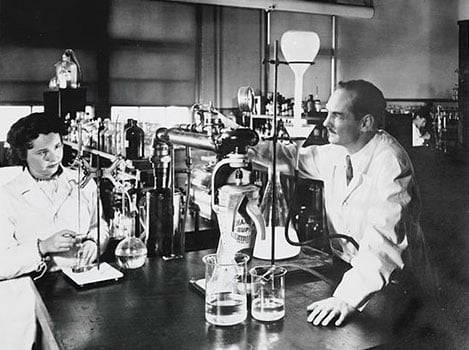
Gertrude Elion and George Hitchings in a laboratory, circa 1948.
Source: Wellcome Images, Wellcome Library, London. CC BY 4.0 via Wikimedia Commons Photographer unknown
Sir James W. Black – Interview
Interview transcript
Professor Sir James Black, welcome to this Nobel interview. The Nobel Prize that you were awarded in 1988 was kind of unusual I would say, you got the prize for the discoveries in drug research, and this was the first prize in this area in 31 years. Were you very surprised when you got the news?
Sir James Black: You bet that. Astonished. Yes, I didn’t think it was prize worthy frankly.
No? Do you think it was?
Sir James Black: I have no way of judging that. I mean I just played the cards that someone dealt me.
But the drug that you have worked on is broadly spread today, it is beta-blockers from the beginning, everybody knows what it is.
Sir James Black: Yes, but you see my notoriety is by an accident, the accident is that the drugs I developed made a lot of money. Now the science could have just been the same and the drugs might not have made much money and then I wouldn’t be here. I’m not here for the science; I’m here because of the notoriety of the widespread use.
Why do you think so? Don’t you think that the development of drugs, there is commercial interests in it …
Sir James Black: The citation was for a new method and that’s true in this sense that it so happened that when I got the idea for my first drug a discovery had been made and the discovery was that we have hundreds of messenger molecules that make our cells work together, we call them hormones. The discovery was that these messenger molecules have two properties, a property of, a cognition property, they recognise a cell which has a sight on it that they can, so there’s recognition and then they do some things to switch it on. The discovery was that these two properties, cognition and efficacy were separable. I wanted to stop the effects of adrenalin on the heart and so I reckoned maybe I can take adrenalin and get rid of its efficacy and leave behind the affinity which in essence was what happened.
But don’t you think that most of the discoveries are kind of a surprise even for the discoverer?
Sir James Black: It’s hard to go back, you know, we take memories and we smooth them like pebbles so we’re comfortable with them and I think memory isn’t about recollection, it’s about reconstruction and so I’m not at all sure now, at this stage, what I was actually thinking or planning or doing, all I know is outcomes and … But motives are very hard to be sure about.
You have worked both for the university and for companies, industries …
Sir James Black: About half my life in each.
Half your life …
Sir James Black: In each.
How do you they compare?
Sir James Black: I have worked as an employee for three drug companies and I have collaborated with a fourth and these companies are like people, they have quite different cultures, characters, but like people they have common diseases. I once thought I’d write a textbook of institutional pathology and the diseases are largely problems of magnitude, problems of communication. A technical company is very people intensive, it’s not something that you can scale up with the equipment and machinery, you have to have a lot of people and when you have a lot of people, you have the problems of communicating between them so that’s the industrial side. It’s very hard to make a general statement about companies because they’re all different. Universities on the other hand, the problem with universities is they have been changing continuously during my association with them …
In what way?
Sir James Black: … and I’m not too comfortable about the way we’re going, because more and more, the big universities, are becoming like companies, more and more they’re concerned mainly with the cash flow, more and more are they concerned with whether or not the intellectual output of the people can be turned into property and start-up companies, spin out companies, there’s huge obsession with making money and I don’t think this is compatible with the job of a university. The job of the university is to make discoveries, not to make inventions. Discoveries are about finding out something which, if you like, is already there but no one knew, whereas an invention … When I made a drug, that was an invention, there hadn’t been anything there before, but the invention was built on other people’s discoveries. If Ray Ahlquist and so on had not done their work, I couldn’t have done mine. So the job of academia is to make discoveries, it’s the job of business to make inventions I think and so I’m unhappy about this. One of the worrying things today is that scientists, because of pressure on them to raise money, either from grants or from private venture capital, are making promises, you know, once we get the protein, once we know it’s structure, once we get the gene, then we’ll get the drug. This is unwise because we’re leading the public, who ultimately are our paymasters, we’re leading them to have expectations. Now if …
So you’re afraid of a blacklash …
Sir James Black: I am afraid of this. If I was running a business and was making my shareholders promise like that they’d have me in prison, but scientists can get away with it. We’ll not get away with it forever, time will catch up with us because here’s the problem. The rate of accumulation of knowledge, the information, is so vast, none of us can take it in, but knowledge just adds, and you might think that all this knowledge will make progress but progress isn’t based on knowledge, it’s based on ideas, and whereas knowledge adds, ideas have to substitute. You have to replace the idea you already have with a new one and that’s painful and that’s slow and that is the rate limiting stamp. For example we’ve had now the human genome project, that has taken 125 years from the time when chemists were extracting material from spermatozoa, from the nucleus and getting out this gooey stuff and then showing there was four bases in there, that was in the 1870s, staying right through now to get a nearly complete map of the sequence of bases in the human genome but that’s, it’s just not even the beginning of the story because now the problems are conceptual. Suddenly we find there’s only about a third of the genes we expected, and we don’t know how they work. The big problem …
Why and what and …
Sir James Black: … and this is going to be the slow thing, our exploitation of the knowledge about the genome is going to require changes in our conceptions from what they are at the moment. At the moment we are still thinking that our gene does our job and so if you can find out the job the gene does, why you can control it, but it isn’t going to be like that.
No, it sounds too simple.
Sir James Black: It’s too simple.
So even if you get more money for thinking the process will take time anyhow …
Sir James Black: Yes.
… even if more people will do it?
Sir James Black: There are some problems you cannot solve just by throwing money at them. AIDS for example, we’ve been trying for what 25 years to get a vaccine for AIDS, so far we’ve failed. Now we’ve been making vaccines, you know, for a century. We want a vaccine, so we throw money at it and we’ve failed and we have to learn from these things that the wish is not enough, there has to be the understanding which is the platform for achieving what you want to do.
Yes, the creative process takes time.
Sir James Black: And the time, the slowness, is the thinking, the concept, that’s the hard bit.
Yes. I have another question to you. As a Nobel Prize winner, you are asked lots of questions and on Thursday you are going to discuss even terrorism.
Sir James Black: No, I’m not.
You’re not. Others are.
Sir James Black: Some maybe, but no, my views on terrorism are the same as yours, we’re against it.
Has your life changed after winning the Nobel Prize?
Sir James Black: There is a period when it’s hectic, yes.
And you become an official person …
Sir James Black: And the problems are we’re not trained, we don’t know how to handle it, we’re not film stars.
No. How did you manage?
Sir James Black: Badly.
And that means?
Sir James Black: It means I had to make a lot of rather messy compromises I suppose, compromises between doing what other people wanted me to do and doing what I wanted to do which was to get on with my work. One of the things people want you to do in this sort of ‘star business’ is give lectures, attend seminars and so on and I just happen not to like it. I have one thing I enjoy and that’s sitting in a room with maybe 10-15 young graduate scientists and just talking. Then I’m happy, but these stand-up lectures I don’t like.
I understand. So what was the problem that you were working on that was known since 1905?
Sir James Black: What I’ve been doing is I gave you the principle earlier and I just keep applying that principle, that’s why I’ve applied that to adrenalin, to histamine, to another small molecule called 5-hydroxytryptamine and then to a bigger molecule cholecystokinin and gastrin, but the principle is always the same. These molecules are messenger molecules, they do things, so I recognise each of them as being a messenger molecule because I have a piece of tissue or something which responds to them characteristically, that is I have an assay. I have the assay, I have the hormone, I expose one to the other and the system does something, it may secrete, contract or … I take this molecule and I walk around it, look at it and think, Well now, maybe if I take that piece off, maybe that will get rid, see. I make this new molecule and now I compete the hormone molecule with my new molecule and … First of all I try it on its own, does it do anything? Then I compete them. It’s an iterative process, it’s like Darwinian evolution only I synthesise, I test, I re-synthesise and on we go.
The one thing which is certain is it’s slow and this is why, in the drug industry today, this method which I have described and which everybody who’s tried it, it always works, you just don’t know how long it’s going to take. The beta-blockers was six years, histamine antagonist was nine years, 5-HTP was eight years, these are long periods. The drug industry has become inpatient, and it has now, if you like, got rid of this method which works and they’ve replaced it with a method which they don’t know yet if it’s going to work and this is now technological advances. We can now screen a hundred thousand molecules a day against proteins in one can or another, we have the technology to make hundreds of thousands of molecules, we have the technology to screen for them and what they’re looking for are leads, a molecule which does something. I never start a project without a lead and yet it still takes me these long periods of time. At the moment the drug industry has doubled its expenditure on research and development in the last ten years and the productivity as judged by newer drugs coming out has fallen by a fifth. This is not sustainable, and this is the thing, our earlier conversation about can you force drug discovery just by throwing money at it? The evidence is you can’t. There was a very well-known American philanthropist, but he was a psychiatrist, a scientist, he had trained as an artist, he became a great collector of paintings, gave them all to the Met eventually, but near the end of his life he summed his life up by saying that art is a passion pursued with discipline. Science is a discipline pursued with passion; passion is the engine of science and if you haven’t got that then give it up.
Thank you for taking your time and sharing your thoughts with us. Thank you very much.
Sir James Black: Thank you.
Did you find any typos in this text? We would appreciate your assistance in identifying any errors and to let us know. Thank you for taking the time to report the errors by sending us an e-mail.
Sir James W. Black – Nobel Lecture
Sir James W. Black held his Nobel Lecture on 8 December 1988, at Karolinska Institutet, Stockholm. He was presented by Professor Folke Sjöqvist of the Karolinska Institutet.
Sir James W. Black held his Nobel Lecture on 8 December 1988, at Karolinska Institutet, Stockholm. He was presented by Professor Folke Sjöqvist of the Karolinska Institutet.
Read the Nobel Lecture
Pdf 281 kB
Gertrude B. Elion – Photo gallery
Gertrude B. Elion receiving her Nobel Prize from H.M. King Carl XVI Gustaf of Sweden at the Stockholm Concert Hall, 10 December 1988. Photo from the Lars Åström archive
The Nobel Laureates in Physiology or Medicine at the Nobel Prize Award Ceremony 1988. From left: Sir James W. Black, Gertrude B. Elion and George H. Hitchings. Photo from the Lars Åström archive
The Nobel Prize award ceremony at the Stockholm Concert Hall 1988. From left medicine laureates Sir James W. Black, Gertrude B. Elion and George H. Hitchings and laureate in economic sciences Maurice Allais. Photo from the Lars Åström archive
Gertrude B. Elion is flanked by HM King Carl XVI Gustaf and his uncle, HRH Prince Bertil of Sweden, at the Nobel Banquet in the Stockholm City Hall, Sweden, on 10 December 1988.
© Svensk Reportagetjänst 1988
Photo: Boo Jonsson
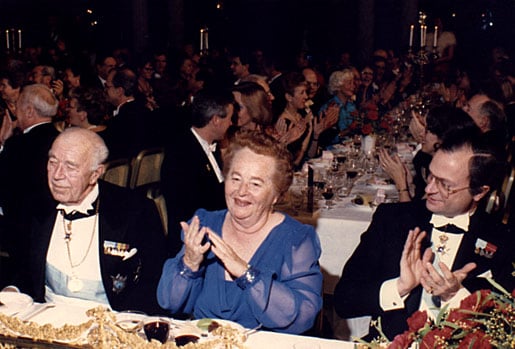
Gertrude B. Elion at the Nobel Banquet in the Stockholm City Hall, Sweden, on 10 December 1988. Photo from the Lars Åström archive
Gertrude Elion during a press conference in Stockholm, Sweden, in December 1998. Photo from the Lars Åström archive
Medicine laureates Gertrude B. Elion, George H. Hitchings and Sir James W. Black at a press conference in Stockholm, Sweden, in December 1988. Photo from the Lars Åström archive
Gertrude B. Elion at a reception during the Nobel Week in Stockholm, Sweden, December 1988. Photo from the Lars Åström archive
The 1988 laureates assembled at the Swedish Academy, 1988. Back row from left: medicine laureate George H. Hitchings, chemistry laureate Johann Deisenhofer, medicine laureate Sir James W. Black, physics laureate Jack Steinberger, chemistry laureate Robert Huber, physics laureate Melvin Schwartz, chemistry laureate Hartmut Michel and physics laureate Leon M. Lederman. Seated are from left: laureate in economic sciences Maurice Allais, medicine laureate Gertrude B. Elion and Umm Kulthoum Mahfouz, daughter of literature laureate Naguib Mahfouz. Photo from the Lars Åström archive
Gertrude Elion in the lab. Courtesy of Gertrude B. Elion Foundation
George Hitchings and Gertrude Elion, 1988.
Source: Wellcome Images, Wellcome Library, London. CC BY 4.0 via Wikimedia Commons
Photograph by Will and Deni McIntyre
Gertrude Elion and George Hitchings in a laboratory, circa 1948.
Source: Wellcome Images, Wellcome Library, London. CC BY 4.0 via Wikimedia Commons
Photographer unknown



Gertrude B. Elion – Other resources
Links to other sites
On Gertrude Elion from The Chemical Heritage Foundation
Exhibit: Women of Valor – Gertrude Elion from The Jewish Women’s Archive
The Academy of Achievement – Profile, Biography and Interview with Gertrude B. Elion
George H. Hitchings – Banquet speech
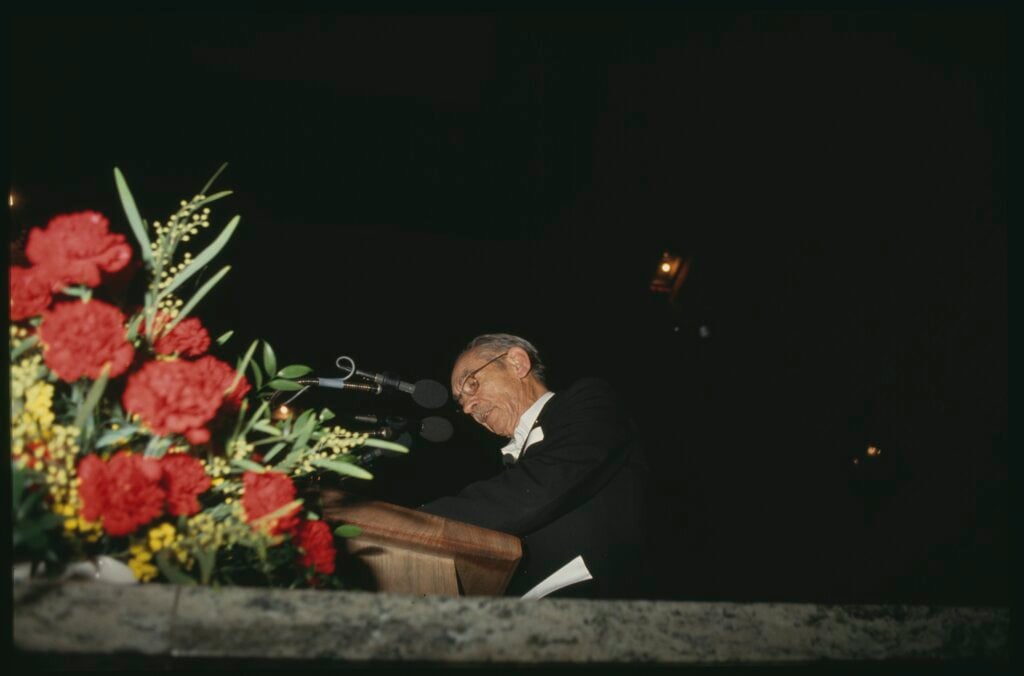
George H. Hitchings’ speech at the Nobel Banquet, December 10, 1988
Your Majesties, Your Royal Highnesses, Ladies and Gentlemen,
On behalf of my colleagues and myself, I wish to express our deepest thanks for the honor granted us today. Forty years ago when we began our studies in nucleic acids, we certainly did not anticipate receiving such an award.
We were inspired by basic questions concerning the biochemistry of cellular reproduction, and the search led us on a journey filled with new knowledge and exciting discoveries. That is the dream of every scientist. We have been further blessed with the privilege of seeing our work in the laboratory become medical therapies to combat diseases like malaria, leukemia, bacterial infections and gout.
The practical application of research to the problems of disease is a special strength of the pharmaceutical industry. It is unlikely that such an array of innovative drugs would have emerged from our investigations had we been working in a different research setting.
Each scientific discovery is built upon its predecessors and we give thanks for the dedicated men and women who held tenaciously to their visions and for the legacy of their knowledge. Our contributions to medicine also were built upon the century-long traditions of Burroughs Wellcome Co. where Gertrude Elion and I pursued our research careers.
The company’s co-founder, Sir Henry Wellcome, was an American pharmacist who made research the foundation of his enterprise. He established the Wellcome Laboratories for physiological and chemical research in 1894 and 1896. Wellcome told his scientists, “If you have an idea, I will give you the freedom to develop it.” That philosophy supported us through four decades of research and continues to nurture our successors. Our greatest reward has been the ability to develop our ideas for the service of mankind.
When William Faulkner accepted the Nobel Prize in Literature in 1949, he spoke of the verities of the human heart – love and honor, pity and pride, compassion and sacrifice. As a scientist, I should like to suggest three verities of the human mind – curiosity, creativity, and the love of knowledge.
The Nobel Prize in Medicine honors these truths, and we receive this recognition with humility and gratitude. Thank you.
George H. Hitchings – Other resources
Links to other sites
“After the Prize”. An interview with George H. Hitchings from University of Washington
On George H. Hitchings from The Chemical Heritage Foundation