Featuring medicine laureate Katalin Karikó
Whose truth? Climate change denial
“Where is there reliable information and where will you be getting that from?”
Despite the impact on millions of lives, denial and lies about the climate emergency continue to spread online. But how can scientists get their message across?
Nobel Prize laureate Sir Paul Nurse discusses how to use science, not politics, to guide the debate surrounding climate change. The BBC’s Babita Sharma also speaks to two young people who are trying to make a difference. UK climate activist Phoebe L Hanson founded Teach the Teacher, which gives school children the resources to engage with their teachers on climate change. Ugandan Nyombi Morris set up a non-profit organisation, Earth Volunteers, to mobilise young people like him who wanted to promote the fight against the climate crisis.
This podcast is part of a co-production between BBC World Service and Nobel Prize Outreach to examine disinformation and the role of critical thinking.
Across four episodes we hear from Nobel Prize laureates about the spread of disinformation in their fields of work and the young people around the world combatting and exposing these distortions.
Listen to the other three episodes
-
-
Featuring peace laureate Maria Ressa
-
Featuring Oleksandra Matviichuk, head of Center for Civil Liberties
First published June 2024
Transcript from an interview with Leland Hartwell
Interview with the 2001 Nobel Laureate in Physiology or Medicine Leland H. Hartwell, at the 57th Meeting of Nobel Laureates in Lindau, Germany, July 2007.
Lee Hartwell, co-recipient of the 2001 Nobel Prize in Physiology or Medicine together with Tim Hunt and Paul Nurse, welcome to this interview. If I mention the word mentorship, what comes to mind?
Leland Hartwell: I think, as laboratory scientists, maybe most scientists, we work very closely with students, often in small groups, I never had more than about eight people in the laboratory. That’s a very intense relationship that’s where a person is learning to do science over many years, for a graduate student it can be as many as six years, for a post doc it can be many as four or five years. Those people come into that situation without knowing anything about how you do science. The way you learn how to do science is through that relationship and what the ethics and principles and judgements are, so it’s an extremely close mentoring relationship. I know everything I use and apply in science I learn from the people I work closely with.
When you bring students into the lab what do you look for in them?
Leland Hartwell: With graduate students I would take anyone into the laboratory that was accepted by the department, because it’s a pretty good department and the quality standards were pretty high. I don’t think that the criteria we have for judging students prior to them getting into the laboratory and doing science are very good so it’s a matter of giving people a chance to see what they can do and in my experience about half of them are cut out to be scientists and about half of them aren’t.
Is there anything in particular that distinguishes early on those that are cut out for it?
Leland Hartwell: I think it’s a couple of things, it’s a strong sense of determination and commitment and it’s also an ability to think for themselves. Then there’s for laboratory science a factor of what people call good hands where you can make things work or you can’t, and nobody really quite knows what that is but those three things are pretty critical. The sense of self confidence that’s needed to make your own judgements and even to argue with your mentor about whether some thing’s important or meaningful, an experiment worth doing, those are very good signs when a student’s willing to argue with you. Whereas primarily in undergraduates we just judge intellectual abilities by whether they pass tests or not and I didn’t even mention that I’m sure that’s an element as well, but these other things are really important in laboratory science.
Maybe the last point is a given.
Leland Hartwell: That’s right anybody who’s there probably has that quality yeah.
When you organise your lab, what do you keep in mind about the environment?
Leland Hartwell: For me it’s primarily intense interaction about ideas and results and in a sense I don’t organise the laboratory. People don’t work in teams in my laboratory, everybody has their own project and they don’t take up where somebody else left off. They come in, they talk to people about what’s going on, they think about, read about things that we’re interested in and come up with some idea, try it out. It usually takes three or four ideas before a student can find something that really opens a door.
But they have to find their own idea?
Leland Hartwell: They have to find their own. We’ll talk about ideas, there’s ideas floating around but I think the critical thing is being able to experimentally open a new door. That’s a huge challenge for new graduate students and I think that’s where some make it and some don’t. Frequently when you try something doesn’t work, so it often takes three or four or five projects before you find something that works and you can’t spend a year or two on each one, so you’ve got to be able to get an idea, think of a critical experiment, do work within a few months, find it doesn’t work, move onto the next thing. I think that’s really critical for students who are going to do science on their own because they’re going to have to open new doors several times in their career. Once you open a door you may have several years of productive research but eventually you’re going to have to open another door.
You have to establish that confidence that you can do it I imagine.
Leland Hartwell: Right, exactly and so you have to do it for yourself.
You’ve said already that people don’t work in teams but is there any physical principle by which you organise the people in the lab, do they all work closely together?
Leland Hartwell: No.
No? It just happens?
Leland Hartwell: It just happens.
I wanted to start by exploring your own scientific beginnings. From your autobiography that you submitted to the Nobel Foundation you describe a childhood with some interest in science but that didn’t really kick off until you got to the end of high school when you became a physicist really?
Leland Hartwell: Right, I never knew I was interested in science, I grew up in a family where no-one had gone to college so I didn’t know anything about academics. Through the first junior high school and half of high school I was pretty rowdy – a lot of sports, lot of hanging out with guys and cars and girls and that kind of stuff. I got tired of it, mid-way through high school and I guess I felt like it wasn’t very satisfying and switched schools to change the environment but not knowing that I really wanted to do anything intellectual. I was just very fortunate and I find over and over again when I talk to people who are successful they often point back to a teacher that was the critical influence. Certainly was for me, it was a physics teacher who recognised I had some ability and would stimulate me with extra problems and give me hard problems to solve and I really got hooked. It was a lot of fun and then I got really interested in school and academics and math and physics and things and then I found I could do very well in those things, but because I had only had a year and a half of decent grades, I went to a junior college for a year.
A junior college is a stepping stone between school and university?
Leland Hartwell: Yes, junior college in the US is usually a two-year college and people then will go from there to a four year college. Again I got lucky because I was thinking I’d probably go into engineering but I had a counsellor who grabbed me by the scuff of the collar one day and said Listen you’ve got a recruiter here from Caltech and you’ve got to talk to this person. I said No no, I don’t want to talk to Caltech, I don’t. Yes you have to do this and I got hooked again, I said Wow, this is really exciting stuff, but I thought it was not possible for me to go to a school like that, because tuition and things and we didn’t have any money and I had no idea that many of the good schools support poor students, so I was very fortunate again. They were recruiting for the freshmen who fail and to replace the sophomore class and you just take the finals from the freshman year and I did well and I got in. Then I found myself in an environment that I had never imagined where people were really scientists, they were thinking about original questions and how you get answers to them and I just didn’t even know that world existed.
You’ve highlighted the importance of the teacher in identifying you, spurring you on and finding the right connections. Do you think that in the US there are more science teachers like that than there were in your day or is there a paucity as there is in many countries now?
Leland Hartwell: I really don’t know, I don’t have much feel for the quality of science teachers in high school. I think that the general impression is the quality’s not very high, it’s often considered a default career.
Which has to be wrong it has to be said.
Leland Hartwell: Yes, I mean for several reasons, one is, and now I realise that you those people have a huge influence and that’s really important but on the other hand we just don’t pay them enough and so it’s not considered a very lucrative career, but teachers should really be paid a lot more than they are.
Anyway, you found yourself at Caltech in this lovely environment and you quite quickly decided that you were going to move towards biology from the physical sciences. What catalysed that change?
Leland Hartwell: That was again the influence of an individual. It was a very interesting time, it was around 1957 or so, it was only three or four years after DNA structure was described. I entered as a physics major and I took a biology course as an extra credit sort of thing and the teacher for that course was James Bonner who was an early molecular biologist, a plant biologist. He was just so excited about DNA and RNA and proteins and cell biology and stuff, you could just see that for the first time there was an opportunity to understand life at a molecular level and that was just so incredibly exciting that I had no choice. It’s funny because at the time I thought I was giving up my career. There weren’t careers really in biology at that time, it was a brand-new science, molecular biology, there were good careers for physicists but it’s funny by the time I got out of graduate school the physicists couldn’t get jobs and biologists were in great demand so you can never predict those things.
Your conversation sounds very similar to Jim Watson’s description of his reading Schrödinger’s What is life and deciding that the problem to solve was exactly that.
Leland Hartwell: Yes.
It’s the same experience. You turned again quickly to cell regulation, what in particular attracted you to that?
Leland Hartwell: I’d had two good experiences in all getting a glimpse of how good science was done in molecular biology. One was when I was an undergraduate with Bob Edgar who was in Max Delbrück’s group and there I was fortunate enough to do bacteria phage genetics and be close to the work that Bob Edgar was doing in terms of studying the morphogenesis of phage and using genetics to take apart the whole morphogenetic pathway of the virus and that was terribly exciting.
You saw that genetics offered a part into studying cell growth and regulation.
Leland Hartwell: Basically what they were doing was they discovered this class of mutants that were called amber mutants that would grow on one bacterium but not in another and of course it ended up into the nonsense suppression, but what it meant was that you could find mutations in essential genes because they would be suppressed in one strain and allowed to grow and then in the other strain you could see what the consequences were. He was collaborating with Kellenberger, an electron microscopist, and they would look in the bacteria where the virus couldn’t grow and look just what they’d see and what they found was that different mutants were blocked at different stage and making the virus, so some would make heads and no tails and others would make tails but no heads and all kinds of things. They were so able to construct this pathway for how this very complicated little virus was put together and all the genes that contributed to it, 50 year of genes. The power of that was just incredible and it was very simple – it was just isolating mutants and looking at them – it’s very simple, but the power was enormous. That was a strong influence for me and then as a graduate student with Boris Magasanik at MIT I studied gene regulation and had a window on the Jacob Monod world of lac operon. that was also very influential – how genetics was able to take a part gene regulation.
When I chose to become a post doc, I knew my influence at Caltech had taught me that you know, you want to pick a big problem, you want to pick something that’s obvious so the next big frontier to me seems to be cell division and the laboratory that seemed to be doing the most interesting work was Renato Dulbecco at the Salk Institute. I went to work with Renato and he was working with animal cells and tissue culture and looking at viruses and that was kind of a fun. I was only there about a year and a half but I was seen to be in a hurry, because I only spent three years in graduate school and I spent a year and a half at my post doc, but during that time we did some sort of bread and butter experiments in terms of how viruses stimulate cellular DNA synthesis. It was important for thinking about cancer but what was important for me was I did a series of projects just like I like the graduate students to do, a series of projects trying to get a handle on something fundamental in cell biology that I could explore. I had exactly that experience of three projects that I thought were a good idea, I took them to the point where I could show they were not interesting and at that point I left and took a job at UC Irvine and I was quite frustrated, I really didn’t know what I was going to do because I had seen the power of genetics in viruses and gene regulation and now I was working with animal cells and there was no possibility of doing genetics in human cells.
Just to stop you a second. It’s interesting that you got a job at UC Irvine on the strength of three post doc projects that hadn’t really got anywhere, you’d taken them to the point of …
Leland Hartwell: As I said we did some bread and butter work too, so we had some good publications as well.
All in 1,5 years, that seems to be a in hurry.
Leland Hartwell: It was an intense time was one. I was expressing my frustration one day, I’d gotten a grant to work on animal cells although I didn’t really want to and while I was waiting for equipment to come in and things I spent time in the library and I was talking to one of my colleagues and expressing this issue about you really need to do genetics to study things in a fundamental way and he said Why don’t you work with some model organism. It was just like somebody flipped a light on and this was Dan Wulff who had also worked in the Delbrück group and had similar experiments, work of lambda phage. I just went to the library intensely looking for … I wanted to study eukaryotic cell so was there a eukaryotic cell where you could do good genetics and that lead me to yeast, budding yeast and just rolled up my sleeves and tried it. But I never had any experience working with yeast.
Did you have any worries that it wouldn’t actually be applicable to higher organisms?
Leland Hartwell: Sure. I had no certainty that it would be and it’s really funny, I think that experience has happened over and over and over again in biology, where you know the genetic code is universal in protein synthesis but cell division, that might have evolved in many different ways and of course it didn’t and other areas of cell biology over and over again we have been uncertain and found that things are universal.
Roger Kornberg’s prize last year for instance, in chemistry, where he had been working on yeast without any guarantee that it was going to be applicable.
Leland Hartwell: Yes, so it just turns out that all of that basic machinery evolved long before everything diverged and it’s all really the same stuff, so that was fortunate because I didn’t know whether that would be true or not.
In all of your studies subsequently you’ve been cataloguing vast numbers of players in cell cycle control, and the picture we have of the cell becomes more and more complicated. Are we still in a phase, do you think, of cataloguing the players that are involved in cellular regulation?
Leland Hartwell: Yes we are, we’re still in a stage of cataloguing players in all aspects of cell biology and I think that will continue for some time because it’s very very complicated, everything is very very complicated and takes hundreds of different proteins involved in processes many of which are not essential but increase the fidelity, and the accuracy, efficiency and the dynamic range and the robustness, there’s just incredible complexity in any cellular process. In fact I think that’s the profound thing we’re at now is, I don’t think it really matters whether we decide to focus our attention on the hundred known players in a process or whether we continue and find the 300 that are involved in it. The real question now is how do all these pieces work together and I think that requires a different approach to biology. We only have two approaches to biology really, the cell biology, one is you take something away by genetics or some other trick and see what happens or you get the complex process to work in some /- – -/ and then you try to purify the pieces to them and put them back together and both are very very primitive approaches.
But they’re both quite isolationist approaches looking at individual components very much.
Leland Hartwell: Yes, the biochemical one starts, they both have their advantages, the genetic one at least, things are working in the cell so they’re working right. The biochemical approach you got the complexity of the whole /- – -/ there and you’re dealing with the system rather than an isolated component, but anyway they’re both very very primitive approaches and they’re not the kind of approaches that a physicist would take with a complex system. There’s a new era in cell biology that we’re just beginning to see the beginnings of where you need to be able to monitor the behaviour of the system under perturbation and understand the dynamic aspects of it which may involve reporters at different stages in the process and seeing how they come on and go off and various kinds of things like, neurophysiologist study pathways but I mean I think the critical thing about biology that goes way beyond understand what the parts do is just the enormous complexity.
It may be a silly point to make but do you think that in some ways the approach to cell biology is conditioned by the way that cell biological pathways are always described which is this element acts with this element acts with this element, it’s basically elements acting in space whereas presumably what we actually face in a cell is an enormous concentration of things barging past each other competing for space, trying to find each other. It’s a much denser picture than we’re used to looking at when we look at cell biology text books.
Leland Hartwell: It’s hard to imagine that things move around in there it’s so concentrated. If you’ve seen diagrams of people who have actually portrayed the density of proteins in a cell and the DNA, I mean the DNA is this compact thing that’s a thousand times more longer than the cell and revolving at this enormous speed to replicate and it’s just unbelievable that these things occur.
But still if you study cell biology that’s not the picture you get probably, the picture you get is of isolated elements and it needs a great experience to reach the point of really having a mental picture of what it must be like.
Leland Hartwell: I think that will only come by getting things that report dynamically in real time from the cell and studying the cell in all its complexity and dynamics and real time.
Where will those reporter systems come from, which disciplines are needed to enter cell biology in order to give us those tools?
Leland Hartwell: Really getting beyond my capability but fluorescents crunching and things where you can see proteins in a rack or proteins fold and unfold, probably things that you know give photons off when things interact and I think it’s a real problem more for chemists than for anyone else.
In terms of systems biology, which is a growing discipline, do you think that that’s taking an appropriate approach to studying cell biology?
Leland Hartwell: I think systems biology is trying to deal with the complexity so sure, but that’s what we have to do but applying a name to it doesn’t really solve it. One aspect of systems biology is trying to catalogue all the components that’s got to start there, that’s good, but I think a real systems approach has got to be in real time in the real situation. One aspect of systems biology is simulation and mathematical modelling and that’s going to be a very powerful approach to these things too because as you say the concentrations in various things, we got to model these things because they’re not intuitive to us.
Yes, and the dynamic nature of things has only been hinted at not for … You’re currently director and you have been for some time at the Fred Hutchinson Cancer Research Centre, what do you feel holds out the most hope for cancer research in the current environment.
Leland Hartwell: I think the reason I went to the Cancer Centre about ten years ago was because I was impressed with the accumulation of knowledge and cell biology, the incredible amount of detail we have, even though we still have a long way to go. There is a lot of detail and it seems to be having a relatively minor impact in medicine and why, that’s what was kind of motivating me. There’s a lot of things to say about the question you asked, but one thing that’s very impressive about cancer is that almost everybody we cure is because we detect cancer early and almost everybody whose cancer is detected late dies of their disease and that’s been true for as long as surgery and radiation has been applied to the cancer patient. The impact of therapeutics has been relatively small and the hope of curing late stage disease with the right drug remains a dream, an unfulfilled dream despite billions and billions of dollars having been spent trying to solve the problem.
Sorry, I didn’t mean to interrupt but I was going to ask, maybe you’re about to address it, do you think that’s mis-spent money do you think that the money should be actually re-directed?
Leland Hartwell: Some of it should be re-directed or some people should be taking a different approach. The reason that that approach continues to be used even though it’s largely unsuccessful is because it’s financially rewarding. New cancer drugs cost 30-100,000 dollars a year per patient even though they may extend life a few months, so it’s lucrative, but that doesn’t mean it’s really solving problems. Anyway, one obvious approach is to try to detect disease earlier and that’s been effective in a number of cancers and cervical cancer and colon cancer to some extent and breast cancer to some extent and prostate cancer, so there’s good reason to think that it is a valid approach and there’s just not very much investment in trying to detect cancers earlier. That’s where I think at least NIH and the National Cancer Institute should be spending its money rather than things that tend to support the pharmaceutical industry. Somebody ought to be working on early detection but that idea has really lead me to a broader concept about medicine in general and what I think medicine really needs to be much more effective is just better diagnostics and I think of it in a very simple way which is that there are a number of questions you need to know about any disease. Who’s at risk for it, what is the risk, does a person have disease, which disease is it, what stage is it, what therapeutics that respond to, these are all diagnostic questions. We’re seeing the impact of molecular diagnostics primarily in cancer at the DNA level because tumours have DNA changes and you can sample the tumour and find out that it has certain DNA changes and that can distinguish it from cancers that look similar to it and is becoming quite a powerful approach to cancer management. But we have to go a lot further, we have to get beyond DNA, we have to get the protein diagnostics and combine those with molecularly targeted imaging and blood tests and various kinds of things, and I just think this field has enormous potential but again there’s very little investment in it.
What about the medical community, presumably that are highly supportive, but are doctors properly trained to take full advantage of what could be done?
Leland Hartwell: They’re not because the science hasn’t provided them with the tools so they haven’t been trained and they don’t … We have very very ineffective diagnostics for most medical problems and it’s true of infectious diseases, it’s true of any disease you look into. I was surprised, I thought infectious diseases could be easily diagnosed by the nuclei acids or something, but it turns out that if you look at tuberculosis or malaria or any of these kinds of things, they have the complexity that cancer has, there’s stages of the disease, people respond differently, people respond differently to therapeutics and so they have the same problem of monitoring the patient and individualising the approach that we have in any disease. I think this is the big frontier in medicine and in concept it’s just very very simple but nobody I think has really said this is exciting, this is where we can really revolutionise medicine.
That was going to be my last question, how do you push that agenda to increase diagnostic development, diagnostic use?
Leland Hartwell: I think what’s needed is to show it can work and I’ve been working at various levels to try to encourage that both at my own institution by recruiting people who are committed to that, raising funds for it from foundations and stuff, developing partnerships with other institutions. We have an international consortium of bio-marker groups throughout Asia and other countries trying to develop paradigms for how you do this in a team science sort of way, it’s not an individual laboratory thing, and the field is progressing. I’m very excited about the developments in the last year or so. I’ve worked with the National Cancer Institute to encourage the funding for the field and they’ve put out a couple of programmes for about 120 million dollars or so and the groups that are being funded by those programmes have made some real breakthroughs in the last year. I think within the next couple of years we’re going to see a lot of useful bio markers being found but then there’s still big problems and it’s because the economic model for validating and commercialising those is not adequate and now that I can see that field developing, I’m trying to work on a different model for validating these bio markers because at the current time things are being introduced into patient care, the nucleic acid markers are being introduced into patient care through in the US through clear approval. It’s a process by which the CMS that funds medicare and medicade approves a laboratory to do a test, reproducibly and that allows you to use that test in that one laboratory but there’s no requirement for validating it for any particular use, for knowing what information it’s providing and there’s something like 7,000 genetic tests now being performed on patients based upon this clear approval process where nobody knows what information you’re getting from that test and so that’s going to create 10,000 PSAs and that’s a disaster for medicine.
It’s just confusion.
Leland Hartwell: Yes, what we need is a model whereby a bio marker for disease becomes validated during its implementation and I imagine an irradiative and very co-operative process whereby a laboratory that is non-profit but does very high through-put, high quality tests, partners with the health care system and I think the motivation for these partnerships will be not only can we improve patient outcome, but we can reduce your costs.
And that has to be the underlying point.
Leland Hartwell: Everybody’s course very concerned about the costs of medicine, nobody’s offering any solution for that. I think there is a solution, the solution is to have better diagnostics so you can catch people earlier, you can treat them more effectively you can change the treatment if it’s not working, you can avoid treating people who aren’t going to respond with expensive treatment. I think that is the road to controlling costs in medicine and if we can partner with a medical system and it’s probably not the US, it’s probably countries where you have a single payer and work within the system where there are clinicians and the payer and the regulators and various people around the table at the very beginning, and we decide ok, what are the performance criteria about this test needs to meet before the clinicians will start using it and the payer will start paying for it and we work toward that goal.
Seems very logical. Are you advanced in these discussions with any particular other country?
Leland Hartwell: We’re at the point right now where I think we’re close to having the non-profit laboratory set up and some foundations to support it and as soon as that’s in place then I’m going to go out to different countries and see if we can build some relationships.
A last thought, does it matter whether you understand what the bio marker is actually telling you?
Leland Hartwell: It’s obviously better if you know what you’re measuring and why it’s there because then you’ll understand something about where it’s not reliable, but at first it’s got to be just empirical, does it correlate with disease or not and how informative is that, what’s the rate of false positives and the rate of false negatives and those kinds of things. You need very very good clinical samples, very high quality controls that are well matched to the patient material to be able to answer those questions, but even once you answer that question and it looks like something is useful, there’s all sorts of confounding diseases for every single disease that you don’t necessarily want to be detecting, so the more you would know about what the actual biology is that the marker’s revealing the more you will understand where it’s likely to be mis-informing.
More information is certainly better of course. Thank you very much indeed Lee Hartwell for spending time with us, that was fascinating, thank you.
Leland Hartwell: My pleasure.
Did you find any typos in this text? We would appreciate your assistance in identifying any errors and to let us know. Thank you for taking the time to report the errors by sending us an e-mail.
Sir Paul Nurse – Podcast
Nobel Prize Conversations
”When a politician gets up and says that we are following the science, the question needs to be what science? Because there are more than one scientific conclusion out there”
What is life? This is a question that has puzzled scientists for centuries, one of the most famous being Erwin Schrödinger. In this podcast episode, conducted in December 2020, we meet Paul Nurse and hear his thoughts on the matter.
The host of this podcast is nobelprize.org’s Adam Smith.
Nobel Prize Conversations was produced with the support of 3M, ABB, Ericsson and Scania.
Discover more
-
Nobel Prize in Physics 2024
John Hopfield – Podcast

-
Sveriges Riksbank Prize in Economic Sciences in Memory of Alfred Nobel 2024
Simon Johnson – Podcast
-
Nobel Prize in Physiology or Medicine 2024
Gary Ruvkun – Podcast
Transcript from an interview Tim Hunt
Interview with Tim Hunt at the 57th Meeting of Nobel Laureates in Lindau, Germany, July 2007.
Tim Hunt, welcome to this interview with Nobelprize.org. You won the 2001 Nobel Prize for Physiology or Medicine together with Lee Hartwell and Paul Nurse.
Tim Hunt: Correct.
And you seem to have been blessed with the lucky chance of knowing that you wanted to be a biologist or a chemist from quite early.
Tim Hunt: Yes, very early on. I think I was sort of scientifically minded but I can’t really remember it, it’s a sort of construct now, but I did very well in a biology exam when I was, I think, 11 years old or something like that and I came out something like 13th in the whole school. In those days everybody took the same science exam whether you were 7 or 12, 13, so you knew exactly where you were in the whole school. I was in the middle of that point, and I did very well and I realised that it came very naturally to me. I also knew another thing, I had a great friend who was a good physicist, he’s an FRS and all that stuff, Peter Pusey, and he was so much better at physics than I was. I liked physics, I would have loved to have been good of physics but the fact of the matter was I just wasn’t. Peter always zoomed ahead.
A man’s got to know his limitations.
Tim Hunt: I think it’s terribly important to know what you’re good at and what you’re not good at. There’s no harm in trying to make yourself better at certain things. Some people love doing nature walks or collect insects and things. I didn’t really. We had a lead factory in the garden; we discovered a lead mine in the garden. It was great. My friend Bill Nimmo Smith and I followed this lead pipe and it disconnected so we cut off bits and then melted it down in the garden in a kind of improvised blast furnace. We would pour them in the back of dinky toys and then stick a piece of green baize. To begin with they were really shiny, and they looked really great and they were very good paperweights so we sold them. We had a little cottage industry. I forgot, did we sell them or did we give them? I can’t remember anyway. That was the kind of thing I liked doing, the usual stuff. Everybody likes tinkering with radios and making crystal sets and in those days radios had lovely bits inside them, valves and one knew about the high tension supply to the valve and you understood how the valves worked and the low tension thing which just made the cathodes glow. It was all very mysterious and listening to test matches, it must have been, was it 1953, Len Hutton’s tour of Australia, listening to it under the blankets at 5 a.m. or whenever it was. That habit of listening to the radio under the blankets has never left me.
That’s a deep seductive pleasure, yes.
Tim Hunt: But you could always tell when the … was it the low tension battery or the high tension battery that was giving out, because I can’t remember, I’ve now forgotten what the symptoms were but they were different and you could always tell which battery needed and they were rather expensive so I forget whether you had to persuade mum and dad to buy a new battery or whether you saved up your pocket money.
But an early love of making things and piecing things together?
Tim Hunt: Yes, my room was always a complete mess with mostly soldering irons and stuff and making funny things. I remember I constructed a clock radio that would turn on the radio in the morning. It could have been the timer for a bomb mechanism but it actually turned on the radio and I can’t now remember anything about how it worked or where I got the idea. I expect I read it in some magazine. Another thing, we used to get book tokens as Christmas presents and Blackwell’s, in those days, had a lovely children’s bookshop, a tiny little one where, if you went up the stairs and you were an adult, you would have hit your head. The trick was to find the book you really wanted. So you’d go in there, they didn’t mind you reading, so you could read quite a lot before you actually plonked down your book token to get the book. Among the books that I very much liked were books which were mostly American, and they were therefore expensive, but they were do it yourself, like the ‘Amateur Scientist’ in the Scientific American, you wrap the coil around the lavatory roll and then made something that did something and that kind of stuff. My friend Peter and I we used to do a lot of electrolysis, I seem to remember. We used to make chlorine gas. I don’t know why we did it, just liked doing it, electrolysing sodium chloride and stuff. It wasn’t very quantitative but it was messy and it was fun and it was sort of slightly naughty. Now it’s strictly frowned upon. I suppose we could have done ourselves an injury.
It’s a step above electroplating your pencil sharpener, which I think is what I was doing.
Tim Hunt: I don’t think it was very directed or anything but you did get a sort of feel for how things worked and it was between that and cricket. I remember a lot of cricket, I was absolutely fanatical about cricket. I think at school I really did like biology and we had a very inspiring biology teacher, a man called Terence Doherty, who really wanted to be an artist. He’d been a researcher at Roth instead and got really fed up, hated that, so he came to the school to teach and there were only three of us in this A level Biology class and among the other things we did, this would have been 1957 I think, or -58, the anniversary of the publication of The Origin of Species. Do you remember which year that was?
-57, I think.
Tim Hunt: I think it was ’57. Anyway, the Oxford University had the series of extramural lectures and there were three in the series, it still resonates with me. One was on evolution, I don’t know who gave the lectures, it was probably somebody quite distinguished, but I don’t know, I was only little, 13 or 14 I suppose. Born in 1943, 14 yes. Then there was a series on radio activity which was very resonant because the bomb had just gone off and I read Brighter than a Thousand Suns and the biological effect of ionising radiation, the idea of your teeth dropping out and your hair dropping out and that had a medical thing as well. Then there was one on biochemistry, which was quite boring probably, but except that I do remember this amazing movie of a biochemical pathway which still people can’t do. You had compounds flowing down the glycolysis and then into the crib cycle and there were ATPs spinning off and NADs and all that kind of stuff and I remember thinking at the time, and I don’t know what year that might have been, so that must have been later, 1958 or -59, maybe even 1960, I can’t quite remember, wondering it was all very well this sort of pathway but there didn’t seem to be any control. How can you have all these reactions going on simultaneously, there must be something controlling it. It was really thrilling to go to Cambridge and then sort of /- – -/ and /- – -/ and all these people discovered /- – -/ and the principles of metabolic control and that was just gorgeous. It was so great, you finally understood that the thing that had been worrying you by its nonexistence did exist and that’s how it worked.
Worlds were unfolding?
Tim Hunt: Worlds were unfolding, yes, and much more so. What I recollect about the A level syllabus. First of all, the books were unbelievably tedious. The most exciting thing was to go out into the field and ask the questions, why were the lilies growing here and the daisies there? There’s a certain amount of ecology, but it was mostly about plant sex. Do you remember alternation of generation and the mosses compared to the ferns compared to the /- – -/. I never did understand how pinecones work and then when I finally read, much much later, Barbara McClintock and her studies of jumping genes, understanding what the pollen nuclei and the endosperm which is triploid. Nobody should teach a teenager about plants’ sex. It’s far too complicated. It’s really, really difficult to understand and there is no point in understanding it.
It’s true but the practicals are cheap.
Tim Hunt: Yes, I suppose that’s right. I remember still the thrill of dropping my fist earthworm into boiling alcohol and dissecting it; that felt very grownup and then there was the famous time when my brother’s rabbit died and I rushed it into the lab and dissected. It was much bigger than a frog, so you could really see what was inside.
Those were the days; you wouldn’t be allowed to do that.
Tim Hunt: Probably not, but we did, and that carried on too, into Cambridge I think, when the physiology practicals were fantastic because there were ones where you did experiments on yourself and there was the one where you re-breathed your own oxygen through/- – -/. I didn’t dare to do that but I watched people doing it, and they just passed out and the demonstrators then had to sort of come and resuscitate them. As far as I know no undergraduates were lost and it was great because the pure biologists, scientists like me, were doing these classes together with people who were going to be medics and there was absolutely no distinction made between the medics and the scientists, which is really, really good. It was a black, black, gloomy day when the medical course was hived off. Medical biochemistry is not the same as the biochemistry. It’s stupid, really, really stupid, it’s all the same.
Now medicine’s tried to reinvent it all.
Tim Hunt: I don’t know what’s going on because I haven’t taught in a course for a long time and the fashions change. It probably comes in and out. I think I was terribly lucky with teachers and lecturers and also colleagues at Cambridge. Again, that’s something which is sort of rather out of fashion now, the idea that you select some really bright people and put them together. I probably learnt more from my friends than I did from the courses but it was done in a very nice sort of framework. Particularly the zoology practicals were also very, very good. That was a first year practical because the guy who taught Jonathan Miller philosophy, a man called Frank Hollick and Ken Joysey and Anna Bidder had a sort of very clear idea of how they wanted to teach these undergraduates and to make them realise that everything was based on your senses, and you could so easily get it wrong by misinterpreting or by having expectations and you really had to look at the material carefully. It was really a comparative physiology course, it just ran through the invertebrate filer. It was tremendous, dissecting snails and stuff like that and that, together with the human physiology, it was a wonderful counterpoint. The medics didn’t take this zoology course but I did and I found it very … you just saw everything. You realised that invertebrates were facing the same problems as the vertebrates and it was wonderful.
Marvellously integrative and also teaching you to look at things from a sort of sideways as well as taking …
Tim Hunt: Yes, and often you found there were some amazing biochemistry practicals that were run in the physiology course. They were run by, now I’ve forgotten his name, this was the first man to measure the molecular weight of a protein. He measured the molecular weight of haemoglobin and got it absolutely spot on in about 1920 something and had been given a fellowship at Trinity on the basis and never done anything very much since. It was sort of in the department of /- – -/ science. Those practicals were very primitive but they had a certain … They were really important in a way because what happened was that you would add carbon monoxide to blood and watch it turn pink or you would acidify the milk and it would throw out a precipitator as though you were making yoghurt and then you would find that if you boiled that you would never re-dissolve the precipitate but if you didn’t it would go straight back in. It was actually a very good introduction to practical physical chemistry and it was the thing the biochemists were way too sophisticated, with those Warburg manometers which were much too complicated to understand really. One thing I should say, I was always much, much better at the practical. I did much better at the practical than I ever did at the theory. I wasn’t particularly good at writing essays. I was much better at dissecting the given frog.
I suppose that’s understandable of course because the theory really goes on in your head.
Tim Hunt: I don’t know, but there were lots of people who were much clever than I who could write brilliant essays about stuff and I just didn’t like that. It was much more the actual, the contact with the material and looking at results. Later on that led very naturally into actually getting data, which you had to make sense of and then you had to imagine what it would be like. I think that’s one of the things, that it’s very hard to convey to the general public. For many years we measured the rates of protein synthesis and that entailed putting samples into a scintillation counter and the standard assay always gave 8,000 counts, sometimes 9,000 and you knew that if it was 1,000 something had gone horribly wrong and if it was 50,000 something had gone wrong, you just threw away the experiment. You could tell what was going on, the whole hypothesise with the rate of which these little nixie tubes would flicker, you could say whether the experiment worked or not and whether your ideas were right or not and that was really great. But the active imagination, these little flickering numbers on the scintillation counter and to imagine what it was like to be a ribosome or what was going on inside the cell, it was such a huge disconnect. I remember thinking that too, in going to hear a lecture, it must have been by Sydney Brenner and Tony Stretton on establishing the collinearity of the code or working out the sequence of the basis in the stop codons, the idea was wonderful. You could deduce the sequence of bases in the amber codon, but the actual data was whether the phage grew or didn’t grow or something like that. It was making that connection between a very carefully constructed experiment and what was going on inside the cell always requires a considerable act of imagination.
And you find it difficult to get that across to the public, the sort of unpalatable nature of the rather dull data?
Tim Hunt: Yes, you collect all this data and you’re pipetting away and sometimes things turn yellow, but mostly they don’t even do that. They just get more or less radioactive or there’s a change in the absorbance at 340 nanometres or whatever that is, because NAD is being reduced or oxidised. It amused me that idea, because we were very biochemical and I grew up in a very biochemical tradition. The cell biology, looking down a microscope, came ever so much later and I wasn’t very good at it and I never have been, so I really like this biochemistry.
I think you have to enjoy the repetitive nature of it.
Tim Hunt: Yes, that’s right. I say to people it’s like gardening. If you don’t enjoy pulling out the weeds and encouraging the young plants you probably shouldn’t be a gardener. You’ve got to like going into the lab and just doing nice experiments, making sure that everything is neat and tidy and that things work and all the controls are in place. I remember some students. I was rather proud of these practicals they’d evolved and they were first year cell biology practicals and mostly they just involved plating out bacteria and assaying phage, which it turned out that most first year Cambridge students were totally incapable of doing. I’ve never seen such scrutty plates in all my born days and it wasn’t that difficult, just doing dilution series and stuff, and the students at the end of that, it’s already the era where you’ve got feedback from the students and the students said, ‘Well, these were really boring practicals. All we did was pipette.’ and I felt like slapping them about the chops and say, ‘If that’s how you feel why don’t you quit science now because that’s all you’re ever going to be doing, pipetting, it’s so important.’
Isn’t there a machine to do that, they ask! But maybe it’s a way to connect with the public because, as you say, people garden, people cook. People do things that are highly repetitive and involve lots of tactile stuff, maybe actually showing people that that’s what science basically is and that the higher deals are what lives on top of it but most of the day is spent…
Tim Hunt: Up in your head, yes. I mean you’re trying to prepare a dinner party to impress somebody or to please yourself or whatever it may be, but what you’re actually doing is chopping onions. It’s exactly like that. Everything is the same. The artist goes out and buys his new paintbrushes or paints or whatever I suppose. It’s like my 9-year-old daughter, Agnes, likes to go to stationery shops and buy lots of crayons and pads and things. I know where she gets that from.
I still like to do that. You published, I think as a graduate student, a Nature paper.
Tim Hunt: Yes, that’s right and I sometimes wonder about that, because we didn’t have any idea in those days how important it was to publish. It was just an absolutely natural. We thought we’d found something interesting, we just sent it in to the editor of Nature and whoever it was, I don’t know who it would have been in those days, found it interesting and so it was published in Nature. We didn’t think anything of it at all. I don’t think champagne was broken out or anything.
As you say, nowadays that would have probably led to you trying to set up an independent group as quickly as possible. It’s a huge feather in your cap. It obviously was a feather then.
Tim Hunt: I think people did notice, yes. I think probably our friends up the road noticed that there was something quite interesting going on down here and we were accepted and it was nice, but there was no big song and dance made about it. Later on, I did encounter a certain amount of … I don’t know what you’d call it, we were accused of being trendy because we published in Nature. It was as if this was not something a gentleman would want to do because what was wrong with the Biochemical Journal or something like that? Just recently Satoru and I had a paper accepted by Nature. We were really, really pleased because that was the first one for a very long time and it is important, but it’s funny that in the olden days, because nobody counted publications. I wouldn’t say we were unpleased, of course we were pleased and the journal that was more important to get into in those days was the Journal of Molecular Biology. That was what today would be Cell, that was the JMB and then it got so hoity toity or boring. The early issues of the Journal of Molecular Biology are very interesting because they’re full of interesting articles, some of them completely batty and wrong as you can now see, but they were always interesting. I think that’s a thing that people still don’t understand that the whole idea of making a good journal is that it should be interesting. You should want to know about the origin of the universe or why the Hox genes are in a particular order and what that means. There are lots of really interesting things out there and you don’t very often find very interesting papers. They tend to be more ‘P38 map kinase is important for the left lung of the lactating valves’ sort of thing.
Safer for editors to deal with?
Tim Hunt: Yes, and you get referees to say this is technically ok and all the controls are in place, but the idea that you should take a risk because something is interesting, I think that’s slightly been lost sight of and the whole editing business is more professionalised now than it perhaps was back then. It probably comes from the fact that everything is now so compartmentalised, and competitive. I wouldn’t know if something out there was interesting, I wouldn’t even know what was known in that field because although once it was all under one roof, now they’re under many, many roofs. That’s regrettable but inevitable I suppose.
I just wanted to return to your career path. You took the decision to stay on soft money for quite a long time, which obviously turned out to be absolutely correct …
Tim Hunt: It wasn’t entirely my decision. I did apply for a job and didn’t get, much to my fear at the time, but in retrospect it was terrific. I think now, looking back on it, it was wonderful to be in charge of your own destiny without having to answer for anybody. I don’t remember how many years of grants I had. I had a Bright Fellowship, I had a Royal Society Fellowship and I think I was on sort of some MRC grant, hired by my friend Richard Jackson at one point too. In all of that you could just get on and do what you wanted to do, you could teach as much or as little. I used to supervise undergraduates and in those days a boy, we had some really, really talented undergraduates pass through my hands. In fact at one point, it was the late 1970s, I was thinking of giving up because they were just so much better than I was. There were three of them in a row, it probably went; Hugh Pelham first, Richard Treisman second, and Andrew Murray third; he’s just awesomely good. Really, really talented people.
I was going to ask you, I don’t suppose you really did, but did you ever think of doing anything else?
Tim Hunt: Not really. I still wouldn’t know what to do. After the Nobel Prize I remember asking Paul, ‘What the hell should I do now?’ I wasn’t feeling very confident about my ability to run a lab at the time, and I was rather taken aback by the prize. Then suddenly you think that maybe you should become a politician or reform the school curriculum and you quickly find out that walking on water is not one of the things that a Nobel Prize allows you to do. I remember Paul saying, ‘Well you know, Tim, I think you’re a pretty good scientist’, and I think that’s right but the trouble is the pleasure of finding things out is a really deep and important pleasure. But you have to find stuff out and there’s an element of luck in that and if you’re travelling as much as you do in the wake of the prize it’s very hard to be in the lab as much. It always surprised me, I used to go off to Woods Hole for the summers and I always would leave the students behind with a clear idea of how much they might have got done by the time I got back. I was always rather disappointed that they didn’t seem to have got very much done, whether they weren’t in the lab at all and playing hooky. When my bosses went away, we got on and did things. Maybe that means that your supervision is important. You can tell people not to do this and do that but just suggest to them that maybe this is… As I said earlier, the people with whom you have a really good relationship, they can reject your bad advice and take the good ideas.
I wanted to land on that point you made of being in the lab enough to find things out because it seems that several points in your career, most notable at Woods Hole, you’ve found something that you weren’t looking for and obviously it’s been a case of chance favour in the prepared mind and all that.
Tim Hunt: I think that’s my talent. The first thing that happened was we were trying to work on polio virus. We were going to map the order of genes in polio virus because I thought I could that. David Baltimore ended up doing it first, he had much better polio virus and stuff. The result of that was I ended up discovering that double stranded RNA was an incredibly potent inhibitor of protein synthesis with Ellie Ehrenfeld and that was when I was a postdoc, that must have been 1970 or -71. That was another Nature paper and it was pure serendipity but doing the right experiments and then just getting an unexpected result which we correctly interpreted and found out what this mysterious inhibitor was, it was very mysterious. The Vietnam war was going so it felt almost immoral to be working in the lab because it was so iniquitous. We used to go down sometimes at weekends to Washington to protest and one day I got tear gassed and wrote a postcard to my mum which caused her to ring up anxiously in the transatlantic phone. In the days when that wasn’t so easy and Grace was very cross with me for writing this rather frivolous postcard; ‘Went to White house, got tear gassed, love Tim’. This was a Jewish school and one was very aware of doing experiments while Rome burned around you. Anyway, we discovered this. It was a wonderful thing because the inhibitor was resistant to DNAs, RNAs and protease and it had a high molecular weight, it was 20S, rather a sharp band, and it took ages, about six weeks for the penny to drop that double stranded RNA doesn’t get digested by ribonuclease. Then we went to Jerry Hurwitz and said, ‘Jerry, what enzyme can we use to digest double stranded RNA?’ and he said ‘Micrococcal nuclease and don’t forget to add the calcium’ and that’s the origin of the messenger RNA dependent reticulocyte lysate because I knew this enzyme need calcium and I knew that calcium didn’t inhibit the reticulocyte if you then added plenty of EGTA to follow it up, that didn’t collate magnesium. There were a little funny cross connections and they all came out of finding weird things. We didn’t expect to find an inhibiter in polio virus infected healer cells which was heat stable and RNA insensitive and stuff and so it was all these sort of little things doing stuff on the side.
But is it fair to say that the majority of people have a lot of this stuff occurring but are missing it because they’re just not …
Tim Hunt: I don’t know, I really don’t know actually. I think I’ve always been a bit naughty and more interested in the highways and byways than the main line. The most recent thing that I said that really pleased me very much recently, that was also a funny little result that Satoru came and showed me, this thing and a band just subside and that’s very interesting, that must mean calcium induced phosphatase is turned on. He’d noticed it but hadn’t put two and two together. I think I’m quite good at noticing those odd little things and putting two and two together and realising immediately what they must mean and rather kicking myself for never having thought of that before. It very often happens that way, you know, ‘Idiot, why did it take us so long to get to this point?’
One can see how this might become a distraction though because you’re good at seeing the side paths, you might get led them too far.
Tim Hunt: I do get very easily misled. There was a time when I should really have been learning how to clone cyclins and get on with that when I got very interested in the fact that rabbit reticulocyte lysate had a cell lysing activity in it which we never got to the bottom of, because it was lipid biochemistry. I spent a lot of time trying to work on that, to no good avail. There are lots of projects which never worked and one of the ones that I really, really wanted to get to work, and it still needs to be got to work, is to find out about the global control of protein synthesis. We wasted quite a few graduate student years on that trying to make really active cell free systems from healer cells and it never seemed to work. We wanted to be able to get growth factors to turn protein synthesis on and off and it just never worked. The cell free system was never accurately replicated what went on in the cells and we never did find out and you never know when it doesn’t work whether it’s because of utterly trivial reasons. When one more push and you get over the top and when it’s a problem which is not going to be solved for the next 25 years because the techniques that you need to solve it haven’t yet been invented and once or twice I’ve come across that too. We’ve found all these protein kinases that inhibited protein synthesis and perhaps we should have purified them, but we didn’t and it was just as well because that’s another story. I think sometimes and I see people getting locked on to problems and it’s very admirable that, they just struggle with them and struggle with them and soon, finally they break but there are often more interesting things which you should be pursuing and it’s not that important to do the main thing.
When you made the cyclin discovery at Woods Hole you then seemed to be remarkably relaxed about it because you dropped the project when you came back to England and then returned to the project when you came back to Woods Hole the following year.
Tim Hunt: It was immediately obvious to me that I’d made a very, very, very important discovery and I was very well aware, right from day one really, of its significance although not many people believed me.
So you’d identified proteins that were regulating cell division?
Tim Hunt: Yes, we didn’t know that though, that had to be proven later and what we had to do was clone and sequence the message, which took a long time to do and could have been done more efficiently. I think, at some point, we certainly had a little look in frogs to see if we could see it there, but we didn’t really dare hope because this was something that had been found in clams and sea urchin eggs, marine invertebrate eggs in water, seawater, it just seemed so remote. The problem was it wasn’t easy to get frog eggs and we didn’t have any frogs and I went to our administrator and said, I would like to keep some frogs’ and she said, ‘Over my dead body, Tim’ and proceeded to then have a head on collision on the A604, the Huntingdon Road, and was never the same since, so it was obviously awful. She was a brilliant administrator, really, really good, but she didn’t want me to have frogs. We did eventually have frogs and they were great frogs too and learn how to keep frogs. I’m really quite an expert on frog husbandry.
Does Agnes have a pet frog?
Tim Hunt: No, the girls have horses, they don’t have frogs. It was just difficult to get the material, and if you don’t have command on your material … The Gurdon lab had it but they were pretty short of frogs and John Gurdon injected /- – -/ one at a time, the idea that you could have a beaker full of them. I’d seen these beakers full of them in the Kirschner lab, by that time but you just didn’t have the resources.
So it was a methodological reason that you had to drop the project?
Tim Hunt: Yes, there were no sea urchins. You just literally couldn’t do anything and then another funny thing happened. Number one, Tom Evans who came with me that summer to work with me had already signed up to do a PhD with David Secher at the LMB and the arrangements had all been made. I thought it was rather a shame because he should really have come to work with me on the cyclin project and we would have got a much better start. The following year Jon Pines did a project with me and I thought that he would be a very good person to do the cyclin project and so he did. He took the course in Woods Hole one summer, I can’t remember if it was that summer or the summer after, no that’s right, Richard Cornell did it that summer and Jon Pines was going to join me at the end of the summer, came through. He wanted to bike across America so he started on the West coast and joined us in Woods Hole right at the end of the summer, which was too late to get any material or do anything but at least he sort of saw what Woods Hole was like and went himself the following summer. That summer it was a terrible summer for sea urchin eggs so we couldn’t collect any material. The result was that Jon Pines and Paul Robiolio, who was a very nice American student who joined us, and I went down to the south of France in Jon Pines’ mother’s car. Jon drove hell for leather down the auto route to …
Not cycling this time?
Tim Hunt: No, no cycling this time, but he’s a very keen motorist as well, to Villefranche-sur-mer where we knew there were sea urchins which should be ripe at that time of year. There was the question of who was going to collect them and Jacky, the diver, was supposed to show up at 8 o’clock the following morning and, ‘Jacky the diver, he’s had a bad night, he’s not here’, so we had to dive for these sea urchins. They were just on the dock and then I remember sending Jon and Paul off to have dinner while I cut the things open and so we harvested the thing. Jon didn’t really want to use those because they were the wrong species, but it wouldn’t really have mattered. It was all completely chaotic. It was hopelessly badly managed, but it was fine. It came out right in the end.
And you weren’t worried about being scooped on cyclins?
Tim Hunt: No, not at all. Mainly because unlike most of the previous discoveries, which had been made by graduate students this was an experiment I did with my own hands, it was a gel that I developed with my own hands and it was an interpretation that I’d made with my own eyes and my own brain, so it was absolutely 100% mine. It was very interesting. That’s quite important psychology because otherwise you feel that it belongs to somebody else a bit and it didn’t in this case. Nobody else had spotted this and they really should have. It was pretty disgraceful that some people, naming no names, hadn’t seen this because it was such a simple experiment and it was so the interpretation was so…
Do you think the experiment had actually been done before? People had had it on their gels and not seen it?
Tim Hunt: The story really is the following that it was all a question of looking for patterns of protein synthesis in newly fertilised sea urchin eggs. The time before Bridget Hogan and Paul Gross had had a look at this but the SDS polyacrylamide gel hadn’t been invented.
That was pre 1970 or something?
Tim Hunt: They did it in 1968, -69, something like that, yes, just the wrong side of that. Then the next time, a guy called Bruce Brandhorst had a look at it, but by that time the 2D gel had been invented and these proteins simply don’t focus on 2D gels plus when you’re running 2D gels – I don’t know if you’ve ever run any – but you would not take 2D gels every 10 minutes. This was perfectly suited to the original studio programme. There are certain people who deserve a lot of credit here and people think that Ulrich Laemmli invented the SDS gel; that’s not actually true. Jake Maizel was the real hero here and he was an Einstein person, so I knew him from Einstein. Then he went and did this sabbatical at the LMB and he and Ulrich collaborated and got this method working and then Bill Studio wanted to look at the patterns of protein synthesis after T7 infection of e coli. That time we were all running tubes and you couldn’t line up the tubes. Mostly the gels broke when you got them out of the tubes and they stretched so you couldn’t really compare. Bill invented this very simple method which lasted a day of building the slab gels with the funny ears, and so you can load the samples side by side. Putting those two things together, I mean it’s bizarre, nobody between 1970 and 1982 had ever run a 1D SDS slab gel of timed samples of proteins after fertilisation in either sea urchin or clam eggs where it’s really easy to see these things. They just hit you between the eyes. I always consider it was an unbelievable luck that nobody had bothered to do that before and it’s such a simple experiment to label the eggs.
It’s coming together a question and the right technology but a relatively simple technology.
Tim Hunt: Very, very simple and that was all you could do in Woods Hole because there was all this sea blowing in through the windows. Cloning was quite difficult because the sodium chloride concentration in all solutions was inexorably rising, there’s a damp fog and fungus growing everywhere. Some people tried to do tissue culture. It was jolly difficult but this was something that was robust and over the years, also, I must admit, together with three important people, Dennis Ballinger, Eric Rosenthal and Andrew Murray who came along and acted as my … Dennis was a PhD student at MIT and Andrew and Eric were graduate students at Harvard and they helped out. We worked out how to run gels of fertilised sea urchins. It’s not completely trivial actually, because fertilised sea urchin eggs, the sperm have a huge concentration of proteases in the acrosome, I don’t know quite why but they do. If you don’t watch out you get a phenomenon known as upper gel wipe out, which was all the high molecular bands are completely missing from. I lost my sense of smell, I think, in the process because our first method was to have boiling SDS gel sample buffer which has mercaptoethanol so the lab stank to heaven. Mercaptoethanol, and I could never smell primroses or roses after that but maybe I’d lost it already before then.
Then we discovered that just acid precipitation with trichloroacetic acid was fine. There was some methodology that had to be worked out and then Andrew found – which was a great advance – that you didn’t have to have SDS in the gel running solution. You could store those solutions in the fridge. If you stored them in the fridge with the SDS the SDS came out a solution and that was rather off putting, but Andrew correctly reasoned that actually the SDS that’s in the gel comes from the upper gel compartment because they run down so there was no point in putting SDS in. These little technical advanced made it … I think one of the problems with doing experiments is the energy barrier often gets very high. You often see people it’s not worth doing that experiment but you should always do the experiment but only if it’s relatively easy. Anything that makes it easier to do the experiments and the reticulocyte lysate experiments are particularly good because the material was frozen in liquid nitrogen and you could do an experiment any day of the week, any time of the day and the material was always exactly available and there. I’m the kind of person that if I had to prepare the cells so that they would be ready at 5 o’clock on a Friday afternoon and there was something more interesting going on I just wouldn’t be able to get it together to …
I can see you really live for the moment of the experiment and you love solving the problem there and then, as it’s confronting you.
Tim Hunt: Yes, and once you’re on the track of something you can then do experiments one after the other very quickly; the result of the next one depending on the result of the previous one, that’s tremendously important to me. I think it’s partly because I don’t have a very good memory and I forget what I’ve done or what I was thinking. You’ve got to keep going otherwise I can’t be dealing with it.
All this brings me on to a question of what’s happening to cell biology as a discipline now. This approach it was, I suppose, very well suited to cataloguing the players and now people are talking a great deal about systems and putting it all together. Is the time right for that?
Tim Hunt: I think systems biology is going back to what we were talking about earlier, it’s just plain old physiology. What you want to know is how things work and I’m not very keen on people making these great big lists of things.We do it ourselves. For example I would really like to know how many proteins get phosphorylated, how much when a cell enters mitosis? Right, simple question. We don’t know the answer. We’ve been trying to get it for the last 20 years and it turns out to be extremely difficult to do that but we’ve had some partial successes, perhaps more than most and we’ve got a list of proteins that get phosphorylated when cells enter mitosis but it’s just a list of proteins. It doesn’t tell you what that does and I recently called up my friend, Eric Karsenti in Heidelberg, and said, ‘Eric, do you understand how CDK assemble the mitotic spindle?’ and he laughed and said, ‘No, you know, we’re none the wiser now’. We’ve know that that’s what does it but how it actually does it. I think the reason is because it’s a very, very difficult problem. You’re talking about one enzyme activity in a super molecular with hundreds and hundreds of components and the guys who work on the form of the mitotic spindle don’t really understand which motors are really important. They know an awful lot; much more than I do, but you still can’t actually say what it is about changing the phosphorylation status. Something that assembles this beautiful structure that serves to separate the chromosomes and that’s what you want to know. We have some idea of how you disassemble a nuclear envelope but the tendency is just to produce these lists of things without actually saying what they do.
It’s like the human genome project. I honestly believe there were some people who thought that when the sequence of a human was established you could be able to predict the shape of your nose and the width of your ears and stuff from that and it’s just ridiculous, you can’t. We do these kind of things because they’re possible but I don’t think that’s the right way to go about it. What you actually want to do is to have, in my case, a biochemical cell free system that does whatever you want to study and then you start pulling it apart and seeing whether you can reconstruct it. It’s like organic chemistry in the old days, that you didn’t know that you’d really got the structure of your thing until you could synthesise it and it’s the same.
But in the current climate is it more difficult to have this approach?
Tim Hunt: I think it is difficult because most people don’t have the training or the courage. It requires a certain nerve to do that. I have a high admiration for people, like my friend Andrew Murray for example. He took a system which was working quite well and he made it really good, this frog cell free system, which will actually do mitosis in a test tube without any membranes around it. It took him two years of development to get that working. It was no guarantee that it would have actually worked and it took a long time to make it reliable and robust and it now is reliable and robust and that’s great. I think there are a number of other things like that. Fred Sanger working away towards being able to sequence DNA and that took a very long time and there’s a funny story. My wife was sitting next to Fred Sanger on the way going out to Stockholm for the celebrations and she introduced herself, I guess she must have recognised him. He said, ‘Oh I was so happy when I could retire’, he said, which he did. On the day he became 65 he just didn’t show up in the lab, just cleaned out. Because it was so hard, you know, I find science so difficult, very interesting, very interesting.
But he’d always found science so hard?
Tim Hunt: I don’t know. As everybody knows, I mean absolutely probably, in many ways, the most brilliant scientist. I mean in terms of actual achievements in the second half of the 20th century. Fred is peerless; proteins RNA and then DNA. I once asked him, I said, ‘Fred’, it was in a public lecture, I said, ‘Fred, this is a silly question but which gave you the most pleasure, was it proteins or DNA?’ He said, ‘Yes Tim, that is a silly question but the answer is DNA’. Because when I was growing up in Cambridge it was said to be impossible to sequence DNA. People said it simply couldn’t be done but Fred figured out how.
And got two prizes along the way.
Tim Hunt: A prize for proteins and a prize for DNA and I was just in Vienna with Roger Kornberg and Rich Roberts and we were reminiscing about Fred. Roger was there at the time when all this stuff was being worked out and he said it was amazing because the post docs used to compete with Fred. They thought they knew better at how to work these things out and they didn’t actually. I remember having dinner with them, after the lab burned down we had dinner up at the hospital, that’s where the new lab was, and I got to know all these people really well. It’s clear that the people working with Fred didn’t really understand the methods that Fred was developing, it was very interesting but you could see them. They were sort of groping towards the solution but it was interesting to hear that he found it hard. I think people around him gave him a … You got the impression that Sydney Brenner didn’t rate him all that highly and stuff, I don’t know why. If you met him, compared to people like Francis and Sydney, who were absolutely brilliant, clearly brilliant and superior beings, Fred just looked like the gardener or something. He was a very nice man and his lectures weren’t particularly good but boy, could he do the science! Which shows I think that it really takes all sorts. Everybody’s different and approaches are different. If everybody was the same it would be A) a dull place and B) I don’t think so much would get done. I think you need the cross cutting.
Yes, that makes perfect sense but you need it all, that’s the thing.
Tim Hunt: But you need it all. I think I was unbelievably privileged growing up at the particular time I did and in the particular place I did, because Cambridge really was the centre. All these famous biologists wanted to come there to be graduate students or post docs from America, and quite a few of them have won Nobel Prizes now as a result. Andy Fire is a recent example. All those nematode people, and everyone said, Oh, you know, the nematode project is useless, it will never work and blah, blah, blah, because they really studied and looked hard and took the worm on its own terms, they got all these wonderful things, the apoptosis and the cell lineage. Then later on, the double stranded RNA business came much later, it wasn’t done in Cambridge but the seeds were sown in Cambridge and one knew these people and they just wanted to know. I think it was a very nice atmosphere and you had these role models too, that’s the other interesting thing. You had the Sanger’s and Perutz’s and the Crick’s, the Brenner’s, César Milstein and so forth, to say nothing of all those physicists and sort of the Waite tradition in the first half of the 20th century.
And they were accessible?
Tim Hunt: They were utterly accessible. Some of them gave lectures to us, some of them went to seminars and you could hear them ask questions, you met them at parties and what was interesting I think, very important I think is they set a standard, you knew you couldn’t be better, these were the best scientists in the world. But you could also see that they weren’t superhuman, they had frailties, they had lacuni in their knowledge but also they gave you a wonderful example of how you operated and the trick was to want to know how things worked, and figure out any means possible to get at it. Just constantly coming at the problems from all possible sides and just trying to work it out so it felt like you probably could get to the bottom of it. The time was ripe and so I think that was a precious, precious example and most people haven’t seen so many people in action simultaneously. I think the idea of getting everyone together in one place… it was really a very small community I guess and lots of interesting problems. That’s the other thing. There was Gurdon’s group and wanting to understand developmental biology and the worm people and the /- – -/ people and we were working on the control of protein synthesis. It’s nice because you’re not actually competing with one another, there’s no direct competition so you can take pride and pleasure in other people figuring out their particular problem and that’s great to see them solved.
That must be an important part, enjoying other people’s success.
Tim Hunt: I think enjoying other people’s success is terribly, terribly important. It’s certainly terribly important for directors of labs, which thank god I’ve never been, and a sort of celebration of science and success and feeling that you can just do it. You’re going to have to work hard, you’re going to have to learn new stuff, it’s going to be very edgy at times and risky and there are always competitors somewhere else in the world but I think the local environment was very nutritious.
The last thing I wanted to address was the local environment in Europe, because particularly after you got the Nobel Prize you became very actively involved in European Research Council and the direction of European …
Tim Hunt: Yes, that’s something I feel very strongly about because I think the sort of balkanisation of European science is very undesirable and I’ve seen it on all kinds of levels. The MRC hates the EMBL because they think it should be money spent with them and on grants panels you saw … There’s a tendency to say we must have somebody working on whatever it must be and he’s the only Brit who’s working on this particular topic. You don’t ask the question where does he stand in the international pecking order, you just say, ‘We got to have that’ and that’s not a good recipe. What you actually want to do is just find out who is doing really good and interesting work anywhere in the world and know where they stand in the world. You don’t have to be a sort of genius, you just have to be good, and lots of people are really good. Science is so international it should really be judged on a Europe wide basis.
For the last four years, this is the last year of doing it, I’ve been involved in helping to select something called European Young Investigators. We have little panels and this is a very wonderful European scheme actually, because the research councils put in money to a pot with no guarantee that they will get anything back, they may and they may not. The Brits, needless to say, stay well clear of this, they’ve never participated and I think it was the first year the Spaniards did terribly well. I was so pleased about that, just that the young scientists we interviewed were just better than anybody else so they got the money and then the /- – -/ did very well one year. I think this year the French are going to do rather well and the first year I remember the French was just hopeless. It’s really nice and that’s the way it should be and it’s like giving out NIH grants. I had an awful argument last night with the person I was sitting next to, who’s the wife of somebody who’s deeply involved with the Framework Programme, and the Eurocrats are very proud of the Framework Programme because by their lights it is a success but by my lights it has all the wrong priorities because I think the only thing you need to do is to say is the science really good? There are lots of different ways in which science can be really good, I mean exciting, cutting edge, interdisciplinary and all that kind of stuff but just seriously good, exciting, something that really turns you on.
But without all the positive discrimination that surrounds…
Tim Hunt: You know, these Framework Programmes … I discovered this talking to the administrator, I was in one of these things, I mean don’t get me wrong, I’m perfectly happy to take the queen’s shilling, the Brussels shilling, but I discovered, talking to our local administrator, who was sort of auditing our programme, that actually the scientific excellence was very low down on their priority. Much more important was the human capital mobility stuff, you must have some Portuguese or whatever it was and then, milestones and then the most important thing of all, which I think is a real disaster about it, was that they issued contracts for research. Now my contention is you cannot have a contract for this kind of research because you have no idea what you’re going to discover. I mean you can have a contract to pipette but you cannot contract and that’s why most people have grants, right.
So they’re milestone dependent contracts so you have to deliver?
Tim Hunt: Yes, you will do in the first year, you will have done this reagent and then that will enable you to do that experiment; it’s just not how it works and how should they know? Because it’s being run by people who … It’s designed by politicians and administrators and I think they just need educating, that’s my experience. We went to see Commissioner Buscan, we went to see Commissioner Patoshnik and the ERC is established. Hope to god it works because otherwise there’ll be terrible egg on our face because it may not work, it may just be the wrong instrument and I think there are quite a lot of people who would quite like to see it not work and people who, early on, were very much not in favour, particularly in the United Kingdom but I think it’s the right way to go. It’s starting out in a relatively modest way, so I think that’s good because it needs to evolve. It’s very unlikely to get it absolutely right first time so I think it needs to evolve and hopefully become a real sort of pan-European funding mechanism. But the other thing I discovered in the course of doing all this and talking to all these sort of politicians and people was that the realisation that unfortunately education is not something that Brussels has any say in.
Again, I was very lucky in a way because at the time when I went to university, you passed the 11+ and you got into Cambridge and it was very elitist, selective system and a very successful one. Three of the top 20 universities in the world, judged by research output, are British. Only one is continental and that’s a Swiss one. Paris, Berlin, Rome, Amsterdam, Stockholm do not feature. I don’t know where they come in the list. They’re sort of way down in the lower 50s or 70s or something like that. You have to ask yourself, why is that? Because these people are just as smart and if any of them ever said, ‘Oh well, the Americans have got so much money’, it isn’t that, it really isn’t that. It’s to do with the spirit and how things are organised. I think the best thing that ever happened to me was the fact that I had no job, no tenure, because I think people unfortunately, like it or not, they need sticks as well as carrots. The knowledge that if you don’t produce something in those three years you won’t get the next grant is actually in the back of people’s minds. In America people really rely on their salaries. If they don’t get their grant, their salary goes down. There’s nowhere in Europe where that’s true.
No, you’re really putting your ability on the line there.
Tim Hunt: Absolutely, absolutely and if you’re good, you’ll be well rewarded. We’re a little bit too comfortable and so I think we’re wasting talent. Not because of the brain drain but it is true that a lot of talented people go to America and the reverse is no longer true. I lived in an era when the Gerry Rubin’s and the Doug Melton’s and the Andy Fire’s and Bob Horvitz’s all came to Cambridge to study at the feet of these masters and understandably so. I don’t think that happens very much anymore. George Bush is on our side. That’s another funny thing, the Americans are very generous and hire all our post docs. Why don’t we have funds to bring Americans in this direction? I think if you suggested that to a European administrator they would hold up their hand in horror but it seems to make sense to me and the same goes for Indians and Chinese. I was very surprised, for example, I had an Indian post doc, she’s just left to go to America needless to say, because her husband’s there, that’s another story. You might imagine that after all the empire there would be earmarked funds for Indians to come to work as post docs in the UK. No, nothing. One or two exchange programmes to take people across for three months and it’s very odd that because we ought to be trawling for this talent.
The US seem to just emphasise getting good people from wherever.
Tim Hunt: Wherever, yes, exactly and they have a much better system in one way because they have these junior colleges so they can actually sift people and they’re much more generous. There are quotas for a certain number of Chinese and a certain number of Koreans and all that kind of stuff whereas we look with horror at these people crossing our borders and there are all kinds of other problems as well.
Thank you very much indeed for offering such a lovely insight.
Tim Hunt: That’s just the way I see things and maybe other people do it differently and much more professional than I am. I always feel a bit like that scientific American, the amateur scientist I think would be …
Successful amateur. Well, it takes all sorts as you yourself said.
Tim Hunt: Yes, it does and I’m good at discovering things, I think.
Thank you very much indeed.
Did you find any typos in this text? We would appreciate your assistance in identifying any errors and to let us know. Thank you for taking the time to report the errors by sending us an e-mail.
Leland H. Hartwell – Nobel Lecture
Yeast and Cancer
Leland H. Hartwell held his Nobel Lecture December 9, 2001, at hall Aula Magna, Stockholm University. He was presented by Professor Anita Aperia.
Yeast and Cancer
Leland H. Hartwell held his Nobel Lecture December 9, 2001, at hall Aula Magna, Stockholm University. He was presented by Professor Anita Aperia.
Read the Nobel Lecture
Pdf 686 kB
Tim Hunt – Nobel Lecture
Protein Synthesis, Proteolysis, and Cell Cycle Transitions
Tim Hunt held his Nobel Lecture December 9, 2001, at hall Aula Magna, Stockholm University. He was presented by Professor Anita Aperia.
Protein Synthesis, Proteolysis, and Cell Cycle Transitions
Tim Hunt held his Nobel Lecture December 9, 2001, at hall Aula Magna, Stockholm University. He was presented by Professor Anita Aperia.
Read the Nobel Lecture
Pdf 348 kB
Sir Paul Nurse – Nobel Lecture
Controlling the Cell Cycle
Sir Paul Nurse held his Nobel Lecture December 9, 2001, at hall Aula Magna, Stockholm University. He was presented by Professor Anita Aperia.
Controlling the Cell Cycle
Sir Paul Nurse held his Nobel Lecture December 9, 2001, at hall Aula Magna, Stockholm University. He was presented by Professor Anita Aperia.
Read the Nobel Lecture
Pdf 242 kB
Sir Paul Nurse – Other resources
Links to other sites
Paul Nurse’s page at The Francis Crick Institute
Paul Nurse’s page at Rockefeller University
On Paul Nurse from the Royal Society
‘Whose truth? Climate change denial’. A podcast episode featuring Paul Nurse
Sir Paul Nurse – Interview
Interview, December 2001
Interview with the 2001 Nobel Laureates in Physiology or Medicine, Tim Hunt, Leland H. Hartwell and Sir Paul Nurse, by science writer Peter Sylwan, 12 December 2001.
The Laureates talk about paradigm shifts in biology; reductionism (6:42); hard questions in bioscience (15:01); the important bridge between scientists and society (18:26); managing good science (26:341); and ethical issues in bioscience (29:32).
Interview transcript
Welcome to this interview with this year’s Nobel Laureates in Medicine or Physiology as it’s called and welcome to you gentlemen, Paul Nurse, Lee Hartwell and Tim Hunt and of course once again congratulations to the prize, you must have heard it thousands of times. What about your stay in Stockholm?
Sir Paul Nurse: I think we’ve all had a wonderful time.
Tim Hunt: Yes, we’ve been treated like royalty, it’s been like living in fairyland.
But is it true you are the royalties is of a scientific community for one year now or for the rest of your life?
Leland Hartwell: Certainly feel it during this celebration here.
Sir Paul Nurse: But of course, science moves on so in fact the Kings get changed very quickly.
Oh yes, those days, no scientist is happier as the one which can prove that the professor was wrong.
Sir Paul Nurse: Correct. That’s one of the beauties of science that it does move on and there isn’t a received wisdom that just stays in one place with one person.
Tim Hunt: But at the same time there were giants present here, this week, I’m thinking people like Jim Watson, I’m thinking of people like François Jacob, thinking of people like Günter Blobel, they haven’t been disapproved, they put a new big step on our constant stairway of knowledge.
But does that mean that science actually really is coming closer and closer to reality? There are some truths that remain truths even throughout the centuries.
Sir Paul Nurse: This is quite complex philosophically because we tend to work in certain paradigms and for a while in fact we put these bricks in the wall as Tim was alluding to within that paradigm, but then you can get a real shift which takes you into a sort of different area altogether. That’s certainly been the case in physics at the beginning of the last century with quantum mechanics and relativity there was a real shift from Newtonian paradigms of the previous two and a half centuries. In biology it’s sometimes a little bit more difficult to see that.
Tim Hunt: That’s really happened in biology, you know, the establishment of the cell theory and then Pasteur proves that there’s no such thing as spontaneous creation, these are sort of universal truths.
But what differentiation that everyone thought that higher animals could never be cloned and then all of a sudden there’s a Dolly. Isn’t that a major shift in how you perceived DNA?
Sir Paul Nurse: I think that not sure so much in the sense that was a technical achievement but it had been achieved with frogs actually that particular …
But not with high animals.
Leland Hartwell: Frogs are very high animals …
Tim Hunt: The frog is a high animal. What do you mean, were you trying to despise the poor frog?
Sir Paul Nurse: You’re talking to a …
Tim Hunt: You’re talking to the wrong people of course, we love frogs. They are called low organisms, but we love them.
Sir Paul Nurse: You’re talking to a CO and two /- – -/ here and frogs are something up there, very complex to us.
Leland Hartwell: But in terms of paradigms we are in an era now, from about the last 30 or 40 years, where we are sort of enumerating the molecular pieces, we’re making catalogues of who the players are in different processes and we’re already beginning to see the end of that era and a new era of you know, what are the properties of assemblies and modules and circuits of these groups.
Tim Hunt: Emergent properties ensemble of all of those subunits, sorry sub-assemblies.
But anyway, if you excuse me, in one way you have solved the easy problem and now you come to the real difficult problem.
Sir Paul Nurse: I think Lee, I mean this is why I was referring to paradigm shifts with physics which is clear, because I have a feeling there will be a paradigm shift in biology. I like to think of it a little bit like this a metaphor is that we’ve been identifying the actors in a play and we now have to write the script, and we’ve been identifying a lot of the molecules, the elements but actually putting it all together is in the symphony analogy or the play analogy requires maybe different sorts of thinking I actually am beginning to wonder.
Leland Hartwell: What’s easy and what’s hard depends on the era, I think when we began our careers and were interested in dissecting some of the complexity of cell biology that was considered very mysterious and difficult and impossible but we’re moving beyond that era now and now people see that as relatively straight forward but how all things work together now appears to be a big mystery.
Tim Hunt: I think one of the curious things … I mean I never really seriously thought in my lifetime to see so much progress and developmental biology. I think Eric Wieschaus and Christiane Nüsslein-Volhard – this was extraordinary what they did – that was one of my favourite prizes of recent years actually, because the deep deep mystery and suddenly it’s all plain.
But nevertheless do you think there is need for a total new concept? Because you made a wonderful metaphor at your banquet speech about the cell being a symphony orchestra. You could maybe add that life was the music and you could have included the audience and even if you can analyse the conductor, could you then explain the symphony orchestra by looking at the details?
Leland Hartwell: I think that’s a metaphor of the transition that’s taking place is that as we learn more and more of the individual musicians, if you will, and what it is that they do as individuals we don’t yet understand how the whole assembly creates something that is as beautiful and mysterious as a cell dividing or just a cell metabolising or any of the wonderful things that cells do. That’s the era that I think most biologists, molecular biologists would say we’re moving into now, is how does the properties emerge.
Tim Hunt: It’s becoming much more … I’m so pleased that we have a prize for physiology because I think that’s exactly where we’re going, it’s molecular physiology from now on by which I mean that how things work together, right. It’s all very well having … we’ve sort of come out of a chemical phase almost and I think we’re entering a real physiological phase.
But I mean science is per definition reductionistic. How you look at structures, you look at details, and life is time- and spacedependent and dynamics and interactive. You have looked at frozen moments of details, can you ever understand system …
Tim Hunt: Oh sure, look at the way that muscles and nerves work for example, was done a long time ago. It’s funny, sometimes things are done from the top down and sometimes done from the bottom up.
Sir Paul Nurse: I often think too much is made of this reductionism holism difference. Of course science has to explain in terms of basic components or elements or sub systems but nearly all of us working at a holistic framework looking at the overall system. The challenge we have now is in particularly in the life sciences is that these systems are actually quite complicated, in fact very complicated and unlike for example in chemistry and physics where you have lots of objects behaving identically like atoms, what we have is lots of objects which don’t behave identically
Tim Hunt: Which interact and each feedback positively and negatively with each other. It’s very complicated and the trick of doing successful science is from isolating the simplicity out of that complexity otherwise you’re lost. It’s all very well to look at a dividing cell and going, ‘Gosh, this is marvellous’! but it doesn’t help you understand what’s going on behind the scenes.
Sir Paul Nurse: I think that’s absolutely right, but now we’ve got to start thinking. We have all this individual components, behaving in different ways, interact in different ways and we’ve got to somehow extract the general principles from that behaviour and try and get … You can use these words like emerge and properties or whatever, they often raise more heat than light when you use these terms, it must be said, but I think there is a challenge there and describing the dynamics of this in real space and real time. which we’re just beginning to do in cell biology. I think a brave new world is going to come from this, I’m an optimist I must say, but I think that it’s very exciting times.
Leland Hartwell: I think there’s another thing too to say about reductionism is that you take some global property and you try to explain it at the next level down and the next level down may just be cell society. We’re now very concentrated on the molecular level but as we start asking how cells behave the right description may not be in molecules, the right description may be in circuits or modules or certain properties, so creating the right concepts to go the next level down is sort of the nature of reductionism and the creative part.
Which means that you can find some very precise detail in hierarchy that is really governing the next level
Tim Hunt: Yes, the clue to the whole thing.
Sir Paul Nurse: I think there’s two ways actually to answer that: One is, which is perhaps what we’ve done, which is to focus on certain components and elements which are crucial and critical and I think that that falls naturally out of our analysis. I think a second way of viewing this, which I think is what Lee was hinting at, is could we describe general properties of these systems, are there rules that would govern general properties which don’t require going down to specific behaviours of individual components but when in a certain assemblage give rise to behaviours that are interesting. I think that’s perhaps what you were getting at.
Leland Hartwell: Exactly, we have our signalling system, cells respond to signals for example and they may respond over a certain concentration range, they may respond by flipping states or by a gradual transition. These are sort of dynamic concepts that don’t necessary require molecular explanation but require some kind of probably creative conceptualisation that may be different than anything we think of right now.
Tim Hunt: I know there’s an economist might describe an economy, sort of abstractable principles.
Leland Hartwell: Exactly, yes.
Does that also mean that you are looking for inspiration from other areas of science, like scientists who are dealing with the mathematics, the complex system, dealing with the scientists from economy are trying to do mathematics for complex systems.
Leland Hartwell: Yes, very much. I think one important area that we can learn a lot about molecular circuits from, or from electronic circuits in order to understand a complex circuit, what you’d really like to have is a very detailed description of the input/output characteristics, as you perturb the system how does it respond. We don’t usually have that for many of our biological circuits, we know what the components are but we don’t know how the input/output are related in any quantitative terms.
Sir Paul Nurse: Because I’d like to push that metaphor even further. It may be by knowing the sorts of components that you have and by knowing that they can be connected in certain ways. In fact all the huge variety that is possible may not actually be occurring because it may be that the only linking certain components that behave in certain ways in particular ways that may only generate certain stable operating systems and that we’re not actually faced with immense complexity we’re faced with a few solutions. If we can identify the rules for getting those solutions, we’ll simplify the problem.
But given that you’re right, what will the implications be? Finding the simple rules that govern complex systems, you said ‘brave new world’, it really sounds something in that direction, Tim?
Sir Paul Nurse: He’s more sceptical of …
Tim Hunt: I think, it’s very interesting. Paul likes theoretical biology and he has some good friends who are rather good theoretical biologists but my own view is that these approaches so far have not been very successful. Partly because we don’t even know the parts, secondly because it’s very difficult to measure accurately the properties of those parts. There are certain kinetic constants about how fast things happen and the values of those parameters are rather critical when it comes to building a model and so far the modellers have been quite good at describing what they know is the right answer because they knew that to start with. They’ve not been so good, in my view, about saying well you know about this component a, b, c, d, e, f and g, but without factor x it won’t have the behaviour that we know that it does have and it would be very helpful if they came in and said you’re missing the x factor and we said oh my goodness we can go and look for that. Actually that’s not the way it works and in fact, what happens is that the geneticists start having a kind of lucky dip and then some biochemists come along and analyse it and we keep on finding the various components, the key components of these systems completely by luck, well not completely by luck, but I mean going and looking for them, never by predicting sort of …
Leland Hartwell: I think we ought to look at history here. For example take gene regulation. This is an area where it might have been simple in Paul’s terms where it makes good sense to control a gene by turning on or off its message. But in fact, nature has used every single step of information transformation from turning on the gene, from getting the message part way started, the stopping it, from once it’s made degrading it, from starting the translation of a protein. You could every single step of information transfer from the gene to the protein and the activity of the programme is utilised by itself.
Tim Hunt: If you conceive a bit controlled somewhere, it will be controlled somewhere.
Leland Hartwell: Yes, and I have a feeling that that’s the level of complexity we’re going to be faced with and everything as anything that could happen will have been used somewhere.
Sir Paul Nurse: But it may be that it doesn’t matter where it’s regulated, in the sense that one can get an explanation by just understanding that this module if you like, will lead to regulation and it may be that when you’re trying to describe the higher order phenomena you do not need the detailed understanding of exactly where that regulation occurs.
But given that your optimism is real and you are getting some correct on the system, what would you like to explain by this, what are the really hard questions in bioscience today that you want to get to.
Sir Paul Nurse: Can I jump in there because there’s a new problem that really is interesting me which is how biological systems generate form, spatial order, because I think this is an interesting issue because, knowing within three-dimensional space, the positions of different objects and components within that is not a trivial problem
Tim Hunt: Theoretical everything should be spherical and they’re not.
Sir Paul Nurse: And that’s what I …
Tim Hunt: /- – -/ was wrong.
Sir Paul Nurse: I’m really fascinated by this because I’m thinking about it in terms of a single cell just because it’s such a simple system to approach. It may be the rules that are important, there are not the same rules that generate the shape of my nose for example, but simply understanding spatial order in any system I think is an interesting challenge.
Maybe we should change the perspective a little. You are all dealing in the frontier size, you are looking into unknown territory and coming back and telling the stories to the audience what you see in these unknown territorial, always or very often creates fright, a scare. People are really getting scared of what you’re doing.
Tim Hunt: I don’t think people are scared of us actually.
Why you’re part of it.
Tim Hunt: I don’t think what we did was at all scary, it simply explained what was …
Bioscience today is generating a lot of fear, so what is your role in this perspective, what is /- – -/ science
Tim Hunt: Trying to explain clearly, for example take genetically modified food for example. I just simply don’t understand why this bothers people, but it turned out on interrogation a lot of people don’t realise that with every mouthful of every food whether it’s a plate of fish and chips or a big fat steak they take in billions of DNA molecules. People really thought that only the genetically modified corn contained DNA and that was dangerous somehow, I mean it’s just absurd ignorance on the part of the public.
Leland Hartwell: I think there’s another side to this which is as explores basic discoverers bring back knowledge that illuminates mystery in the world and I think everybody enjoys that. That’s an experience of awe over nature and astronomy is a terrific science in a sense because it is almost all that level of appreciation, but the other aspect that scientific knowledge brings in is the possibility to apply it in some way. It’s the application phase, particularly with respective biology and medicine and human life that fear is created and I think we are all afraid. For example just the transition from being not knowing what the sex of a child was until it’s born to being able to determine at an early stage and decide whether or not you want a child of that sex, that really changes human culture and make life in a very profound way.
Paul Nurse, in this debate on science and society there has been much talk about public understanding of science but maybe there is a reverse of that question, science understanding of public, do you think that is crucial?
Sir Paul Nurse: I think there is a bridge that we have to construct between scientists and society and it has two sides to that bridge and one is the public understanding, the point Tim emphasised, we have to explain these things so that society has a proper sense. Quite often, just to expand on that briefly, quite often the real debates are not actually about science but they’re about politics and in fact the GM foods debate is as much to do with large corporations controlling the crops and having economic control over issues as much as the gene transfer issue and it all gets mixed together and that’s why it creates so much fire and I think we …
Tim Hunt: It’s sort of eased a demonise some giant corporation …
Sir Paul Nurse: We need to separate those debates so that there’s a clear scientific issue and a political one because you may find people are on one side of that debate with one issue and on the other with the other. But back to this bridge between science and society, I think there it is also important for the scientists to be listening to the public and to be aware of what their issues are and to be aware of the sorts of questions they want answered and the sorts of approaches that should be taken. Sometimes we may get divorced from what the ordinary person or the politician’s thinking, and that I think is truly potentially dangerous because we can become a priesthood and separate it off as some sort of witch doctor class and I think that is a real danger for us.
Tim Hunt: It’s so important that the public should really trust us as far as we’re trustworthy, otherwise everything will break down.
They might not lay their trust on you, unless you understand them.
Leland Hartwell: It’s not there to understand what our roles are, our role is to provide new knowledge and insights but it’s really society’s role to decide how to use those. Science may identify stem cells and provide ways in which they could be used, but it’s really society’s role to decide whether to make use of that or not.
Tim Hunt: Yes, and in what circumstances they should be used and what circumstances should not.
Leland Hartwell: And scientists should not … their role, we should not say what society should do or not.
But if you pick up one thing that Paul said that if you separate roles, you might find out that what people are really scared of is not the DNA, it’s the companies.
Tim Hunt: Yes, yes.
And you might be if …
Tim Hunt: Then you can set up … I would say it’s none of our business, but we cannot just take care of the DNA issue.
But somehow you are advisors to the companies and some of you work inside the companies, and you are funded by money from the company. How do you look upon your credibility when it comes to funding in this respect.
Sir Paul Nurse: This is another huge area of course.
About ten minutes left.
Sir Paul Nurse: This is a huge area about funding and accountability and these issues. I think that there are a number of misconceptions and I think that often many of the general public think that many scientists are funded simply by private capital and they have this sense that we’re in the pockets of a big industry. That is very often not the case. We have received most of our support from Government funded work, mostly at the front end of work which is available to everybody and indeed one of the nice aspects of science is making that information, that knowledge available for all the societies in the world to make use of, so I think we do have a role here in explaining how work is funded and our accountability within that.
Leland Hartwell: But there also is a conflict of interest thing that we need to be very cautious of and within our Institutions we have rules for dealing with conflict of interest, for example if you have an interest in a company, you cannot be involved in clinical trials in a direct way that are testing products that you have a financial interest in and when we make pronouncements to the public about some area of knowledge if we have a financial interest in it we should disclose that.
I mean have an interest in thing is not only financial interest. Today I think almost every research is interest driven, you have strategic interests, you have environmental interests, you have commercial interests, you have carrier interests, so what about the credibility of a scientist when they are all driven by interests.
Leland Hartwell: Everybody’s driven by interests. If you don’t limit it to a financial conflict of interest, then of course we’re all interested in all sorts of /- – -/.
Why do we always distrust the science that are commercial driven interests and not suspicious about the idealistic interests?
Leland Hartwell: I don’t distrust scientists who have a commercial interest, I just want to know what their biases are, I want to know, that’s all.
Tim Hunt: There’s no reason to distrust companies. After all drug companies, the best thing you can do is produce a highly successful drug and the more people it cures the better, so I must say I think their interests and the public interests are one in the same. Where it comes bad is if they try and foist some imperfect product and exaggerate it’s properties, that’s a different matter.
Sir Paul Nurse: But you touch upon something which is not quite what you were getting at, but I’d like to draw attention to, which is actually a problem to do with managing good science, because in fact good science is carried out by creative individuals working within the scientific society because it’s very socially interactive but still with lots of freedom to follow their own ideas. Then sitting on top of that is some sort of scientific management that provides money and support which has certain strategic objectives and because we’re not paid as scientists simply to play in our laboratories, we like to think that we are, but in fact society supports us and we’re very expensive to support, because they expect something back. They expect something to increase the health or wealth of the nation and balancing this is actually a very difficult task and I don’t think anybody gets it quite right and it’s very very difficult to explain that to our political masters who would really be much happier sometimes with a very heavy strong strategic top /- – -/.
Tim Hunt: They would love to be able to say just solve this problem. In Britain for example BSE is a problem, we really don’t know whether sheep have it, we really don’t know whether humans eating this stuff are going to get it and they would love to be able to direct scientists to solve these problems and the trouble is that people like us are really not very good at behaving under those circumstances.
Leland Hartwell: There are a full range of possibilities though. It’s ok to have to fund areas of strategic direction that where you want problems solved and at that point they almost become engineering problems but if you don’t have a foundation of undirected investigation, it’s going to draw you up.
But given the path, the experience of the path of science you know that when you’re looking for one thing you always pop up with something else, so those who are going to finance you with a specific goal will probably find themselves financing some totally different knowledge not that they really knew they were looking for.
Sir Paul Nurse: That’s certainly the case, but there is, you know, science is a complex activity and there are roles of different sorts of people at different stages in that process. At the front end you need the explorers, a little later the explorers are no good at turning into practical benefit some of those, or not necessarily good at it.
Tim Hunt: And explorers maybe very good exploring mountains but rotten at the seabed.
Leland Hartwell: In one place you see this happening is in start-up companies. Very often start-up company starts up with a very specific idea and they get venture capital to go out and six months later they’re doing something entirely different because the first idea didn’t work and they’ve still got to be profitable and that’s an arena in which you see a lot of shifting around.
But that turns us into what might be the gist of science, the serendipity I mean you are always seeking for something else what you really found. What is the role of serendipity in science?
Sir Paul Nurse: I’ll kick off with this but I think we’ve all had our own experiences. I think that serendipity does play an important role but in a very particular context. We’re biologists, we’re trying to understand nature and we have to pay real attention to what nature gives us. If we try and impose too much our own thoughts on such complex system, we will either miss things or simply try and force it into a box that is not good for it. I think you have to be very aware of all the possibilities, you have to be very observant and then you can pick up on the serendipitous event, which has certainly happened to me on many occasions in my career and the way I like to think of it, is that nature is giving us the clue that we try and follow.
Leland Hartwell: I think there are actually two forms of approaches to science, both of which lend themselves to serendipity. One is Tim’s example which maybe he can amplify, where all of a sudden nature presents you with some observations say, My gosh that’s interesting, I wasn’t looking for that, let’s see what’s there. The other is more /- – -/ approach where we knew what we looking for, but we didn’t know quite how to find it and all of a sudden something popped up that said, Look over here and you might find what you’re looking for.
Tim Hunt: In my case it really was complete serendipity and I was really studying one problem but interestingly in a system where actually cell division was very much a part of the system, that’s what it was specialised for, but that aspect of it was just fun for me. It was fun to look at these things down a microscope, I never seriously thought I would make any advance, it was much too difficult a problem. Then suddenly I saw this protein go away and because I’d been sort of half thinking about the nature of the problem, worrying about things, it immediately announced to me what was going on. It was something that nobody for a century had even sort of remotely considered possible but once you see it, bang, it’s obvious. Then you go chasing after it because it leads you in that direction. But nobody would ever have even gone looking for the damn thing in the first place because, precisely, because theoretical biology hadn’t said we should be looking for this so, when nature sort of presents itself to you on a plate then you’re …
The secret is to really be open minded …
Tim Hunt: You’ve got to be terribly open minded and have …
… to the unexpected.
Tim Hunt: Yes, absolutely, and all my career I’ve had things like that, you know, suddenly, it’s like walking down the street and seeing something shiny and kneel down and have a look and see whether it’s gold or not.
Let’s finish off then with some really easy questions.
Sir Paul Nurse: I suspect not.
It seems as if bioscience is getting into realms that before has been totally occupied by philosophers and theologians. We’re starting to ask those questions about when does a human become human and when do we finish being human. Take for example this stem cell debate and the debate of embryology. How do you look on your own science when you were really going into this field that raises so many existential questions?
Sir Paul Nurse: First of all you’re right, and this is why biomedical research is now becoming increasingly contentious because we now are addressing really critical problems about the nature of a human being, about the nature of identity when a human being begins and finishes, and this moves us really into the realm of religious thoughts and brings in fact scientists increasingly into a challenging position with well established religious thoughts. Not unlike I would suggest, the Copernican revolution in the 16th century with physics and the heliocentric, the sun centred world, and I have a feeling that biology and biomedicine is really going to take us into that realm which is one reason why I think this two way process of listening to the society and listening to what really bothers people is so important so that we can make a better go at this transition in the brave new world than maybe happened with astronomy and physics in the 16th century.
With the big difference that there is no death sentence for scientists these days.
Tim Hunt: I find these kind of ethical issues very difficult to deal with and I’m not really used to thinking about them, and I’m not even particularly well informed on the details for example of the stem cell debate which I’ve been asked about a lot. I myself don’t think there’s much wrong with it, I have to say, after all you know things like blood transfusions have been going on for a very long time, that doesn’t seem to bother anybody. I’m slightly confused, I don’t really understand, maybe again it’s a case of what Paul said I should be listening more to the public and finding out what’s really bothering them at the bottom because, scientifically, it seems to be only a good thing. If your leg drops off and you can make a new one from stem cells – who could possibly say that was a bad thing, I just don’t … am I missing something?
Leland Hartwell: It’s a moving target, I feel like the ethics and religious and things come up around areas of mystery where we try to develop some concepts about what’s going on and as knowledge accumulates and enlightens these areas, the sort of ethical questions have to move with them and that’s sort of hard. It’s always a difficult transition and as I look forward, one of the things that I see that looks scary to me, I don’t think I’ll live to see it, is the sort of combination of much more integration of machines with people. Now we wear glasses for example to correct eyesight, I don’t think it will be long before we have all sorts of little computer chips in us and you know …
Tim Hunt: Yes, you can get false ears that really say work like ears if you are deaf …
Leland Hartwell: … and that sort of bothers me you know, it’s going to happen, it’s inevitable.
Tim Hunt: Yes, and completely synthetic hearts.
Finally, many people are really getting scared about what is going to happen. One of the questions thar raises is when you really have managed to find the mechanisms of life, we feel, many of us, that life is also going to be instrumentalised as you decrease the respect for life. What is going on in your own mind when you see the details on how intricate the system is in biology. Are you getting more or less a miracle when you’re looking at it?
Sir Paul Nurse: I think the more you understand about this beautiful thing we call life the more wonderful it is. Again, it’s easier to look to history because it’s less contentious. Darwin’s theory of evolution by natural selection was such a beautiful idea that you could still have a sense of god who created such a beautiful process and still see it as a wonderful solution to that particular problem. I think if we look at today’s new understanding you can have nothing but a great sense of wonder that comes with that, I think it deepens, in a sense a spiritual understanding beyond simply ignorance and total mystery.
Leland Hartwell: I agree in a little bit difference sense. I don’t think we really ever understand anything. I think we only describe it. That we look and look at greater detail and we develop words and concepts to describe it and we’re all just describing the beauty of nature and it doesn’t become any less beautiful just because we describe it.
Tim Hunt: Yes exactly, as you walk through a forest, knowing what the trees are growing it doesn’t make it any less the more beautiful forest exactly as Lee says. Inside the cell you find almost every day more wonderful things and say, Oh, that’s how it works, it’s beautiful it’s really beautiful.
You are making mysteries into miracles. Thank you very much, gentlemen, for sharing your time and your knowledge and your views. Thank you.
Sir Paul Nurse: Thank you.
Leland Hartwell: Thank you.
Tim Hunt: Thanks.
Did you find any typos in this text? We would appreciate your assistance in identifying any errors and to let us know. Thank you for taking the time to report the errors by sending us an e-mail.
Tim Hunt – Photo gallery
Tim Hunt receiving his Nobel Prize from
His Majesty the King at the Stockholm Concert Hall.
Copyright © The Nobel Foundation 2001
A bird's eye view of 2001 Nobel Prize Award Ceremony at the Stockholm Concert Hall.
© Pressens Bild AB 2001, SE-112 88 Stockholm, Sweden, telephone: +46 (0)8 738 38 00. Photo: Jessica Gow
All 2001 Nobel Laureates on stage at the Stockholm Concert Hall during the 2001 Nobel Prize Award Ceremony.
© The Nobel Foundation 2001
Photo: Hans Mehlin
The Prize Award Ceremony at the Stockholm Concert Hall.
George A. Akerlof is third from right, front row.
Copyright © The Nobel Foundation 2001
Sir Paul Nurse (center) gets a hug from Tim Hunt (left).
Both shared the 2001 Prize in Physiology or Medicine with Leland Hartwell.
At right is 2001 Literature Laureate V.S. Naipaul.
© Pressens Bild AB 2001, S-112 88 Stockholm, Sweden, telephone: +46(0)87383800. Photo: Gerry Penny

Photo: Hans Mehlin
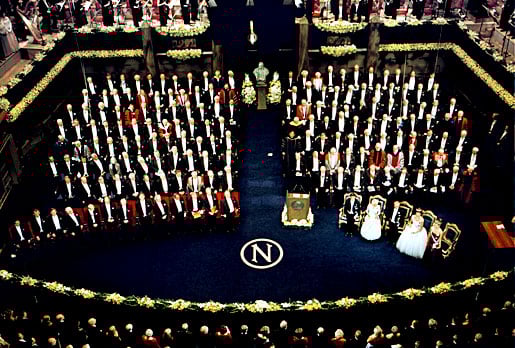
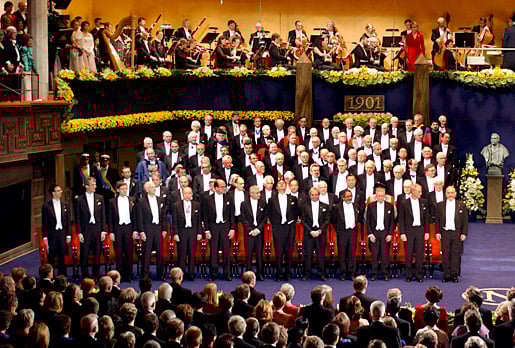

Photo: Hans Mehlin