Paul C. Lauterbur – Nobel Lecture
Read the Nobel Lecture
Pdf 50 kB
Paul C. Lauterbur – Nobel diploma
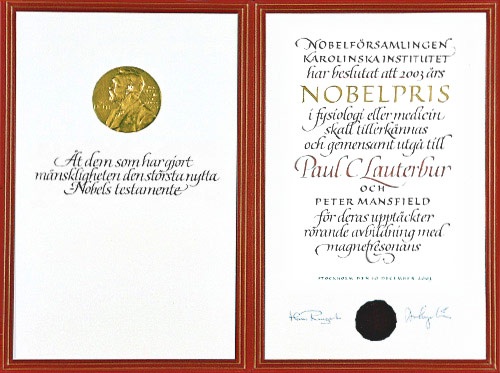
Copyright © The Nobel Foundation 2003
Calligrapher: Susan Duvnäs
Paul C. Lauterbur – Photo gallery
Paul C. Lauterbur receiving his Nobel
Prize from His Majesty King Carl XVI Gustaf of Sweden at the Stockholm Concert Hall, 10 December 2003.
Copyright © The Nobel Foundation 2003
Paul C. Lauterbur and Sir Peter Mansfield at the Nobel Prize Award Ceremony at the Stockholm Concert Hall, 10 December 2003.
Copyright © The Nobel Foundation 2003
Paul C. Lauterbur delivering his Nobel Lecture at Berzeliuslaboratoriet
at Karolinska Institutet in Stockholm, 8 December 2003.
Copyright © Nobel Media AB 2003
Photo: Hans Mehlin

Photo: Hans Mehlin

Photo: Hans Mehlin
Paul C. Lauterbur – Interview
Interview with 2003 Nobel Laureate in Physiology or Medicine Paul C. Lauterbur, 11 December 2003. The interviewer is Peter Sylwan, science writer.
Professor Lauterbur talks about his experiences during the Nobel week; the discovery of magnetic resonance imaging and how it was received (3:21); his previous research in chemistry (12:08); and prospects for the future (13:52).
Interview transcript
Welcome to the Nobel E-museum to meet Professor Paul Lauterbur, one of the Nobel Laureates in Physiology or Medicine for 2003. First of all Professor Paul Lauterbur, congratulations to the prize. You must have heard this 1,000 times in the days passing.
Paul Lauterbur: Very good experience and I’m certainly happy that it happened.
Today it’s the afternoon, the day after the big day, it’s almost a little cruel to ask you to come here to answer a lot of questions but what are your feelings today after this big event?
Paul Lauterbur: I’m beginning to believe it’s real. It’s a very overwhelming experience, the whole week, which is almost over, but my wife and I were discussing just last night that there is a sense of unreality almost, because of course not our usual working day or week and you never know exactly what it is going to be like.
What will be the strongest memories you will bring back home from these days?
Paul Lauterbur: The first thing that comes to mind is some of the guests I arranged to come here, some people I’d not seen in many cases for many years who were very important in my early work and making it possible and encouraging me and collaborating with me. In general I was happy to see them all and happy that they all enjoyed one another’s company as well.
One of the strongest memories I will remember is the way you described how your science emerged and the sort of struggle between the chemist and physicist in the early days.
Paul Lauterbur: Oh yes. Of course I’m happy that the Nobel organization has been relaxed about the official designation of laureates in various categories, which it was not always I understand from history, 50–100 years ago, there were sometimes serious debates about whether someone is a proper scientist of a certain kind but so far as I could tell from the selection of laureates in recent years the Nobel people really do understand in their hearts how unified the various disciplines are.
When the idea came up of using magnetic resonance, what did the physicist say about your idea?
Paul Lauterbur: The first reaction at least was always scepticism, including the reactions of Nobel Laureates. However, unlike some other people the second reaction, sometimes within minutes, was I was mistaken. Now that shows a quality of mind that was able to live with the fact that you have made a public error in a major matter and to apologise for it immediately. Not everyone has the self-confidence and largess of spirit to make it possible for them to do that. Some of the most vigorous objections were some people who quickly became the most intelligent about it.
It has passed some time since the first ideas come up and the first experiments were done so there is the possibility to put this into perspective. What would you say is the greatest significance of the possibility of using magnetic resonance imaging?
Paul Lauterbur: The goal that drew my attention to the problem was medical diagnosis. What really captured my personal interest was that the solution was one of these ideas that in retrospect seems perfectly obvious and could have been done any time in the proceeding 20 years but was not. It was also a novel kind of science that had not been thought of before. So that, not /- – -/ applications but that immediate kind of mental response is the most exciting to a working scientist.
But it was a very big shift in paradigm going from radiology to magnetic phenomena?
Paul Lauterbur: The shift of paradigm was that there was no previous example of applying the kind of techniques to making images that I was proposing and, as is the case with any good idea, one of the first responses of many people was oh of course, why not, those who were not totally sceptical but that again is a well-known phenomenon that the better the idea is the more simple and intuitive it seems to be to some people which makes them think it’s trivial. However, if it really is trivial why did not some of the best people in the world who are doing the work think of it in the previous 20 years?
And why didn’t they?
Paul Lauterbur: Because they were thinking about physics in a too limited way. As I used to say, it was good to be working with undergraduates in my laboratory because they had not yet learned too much to believe in what we were doing.
Ignorance might sometimes be a help.
Paul Lauterbur: People who are intentionally educated but have not risen beyond their education have a tendency to mistake practical approximations in using calculations for fundamental principles. That is one of the things that you try to bring to students in a proper education and it doesn’t always work but it’s a difficult trick of mind to have worked hundreds of homework problems with a professor telling you you’re making mistakes about something and then to have someone propose something that says all of this work that you’ve been doing is simply a practical approximation to a calculation trick and you’re supposed to think beyond that, which is not always easy. That’s why there’s a long apprenticeship in science and most people continue even after years relying upon what is called in English, I don’t know about Swedish, a rule of thumb, approximations that simple calculations and problems to make them easier to do but that is not the real science, that is just a helpful trick.
The history of science is very often connected to new instruments and hands shift in paradigm or quite a new way of looking on the world. I mean Galileo and the telescope and Leeuwenhoek and the microscope. So what about the MRI and Lauterbur?
Paul Lauterbur: Not quite the same. There are many ways of doing science but I had been working with the basics of nuclear magnetic resonance essentially all of my professional life and doing chemical structure and analytical measurements using nuclear magnetic resonance with no reference whatsoever to imaging because if anyone thought about it they didn’t even think it was impossible, it did not occur to them whether there was anything there to think about.
But in what way do you think that the possibility of looking into the body and looking into the brain, will it in a way change the way we look upon ourselves and the life we live or give us new explanations?
Paul Lauterbur: What forced me to think about the problem seriously was that I saw that such a non-invasive method would be very useful, but I had never heard of any way of solving that problem, not a hint. The actual idea formulated itself in a way that does have some generality, that is by looking at a problem metaphorically instead of right side up, upside down. I was in the middle
of a sentence, which one of my guests here, who was there at the time, reminded me of. I was describing how it was impossible to do any such thing because of certain problems with the physics of the measurements. Halfway through that sentence I realised that those problems were in fact the solution to the fundamental problem. At that point, right in the middle of a sentence was a paradigm shift and of course it took more than just one instant to work out a lot of the practical details but there was a moment where essentially was seeing a problem has actually been its own solution.
You are a chemist originally and now you are turning your attention to quite another area of science. You are very interested in the origin of life.
Paul Lauterbur: Yes, which is chemistry.
Which is chemistry. Have you started to formulate some new hypothesis about how life originated on earth?
Paul Lauterbur: Yes, but it’s very early. It’s something I’ve been officially working on only for about two years or so and so it’s premature to talk about.
You couldn’t give us a hint?
Paul Lauterbur: It’s very technical also. It involves a part of chemistry that people have known about for some years but no-one has thought was any significance and so there’s a paradigm shift there too but really I’d rather not talk about it because we’re trying to do some of the necessary experiments in my laboratory right now. I don’t know if at this exact moment, but I hope my students are working hard back home but if there’s one thing that you learn, you know, a lifetime in science, even though an idea seems very good to you, the personification of nature, mother nature, can say, Naughty boy, you have not been listening to me, you are totally wrong and you always have to go back to what nature is able to do.
But let’s, for a short while go back then to magnetic imaging. What is your prospect for the future? I mean how far can imaging be done? Or can you always find some new phenomena that could be used for imaging?
Paul Lauterbur: There are many kinds of results that are being found in a preliminary way, which I’m not actively involved with at the moment. I don’t have even a normal understanding of where some of these very new things will go since I have not been following them for two years or so. I don’t know where they will be going in the immediate future. I know there were things that I was working on a few years ago, as well as other people were, that seemed to me to have a great deal of potential, some of which I don’t really have any idea whether they are just clever tricks or whether they have real fundamental potential. I will have to wait, like everyone else, to find that out.
Thank you very much for sharing your time and sharing your ideas and experience with us.
Paul Lauterbur: You’re welcome.
Did you find any typos in this text? We would appreciate your assistance in identifying any errors and to let us know. Thank you for taking the time to report the errors by sending us an e-mail.
Paul C. Lauterbur – Prize presentation
Watch a video clip of the 2003 Nobel Laureate in Physiology or Medicine, Paul C. Lauterbur, receiving his Nobel Prize medal and diploma during the Nobel Prize Award Ceremony at the Concert Hall in Stockholm, Sweden, on 10 December 2003.
Paul C. Lauterbur – Curriculum Vitae
| Paul C. Lauterbur, born May 6, 1929 in Sidney, Ohio, USA. US citizen. | |
| Address: | Biomedical Magnetic Resonance Laboratory, University of Illinois, 2100 South Goodwin Avenue, Urbana, IL 61801, USA |
| Academic Education and Appointments | |
| 1951 | B.S. in Chemistry, Case Institute of Technology, Cleveland |
| 1962 | Ph.D. in Chemistry, University of Pittsburgh, Pennsylvania |
| 1969-85 | Professor of Chemistry, Radiology, State University of New York at Stony Brook |
| 1985-90 | Professor, University of Illinois, College of Medicine at Chicago |
| 1985- | Professor and Director, Biomedical Magnetic Resonance Laboratory, University of Illinois, College of Medicine at Urbana-Champaign, IL |
| Selected Honours and Awards | |
| 1982 | Gold Medal of the Society of Magnetic Resonance in Medicine |
| 1984 | Albert Lasker Clinical Research Award |
| 1985 | Member, National Academy of Sciences |
| 1986 | European Magnetic Resonance Award |
| 1987 | National Medal of Science (USA) |
| 1987 | Roentgen Medal |
| 1987 | The Gold Medal of the Radiological Society of North America |
| 1992 | International Society of Magnetic Resonance in Medicine Award |
| 1994 | The Kyoto Prize for Advanced Technology |
| 1999 | Gold Medal of the European Congress of Radiology |
| 2001 | NAS Award for Chemistry in Service to Society |
The Nobel Assembly at the Karolinska Institutet
Paul C. Lauterbur died on 27 March, 2007.
Sir Peter Mansfield – Curriculum Vitae
| 1. | University Education | |
| 1956–1959 | Full time honours course in physics at Queen Mary College, London. Awarded First Class Honours. | |
| 1959–1962 | Full time course for PhD at Queen Mary College, London. Awarded PhD in September 1962. | |
| 2. | Appointments held | |
| 1962–1964 | Appointed Research Associate at the Physics Department, University of Illinois, Urbana, Illinois, U.S.A. | |
| 1964 | Appointed Lecturer in Physics, University of Nottingham. | |
| 1968 | Promoted to Senior Lecturer in Physics. | |
| 1970 | Promoted to Reader in Physics. | |
| 1972–1973 | Senior Visitor at the Max-Planck-Institute for Medical Research, Heidelberg. | |
| 1979 | Appointed Professor of Physics at Nottingham. | |
| 1983–1988 | Medical Research Council Professorial Research Fellow. | |
| 1988–1994 | Resumed Professorship in Physics at Nottingham. | |
| 1994 | Emeritus Professor of Physics, Nottingham. | |
| 3. | Awards and Prizes | |
| 1983 | Gold Medal of the Society of Magnetic Resonance in Medicine. | |
| 1984 | Royal Society Wellcome Foundation Gold Medal and Prize. | |
| 1988 | Duddell Prize and Medal, Institute of Physics. | |
| 1988 | British Institute of Radiology, Silvanus Thompson Medal. | |
| 1989 | International Society of Radiology and the Antoine Béclère Institute in Paris, Antoine Béclère Medal for 1989 in Radiology. | |
| 1990 | Joint award of the Royal Society Mullard Medal and Prize. | |
| 1992 | International Society of Magnetic Resonance (ISMAR) prize, awarded jointly with P Lauterbur. | |
| 1993 | Barclay Medal, British Journal of Radiology. | |
| 1993 | First Silver Plaque of the European Society of Magnetic Resonance in Medicine and Biology. | |
| 1995 | Garmisch-Partenkirchen Prize for MRI. | |
| 1995 | Gold Medal of the European Congress of Radiology and the European Association of Radiology. | |
| 1995 | Gold Medal of the Journal of Clinical MRI. | |
| 1996 | Joint award of First Annual Editor’s Excellence Award, J CAT. | |
| 1997 | Joint award of the Rank Prize. | |
| 2003 | Joint Award of the Nobel Prize in Physiology or Medicine with Professor Paul Lauterbur. | |
| 4. | Honours | |
| Elected Fellow of Queen Mary College (now Queen Mary and Westfield College), London University in June 1986. | ||
| Elected Fellow of the Royal Society, London in February 1987. | ||
| Elected President of the Society of Magnetic Resonance in Medicine,1987–88. | ||
| Knighted in the New Year’s Honours for 1993. | ||
| Elected Honorary Fellow of the Royal College of Radiology in 1993. | ||
| Elected to Honorary Membership of the British Institute of Radiology in 1993. | ||
| Elected Honorary Member of the Society of Magnetic Resonance Imaging in 1994. | ||
| Elected Fellow of the Society of Magnetic Resonance in 1994. | ||
| Conferred Doctor Honoris Causa, University of Strasbourg, 1995. | ||
| Conferred Honorary Doctorate, University of Kent at Canterbury 1996. | ||
| Honorary Fellow of the Institute of Physics, Jan 1997. | ||
| Conferred Doctor of Science Honoris Causa, Jagellonian University, Department of Physics, Krakow, Poland, June 2000. | ||
| Conferred Doctor of Science Honoris Causa, University of Nottingham, June 2004. | ||
| Elected Fellow (hon) Royal College of Physicians, July 2004. | ||
Sir Peter Mansfield – Other resources
Links to other sites
Obituary from University of Nottingham
Sir Peter Mansfield Magnetic Resonance Centre
Sir Peter Mansfield talks about the development of MRI. A video from The University of Nottingham
Sir Peter Mansfield – Nobel Lecture
Sir Peter Mansfield held his Nobel Lecture December 8, 2003, at Sal Adam, Berzeliuslaboratoriet, Karolinska Institutet.
Read the Nobel Lecture
Pdf 260 kB
Sir Peter Mansfield – Nobel diploma
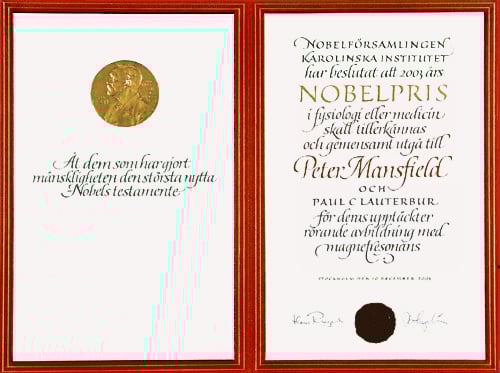
Copyright © The Nobel Foundation 2003
Calligrapher: Susan Duvnäs