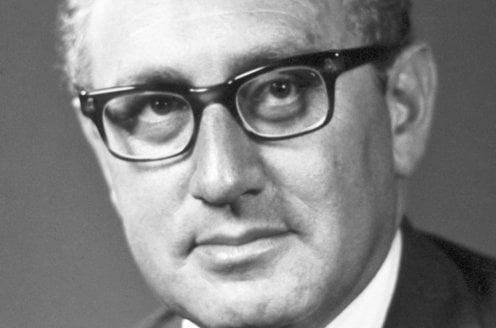
Henry Alfred Kissinger was the 56th Secretary of State of the United States from 1973 to 1977, continuing to hold the position of Assistant to the President for National Security Affairs which he first assumed in 1969 until 1975 …
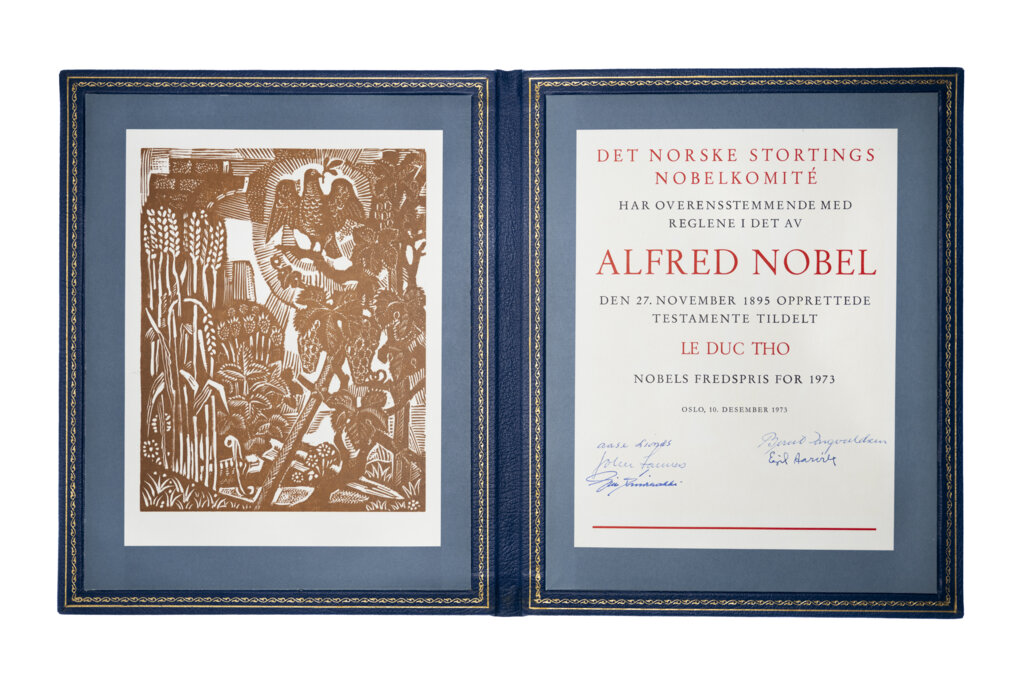
Artist: Ørnulf Ranheimsaeter
Photo reproduction: Nanaka Adachi
© The Nobel Foundation 1973
Le Duc Tho was awarded the Nobel Peace Prize, jointly with Henry Kissinger, for negotiating a cease-fire in Vietnam in 1973.
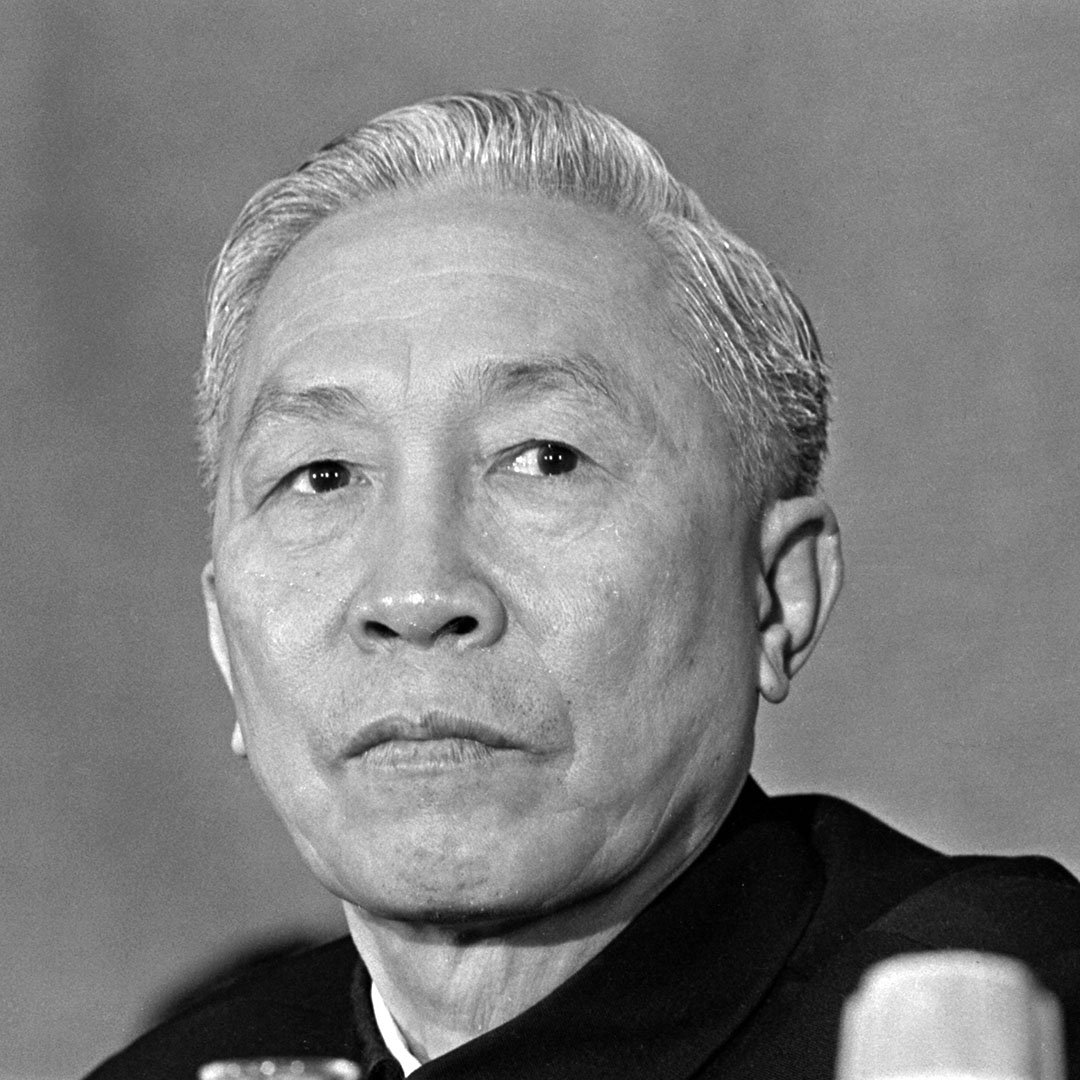
Full name: Le Duc Tho
Born: 14 October 1911, Nam Ha province, Vietnam
Died: 13 October 1990, Hanoi, Vietnam
Date awarded: 17 October 1973
Educated at French schools, Le Duc Tho became a communist, fighting from the age of 16 to free his country from both French colonial rule and Japanese occupation in WW2. In 1954 Vietnam was partitioned into a US-backed South Vietnam and a communist North Vietnam. By the mid-1960s North Vietnam had embarked on a guerrilla war to reunite the country. Although Le Duc Tho dismissed the USA’s intervention in the Vietnam conflict as neo-colonialism, it was he who led negotiations with the USA in Paris from 1968. In 1973 a ceasefire was agreed, though it quickly broke down. This led Le Du Tho to refuse the Nobel Peace Prize he had been awarded jointly with US negotiator Henry Kissinger. In 1975 Le Du Tho masterminded the campaign that resulted in the conquest of South Vietnam.
During Japan’s WW2 occupation of Vietnam, Le Duc Tho joined the Communist Party’s central committee. After the war, he was one of those who led the armed resistance to France’s reestablishment of colonial rule. Following a military defeat in 1954, the French withdrew, but Vietnam was partitioned. The USA backed South Vietnam, and provided military support to prevent Vietnam from reuniting under communist rule. From the late 1950s Le Duc Tho was responsible for organising a guerrilla movement in the South, which fought with North Vietnam against the USA and the South Vietnamese regime.
Having failed to win on the battlefield, the USA started peace negotiations with North Vietnam in 1968. Le Duc Tho was chosen to meet President Nixon’s adviser, Henry Kissinger, at the negotiating table in Paris. Le Duc Tho demanded that USA pull out of Vietnam, and that the South Vietnamese regime be dissolved. In January 1973 an agreement was reached. Le Duc Tho renounced the total dissolution of South Vietnam, but the FNL/Vietcong, which was backed by the North, was allowed to retain areas it had conquered in the South.
In October 1973 the Norwegian Nobel Committee awarded the peace Prize to Henry Kissinger and Le Duc Tho for having “acted in accordance with Alfred Nobel’s philosophy, which was that international conflicts must be resolved through negotiation and not war”. But the ceasefire had already broken down. Le Duc Tho sent a telegram to the Committee, saying it was “impossible to accept the prize with which the Committee has honoured me. When the Paris Agreement on Vietnam is respected, the weapons fall silent and peace is restored in South Vietnam, I will consider accepting the prize”.
Although the USA pulled the bulk of its military forces out in 1973, the war between North and South Vietnam continued. Le Duc masterminded the campaign by the FNL/Vietcong guerrillas and North Vietnamese forces which led to the collapse of the South Vietnamese regime in 1975. A year later Vietnam was reunified. In 1979 Le Duc Tho led the invasion of Kampuchea that ended the Khmer Rouge’s reign of terror. Domestically, Le Duc Tho was a political dogmatist. His refusal to sanction economic reforms led to his ejection from the party leadership in 1986. He died four years later, aged 79.
“The just cause triumphs over the evil cause. The will to live in freedom triumphs over cruelty.”
Le Duc Tho, 24 January 1973.
Disclaimer: Every effort has been made by the publisher to credit organisations and individuals with regard to the supply of photographs. Please notify the publishers regarding corrections.

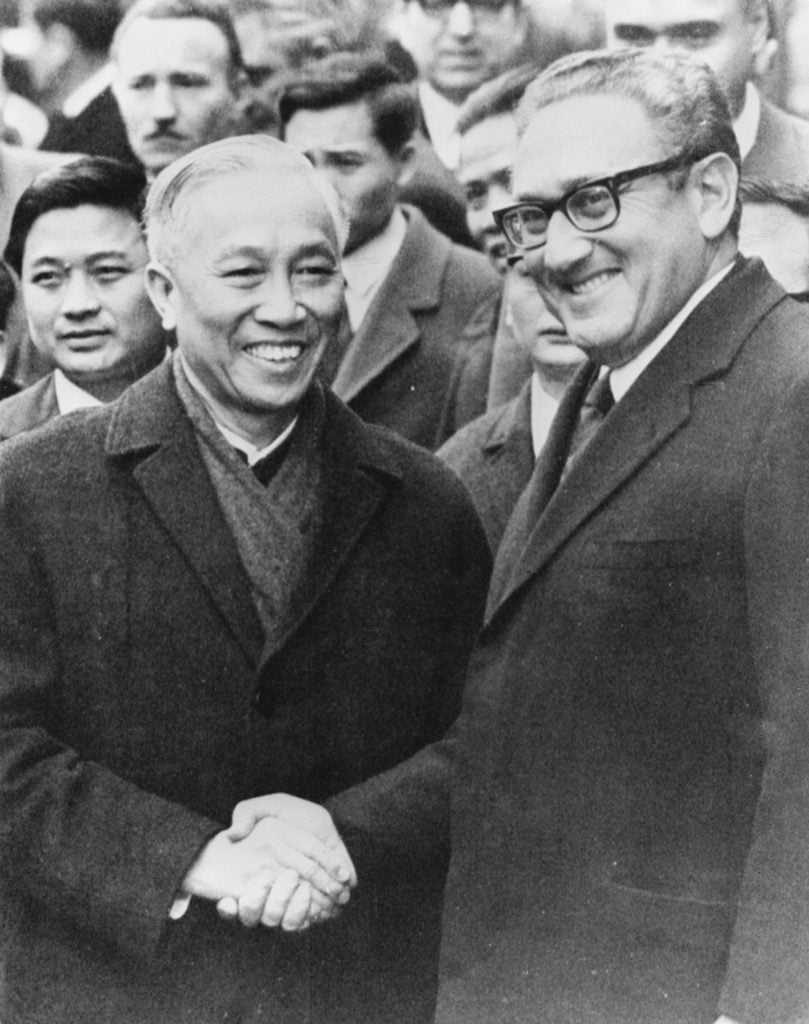
Le Duc Tho and Henry Kissinger during peace talks on the Vietnam War in Paris, France, on 24 January 1973.
Photo: Daily Express/Stringer via Getty Images
Henry Kissinger was awarded the Nobel Peace Prize, jointly with Le Duc Tho, for negotiating a ceasefire in Vietnam in 1973.

Full name: Henry Alfred Kissinger
Born: 27 May 1923, Fürth, Germany
Date awarded: 17 October 1973
A student of history and political science, Henry Kissinger became a professor at Harvard in 1962. During the Vietnam War, he laid the groundwork for President Lyndon Johnson’s peace negotiations with North Vietnam in Paris. After the 1968 election, Kissinger became President Richard Nixon’s key foreign policy adviser. Kissinger’s strategy was to negotiate with North Vietnam while the USA applied powerful military pressure, including the 1972 Christmas bombing of the North Vietnamese capitol Hanoi. A ceasefire agreement was signed in January 1973. That autumn Kissinger and his North Vietnamese counterpart Le Duc Tho received the Nobel Peace Prize, which Tho declined. The peace prize inspired heated debate, and for the first time in the history of the prize, two of the Norwegian Nobel Committee members resigned in protest.
“There is no other comparable honor. A statesman’s final test, after all, is whether he has made a contribution to the well-being of mankind.”
Henry Kissinger about the Nobel Peace Prize in Years of Upheaval, page 370, Little, Brown and Company 1982.
The North Vietnamese viewed the USA as the last in a long line of foreign colonisers that included China, France and Japan. North Vietnamese leaders saw the South Vietnamese government as puppets for the US government. But the South Vietnamese government did not comply with US plans in the wake of the January 1973 ceasefire. It tried to recapture areas in South Vietnam controlled by nationalist and communist rebels. The agreement on which the peace prize was based was thus visibly losing its impact as the award ceremony approached.
The North Vietnamese negotiator in Paris, Le Duc Tho, declined the 1973 peace prize on the grounds that the USA and South Vietnam had broken the ceasefire negotiated by Kissinger and himself. Le Duc Tho had fought for Vietnam’s independence during both the French colonial era and the Japanese occupation during WWII. He became a leader in the Communist Party, where he developed a reputation as a hard-line hawk who would only agree to compromise under extreme circumstances. That is why he was chosen as Kissinger’s negotiating partner in 1968.
“Kissinger’s realpolitik was ill-suited to an open and democratic society, where it is difficult to invoke distant ends to justify unpalatable means.”
Walter Isaacson: Kissinger. A Biography, page 767, Faber and Faber 1992.
The awarding of the peace prize to Kissinger provoked outrage, also in the USA. Many felt Kissinger was responsible for a bombing war that took a huge toll on civilian lives. The New York Times dubbed the peace prize “the War Prize”, and US and British Quakers travelled to Norway to directly address the Norwegian Nobel Committee. In Norway, two Nobel Committee members resigned in an unprecedented act of protest over the committee chairman’s statement that the committee had unanimously supported the selection of Kissinger and Tho. The chairman violated an unwritten rule prohibiting public mention of internal committee discussions.
Henry Kissinger is a controversial figure. Some hold him to be one of the best secretaries of state ever. Critics have called him a cynical power broker willing to utilise brute force and undemocratic means to achieve his goals. They believe that the USA could have withdrawn from Vietnam as early as 1969, saving thousands of lives. They also consider Kissinger partly responsible for the illegal bombing of Cambodia and Laos. Additionally, Kissinger has been criticised for supporting the military coup in Chile in the autumn of 1973 and approving the Indonesian invasion of East Timor in 1975.
Henry Alfred Kissinger was the 56th Secretary of State of the United States from 1973 to 1977, continuing to hold the position of Assistant to the President for National Security Affairs which he first assumed in 1969 until 1975 …
Disclaimer: Every effort has been made by the publisher to credit organisations and individuals with regard to the supply of photographs. Please notify the publishers regarding corrections.
On Henry Kissinger from Nobel Peace Center
Biography from Office of the Historian, U.S. Department of State
Henry Kissinger did not deliver a Nobel Lecture.
Le Duc Tho and Henry Kissinger during peace talks on the Vietnam War in Paris, France, on 24 January 1973.
Photo: Daily Express/Stringer via Getty Images

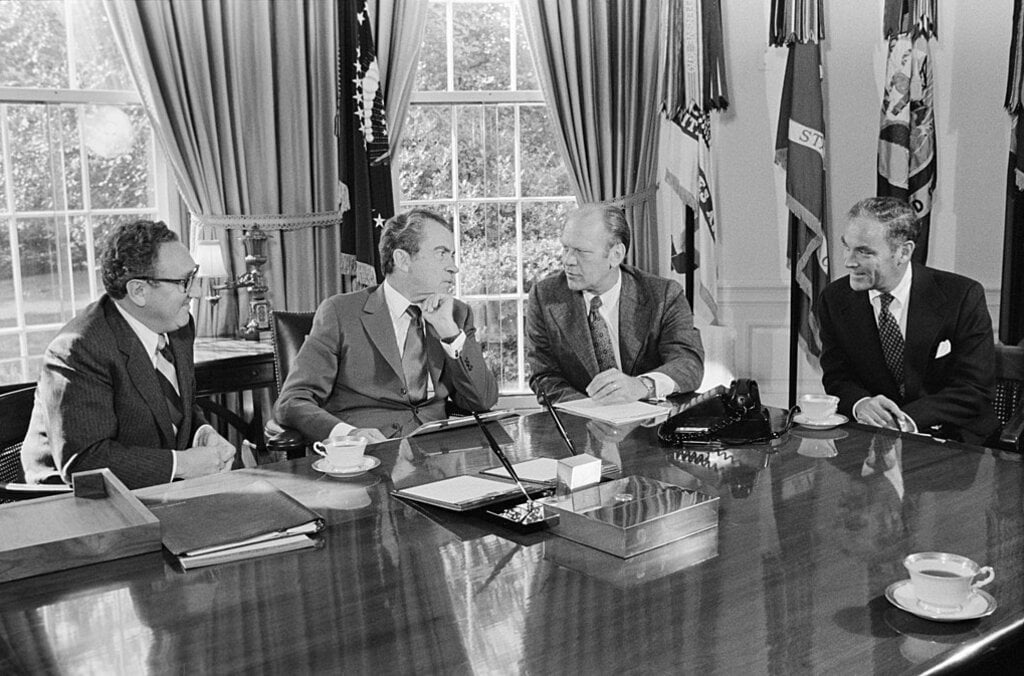
Secretary of State Henry Kissinger in a meeting with President Richard Nixon, Vice President-Designate Congressman Gerald Ford and Chief of Staff Alexander Haig, Jr in the Oval Office of the White House in Washington, DC, 13 October 1973.
Photo: The Nixon library. Public domain, via Wikimedia Commons

Henry Kissinger in his office. (Photo taken 24 January 1978.)
Copyright © Bernard Lee Schwartz Foundation 1978 Photo: Bern Schwartz
As the Laureate was unable to be present on the occasion of the award of the Nobel Peace Prize in Oslo, December 10, 1973, the acceptance was read by Thomas R. Byrne, Ambassador of the United States to Norway
The Nobel Peace Prize is as much an award to a purpose as to a person. More than the achievement of peace, it symbolises the quest for peace. Though I deeply cherish this honour in a personal sense, I accept it on behalf of that quest and in the light of that grand purpose.
Our experience has taught us to regard peace as a delicate, ever-fleeting condition, its roots too shallow to bear the strain of social and political discontent. We tend to accept the lessons of that experience and work toward those solutions that at best relieve specific sources of strain, lest our neglect allows war to overtake peace.
To the realist, peace represents a stable arrangement of power; to the idealist, a goal so pre-eminent that it conceals the difficulty of finding the means to its achievement. But in this age of thermonuclear technology, neither view can assure man’s preservation. Instead, peace, the ideal, must be practised. A sense of responsibility and accommodation must guide the behavior of all nations. Some common notion of justice can and must be found, for failure to do so will only bring more “just” wars.
In his Nobel acceptance speech, William Faulkner expressed his hope that “man will not merely endure, he will prevail”.1 We live today in a world so complex that even only to endure, man must prevail – over an accelerating technology that threatens to escape his control and over the habits of conflict that have obscured his peaceful nature.
Certain war has yielded to an uncertain peace in Vietnam. Where there was once only despair and dislocation, today there is hope, however frail. In the Middle East the resumption of full scale war haunts a fragile ceasefire. In Indo-china, the Middle East and elsewhere, lasting peace will not have been won until contending nations realise the futility of replacing political competition with armed conflict.
America’s goal is the building of a structure of peace, a peace in which all nations have a stake and therefore to which all nations have a commitment. We are seeking a stable world, not as an end in itself but as a bridge to the realisation of man’s noble aspirations of tranquility and community.
If peace, the ideal, is to be our common destiny, then peace, the experience, must be our common practice. For this to be so, the leaders of all nations must remember that their political decisions of war or peace are realised in the human suffering or well-being of their people.
As Alfred Nobel recognised, peace cannot be achieved by one man or one nation. It results from the efforts of men of broad vision and goodwill throughout the world. The accomplishments of individuals need not be remembered, for if lasting peace is to come it will be the accomplishment of all mankind.
With these thoughts, I extend to you my most sincere appreciation for this award.
*This message from Henry A. Kissinger to the Norwegian Nobel Committee was read by Thomas R. Byrne, Ambassador of the United States to Norway, who represented him at the award ceremonies.
1. William Faulkner was awarded the 1949 Nobel Prize for Literature.