Frederik Willem de Klerk was born in Johannesburg on March 18, 1936. He is the son of Senator Jan de Klerk, a leading politician, who became minister in the South African government …
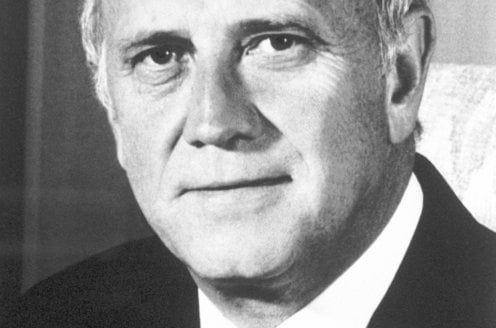
Frederik Willem de Klerk was awarded the Nobel Peace Prize, jointly with Nelson Mandela, for his work for the peaceful termination of the apartheid regime, and for laying the foundations for a new democratic South Africa.
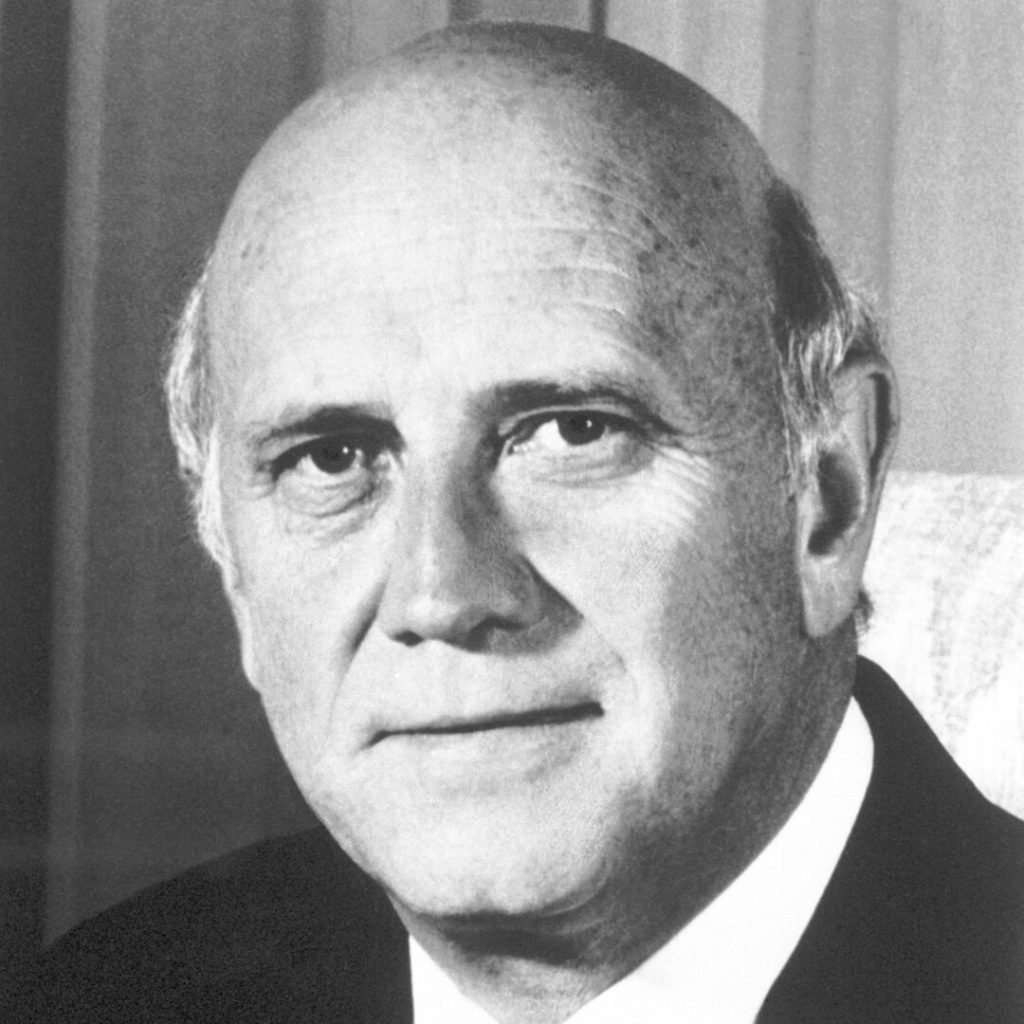
Full name: Frederik Willem de Klerk
Born: 18 March 1936, Johannesburg, South Africa
Died: 11 November 2021, Cape Town, South Africa
Date awarded: 15 October 1993
In 1990, South Africa’s President F. W. de Klerk ordered the release of political prisoner Nelson Mandela, who had been imprisoned since 1962. These two leaders then joined forces to dismantle apartheid. Their efforts led to their selection as the 1993 Nobel Peace Prize recipients. Both as a parliamentarian and a cabinet member, de Klerk had defended the privileges of whites. When he realised that the system of apartheid was about to collapse, he sought out a new course. In the face of threats set forth by white extremists, he chose to negotiate with Mandela and the ANC liberation movement. Together they laid the groundwork for presidential elections and a new constitution that ensured universal suffrage.
“Eminent statesmanship has been demonstrated in South Africa, and it is astonishing what has been achieved since Mandela was released in 1990.”
Leader of the Nobel Committee Francis Sejersted, Presentation speech, 10 December 1993.
Many adherents of apartheid believed that they were “a chosen people” who had been given divine rights to the country of South Africa. They also felt it was their sacred duty to civilise the blacks, who were both spiritually and culturally inferior. Some members of the clergy perceived the obligation of the whites as follows: “The Natives must be led and formed towards independence so that they will eventually be equal to the Europeans, but each in his own territory and each serving God in his own fatherland.”
When de Klerk became president of South Africa in 1989, he chose to continue negotiations with ANC leader Mandela. The Soviet Union had collapsed, which meant that the ANC lost an important source of international support. The communist spectre behind the ANC disappeared, making it easier for de Klerk to negotiate. In addition, the ANC changed its economic policy line, abandoning its demands that the state should expropriate private property. This generated hope that the white majority could retain much of its dominance in trade and industry.
The proceedings of the Truth and Reconciliation Commission in 1998 led to an outcry of recrimination against F.W. de Klerk. During the Commission’s enquiries into human rights violations by the apartheid regime, de Klerk was accused of having been informed of security force bombings against members of the black liberation struggle in the 1980s. De Klerk denied these accusations, which were not pursued by the Commission. Since then the laureate has concentrated his efforts on the F.W. de Klerk Foundation, which promotes conflict resolution in multicultural societies.
Following the 1994 parliamentary elections, the National Party, which had nurtured the apartheid system in South Africa, entered into extensive cooperation with its arch-enemy the ANC. The National Party was awarded several cabinet posts and became integrated into the ANC party organisation. F.W. de Klerk was among those who objected to these developments. Expressing his concern that dismantling the National Party would curb political debate, he resigned from the party.
| National Party (South Africa) Established in 1914 by South Africans of Dutch descent (Boers). First came to power in 1924. Ruling party in South Africa from 1948 to 1994, responsible for introducing the segregationist policy of apartheid. |
Frederik Willem de Klerk was born in Johannesburg on March 18, 1936. He is the son of Senator Jan de Klerk, a leading politician, who became minister in the South African government …
Read F.W. de Klerk’s Nobel Prize lecture held in Oslo, Norway on 10 December 1993.

F.W. de Klerk delivering his Nobel Lecture.
© Knudsens fotosenter/Dextra Photo, Norsk Teknisk Museum.
Disclaimer: Every effort has been made by the publisher to credit organisations and individuals with regard to the supply of photographs. Please notify the publishers regarding corrections.
Nelson Mandela was awarded the Nobel Peace Prize, jointly with Frederik Willem de Klerk, for his work for the peaceful termination of the apartheid regime, and for laying the foundations for a new democratic South Africa.
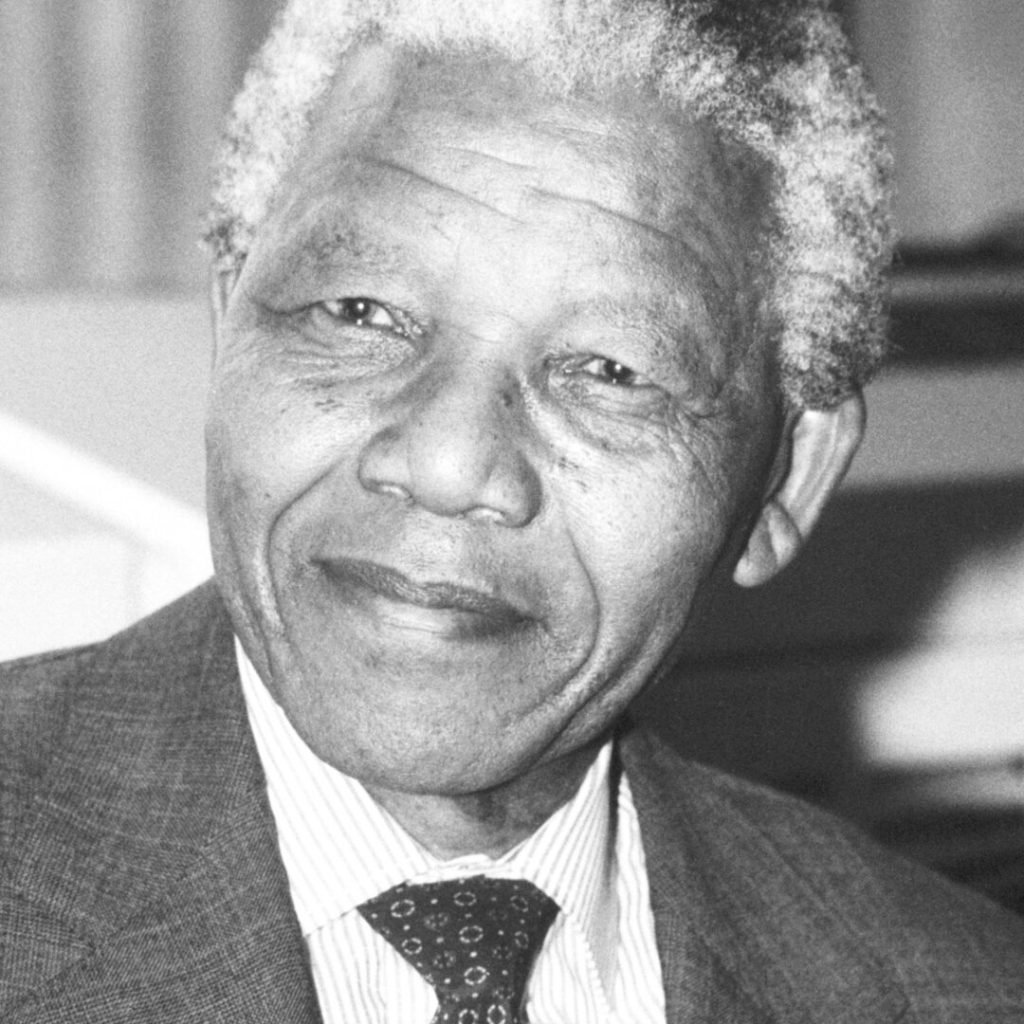
Full name: Nelson Rolihlahla Mandela
Born: 18 July 1918, Mvezo, South Africa
Died: 5 December 2013, Johannesburg, South Africa
Date awarded: 15 October 1993
The refrain of “Free Nelson Mandela!” resounded among opponents of South Africa’s system of racial segregation while Africa’s foremost champion of freedom was imprisoned. Son of a village chief, the black lawyer Nelson Mandela was interned from 1962 until 1990 for leading the African National Congress (ANC) liberation movement in its armed struggle against apartheid. In prison Mandela became a unifying figure for the oppressed peoples of South Africa. Unwaveringly he pursued the goal of liberty for all until the white racist regime released him and agreed to negotiate. Nelson Mandela shared the peace prize with the man who had ordered his release, President Frederik Willem de Klerk. These former adversaries now agreed on a peaceful transition to a system of majority rule. From 1994 to 1999 Mandela was president of South Africa.
“He spoke with a moral authority and in a constructive tone that made a profound impression.”
Francis Sejersted, Presentation speech, 10 December 1993.
In 1960, South African police massacred 69 black demonstrators at an anti-apartheid protest in Sharpeville. That incident spurred the ANC liberation movement to engage in armed struggle against the white minority rule. Nelson Mandela, lawyer and son of a village chief, was chosen to lead the covert guerrilla organisation ‘Spear of the Nation’. Inspired by wars of liberation in Algeria and on Cuba, power lines and railways were bombed. In 1962 Mandela was arrested by the authorities, and two years later he was sentenced to life imprisonment.
“Nelson Mandela was the jailed symbol of the struggle to end apartheid in South Africa. Ten years after his release, he symbolizes peace and reconciliation to the entire world.”
The Norwegian newspaper Dagbladet, 16 February 2000.
In 1964 Nelson Mandela, the military leader of the ANC liberation movement, was sentenced to life imprisonment for treason and conspiracy against the South African regime. Until 1982 he was interned on Robben Island, off Cape Town. During these years he emerged as the foremost symbol of the struggle against apartheid both at home and abroad. In 1982 Mandela was transferred to a prison on the mainland, where he entered into negotiations with the white minority government on the future of South Africa. These talks continued until 1990, when he was granted an unconditional release.
| Robben Island Island located 12 km from Cape Town, off the coast of South Africa. Used as a prison camp from the 1600s. Peace laureate Nelson Mandela was incarcerated on the island from 1962 to 1984. |
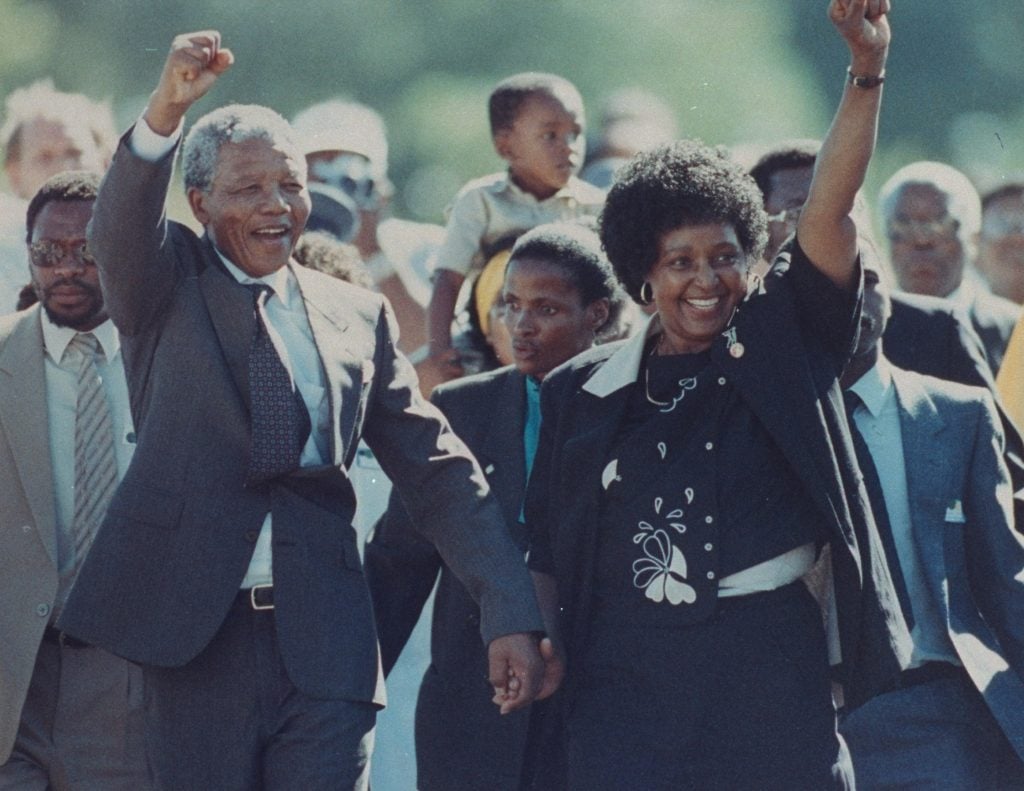
President F. W. de Klerk and Nelson Mandela planned the transition to democracy in South Africa. For their efforts they were named co-recipients of the Nobel Peace Prize. The ANC liberation movement won the 1994 parliamentary elections. Mandela became president and presided over the construction of democracy. At the same time, he shed light on the truth about apartheid. Through his policy of reconciliation he strengthened the belief in a South Africa for all ethnic groups. Mandela did not cling to power, but retired with honour in 1999. At the turn of the century he was indisputably the world’s foremost symbol of peace and reconciliation.
In 1994 the ANC swept to power in South Africa. The country adopted a new constitution granting equal rights for all. Under President Nelson Mandela’s leadership, a democratisation process was launched. The Commission for Truth and Reconciliation addressed injustices wrought in the name of apartheid, and many poor people gained access to electricity and clean water. Yet serious problems remain: South Africa continues to fight high unemployment and crime rates, and millions of South Africans are infected with HIV. The gap between rich and poor persists, the whites control the economy, and demands for land reform have not been met.
| The Truth and Reconciliation Commission Formed in 1996 in South Africa to promote reconciliation between ethnic groups after the policy of racial segregation was abolished. Through public hearings, the Commission exposed abuses committed by the apartheid regime. |
Nelson Rolihlahla Mandela was born in Transkei, South Africa on July 18, 1918. His father was Hendry Mphakanyiswa of the Tembu Tribe …
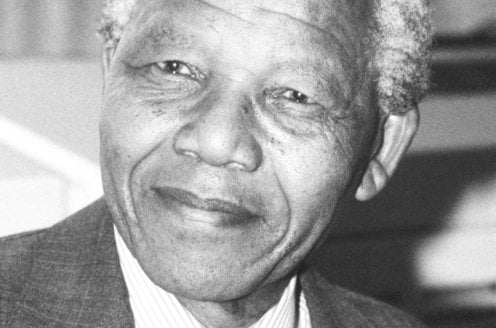
Read Nelson Mandela’s Nobel Prize lecture held in Oslo, Norway on 10 December 1993.

Nelson Mandela delivering his Nobel Lecture.
© Knudsens fotosenter/Dextra Photo, Norsk Teknisk Museum.
Disclaimer: Every effort has been made by the publisher to credit organisations and individuals with regard to the supply of photographs. Please notify the publishers regarding corrections.
In this film you get to follow the two South African musicians; Tsepo Pooe, who grew up in Soweto Township; and Lize Schaap, who grew up in wealthy Pretoria. They are both part of a very special and unique orchestra, the Miagi Orchestra. Inspired by the legacy of Nobel Peace Laureate Nelson Mandela, the orchestra aims to help the nation overcome decades of violence, conflict and division through the power of music.
| Works in English |
| We accuse : the Trial of Nelson Mandela. – London : African National Congress (S.A.), [1963?] |
| No Easy Walk to Freedom : Articles, Speeches, and Trial Addresses / edited by Ruth First. – New York : Basic Books, 1965 |
| Nelson Mandela Speaks : Speeches, Statements, and Articles. – London : African National Congress Publicity and Information Bureau, 1970 |
| I Am Prepared to Die. – London : Christian Action Publications Ltd, for the International Defence and Aid Fund, [1970] |
| The Struggle Is My Life : His Speeches and Writings Brought Together to Mark his 60th Birthday … – London : International Defence and Aid Fund, 1978 |
| Nelson Mandela, Symbol of Resistance and Hope for a Free South Africa : Selected Speeches Since His Release / edited by E.S. Reddy. – New Delhi : Sterling, 1990 |
| Walk the Last Mile with Us : Nelson Mandela’s Speeches in Ireland. – Dublin : Irish Anti-Apartheid Movement, 1990 |
| Nelson Mandela, Speeches 1990 : “Intensify the Struggle to Abolish Apartheid” / edited by Greg McCartan ; photos by Margrethe Siem. – New York : Pathfinder, 1990 |
| How Far We Slaves Have Come!: South Africa and Cuba in Today’s World / Nelson Mandela, Fidel Castro. – New York : Pathfinder Press, 1991 |
| Nelson Mandela Speaks : Forging a Democratic, Nonracial South Africa / edited by Steve Clark. – New York : Pathfinder Press, 1993 |
| A Better Life for All : Working Together for Jobs, Peace, and Freedom. – Johannesburg : ANC Department of Information and Publicity, 1994 |
| Long Walk to Freedom : The Autobiography of Nelson Mandela. – Boston, MA : Little, Brown, 1994 |
| A Time to Build : Addresses by the President, Mr. Nelson R. Mandela … – Johannesburg : Thorold’s Africana Books, 1994 |
| Invest in Peace : Addresses by the President of the Republic of South Africa, Mr. Nelson Mandela … – Pretoria : South African Communication Ser, 1994 |
| Address by President Nelson Mandela to the 49th ANC National Conference, 17 December 1994, Bloemfontein. – Johannesburg : Dept. of Information & Publicity, [1995?] |
| Mandela : An Illustrated Autobiography. – Boston : Little, Brown, 1996 |
| South and Southern Africa into the Next Century. – Singapore : Institute of Southeast Asian Studies, 1997 |
| The Essential Nelson Mandela / compiled by Robin Malan, D. Philip Publishers. – Cape Town : D. Philip Publishers, 1997 |
| In the Words of Nelson Mandela / edited by Jennifer Crwys-Williams. – Secaucus, N.J. : Carol Publishing, 1998 |
| Long Walk to Freedom with Connections : the Autobiography of Nelson Mandela / abridgment and connecting notes by Richard W. Kelso. – Austin, Tex. : Holt, Rinehart and Winston, 2000 |
| Nelson Mandela : Words of Wisdom / selected by Margaret Gee. – Sydney, Australia : Pan Macmillan, 2000 |
| In His Own Words / edited by Kader Asmal, David Chidester, and Wilmot James. – New York : Little, Brown, 2003 |
| Nelson Mandela : From Freedom to the Future : Tributes and Speeches / edited by Kader Asmal, David Chidester, and Wilmot James. – Johannesburg : Jonathan Ball, 2003 |
| Conversations with Myself. – New York : Farrar, Straus & Giroux, 2010 |
| In the Words of Nelson Mandela : a Little Pocketbook / compiled and edited by Jennifer Crwys-Williams. – Johannesburg. : Penguin Books, 2010 |
| Let Freedom Reign : the Words of Nelson Mandela / selected and introduced by Henry Russell. – Northampton, Mass. : Interlink Books, 2010 |
| Selected Speeches and Writings of Nelson Mandela : the End of Apartheid in South Africa. – St. Petersburg, Fla. : Red and Black Publishers, 2010 |
The Swedish Academy, 2011
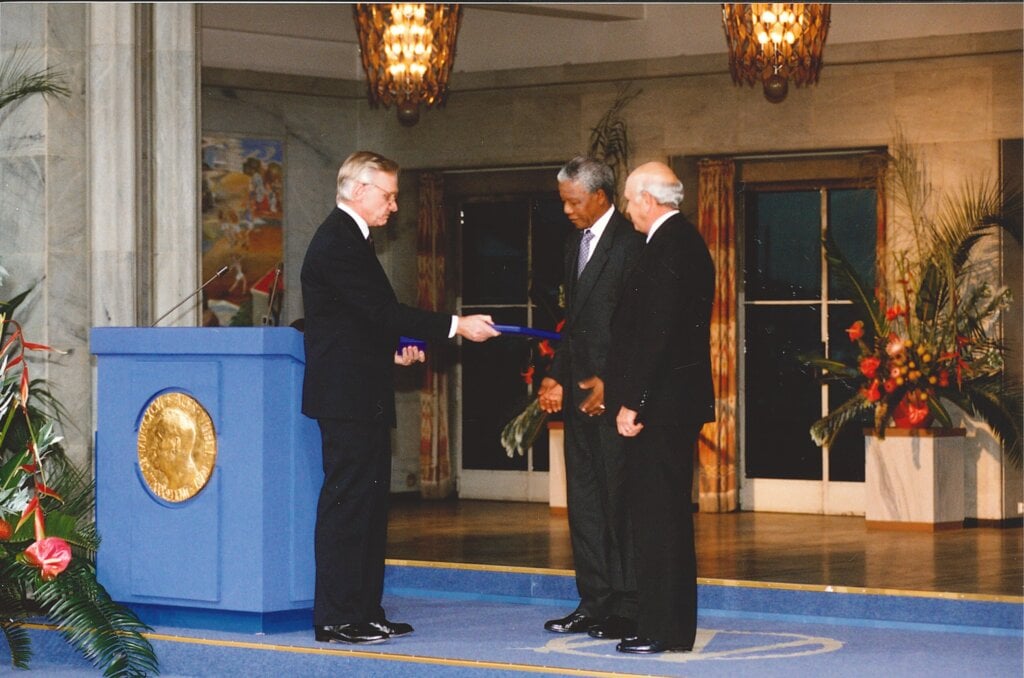
Watch a video clip of Nelson Mandela and Frederik Willem de Klerk receiving their Nobel Peace Prize medals and diplomas during the Nobel Peace Prize Award Ceremony at the Oslo City Hall in Norway, 10 December 1993.
Question: When was Nelson Mandela born?
Answer: According to his biography at Nobelprize.org, Nelson Mandela was born on 18 July 1918. After his birth, his parents gave him the name Rolilahla. It was this African name that was later on supplemented with the English first name Nelson, given to him by his teacher, Miss Mdingane, as the name he should answer to in school.
Question: Where was he born?
Answer: He was born in Transkei, South Africa.
Question: Who were his parents?
Answer: His father was Hendry Mphakanyiswa, chief of the Thembu tribe of the Xhosa nation, South Africa. He was also known as Henry Mandela (Mandela being the name of the family chieftainship), and his mother was Nosekeni Fanny, who later converted to Christianity.
Question: Why is he also called ‘Madiba’?
Answer: Madiba is his clan name, telling people that he was a member of the Madiba clan (named after an eighteenth century Thembu tribe chief). In his autobiography, Nelson Mandela explains: “I am often addressed as Madiba, my clan name, as a sign of respect.”
Question: What is his educational background?
Answer: Nelson Mandela started his schooling at the local mission school. He graduated from the University College of Fort Hare in Alice, Eastern Cape, at the end of 1942 with a BA degree. In early 1943, he enrolled at the University of the Witwatersrand in Johannesburg for a bachelor of law degree, but he never completed his LLB. After several failed attempts, in 1952 he decided to do the qualifying exam that would allow him to practice as a fully-fledged attorney. He got his law degree in 1989.
Question: Why was Nelson Mandela sent to jail?
Answer: Nelson Mandela was arrested and jailed because he was accused of treason by the South African government. In 1944 he joined the African National Congress (ANC), which challenged the South African ruling party’s apartheid policies. He went on trial for treason in 1956-1961 and was acquitted in 1961. Mandela formed the military wing of the ANC, the Umkhonto we Sizwe (MK), which went underground after the ANC was banned in 1960. He was arrested in 1962 and sentenced to five years’ imprisonment with hard labour. When many leaders of the ANC and the MK were arrested for plotting to overthrow the government by violence, Nelson Mandela was also brought to stand trial with them, and he was one of eight accused that were sentenced to life imprisonment.
Question: Where was he jailed?
Answer: He was jailed at the Robben Island Prison, 12 kilometers away from Cape Town, off the coast of South Africa.
Question: How long was he jailed in Robben Island?
Answer: He was jailed for 18 years before he was moved to Pollsmoor Prison on the mainland, staying there until 11 February 1990 when he was finally released.
Question: He was also known as ‘The Black Pimpernel’? Why?
Answer: The press called Nelson Mandela ‘The Black Pimpernel’ during his clashes with the South African authorities because of his ability to avoid the police, using several disguises, a favourite of which was a chauffeur.
Question: What happened to him after he was released?
Answer: He was elected president of the ANC in 1991 and became the first democratically elected President of South Africa in 1994.
Question: When was Nelson Mandela awarded the Nobel Peace Prize? And why?
Answer: In 1993, Nelson Mandela was awarded the Nobel Peace Prize, sharing it with Frederik Willem de Klerk, president of South Africa at the time, “for their work for the peaceful termination of the apartheid regime, and for laying the foundations for a new democratic South Africa.”
Sources:
Nelson Mandela: Long Walk to Freedom, London: Little, Brown and Company, 1994
“Nelson Mandela and the Rainbow of Culture” by Anders Hallengren
(http://nobelprize.org/nobel_prizes/peace/articles/mandela/index.html)
First published 30 May 2008
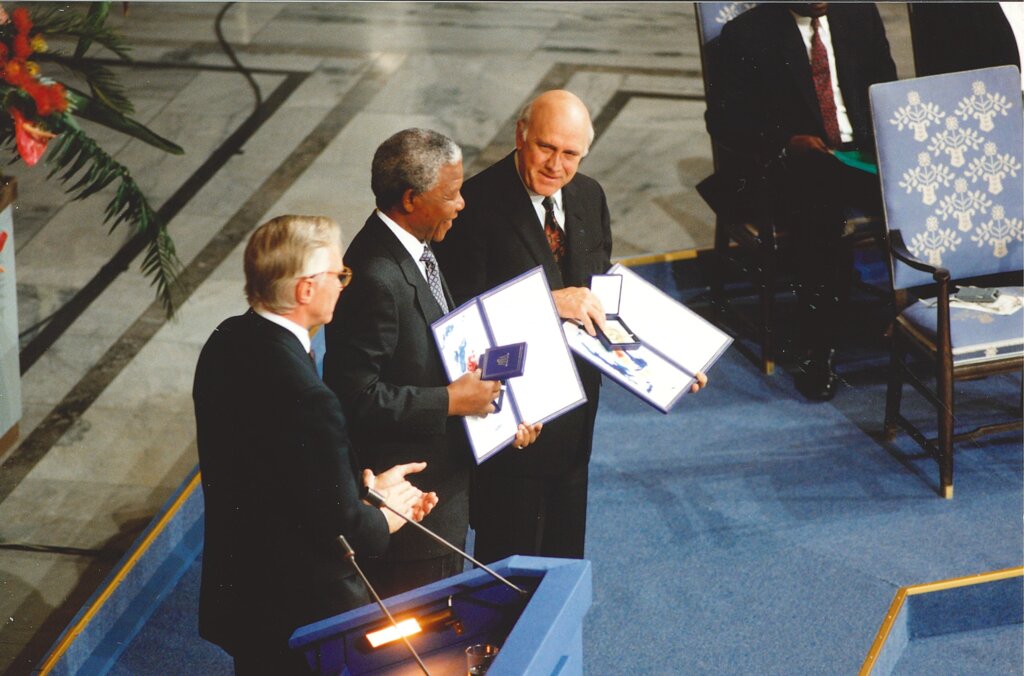
Nelson Mandela and F.W. de Klerk receiving their Nobel Prize medals and diplomas from Francis Sejersted, Chairman of the Norwegian Nobel Committee at the Nobel Peace Prize award ceremony, 10 December 1993. © Knudsens fotosenter/Dextra Photo, Norsk Teknisk Museum.
Nelson Mandela and F.W. de Klerk with their Nobel Prize medals and diplomas. © Knudsens fotosenter/Dextra Photo, Norsk Teknisk Museum.
Nelson Mandela at the Nobel Peace Prize award ceremony at Oslo City Hall, Norway, on 10 December 1993. © Knudsens fotosenter/Dextra Photo, Norsk Teknisk Museum.
Nelson Mandela delivering his Nobel Lecture. © Knudsens fotosenter/Dextra Photo, Norsk Teknisk Museum.
The Nobel Peace Prize award ceremony at Oslo City Hall, Norway, on 10 December 1993. © Knudsens fotosenter/Dextra Photo, Norsk Teknisk Museum.
From left: Nelson Mandela, Francis Sejersted, Chairman of the Norwegian Nobel Committee, F.W. de Klerk and Prime Minister Gro Harlem Brundtland at the Nobel Peace Prize award ceremony at Oslo City Hall, 10 December 1993. © Knudsens fotosenter/Dextra Photo, Norsk Teknisk Museum.
From left: Nelson Mandela, Francis Sejersted, Chairman of the Norwegian Nobel Committee and F.W. de Klerk at the Nobel Peace Prize award ceremony at Oslo City Hall, 10 December 1993. © Knudsens fotosenter/Dextra Photo, Norsk Teknisk Museum.
Nelson Mandela signing protocol during his visit to the Norwegian Nobel Institute, December 1993. © Knudsens fotosenter/Dextra Photo, Norsk Teknisk Museum.
Nelson Mandela with Prime Minister Gro Harlem Brundtland in Oslo, Norway, December 1993. © Knudsens fotosenter/Dextra Photo, Norsk Teknisk Museum.
Nelson Mandela with Prime Minister Gro Harlem Brundtland at the Nobel Peace Prize Banquet at the Grand Hotel in Oslo, Norway, on 10 December 1993. © Knudsens fotosenter/Dextra Photo, Norsk Teknisk Museum.
Nelson Mandela arriving in Oslo, Norway, December 1993. © Knudsens fotosenter/Dextra Photo, Norsk Teknisk Museum.
Nelson Mandela during a visit to the Nobel Foundation, Stockholm, in December 1993. © Nobel Foundation. Photo: Boo Jonsson.
Group photo of the 1993 Nobel Laureates, assembled at the Nobel Foundation, December 1993. From left: Chemistry Laureate Kary B. Mullis, Medicine Laureate Phillip A. Sharp, Physics Laureate Russell A. Hulse, Medicine Laureate Michael Smith, Peace Prize Laureates Nelson Mandela and Frederik Willem de Klerk, Medicine Laureate Richard J. Roberts, Laureate in Economic Sciences Robert W. Fogel, Literature Laureate Toni Morrison, Physics Laureate Joseph H. Taylor Jr. and Laureate in Economic Sciences Douglass C. North. © Nobel Foundation. Photo: Boo Jonsson
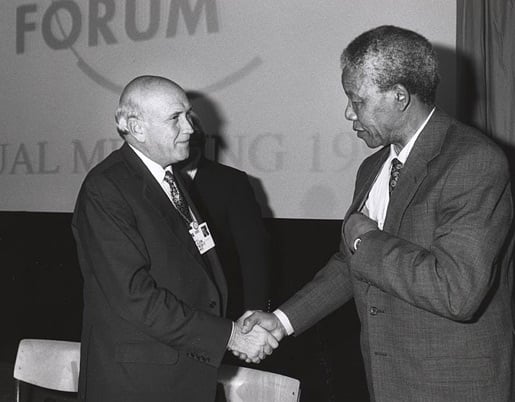
Nelson Mandela (right) and Frederik de Klerk (left) shake hands at the Annual Meeting of the World Economic Forum held in Davos in January 1992.
Copyright © World Economic Forum. Photographer unknown
Source: Flickr, Creative Commons ShareAlike 2.0
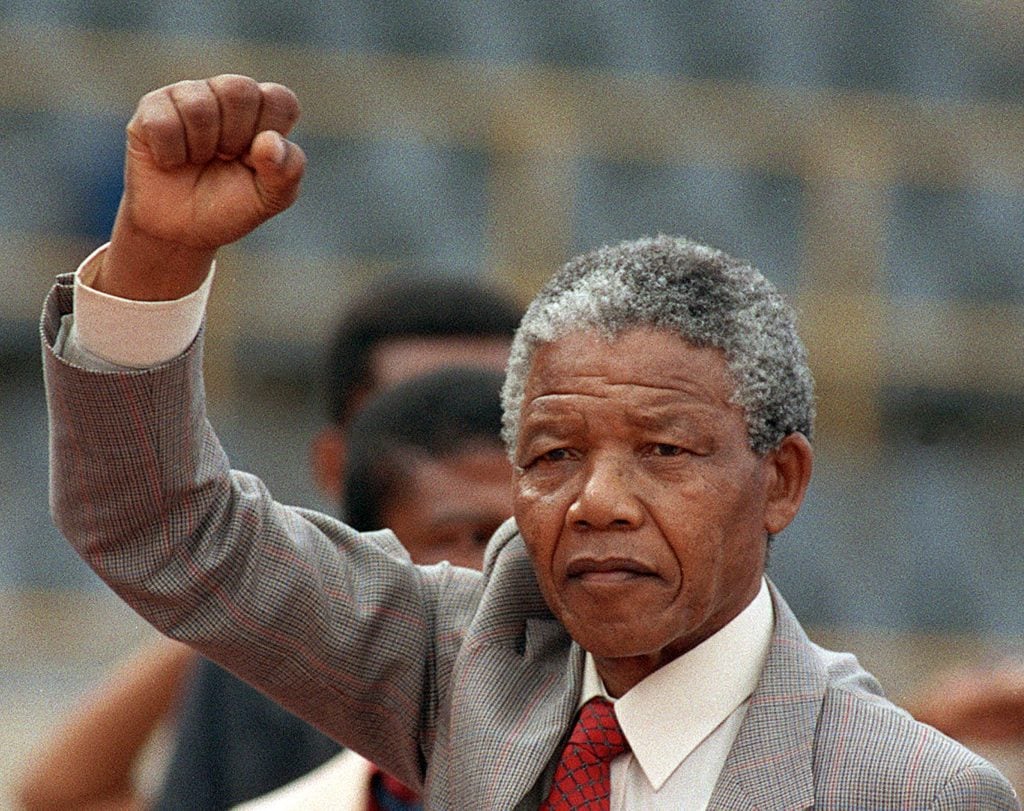
Nobel Peace Prize laureate Nelson Mandela a few days after being released from prison in February 1990. Photo by TREVOR SAMSON/AFP via Getty Images
On 11 February 1990 Nelson Mandela became a free man after spending 27 years in prison. Here he is celebrating his freedom with his wife Winnie Mandela. Photo by Allan Tannenbaum/Getty Images




Interview with the 1993 Nobel Peace Prize Laureate, F.W. de Klerk, in Cape Town, South Africa, 4 March 2009. The interviewer is Marika Griehsel, freelance journalist.
F.W. de Klerk talks about why he never thought he would be awarded the Nobel Peace Prize, the impact the Prize had on continued negotiations in South Africa (4:41), the different elements he feels are necessary for successful peacemaking (6:24), the major challenges Africa now faces (15:38), the value of quality education (19:06), and the residual responsibility of being a peacemaker (22:04).