Wangari Muta Maathai was born in Nyeri, Kenya (Africa) in 1940. The first woman in East and Central Africa to earn a doctorate degree …
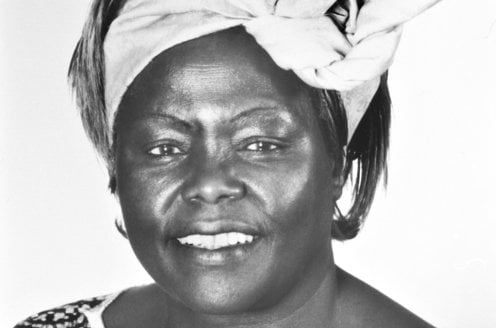
Wangari Maathai was awarded the Nobel Peace Prize for her contribution to sustainable development, democracy and peace.
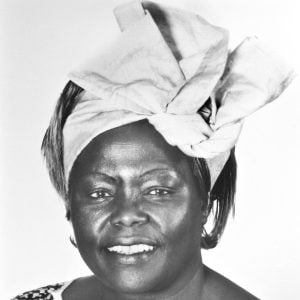
Full name: Wangari Muta Maathai
Born: 1 April 1940, Nyeri, Kenya
Died: 25 September 2011, Nairobi, Kenya
Date awarded: 8 October 2004
Wangari Maathai was the first African woman to receive the Nobel Peace Prize and the first laureate to have been selected for activities focused primarily on environmental sustainability. Educated as a biologist in the USA and Kenya, Maathai saw how deforestation and erosion were making life increasingly difficult for women in rural Kenyan villages in the 1970s. They were forced to walk miles to find wood for cooking fires, and livestock grasing grounds were becoming depleted. In 1977, Maathai founded the Green Belt Movement with the aim of regenerating Africa’s forests and ending the deprivation and conflict created by deforestation. The movement was a success, but the dictatorial Kenyan authorities tried to curb her efforts. She was harassed, beaten and jailed. Thus an environmental campaign became a fight for human rights.
”In its award to you, Wangari Maathai, of the Nobel Peace Prize for 2004, the Nobel Committee wishes to pay a special tribute to and express special support for the women of Africa and in the rest of the world.”
– Chairman of the Nobel Committee Ole Danbolt Mjøs, Presentation speech, 10 December 2004.
Wangari Maathai was the first person to be awarded the peace prize mainly for environmental work. The Nobel Committee said that her tree-planting campaign would improve living conditions, helping to prevent war and conflict. The committee had, however, previously awarded the prize to Boyd Orr (1949) from the UK, and the American Norman Borlaug (1970), both of whom saw famine and poverty as key causes of conflict. And in 1989, when awarding the prize to the Dalai Lama, the committee had praised his environmental philosophy.
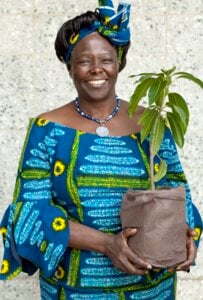
In 1972, the UN held its first conference on ecological issues in Stockholm and launched 5 June as World Environment Day. Wangari Maathai founded the Green Belt Movement on 5 June 1977. In rural African villages, most of the physical labour associated with daily living is carried out by women. Women quickly saw the positive impact that planting trees had on their meagre living conditions. Maathai helped to establish thousands of tree nurseries in rural villages to ensure a regular supply of seeds. The movement spread from Kenya to other African countries, and during the 1980s, women planted millions of trees.
”Although initially the Green Belt Movement’s tree planting activities did not address issues of democracy and peace, it soon became clear that responsible governance of the environment was impossible without democratic space.”
– Wangari Maathai, Nobel Prize lecture, 10 December 2004.
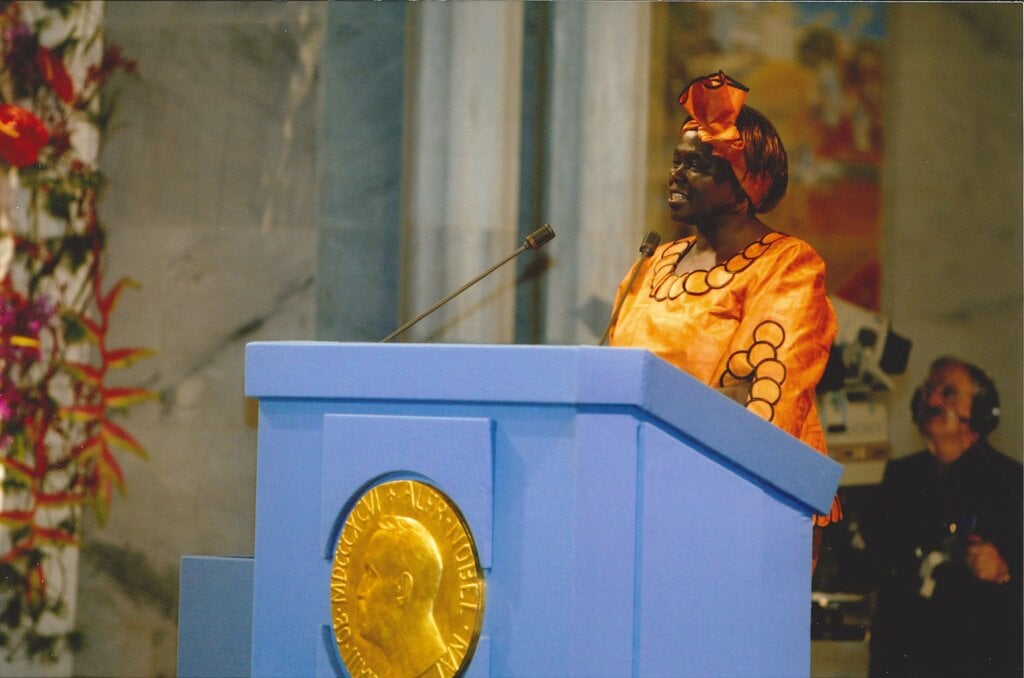
President Daniel arap Moi disliked Wangari Maathai’s environmental movement. His government had become accustomed to using Kenya’s natural resources at its own discretion. In 1989, Maathai prevented the construction of a skyscraper in a central Nairobi park, and she organised protest actions against the reallocation of state land for commercial use. She also showed her support for political prisoners. The demonstrations were met with violence, which was condemned by Amnesty International and the UN. Their protests had the desired effect. In 2002, Moi lost in free elections, and a year later Maathai became a cabinet minister.
Although Wangari Maathai received acclaim as a Nobel Peace Prize laureate, she was also criticised. Some claimed that her comments could be interpreted as blaming the West for the spread of the HIV virus in Africa. A Norwegian specialist in the area said that the Nobel Committee should not have awarded the peace prize to a person whose comments had created hatred among many Africans. Maathai replied that she had been misunderstood. She distanced herself from claims that the HIV virus had been created by white people in the West in order to destroy Africa’s population.
”Hail woman of Africa, you have done us all proud.”
– Mumbi Ngugi, The Standard, Nairobi, 9 October 2004.
Wangari Muta Maathai was born in Nyeri, Kenya (Africa) in 1940. The first woman in East and Central Africa to earn a doctorate degree …
Disclaimer: Every effort has been made by the publisher to credit organisations and individuals with regard to the supply of photographs. Please notify the publishers regarding corrections.
| Wangari Muta Maathai, PhD, EBS | |
| Personal | |
| Date of birth: April 1, 1940 | |
| Nationality: Kenyan | |
| Family: Three children (Waweru, Wanjira and Muta) | |
| Education | |
| PhD, Anatomy, University of Nairobi (1971) | |
| MS, Biological Sciences, University of Pittsburgh (1966) | |
| BS, Biology, Mount St. Scholastica College, USA (1964) | |
| Personal Achievements | |
| Director, Kenya Red Cross (1973–1980) | |
| Founder and Coordinator, The Green Belt Movement (1977–2002) | |
| Founding member, GROOTS International (1985) | |
| Member of Parliament, Tetu Constituency, Republic of Kenya (2002–Present) | |
| Assistant Minister, Environment, Natural Resources & Wildlife, Republic of Kenya (2003–Present) | |
| Academic Appointments | |
| Chair, Department of Veterinary Anatomy, University of Nairobi (1976) | |
| Assoc. Professor, Department of Veterinary Anatomy, University of Nairobi (1977) | |
| Endowed Chair in Gender & Women’s Studies named “Fuller-Maathai”, Connecticut College (2000) | |
| Montgomery Fellow, Dartmouth College, USA (2001) | |
| Dorothy McCluskey Visiting Fellow for Conservation, Yale University, USA (2002) | |
| Professional Affiliations | |
| Member, United Nations Advisory Board on Disarmament, USA | |
| Member, UN Commission on Global Governance, USA | |
| Member, Advisory Board, Democracy Coalition Project, USA | |
| Member, Earth Charter Commission, USA | |
| Selection Committee, Sasakawa Environmental Prize, UNEP, KENYA | |
| Board Member, Women and Environment Development Organization (WEDO), USA | |
| Board Member, World Learning for International Development, USA | |
| Board Member, Green Cross International | |
| Board Member, Environment Liaison Center International, KENYA | |
| Board Member, the WorldWIDE Network of Women in Environmental Work, USA | |
| Board Member, National Council of Women of Kenya, KENYA | |
| Honorary Degrees | |
| Doctor of Law, Yale University (2004) | |
| Doctor of Agriculture, University of Norway (1997) | |
| Doctor of Science, Hobart & William Smith Colleges (1994) | |
| Doctor of Law, William’s college, MA USA (1990) | |
| Awards | |
| 2004 | Nobel Peace Prize |
| 2004 | Sophie Prize |
| 2004 | Petra Kelly Environment Prize |
| 2004 | J. Sterling Morton Award |
| 2004 | Conservation Scientist Award |
| 2003 | Elder of the Burning Spear, Republic of Kenya |
| 2003 | WANGO Environment Award |
| 2002 | Outstanding Vision and Commitment Award, Bridges to Community |
| 2001 | Excellence Award, Kenyan Community Abroad |
| 2001 | The Juliet Hollister Award |
| 1997 | One of 100 in the world who’ve made a difference in environment, Earth Times |
| 1995 | International Women’s Hall of Fame |
| 1994 | The Golden Ark Award |
| 1993 | The Jane Adams Leadership Award |
| 1993 | The Edinburgh Medal |
| 1991 | The Hunger Project’s Africa Prize for Leadership |
| 1991 | Global 500 Hall of Fame, United Nations Environment Program |
| 1991 | The Goldman Environmental prize |
| 1990 | The Offeramus Medal |
| 1989 | The Woman of the World |
| 1988 | The Windstar Award for the Environment |
| 1986 | Better World Society Award |
| 1984 | Right Livelihood Award |
| 1983 | Woman of the year award |
* This CV was provided by the Laureate in November 2004.
Nobel Lecture, Oslo, December 10, 2004
Your Majesties
Your Royal Highnesses
Honourable Members of the Norwegian Nobel Committee
Excellencies
Ladies and Gentlemen
I stand before you and the world humbled by this recognition and uplifted by the honour of being the 2004 Nobel Peace Laureate.
As the first African woman to receive this prize, I accept it on behalf of the people of Kenya and Africa, and indeed the world. I am especially mindful of women and the girl child. I hope it will encourage them to raise their voices and take more space for leadership. I know the honour also gives a deep sense of pride to our men, both old and young. As a mother, I appreciate the inspiration this brings to the youth and urge them to use it to pursue their dreams.
Although this prize comes to me, it acknowledges the work of countless individuals and groups across the globe. They work quietly and often without recognition to protect the environment, promote democracy, defend human rights and ensure equality between women and men. By so doing, they plant seeds of peace. I know they, too, are proud today. To all who feel represented by this prize I say use it to advance your mission and meet the high expectations the world will place on us.
This honour is also for my family, friends, partners and supporters throughout the world. All of them helped shape the vision and sustain our work, which was often accomplished under hostile conditions. I am also grateful to the people of Kenya – who remained stubbornly hopeful that democracy could be realized and their environment managed sustainably. Because of this support, I am here today to accept this great honour.
I am immensely privileged to join my fellow African Peace laureates, Presidents Nelson Mandela and F.W. de Klerk, Archbishop Desmond Tutu, the late Chief Albert Luthuli, the late Anwar el-Sadat and the UN Secretary General, Kofi Annan.
I know that African people everywhere are encouraged by this news. My fellow Africans, as we embrace this recognition, let us use it to intensify our commitment to our people, to reduce conflicts and poverty and thereby improve their quality of life. Let us embrace democratic governance, protect human rights and protect our environment. I am confident that we shall rise to the occasion. I have always believed that solutions to most of our problems must come from us.
In this year’s prize, the Norwegian Nobel Committee has placed the critical issue of environment and its linkage to democracy and peace before the world. For their visionary action, I am profoundly grateful. Recognizing that sustainable development, democracy and peace are indivisible is an idea whose time has come. Our work over the past 30 years has always appreciated and engaged these linkages.
My inspiration partly comes from my childhood experiences and observations of Nature in rural Kenya. It has been influenced and nurtured by the formal education I was privileged to receive in Kenya, the United States and Germany. As I was growing up, I witnessed forests being cleared and replaced by commercial plantations, which destroyed local biodiversity and the capacity of the forests to conserve water.
Excellencies, ladies and gentlemen,
In 1977, when we started the Green Belt Movement, I was partly responding to needs identified by rural women, namely lack of firewood, clean drinking water, balanced diets, shelter and income.
Throughout Africa, women are the primary caretakers, holding significant responsibility for tilling the land and feeding their families. As a result, they are often the first to become aware of environmental damage as resources become scarce and incapable of sustaining their families.
The women we worked with recounted that unlike in the past, they were unable to meet their basic needs. This was due to the degradation of their immediate environment as well as the introduction of commercial farming, which replaced the growing of household food crops. But international trade controlled the price of the exports from these small-scale farmers and a reasonable and just income could not be guaranteed. I came to understand that when the environment is destroyed, plundered or mismanaged, we undermine our quality of life and that of future generations.
Tree planting became a natural choice to address some of the initial basic needs identified by women. Also, tree planting is simple, attainable and guarantees quick, successful results within a reasonable amount time. This sustains interest and commitment.
So, together, we have planted over 30 million trees that provide fuel, food, shelter, and income to support their children’s education and household needs. The activity also creates employment and improves soils and watersheds. Through their involvement, women gain some degree of power over their lives, especially their social and economic position and relevance in the family. This work continues.
Initially, the work was difficult because historically our people have been persuaded to believe that because they are poor, they lack not only capital, but also knowledge and skills to address their challenges. Instead they are conditioned to believe that solutions to their problems must come from ‘outside’. Further, women did not realize that meeting their needs depended on their environment being healthy and well managed. They were also unaware that a degraded environment leads to a scramble for scarce resources and may culminate in poverty and even conflict. They were also unaware of the injustices of international economic arrangements.
In order to assist communities to understand these linkages, we developed a citizen education program, during which people identify their problems, the causes and possible solutions. They then make connections between their own personal actions and the problems they witness in the environment and in society. They learn that our world is confronted with a litany of woes: corruption, violence against women and children, disruption and breakdown of families, and disintegration of cultures and communities. They also identify the abuse of drugs and chemical substances, especially among young people. There are also devastating diseases that are defying cures or occurring in epidemic proportions. Of particular concern are HIV/AIDS, malaria and diseases associated with malnutrition.
On the environment front, they are exposed to many human activities that are devastating to the environment and societies. These include widespread destruction of ecosystems, especially through deforestation, climatic instability, and contamination in the soils and waters that all contribute to excruciating poverty.
In the process, the participants discover that they must be part of the solutions. They realize their hidden potential and are empowered to overcome inertia and take action. They come to recognize that they are the primary custodians and beneficiaries of the environment that sustains them.
Entire communities also come to understand that while it is necessary to hold their governments accountable, it is equally important that in their own relationships with each other, they exemplify the leadership values they wish to see in their own leaders, namely justice, integrity and trust.
Although initially the Green Belt Movement’s tree planting activities did not address issues of democracy and peace, it soon became clear that responsible governance of the environment was impossible without democratic space. Therefore, the tree became a symbol for the democratic struggle in Kenya. Citizens were mobilised to challenge widespread abuses of power, corruption and environmental mismanagement. In Nairobi ‘s Uhuru Park, at Freedom Corner, and in many parts of the country, trees of peace were planted to demand the release of prisoners of conscience and a peaceful transition to democracy.
Through the Green Belt Movement, thousands of ordinary citizens were mobilized and empowered to take action and effect change. They learned to overcome fear and a sense of helplessness and moved to defend democratic rights.
In time, the tree also became a symbol for peace and conflict resolution, especially during ethnic conflicts in Kenya when the Green Belt Movement used peace trees to reconcile disputing communities. During the ongoing re-writing of the Kenyan constitution, similar trees of peace were planted in many parts of the country to promote a culture of peace. Using trees as a symbol of peace is in keeping with a widespread African tradition. For example, the elders of the Kikuyu carried a staff from the thigi tree that, when placed between two disputing sides, caused them to stop fighting and seek reconciliation. Many communities in Africa have these traditions.
Such practises are part of an extensive cultural heritage, which contributes both to the conservation of habitats and to cultures of peace. With the destruction of these cultures and the introduction of new values, local biodiversity is no longer valued or protected and as a result, it is quickly degraded and disappears. For this reason, The Green Belt Movement explores the concept of cultural biodiversity, especially with respect to indigenous seeds and medicinal plants.
As we progressively understood the causes of environmental degradation, we saw the need for good governance. Indeed, the state of any county’s environment is a reflection of the kind of governance in place, and without good governance there can be no peace. Many countries, which have poor governance systems, are also likely to have conflicts and poor laws protecting the environment.
In 2002, the courage, resilience, patience and commitment of members of the Green Belt Movement, other civil society organizations, and the Kenyan public culminated in the peaceful transition to a democratic government and laid the foundation for a more stable society.
Excellencies, friends, ladies and gentlemen,
It is 30 years since we started this work. Activities that devastate the environment and societies continue unabated. Today we are faced with a challenge that calls for a shift in our thinking, so that humanity stops threatening its life-support system. We are called to assist the Earth to heal her wounds and in the process heal our own – indeed, to embrace the whole creation in all its diversity, beauty and wonder. This will happen if we see the need to revive our sense of belonging to a larger family of life, with which we have shared our evolutionary process.
In the course of history, there comes a time when humanity is called to shift to a new level of consciousness, to reach a higher moral ground. A time when we have to shed our fear and give hope to each other.
That time is now.
The Norwegian Nobel Committee has challenged the world to broaden the understanding of peace: there can be no peace without equitable development; and there can be no development without sustainable management of the environment in a democratic and peaceful space. This shift is an idea whose time has come.
I call on leaders, especially from Africa, to expand democratic space and build fair and just societies that allow the creativity and energy of their citizens to flourish. Those of us who have been privileged to receive education, skills, and experiences and even power must be role models for the next generation of leadership. In this regard, I would also like to appeal for the freedom of my fellow laureate Aung San Suu Kyi so that she can continue her work for peace and democracy for the people of Burma and the world at large.
Culture plays a central role in the political, economic and social life of communities. Indeed, culture may be the missing link in the development of Africa. Culture is dynamic and evolves over time, consciously discarding retrogressive traditions, like female genital mutilation (FGM), and embracing aspects that are good and useful.
Africans, especially, should re-discover positive aspects of their culture. In accepting them, they would give themselves a sense of belonging, identity and self-confidence.
Ladies and Gentlemen,
There is also need to galvanize civil society and grassroots movements to catalyse change. I call upon governments to recognize the role of these social movements in building a critical mass of responsible citizens, who help maintain checks and balances in society. On their part, civil society should embrace not only their rights but also their responsibilities.
Further, industry and global institutions must appreciate that ensuring economic justice, equity and ecological integrity are of greater value than profits at any cost. The extreme global inequities and prevailing consumption patterns continue at the expense of the environment and peaceful co-existence. The choice is ours.
I would like to call on young people to commit themselves to activities that contribute toward achieving their long-term dreams. They have the energy and creativity to shape a sustainable future. To the young people I say, you are a gift to your communities and indeed the world. You are our hope and our future.
The holistic approach to development, as exemplified by the Green Belt Movement, could be embraced and replicated in more parts of Africa and beyond. It is for this reason that I have established the Wangari Maathai Foundation to ensure the continuation and expansion of these activities. Although a lot has been achieved, much remains to be done.
Excellencies, ladies and gentlemen,
As I conclude I reflect on my childhood experience when I would visit a stream next to our home to fetch water for my mother. I would drink water straight from the stream. Playing among the arrowroot leaves I tried in vain to pick up the strands of frogs’ eggs, believing they were beads. But every time I put my little fingers under them they would break. Later, I saw thousands of tadpoles: black, energetic and wriggling through the clear water against the background of the brown earth. This is the world I inherited from my parents.
Today, over 50 years later, the stream has dried up, women walk long distances for water, which is not always clean, and children will never know what they have lost. The challenge is to restore the home of the tadpoles and give back to our children a world of beauty and wonder.
Thank you very much.
Copyright © The Nobel Foundation 2004 
Copyright © The Nobel Foundation 2004
Artist: Halvdan Ljøsne
Calligrapher: Inger Magnus
Wangari Maathai receiving her Nobel Prize from Ole Danbolt
Mjøs, Chairman of the Norwegian Nobel Committee, 10 December 2004.
Copyright © Pressens Bild AB 2004,
SE-112 88 Stockholm,
Sweden,
telephone: +46-8-738 38 00
Photo: John McConnico
Wangari Maathai with her Nobel Medal and Diploma at the Nobel Peace Prize Award Ceremony, Oslo City Hall, Norway. The Kenyan ecologist is the first African woman awarded the Nobel Peace Prize.
© Pressens Bild AB 2004, S-112 88 Stockholm, Sweden, telephone: +46(0)87383800. Photo: John McConnico
Wangari Maathai delivers her Nobel Lecture after receiving the 2004 Nobel Peace Prize in the Oslo City Hall, Norway.
© Pressens Bild AB 2004, SE-112 88 Stockholm,
Sweden, telephone: +46-8-738 38 00. Photo: John McConnico
At the Nobel Peace Prize Award Ceremony, Oslo City Hall, Norway, Kenyan dancers perform to celebrate ecologist Wangari Maathai's Nobel Peace Prize.
Copyright © Pressens Bild AB 2004,
SE-112 88 Stockholm,
Sweden,
telephone: +46-8-738 38 00
Photo: Eric Feferberg
The award ceremony at Oslo City Hall, 10 December 2004. © Knudsens fotosenter/Dextra Photo, Norsk Teknisk Museum.
Nobel Peace Prize Laureate Wangari Maathai, right, shakes hands with Norway's Queen Sonja in the Oslo City Hall, Norway. King Harald V is in the middle.
© Pressens Bild AB 2004, S-112 88 Stockholm, Sweden, telephone: +46(0)87383800. Photo: Bjorn Sigurdson
Kenyan ecologist and Nobel Peace Prize Laureate Wangari Maathai waves to 3,000 children invited by the organization Save the Children. To the right, Norway's Crown Prince Haakon.
© Pressens Bild AB 2004, S-112 88 Stockholm, Sweden, telephone: +46(0)87383800. Photo: Eric Feferberg
Nobel Peace Prize Laureate Wangari Maathai before entering Oslo City Hall, Norway, to receive the Nobel Peace Prize.
Copyright © Pressens Bild AB 2004,
SE-112 88 Stockholm, Sweden,
telephone: +46-8-738 38 00
Photo: John McConnico
Wangari Maathai viewing the traditional torch light procession in Oslo from a balcony at the Grand Hotel in Oslo, Norway, 10 December 2004. © Knudsens fotosenter/Dextra Photo, Norsk Teknisk Museum.
Wangari Maathai in front of a painting of Alfred Nobel in the Nobel suite of Grand Hotel, Oslo, Norway, December 2004. © Knudsens fotosenter/Dextra Photo, Norsk Teknisk Museum.
Wangari Maathai watching photos of previos peace laureates in the Committee room at the Norwegian Nobel Institute in Oslo, Norway, December 2004. © Knudsens fotosenter/Dextra Photo, Norsk Teknisk Museum.
Wangari Maathai pays the traditional visit to the Nobel Foundation days after the award ceremony in December 2004.
Copyright © Nobel Media AB 2004
2004 Nobel Peace Prize Laureate Wangari Maathai during the interview at the Nobel Foundation in Stockholm, 2 April 2009. The interviewer is Marika Griehsel, freelance journalist.
Copyright © Nobel Media AB 2009
2004 Nobel Peace Prize Laureate Wangari Maathai during the interview for Nobelprize.org in Stockholm, 2 April 2009.
Copyright © Nobel Media AB 2009
2004 Nobel Peace Prize Laureate Wangari Maathai arrives in Stockholm, 2 April 2009.
Copyright © Nobel Media AB 2009
Nobel Laureate Wangari Maathai is greeted by staff at the Nobel Peace Center during her visit in September 2006.
Copyright © Nobel Peace Center 2006
Wangari Maathai in front of the wall exhibiting her Nobel Peace Prize awarded work during her visit to the Nobel Peace Center in September 2006.
Copyright © Nobel Peace Center 2006
Wangari Maathai on one of her visits to the Nobel Peace Center – her "home away from home", as she put it.
Copyright © Nobel Peace Center 2005
Photo: Simen Myrberget
Wangari Maathai delivers her speech at the opening of the Nobel Peace Center, 11 June 2005.
Copyright © Nobel Peace Center 2005
Photo: Telenor
Portrait of Wangari Maathai, taken in 1989 during her time as the leader of the Green Belt Movement in Nairobi, Kenya.
Copyright © David Blumenkrantz
Kindly provided by David Blumenkrantz

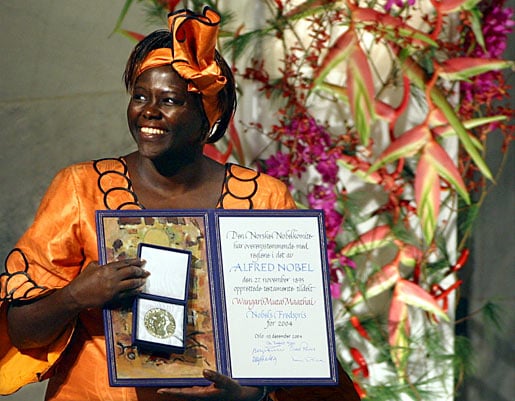


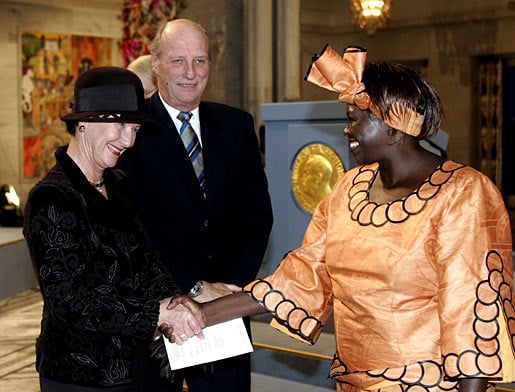
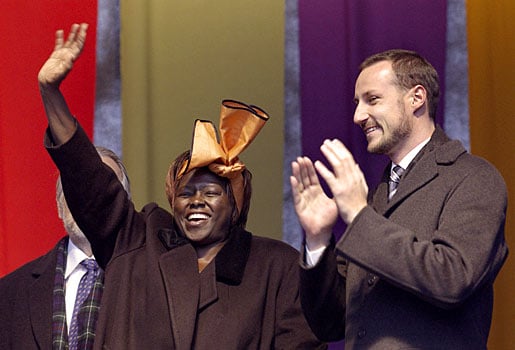


Photo: Jonas Rosén
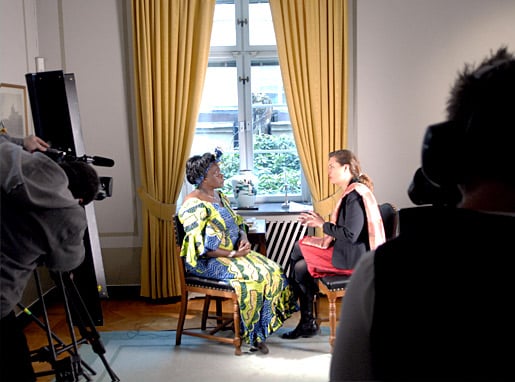
Photo: Annalisa B. Andersson

Photo: Annalisa B. Andersson

Photo: Annalisa B. Andersson

Photo: Kirsti Svenning

Photo: Kirsti Svenning

Watch a video clip of the 2004 Nobel Peace Prize Laureate, Wangari Maathai, receiving her Nobel Prize medal and diploma during the Nobel Peace Prize Award Ceremony at the Oslo City Hall in Norway, 10 December 2004.
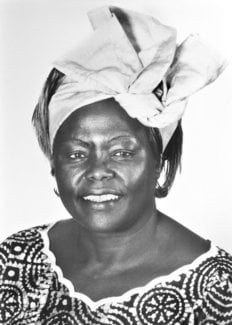
Wangari Muta Maathai was born in Nyeri, Kenya (Africa) in 1940. The first woman in East and Central Africa to earn a doctorate degree. Wangari Maathai obtained a degree in Biological Sciences from Mount St. Scholastica College in Atchison, Kansas (1964). She subsequently earned a Master of Science degree from the University of Pittsburgh (1966). She pursued doctoral studies in Germany and the University of Nairobi, obtaining a Ph.D. (1971) from the University of Nairobi where she also taught veterinary anatomy. She became chair of the Department of Veterinary Anatomy and an associate professor in 1976 and 1977 respectively. In both cases, she was the first woman to attain those positions in the region. Wangari Maathai was active in the National Council of Women of Kenya in 1976-87 and was its chairman in 1981-87. It was while she served in the National Council of Women that she introduced the idea of planting trees with the people in 1976 and continued to develop it into a broad-based, grassroots organization whose main focus is the planting of trees with women groups in order to conserve the environment and improve their quality of life. However, through the Green Belt Movement she has assisted women in planting more than 20 million trees on their farms and on schools and church compounds.
In 1986, the Movement established a Pan African Green Belt Network and has exposed over 40 individuals from other African countries to the approach. Some of these individuals have established similar tree planting initiatives in their own countries or they use some of the Green Belt Movement methods to improve their efforts. So far some countries have successfully launched such initiatives in Africa (Tanzania, Uganda, Malawi, Lesotho, Ethiopia, Zimbabwe, etc). In September 1998, she launched a campaign of the Jubilee 2000 Coalition. She has embarked on new challenges, playing a leading global role as a co-chair of the Jubilee 2000 Africa Campaign, which seeks cancellation of the unpayable backlog debts of the poor countries in Africa by the year 2000. Her campaign against land grabbing and rapacious allocation of forests land has caught the limelight in the recent past.
Wangari Maathai is internationally recognized for her persistent struggle for democracy, human rights and environmental conservation. She has addressed the UN on several occasions and spoke on behalf of women at special sessions of the General Assembly for the five-year review of the earth summit. She served on the commission for Global Governance and Commission on the Future. She and the Green Belt Movement have received numerous awards, most notably The 2004 Nobel Peace Prize. Others include The Sophie Prize (2004), The Petra Kelly Prize for Environment (2004), The Conservation Scientist Award (2004), J. Sterling Morton Award (2004), WANGO Environment Award (2003), Outstanding Vision and Commitment Award (2002), Excellence Award from the Kenyan Community Abroad (2001), Golden Ark Award (1994), Juliet Hollister Award (2001), Jane Addams Leadership Award (1993), Edinburgh Medal (1993), The Hunger Project’s Africa Prize for Leadership (1991), Goldman Environmental Prize (1991), the Woman of the World (1989), Windstar Award for the Environment (1988), Better World Society Award (1986), Right Livelihood Award (1984) and the Woman of the Year Award (1983). Professor Maathai was also listed on UNEP’s Global 500 Hall of Fame and named one of the 100 heroines of the world. In June 1997, Wangari was elected by Earth Times as one of 100 persons in the world who have made a difference in the environmental arena. Professor Maathai has also received honorary doctoral degrees from several institutions around the world: William’s College, MA, USA (1990), Hobart & William Smith Colleges (1994), University of Norway (1997) and Yale University (2004).
The Green Belt Movement and Professor Wangari Maathai are featured in several publications including The Green Belt Movement: Sharing the Approach (by Professor Wangari Maathai, 2002), Speak Truth to Power (Kerry Kennedy Cuomo, 2000), Women Pioneers for the Environment (Mary Joy Breton, 1998), Hopes Edge: The Next Diet for a Small Planet (Frances Moore Lappé and Anna Lappé, 2002), Una Sola Terra: Donna I Medi Ambient Despres de Rio (Brice Lalonde et al., 1998), Land Ist Leben (Bedrohte Volker, 1993).
Professor Maathai serves on the boards of several organizations including the UN Secretary General’s Advisory Board on Disarmament, The Jane Goodall Institute, Women and Environment Development Organization (WEDO), World Learning for International Development, Green Cross International, Environment Liaison Center International, the WorldWIDE Network of Women in Environmental Work and National Council of Women of Kenya.
In December 2002, Professor Maathai was elected to parliament with an overwhelming 98% of the vote. She was subsequently appointed by the president, as Assistant Minister for Environment, Natural Resources and Wildlife in Kenya’s ninth parliament.
This autobiography/biography was written at the time of the award and later published in the book series Les Prix Nobel/ Nobel Lectures/The Nobel Prizes. The information is sometimes updated with an addendum submitted by the Laureate.
For more updated biographical information, see:
Maathai, Wangari, Unbowed : a memoir. William Heinemann, London, 2007.
Wangari Maathai died on 25 September 2011.
On Wangari Maathai from The Green Belt Movement
Profile: Wangari Maathai from BBC News
Wangari Maathai Institute for Peace and Environmental Issues
The documentary ‘Taking Root’ – the inspiring story of the Green Belt Movement and its founder, Wangari Maathai
Interview with the 2004 Nobel Peace Prize Laureate, Wangari Maathai, 2 April 2009. The interviewer is Marika Griehsel, freelance journalist.
Wangari Maathai discusses the value of recognition as a part of the peace ‘puzzle’, the real effects of climate change in Africa (7:55), the importance of recapturing her childhood memories (12:56), the evolution of Green Belt from a pilot project to a movement (18:03), the custodial role of governments (20:54), and her new book, The Challenge for Africa (27:50).
Telephone interview with Professor Wangari Maathai, by freelance journalist Marika Griehsel, after the announcement of the 2004 Nobel Peace Prize, 8 October 2004.
– Hello?
– Hello, Professor Wangari?
– Yes, how are you? I am here in Nairobi celebrating like crazy.
– We are so happy to congratulate you here from Stockholm. My name is Marika Griehsel and I am calling from the website of The Nobel Foundation.
– Yes.
– A few hours have passed since you got the message. How do you feel today?
– I’m still trying to believe it is true, it is me, it is real. For it’s a lot of emotions to process.
– What are the strongest emotions for you personally at the moment?
– Just the thought of our being recognized as …, having made that impact on The Nobel Committee, the fact that the Committee was able to see that what is important for us in the world is not only to bring peace … but also to … And for them to recognize that the fight over natural resources are usually the source of conflict.
– Looking at the role of African women in trying to build peace and a sustainable future, in which way will this prize impact their future role on the continent?
– Well, I’m sure that many people who are involved in an environmental effort … they will be pretty much encouraged by this recognition, and they will realize that what they’re doing is extremely important, and I’m sure it is not only here in Africa, but also throughout the world. We have received the congratulations from practically every place of the world.
– As you know, there is often a male structure that is in power in many African countries. And not just in Africa, but if we look at Africa …
–”Male”? Are you talking about ”male”?
– Yeah.
– Are you saying, ”male”?
– Yes, ”male.” Hmm.
– Yes. Ask again.
– Do you think this prize can influence them to understand the role of the women clearer?
– I’m quite sure that, with this kind of a prize, a lot of prejudices against women are automatically removed. I can say without exaggeration that everybody in this country, and I’m sure many people in Africa are extremely happy, and are associating themselves with the prize – both men and women. And I’m sure that, at such a time, men appreciate the role that women can play. I know that, for many men in this country, they’re very proud. And they associate themselves with what the women have been doing. And this is something that I had already seen in the work that many men associate themselves. So, I think that, at a certain level, when women are dealing too with real issues, and when those issues are recognized, that there is no longer the gender bias, and that both men and the women converge in their appreciation.
– If I may ask you, which issues do you see as the most pressing issues to work on, from your point of view?
– Well, the issue of environment in Africa. And the issue of good governance are issues that are still needing a lot of work in this continent. And therefore I will continue to work in this work. And I know that this prize has given me a special responsibility as spokesperson, not only here in Kenya, but in the whole of Africa. And there is plenty to be done.
– I just want to ask you – you have taken huge personal risks in your fight for justice, and human rights, and environment. What is necessary to be able to be brave like you? Will you recommend people to take the same kind of risks as you have taken?
– Well, I presume that people react to the challenges that face them in their countries and in their regions, and quite often people know the best way to approach those challenges. But, everywhere in the world, people have faced those challenges, and they have stood up, and they have taken a lot of risk for what they believed in. People like Martin Luther King, who was honored by the same Nobel Peace Prize, people like Mandela, Nelson Mandela, people like Bishop Tutu, when he was fighting apartheid in South Africa.
– We have a bad line. But I would like to ask you, do you see a role for yourself in the present crisis in Darfur, in Sudan? And other conflicts in Africa?
– Well, I have not been involved. And it’s only yesterday that I became a Nobel Peace Prize winner. But I’m quite sure that it will be some of the – this will be some of the roles that we shall be expected to provide leadership in.
– Another huge demand and crisis for Africa and the world is the HIV and AIDS epidemic. In which way do you think we can work together to solve that crisis?
– Well, the first and most important thing has been to educate Africans about the disease, so that they address it from a point of information, rather than from a point of ignorance and fear. And the other is to provide medicine for those who are unfortunate enough to be infected. And probably, the third is to address the issue of poverty, which is one cause of – not infection – but rather the cause of death. Because many Africans in their poverty, they do not have adequate immune system, and therefore, when they are infected they succumb to the virus very quickly.
– I would like to thank you very much Professor for having talked to us. How will you spend the rest of the weekend? I believe there is a meeting of environmental ministers that are teaming up in Kenya over the next couple of days.
– Yes, in fact on Monday there is a meeting of environment ministers at UN. And I shall be there … and so I shall be very busy celebrating and sharing this wonderful recognition. I would like to tell you that this country is on fire. They are celebrating very hard, from the presidents even down to the children in the rural areas. Everybody feels very very honored. It is not my own prize, but a recognition for the entire country. And I’m told the whole of Africa is celebrating.
– Thank you very much Professor Wangari Maathai. And we will be looking forward to see you here in the Nordic countries in the next couple of months. Thank you very much.
– I wanted to say, if I may, would you please extend my deep appreciation to the people of Norway and the Nobel Committee.
– Certainly, I will be very happy to relay this interview on to the home page and thank you so much Professor. And we are so proud. Thank you.
– Bye.
Did you find any typos in this text? We would appreciate your assistance in identifying any errors and to let us know. Thank you for taking the time to report the errors by sending us an e-mail.
The Norwegian Nobel Committee has decided to award the Nobel Peace Prize for 2004 to Wangari Maathai for her contribution to sustainable development, democracy and peace.
Peace on earth depends on our ability to secure our living environment. Maathai stands at the front of the fight to promote ecologically viable social, economic and cultural development in Kenya and in Africa. She has taken a holistic approach to sustainable development that embraces democracy, human rights and women’s rights in particular. She thinks globally and acts locally.
Maathai stood up courageously against the former oppressive regime in Kenya. Her unique forms of action have contributed to drawing attention to political oppression – nationally and internationally. She has served as inspiration for many in the fight for democratic rights and has especially encouraged women to better their situation.
Maathai combines science, social commitment and active politics. More than simply protecting the existing environment, her strategy is to secure and strengthen the very basis for ecologically sustainable development. She founded the Green Belt Movement where, for nearly thirty years, she has mobilized poor women to plant 30 million trees. Her methods have been adopted by other countries as well. We are all witness to how deforestation and forest loss have led to desertification in Africa and threatened many other regions of the world – in Europe too. Protecting forests against desertification is a vital factor in the struggle to strengthen the living environment of our common Earth.
Through education, family planning, nutrition and the fight against corruption, the Green Belt Movement has paved the way for development at grass-root level. We believe that Maathai is a strong voice speaking for the best forces in Africa to promote peace and good living conditions on that continent.
Wangari Maathai will be the first woman from Africa to be honoured with the Nobel Peace Prize. She will also be the first African from the vast area between South Africa and Egypt to be awarded the prize. She represents an example and a source of inspiration for everyone in Africa fighting for sustainable development, democracy and peace.
Oslo, 8 October 2004.