Read or watch the Nobel Prize lecture by Tawakkol Karman.
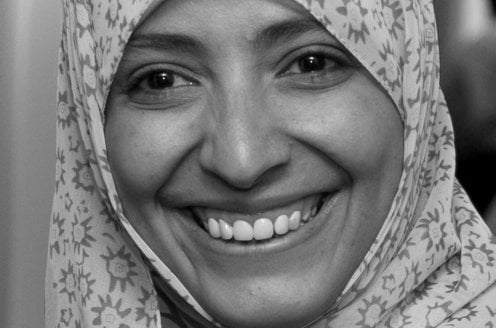
Tawakkol Karman was awarded the Nobel Peace Prize, jointly with Ellen Johnson Sirleaf and Leymah Gbowee, for her non-violent struggle for the safety of women and for women’s rights to full participation in peace-building work.
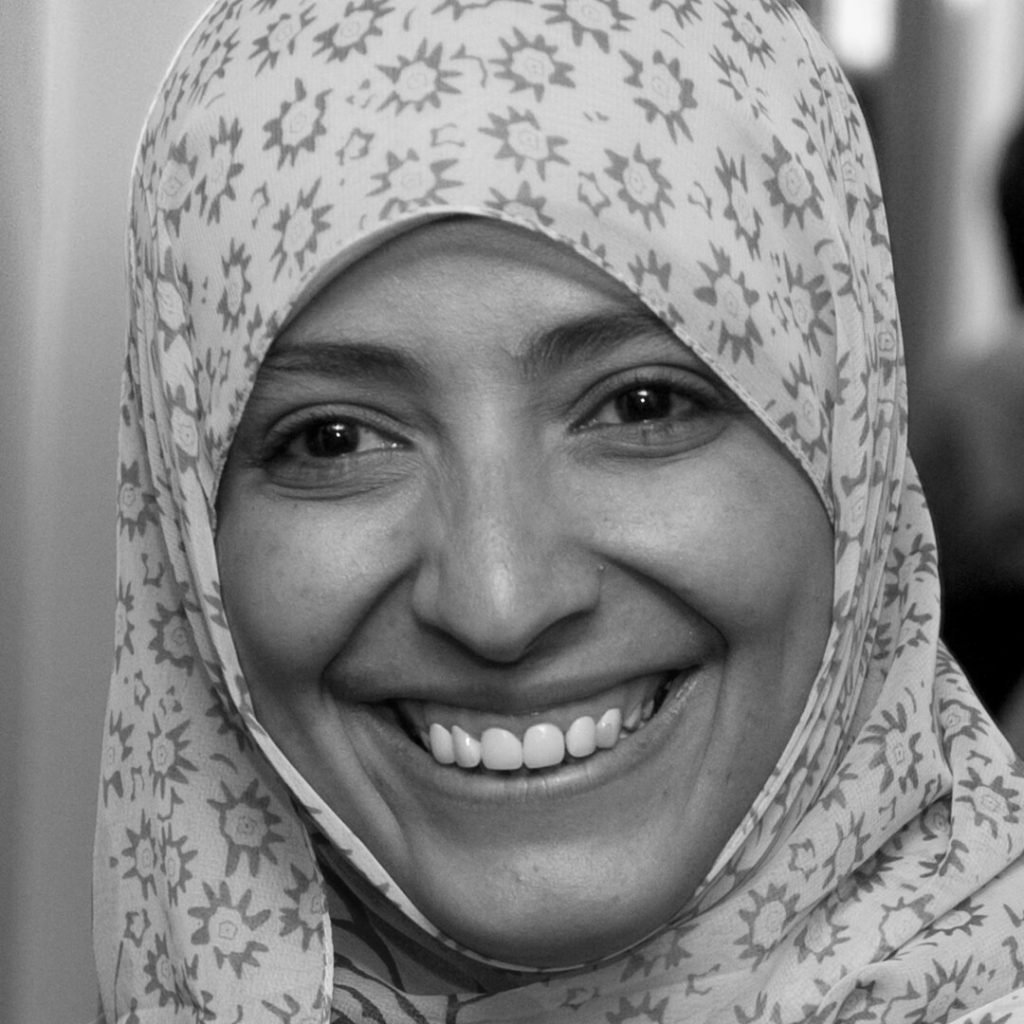
Full name: Tawakkol Karman
Born: 7 February 1979, Ta’izz, Yemen
Date awarded: 7 October 2011
Tawakkol Karman has played a lead role in the struggle for women’s rights and for democracy and peace in Yemen, both before and during “the Arab Spring “. Since 2005, Karman has been an outspoken critic of Yemen’s President Ali Abdullah Saleh and a regime that prevents people from influencing the country’s political development. Karman founded and led “Women Journalists Without Chains”. In January 2011 she was arrested, but released the next day. Several hundred thousand people protested against Saleh’s regime, which has met the demonstrations in turn with negotiations, concessions and brutal violence. Karman, a mother of three, has received death threats.
“We cannot achieve democracy and lasting peace in the world unless women obtain the same opportunities as men to influence the development of society at all levels of society.”
– The Norwegian Nobel Committee, Oslo, 7 October, 2011.
| Democracy Greek for government by the people. A form of government in which all adult citizens participate in the governing of the state and everyone is equal under the law. Most democracies are representative governments. Individuals are elected to assemblies that take decisions on behalf of all citizens. |
“This is a prize for the revolutions in the Arab world. It is for the youth and for peace.”
– Tawakkol Karman, Sana’a, 7 October 2011.
The Arab Spring began in Tunisia when Mohamed Bouazizi set himself on fire. Widespread frustration at poverty, unemployment and political oppression fanned the protests through the Arab world. Citizens of several countries soon rose against their leaders. Social media such as Facebook and Twitter were key lines of communication. In Yemen, Tawakkol Karman quickly became a leader of the protests against President Saleh’s regime. In response to the awarding of the Nobel Peace Prize, she says that she will continue the struggle for a democratic Yemen “until universal rights are achieved”.
Although democracy in North Yemen was introduced on paper following the 1962 revolt against the imam rule, the country is in practice governed by an elite made up of tribal leaders and military officers and businessmen. Yemen is riven by conflict, and the regime has played various groups off against each other. At the same time, it derives much of its legitimacy from presenting itself as the only possible stable alternative. A lack of state-provided infrastructure and social services means the extended family and clan remain extremely important in everyday life.
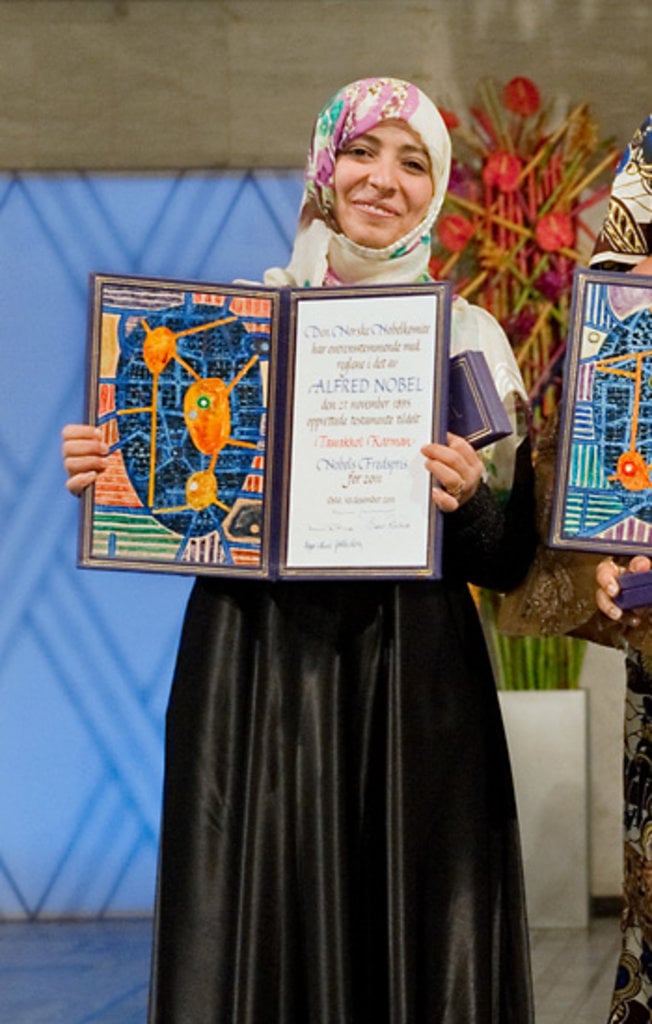
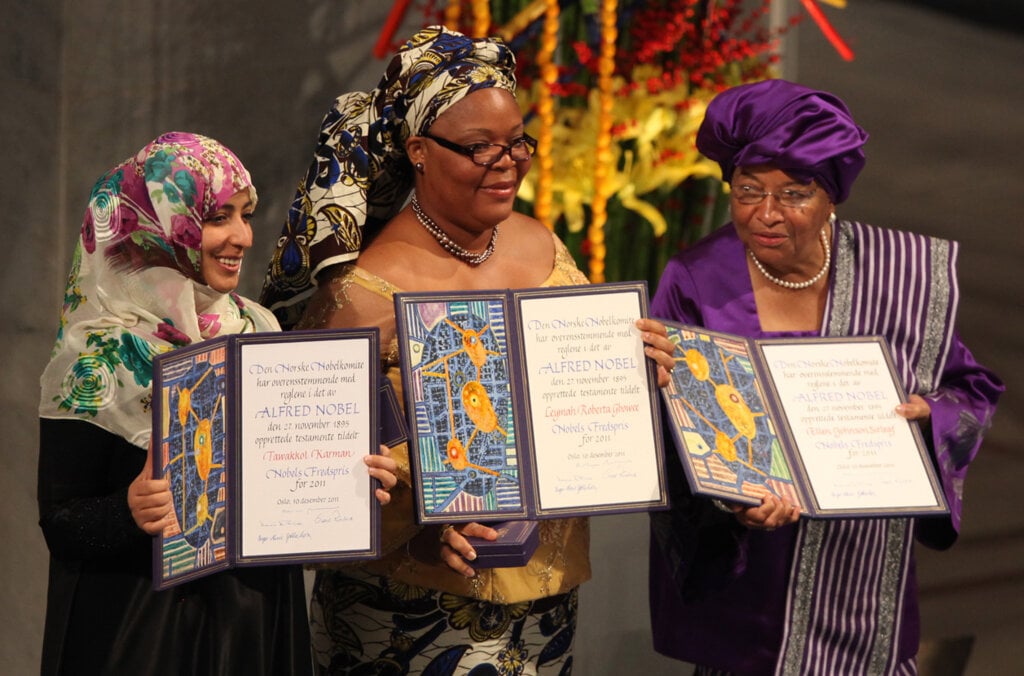
The Nobel Peace Prize 2011 was awarded equally to Ellen Johnson Sirleaf, Leymah Gbowee and Tawakkol Karman. They got the prize for their non-violent struggle for women’s security and the right to full participation in peace-building activities. This is the second time in the Nobel Peace Prize’s history that it is awarded to three individuals. The first time was in 1994, when the prize went to Yasser Arafat, Shimon Peres and Yitzhak Rabin for their efforts to bring peace in the Middle East.
Read or watch the Nobel Prize lecture by Tawakkol Karman.
Disclaimer: Every effort has been made by the publisher to credit organisations and individuals with regard to the supply of photographs. Please notify the publishers regarding corrections.
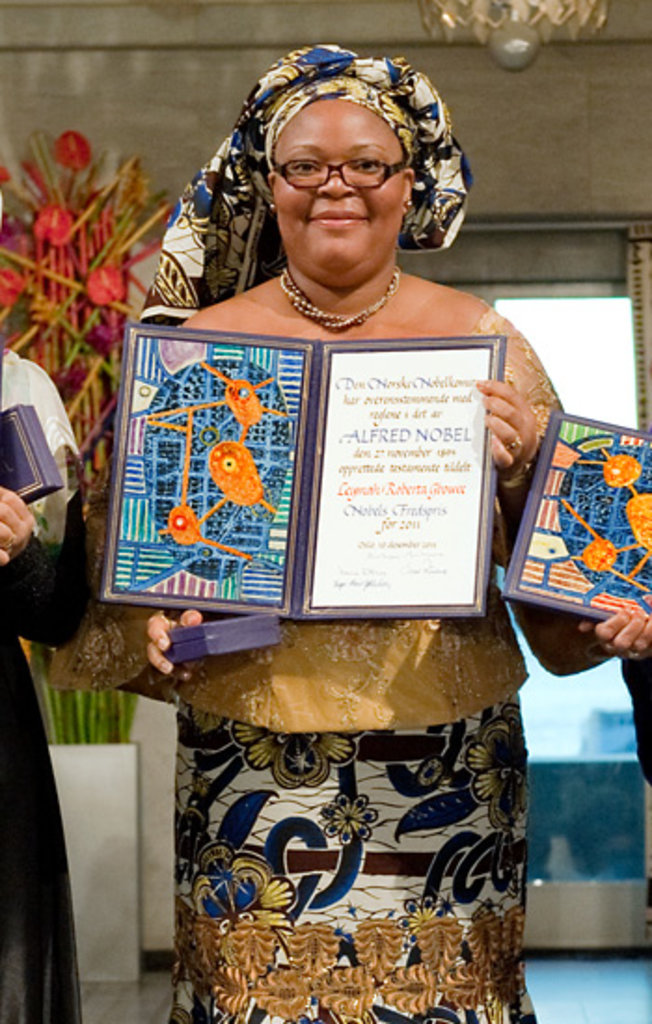
Leymah Gbowee was awarded the Nobel Peace Prize, jointly with Ellen Johnson Sirleaf and Tawakkol Karman, for her non-violent struggle for the safety of women and for women’s rights to full participation in peace-building work.
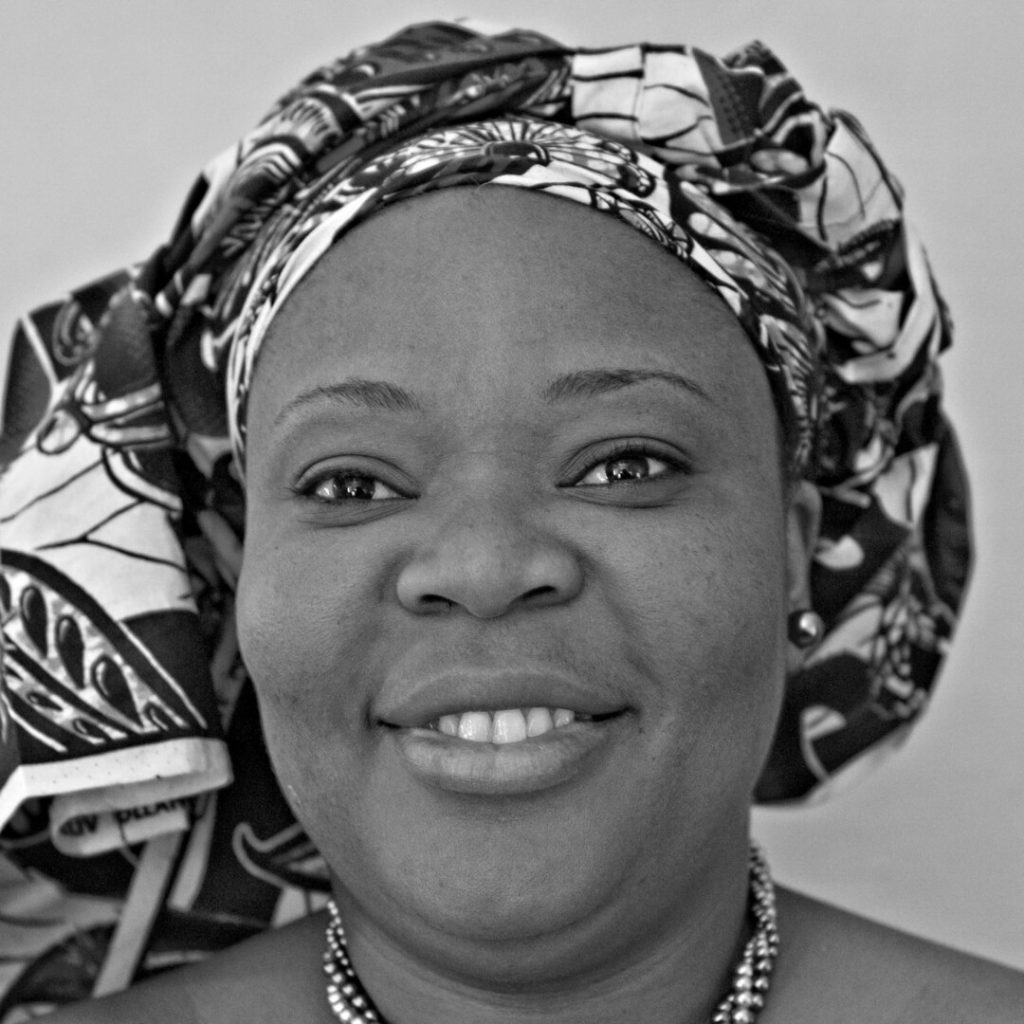
Full name: Leymah Gbowee
Born: 1 February 1972, Monrovia, Liberia
Date awarded: 7 October 2011
Leymah Gbowee got the Nobel Peace Prize because she mobilised and organised women of all ethnic and religious backgrounds, in order to end the prolonged war in Liberia and to secure women’s participation in its elections. In 2002, Gbowee organised the peace movement “Women of Liberia Mass Action for Peace” which included both Muslim and Christian women. Through non-violent protests with prayers for peace the organisation became a key factor in the downfall of dictator Charles Taylor and the ending of the civil war. Gbowee has since helped strengthen women’s influence in Liberia and other parts of West Africa, and today heads the ”Women’s Peace and Security Network Africa (WIPSEN)”. Leymah Gbowee was born in Liberia in 1972, has six children and lives in Accra, Ghana.
“We cannot achieve democracy and lasting peace in the world unless women obtain the same opportunities as men to influence the development of society at all levels of society.”
– The Norwegian Nobel Committee, Oslo, 7 October, 2011.
In addition to having a Masters degree in Conflict Transformation from the USA, Gbowee is also a trauma therapist. In a number of positions, Gbowee has shown a true ability to focus people on common goals. In particular, this concerns her efforts to end to the bloody civil war. After the civil war Gbowee’s efforts have included the rehabilitation of Charles Taylor’s child soldiers, and she was also commissioner for Liberia’s Truth and Reconciliation Commission. Gbowee plays a central role in the award-winning documentary “Pray the Devil Back to Hell” which shows the struggle for democracy in Liberia.
| Democracy Greek for government by the people. A form of government in which all adult citizens participate in the governing of the state and everyone is equal under the law. Most democracies are representative governments. Individuals are elected to assemblies that take decisions on behalf of all citizens. |
The peace prize to Ellen Johnson Sirleaf, Leymah Gbowee and Tawakkol Karman resulted in a significant increase in the number of female peace prize laureates. Until 2011, only 12 of 97 individual peace prize laureates were women. The first was Bertha von Suttner in 1905 and the last Wangari Maathai in 2004. The Norwegian Nobel Committee hopes that the prize to Sirleaf, Gbowee and Karman can help to end the oppression of women which is common in many countries, and to unleash women’s enormous potential for democracy and peace.
Liberia is still struggling with the material and social fallout from 14 years of brutal civil war that began with the revolt and assassination of President Samuel Doe in 1989. Doe had himself seized power a decade earlier in a military coup, subsequently executing the former president, most of his cabinet and other government officials. By 2003, 270,000 people had been killed, 1/3 of the population had fled their homes, and the country’s economy and infrastructure had largely ceased to function. In other words, the country had to be rebuilt almost from scratch.
The Nobel Peace Prize 2011 was awarded equally to Ellen Johnson Sirleaf, Leymah Gbowee and Tawakkol Karman. They got the prize for their non-violent struggle for women’s security and the right to full participation in peace-building activities. This is the second time in the Nobel Peace Prize’s history that it is awarded to three individuals. The first time was in 1994, when the prize went to Yasser Arafat, Shimon Peres and Yitzhak Rabin for their efforts to bring peace in the Middle East.
“If any changes were to be made in society it had to be by the mothers.”
– Leymah Gbowee, Gruber Foundation, Women’s Rights Prize, 2009.
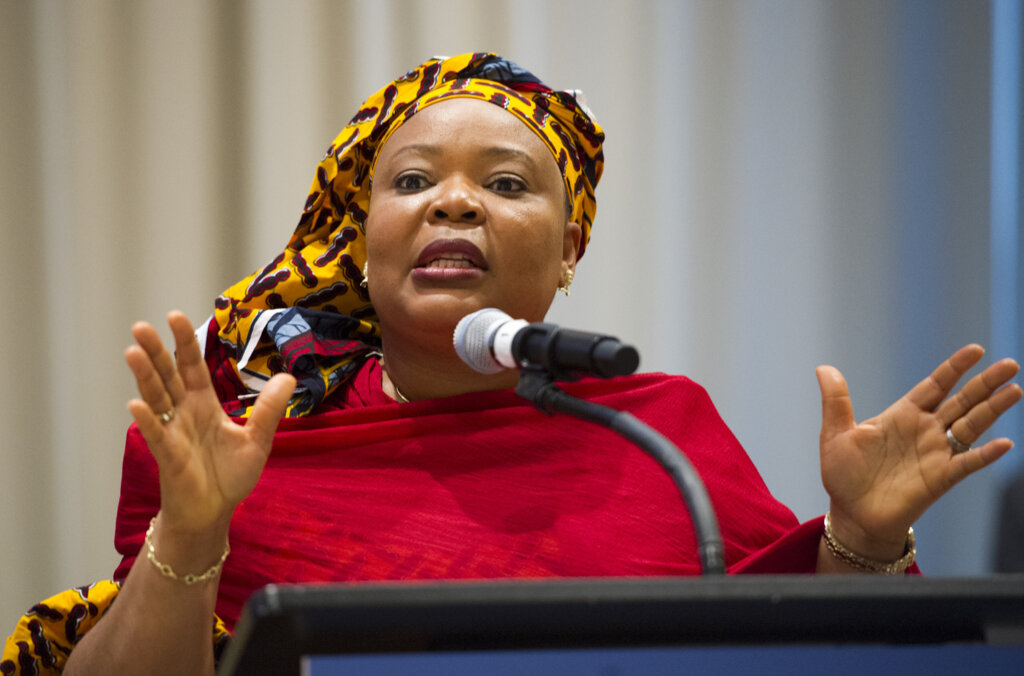
2011 Nobel Peace Laureate Leymah Gbowee is a Liberian peace activist, social worker and women’s rights advocate. She is Founder and President of the Gbowee Peace Foundation Africa, based in Monrovia …
Disclaimer: Every effort has been made by the publisher to credit organisations and individuals with regard to the supply of photographs. Please notify the publishers regarding corrections.
Ellen Johnson Sirleaf was awarded the Nobel Peace Prize, jointly with Leymah Gbowee and Tawakkol Karman, for her non-violent struggle for the safety of women and for women’s rights to full participation in peace-building work.
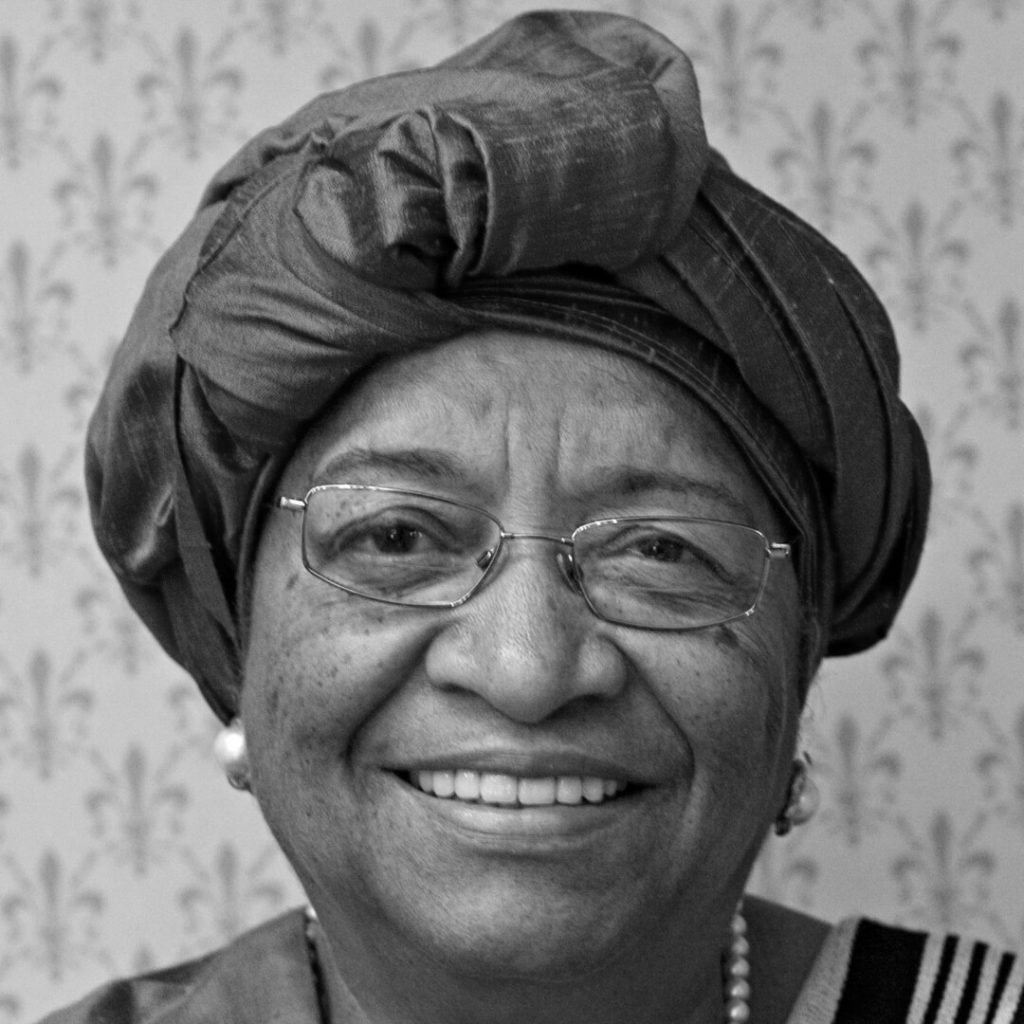
Full name: Ellen Johnson Sirleaf
Born: 29 October 1938, Monrovia, Liberia
Date awarded: 7 October 2011
Ellen Johnson Sirleaf is Africa’s first democratically elected female president. Sirleaf held several government positions in Liberia during the 1970s. During the 1980s and 1990s she ran for election as vice president and president, which resulted in house arrest, imprisonment and defeat. During the 1990s she held senior positions in international banks and led the UN Regional Bureau for Africa. After the fall of dictator Charles Taylor in 2003, she was elected President in the first democratic election in 2005. In 2006, Sirleaf established Liberia’s Truth and Reconciliation Commission after decades of bloody conflict. The Norwegian Nobel Committee emphasised Sirleaf’s contribution to securing peace in Liberia, promoting economic and social development, and strengthening the position of women.
“We cannot achieve democracy and lasting peace in the world unless women have the same opportunities as men to influence the development of society at all levels.”
– The Norwegian Nobel Committee, Oslo, 7 October, 2011.
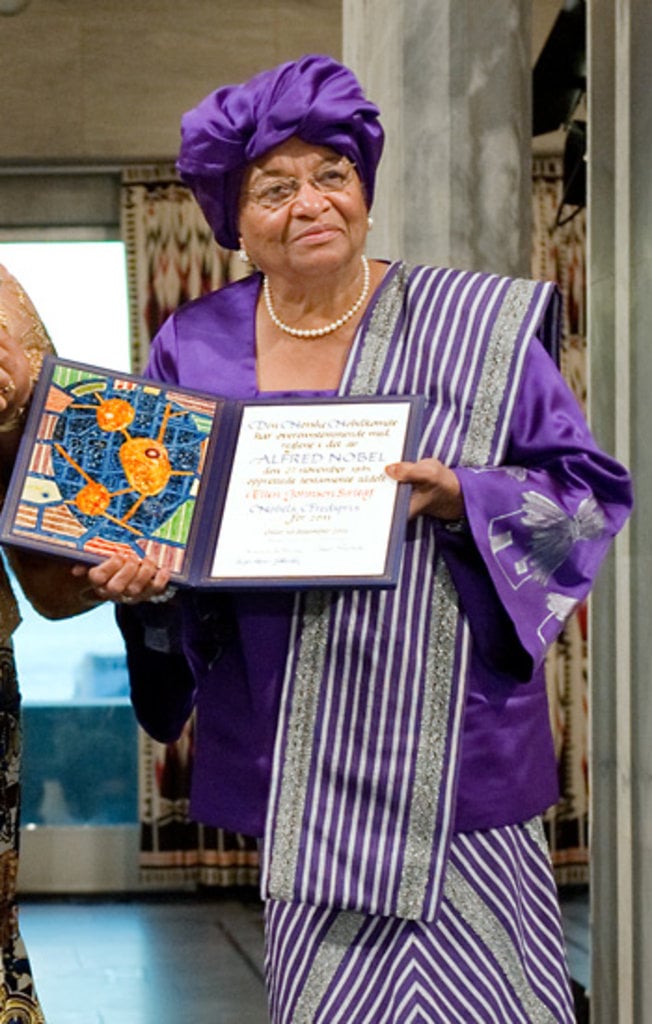
“If your dreams do not scare you, they are not big enough.”
– Ellen Johnson Sirleaf, This Child Will Be Great: Memoir of a Remarkable Life by Africa’s First Woman President, 2010.
Harvard-alumni Ellen Johnson Sirleaf represents the Unity Party, and held several government positions in Liberia during the 1970s. After Samuel Doe’s coup d’état in 1980, she left the country, returning to run for vice presidency in 1985. She was put under house arrest and sentenced to 10 years in prison. The year after, she went into exile. Sirleaf initially supported Charles Taylor’s revolt against the Doe regime, but later withdrew it. In 1997, she ran for the presidency against Taylor, but lost in a heavily disputed election. After several attempts, she won the presidential election in 2005.
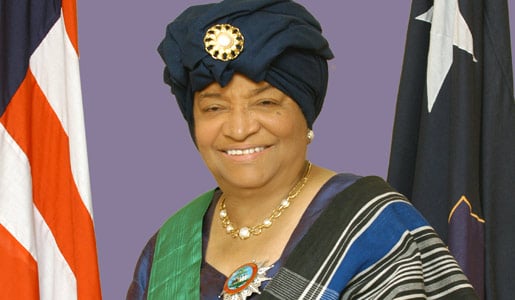
In 2000, the UN Security Council adopted Resolution 1325. The resolution made attacks against women in times of war a matter of international security. In its announcement of the peace prize 2011, the Nobel Committee emphasised the need for women to have the same status as men in peace efforts. During the follow-up phase to the resolution, Ellen Johnson Sirleaf contributed to the report “Women, War and Security”, which contains proposals for how to involve women in peace efforts. Sirleaf made sure that Liberia was among the first countries to have a national plan for implementing Resolution 1325.
Liberia is still struggling with the material and social fallout from 14 years of brutal civil war that began with the revolt and assassination of President Samuel Doe in 1989. Doe had himself seized power a decade earlier in a military coup, subsequently executing the former president, most of his cabinet and other government officials. By 2003, 270,000 people had been killed, 1/3 of the population had fled their homes, and the country’s economy and infrastructure had largely ceased to function. In other words, the country had to be rebuilt almost from scratch.
The Nobel Peace Prize 2011 was awarded equally to Ellen Johnson Sirleaf, Leymah Gbowee and Tawakkol Karman. They got the prize for their non-violent struggle for women’s security and the right to full participation in peace-building activities. This is the second time in the peace prize’s history that it is awarded to three individuals. The first time was in 1994, when the prize went to Yasser Arafat, Shimon Peres and Yitzhak Rabin for their efforts to bring peace to the Middle East.
Internationally known as Africa’s “Iron Lady,” President Ellen Johnson Sirleaf is a leading promoter of peace, justice and democratic rule. She grew up in Liberian capital of Monrovia, where she married and had four sons …
Disclaimer: Every effort has been made by the publisher to credit organisations and individuals with regard to the supply of photographs. Please notify the publishers regarding corrections.
In this podcast episode with Liberian peace activist Leymah Gbowee, conducted in December 2021, she shares her heartbreaking life story of growing up during the Liberian civil war. The consequences from the war required her to grow up quickly or as she puts it herself: ”one minute I was a teenager and the next minute I was a woman”.
Gbowee also tells us about her constant and tireless struggle for women’s rights and peace in her home country. To never give up has been her constant motto in life. She has dedicated her life to encouraging young people “to believe that they can do whatever they put their mind to”. When asked how she would like to be remembered, she gives a heartwarming reply.
The host of this podcast is nobelprize.org’s Adam Smith.
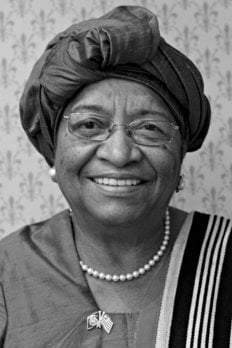
Internationally known as Africa’s “Iron Lady,” President Ellen Johnson Sirleaf is a leading promoter of peace, justice and democratic rule. She grew up in Liberian capital of Monrovia, where she married and had four sons.
President Johnson Sirleaf later moved to the United States where she earned an accounting degree from the Madison College of Business and a Masters Degree in Public Administration from Harvard University’s Kennedy School of Government.
In her efforts to bring justice to her people in Liberia, she has spent more than a year in jail at the hands of the military dictatorship of General Samuel Doe and had her life threatened by former President Charles Taylor. She campaigned relentlessly for Taylor’s removal from office and played an active and supportive role in the Transitional Government of Liberia as the country prepared for elections in October of 2005.
President Johnson Sirleaf was a presidential candidate in the 1997 Liberia general election where she finished second in the field of 13. Before that, she served for five years as Assistant Administrator and Director of the Regional Bureau for Africa of the United Nations Development Program as Assistant Secretary General of the United Nations and was the first woman to lead the United Nations Development Project for Africa.
She served as the Chairperson of the Governance Reform Commission of the National Transitional Government of Liberia until she resigned in March 2004 to accept the nomination of the Unity Party of Liberia as the party’s leader.
In November 2005, President Ellen Johnson Sirleaf was elected President of Liberia and became the first woman to lead an African nation. In the elections she defeated popular world-class soccer star George Weah with an impressive 59.4 percent of the vote.
In October 2007, President Ellen Johnson Sirleaf was awarded the Presidential Medal of Freedom, the United States’ highest civil award, for her personal courage and unwavering commitment to expanding freedom and improving the lives of people in Liberia and across Africa. And in 2010, as the only female and African Head of State, President Ellen Johnson Sirleaf was named by Newsweek Magazine as one of the World Top Ten Leaders.
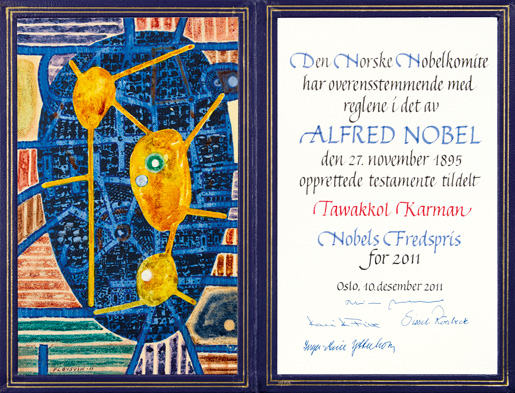
Copyright © The Nobel Foundation 2011
Artist: Jan Trygve Fløysvik
Calligrapher: Inger Magnus
Book binder: Julius Johansen
Photo reproduction: Thomas Widerberg
Video: Questions and Answers with Ellen Johnson Sirleaf from TED Conferences
On Ellen Johnson Sirleaf from Ellen Johnson Sirleaf Presidential Center for Women and Development
Interview with Ellen Johnson Sirleaf for the Nobel Peace Center, Oslo, Norway
Profile: Leymah Gbowee – Liberia’s ‘peace warrior’ from BBC
Interview with Leymah Gbowee for the Nobel Peace Center, Oslo, Norway
On Leymah Gbowee from the PeaceJam Foundation
On Leymah Gbowee from Nobel Women’s Initiative
Leymah Gbowee: ‘Unlock the intelligence, passion and greatness of girls’ from TED talks

Nobel Peace Prize laureate Tawakkol Karman with her Nobel Prize diploma at the Nobel Peace Prize award ceremony in Oslo, Norway, 10 December 2011.
Copyright © The Nobel Foundation 2011. Photo: Ken Opprann
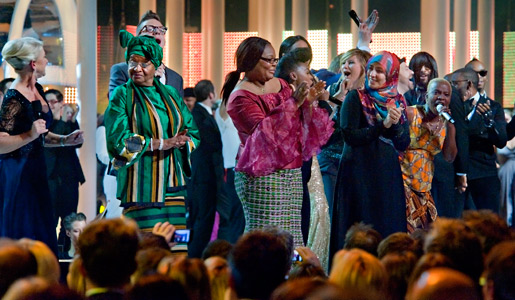
From left: Host Helen Mirren, Nobel Peace Prize Laureates Ellen Johnson Sirleaf, Leymah Gbowee and Tawakkol Karman, and artist Angélique Kidjo at the Nobel Peace Prize Concert at the Oslo Spektrum Arena on 11 December 2011.
© The Nobel Foundation 2011. Photo: Ken Opprann

Nobel Peace Prize Laureates Ellen Johnson Sirleaf, Leymah Gbowee and Tawakkol Karman during their visit to the Nobel Museum in Stockholm, 12 December 2011.
Copyright © Scanpix 2011 Photo: Fredrik Sandberg/Scanpix
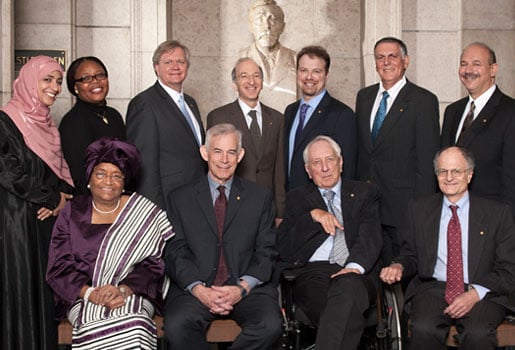
Eleven of the thirteen 2011 Nobel Laureates assembled for a group photo during their visit to the Nobel Foundation in Stockholm, 12 December 2011. Back row, left to right: Nobel Peace Prize Laureates Tawakkol Karman and Leymah Gbowee, Nobel Laureates in Physics Brian P. Schmidt, Saul Perlmutter and Adam G. Riess, Nobel Laureate in Chemistry Dan Shechtman and Nobel Laureate in Physiology or Medicine Bruce A. Beutler. Front row, left to right: Nobel Peace Prize Laureate Ellen Johnson Sirleaf, Laureate in Economic Sciences Christopher A. Sims, Nobel Laureate in Literature Tomas Tranströmer and Laureate in Economic Sciences Thomas J. Sargent.
© The Nobel Foundation 2011. Photo: Orasisfoto

Tawakkol Karman during an interview at the Nobel Museum in Stockholm on 7 March 2014. Copyright © Nobel Media AB 2014
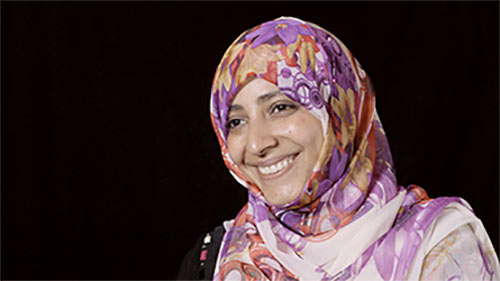
Portrait of Tawakkol Karman during an interview at the Nobel Museum in Stockholm on 7 March 2014. Copyright © Nobel Media AB 2014