Wilhelm Wien – Other resources
Links to other sites
On Wilhelm Wien from Universität Würzburg
Wilhelm Wien – Nobel Lecture
Nobel Lecture, December 11, 1911
On the Laws of Thermal Radiation
The kind recognition which my work on thermal radiation has received in the views of your ancient and famous Academy of Sciences gives me particular pleasure to speak to you about this subject which is again attracting the attention of all physicists because of the difficulty of the problems involved. As soon as we step beyond the established boundaries of pure thermodynamic theory, we enter a trackless region confronting us with obstacles which even the most astute of us are almost at a loss to tackle.
If, as is the custom, I speak mainly about my own researches, I must say that I was fortunate in finding that not everything had yet been gleaned in the field of general thermodynamic radiation theory. Using known physical laws it was possible to derive a general law of radiation theory which has, under the name of the displacement law, been acclaimed by fellow workers. In applying thermodynamics to the theory of radiation, we make use of the ideal processes which have been found so fruitful elsewhere. These are mental experiments whose realization is frequently impracticable and which nevertheless lead to reliable results. Such deliberations can only be undertaken if all the processes on which, governed by laws, the mental experiments are based, are known, so that the effect of any change can be stated accurately and completely. Further, to be allowed to idealize, we must neglect all non-essential secondary phenomena, while considering only everything indissolubly connected with the processes under examination. In the application of mechanical heat theory, this method has proved to be extremely fruitful. Helmholtz used it in the theory of concentration flows, Van ‘t Hoff used it in applying thermodynamics to the theory of solutions. It is necessary, in these deliberations, to presuppose the existence of a so-called semi-permeable membrane which permits the solvent to pass, but not the substance dissolved. Although it is impossible to prepare membranes which strictly satisfy this requirement, we can assume them as possible in the ideal processes, because the laws of Nature set no limit to approximation to semipermeability. The conclusions drawn from these assumptions have in any case always been in agreement with experience. In radiation theory, analogous deliberations can be made if we assume perfectly reflecting bodies as possible in the ideal processes. Kirchhoff used them for proving his famous theorem of the constancy of the ratio of emission and absorption power. This theorem has become one of the most general of radiation theory and expresses the existence of a certain temperature equilibrium for radiation. According to it, there must exist, in a cavity surrounded by bodies of equal temperature, a radiation energy that is independent of the nature of the bodies. If in the walls surrounding this cavity a small aperture is made through which radiation issues, we obtain a radiation which is independent of the nature of the emitting body, and is wholly determined by the temperature. The same radiation would also be emitted by a body which does not reflect any rays and which is therefore designated as completely black, and this radiation is called the radiation of a black body or black-body radiation.
The Kirchhoff theorem is not limited to radiation caused by thermal processes. It seems to be valid for most, if not all luminous processes. That the temperature concept can be applied to all luminous processes is beyond doubt. Since we can produce all types of light by means of hot bodies, we can ascribe, to the radiation in thermal equilibrium with hot bodies, the temperature of these bodies, and thus every radiation, even that issuing from a phosphorescent body, has a certain temperature for every colour. This temperature has however no connection whatever with that of the body, nor is it possible as yet to state how e.g. a phosphorescent body comes into equilibrium with radiation. These conditions are bound to be very complicated, in particular in the case of bodies which convert the absorbed radiation and emit it after a long interval of time.
Again using ideal processes and assuming radiation pressure, which at that time had been deduced from the electromagnetic theory of light, Boltzmann derived from thermodynamics the law, previously empirically formulated by Stefan, that the radiation of a black body is proportional to the fourth power of the absolute temperature.
This did not exhaust the conclusions to be drawn from thermodynamics. There remained the determination of the changes undergone by the colours present in radiation with changes of temperature. Computation of this change is again based on an ideal process. For this, we must assume wholly reflecting bodies as possible that scatter all incident radiation and which can therefore be described as completely white. If we allow the radiation coming from a black body to enter a space of this kind, it will in the end propagate exactly as if the walls of the space were themselves radiant and had the same temperature as the black body. If we then seal off the black body from the white space, we obtain the unrealisable case of a radiation permanently reciprocated between mirroring walls. In our thoughts, we continue the experiment. We imagine the volume of our space to be reduced by movement of the walls, so that the entire radiation is concentrated in a smaller space. Since radiation exercises a certain pressure, the pressure of light, on the walls it strikes, it follows that some work must have been expended in size reduction, as if we had compressed a gas. Because of the low magnitude of the pressure of light, this work is very small, but it can be computed accurately, which is all that matters in the case under discussion. In accordance with the principle of the conservation of energy, this work cannot be lost, it is converted into radiation, which further increases the radiation concentration. This change of radiation density due to the movement of the white walls is not the only change to which the radiation is subjected. When a light ray is reflected by a moving mirror, it undergoes a change of the colour dictated by the oscillation frequency. This change in accordance with the so-called Doppler principle plays a substantial part in astrophysics. The spectrum line emitted by an approaching celestial body appears to be displaced in the direction of shorter wavelengths in the ratio, its velocity: the velocity of light. This is also the case when a ray is reflected by a moving mirror, except that the change is twice as great. We are therefore able to calculate completely the change undergone by the radiation as a result of the movement of the walls. The pressure of light which is essential to these deliberations was demonstrated at a much later date, Lebedev being the first to do so. Arrhenius used it to explain the formation of comet tails. Before that, it was only a conclusion drawn from Maxwell’s electromagnetic theory. We now calculate both the change of radiation density due to movement, and the change of the various wavelengths. From this mental experiment, we can draw an important conclusion. We can conclude from the second law of mechanical heat theory that the spectral composition of the radiation which we have changed by compression in the space with mirror walls is exactly the same as it would be had we obtained the increased density of radiation by raising the temperature, because we would otherwise be able to produce, by means of colour filters, unequal radiation densities in the two spaces, and to generate work from heat without compensation. Since we can calculate the change of individual wavelengths due to compression, we can also derive the manner in which the spectral composition of black-body radiation varies with temperature. Without discussing this calculation in detail, let me give you the result: the radiation energy of a certain wavelength varies with changing temperature so that the product of temperature and wavelength remains constant.
Using this displacement law it is easy to calculate the distribution of the intensity of thermal radiation over the various wavelengths for any temperature, as soon as it is known for one temperature.
The shift of the maximum of intensity in particular is directly accessible to observation. Since the wavelength at which the maximum intensity lies also defines the principal area of the wavelength which is most intense at this temperature, we can, by changing the temperature, shift the principal area of radiation in the direction of short or long wavelengths of any desired magnitude. Of the other derivations of the displacement law, I shall only mention that by H.A. Lorentz. If, in the electromagnetic equations of Maxwell, we imagine all spatial dimensions as being displaced in time in the same ratio, these equations show that the electromagnetic energy must decrease in proportion to the fourth power of displacement. Since, according to the Stefan-Boltzmann law, energy increases with the fourth power of absolute temperature, the linear dimensions must vary inversely proportionately to the absolute temperature. Each characteristic length must vary in this ratio, from which the displacement law follows.
From the displacement law, we can calculate the temperature of the sun if we are entitled to assume that the radiation of the sun must be ascribed to heat, and if we know the position of the maximum of the energy of solar radiation. Different figures are given for this position by different observers, i.e. 0.532 m according to Very, and 0.433 m according to Abbot and Fowle. Depending on the figure used, the temperature of the sun works out at 5,530° and 6,790°. However much the observers may differ, there can be no doubt that the maximum of solar radiation is situated in the visible range of wavelengths. This is to say that the temperature of the sun is the most favourable utilization of the radiant energy of a black body for our illumination and that, in our artificial light sources which utilize thermal radiation we must aim at achieving this temperature, from which we are admittedly far removed as yet.
I wish to discuss yet another application of the displacement law, i.e. the possibility of calculating the wavelength of X-rays. As we know, X-rays are produced by the impact of electrons on solid bodies, and their wavelength must be a function of the velocity of the electrons. According to the kinetic theory of gases, the mean kinetic energy of a molecule is a measure of absolute temperature. If, as is done in the theory of electrons, we assume that this is also valid for the kinetic energy of the electrons, the electric energy of the cathode rays would be a measure of their temperature. If we substitute the temperature thus calculated in the displacement law, we find that the wavelength of the maximum of the intensity indicates a wavelength range of X-rays which agrees well with the wavelengths found by other arguments. It might be objected that we must not ascribe a temperature to the electrons. The permissibility of our procedure can however be justified by an inversion of the above argument. Radiation in an enclosed space must necessarily release electrons whose velocity according to Einstein’s law is proportional to the oscillation frequency. The energy maximum of radiation generates electrons whose velocity is so great that their kinetic energy comes very close to the temperature associated with the maximum of energy.
The displacement law exhausts the conclusions that can be drawn from pure thermodynamics with respect to radiation theory. All these conclusions have been confirmed by experience. The individual colours present in the radiation are mutually wholly independent. The manner in which at a given temperature the intensity of radiation is distributed over the individual wavelengths cannot be determined from thermodynamics. For this, one must examine the mechanism of the radiation process in detail. Similar conditions obtain in the theory of gases. Thermodynamics can tell us nothing about the magnitude of the specific heat of the gases; what is required, is to examine molecular motion. But the kinetic theory of gases which is based on probability calculations has made much greater progress than the corresponding theory of radiation. The statistical theory of gases has set itself the task of accounting also for the laws of thermodynamics. I do not wish to discuss here the extent to which the task may be considered as having been solved, and whether we are entitled to consider the reduction of the second law to probability as a wholly satisfactory theory. It has in any case been very successful, in particular since a theoretical explanation has been found of the deviations from the thermodynamic state of equilibrium, the so-called fluctuations, e.g. in Brownian movement. None of the statistical theories of radiation has however as yet even attempted to derive the Stefan-Boltzmann law and the displacement law, which must always be introduced into theory from outside. Quite apart from this, we are as yet far removed from a satisfactory theory to account for the distribution of radiation energy over the individual wavelengths.
I myself made the first attempt in this direction. I endeavoured to bypass the problem of applying probability calculation to radiation theory by imagining radiation as resulting from gas molecules moving according to laws of probability. Instead of these we could also imagine electrons generating radiation on striking molecules. What is essential is the further assumption that such a particle will only emit radiation of a certain wavelength dictated by velocity, and that the velocity distribution of the particles obeys Maxwell’s law. With the assistance of the radiation laws derived from thermodynamics we obtain a radiation law which shows good agreement with experience for a wide range of wavelengths, i.e. for the range in which the product of temperature and wavelength is not unduly large.
Imperfect as this first attempt was, a formula had been obtained which considerably deviates from reality for large wavelengths only. Since observations however establish these deviations beyond doubt, it was clear that the formula had to be modified.
Lord Rayleigh was the first to approach the problem from an entirely different angle. He made the attempt to apply to the radiation problem a very general theorem of statistical mechanics, i.e. the theorem of the uniform distribution of energy over the degrees of freedom of the system in the state of statistical equilibrium. The meaning of this theorem is as follows:
In the state of thermal equilibrium, all movements of the molecules are so completely irregular that there exists no movement which would be preferred over any other. The position of the moving parts can be established by geometrical parameters which are mutually independent and in the direction of which the movement falls. These are called the degrees of freedom of the system. As regards the kinetic energy of movement, no degree of freedom is preferred over another, so that each contains the same amount of the total energy.
Radiation present in an empty space can be represented so that a given number of degrees of freedom is allocated to it. If the waves are reflected back and forth by the walls, systems of standing waves are established which adapt themselves to the distances between two walls. This is most easily understood if we consider a vibrating string which can execute an arbitrary number of individual vibrations, but whose half wavelengths must be equal to the length of the string divided by an integer.
The individual standing waves possible represent the determinants of the processes and correspond to the degrees of freedom. If we allocate to each degree of freedom its proper amount of energy, we obtain the Rayleigh radiation law, according to which the emission of radiation of a given wavelength is directly proportional to the absolute temperature, and inversely proportional to the fourth power of the wavelength. The law agrees with observation at exactly the point where the law discussed above failed, and it was at first considered to be a radiation law of limited validity. But if the process of radiation obeys the general laws of electromagnetic theory or of the theory of electrons, we must necessarily arrive at Rayleigh’s radiation law, as Lorentz has shown. Viewed as a general radiation law, it directly contradicts all experience, because, according to it, energy would have to accumulate increasingly at the shortest wavelengths. The possibility that we are not dealing in reality with a true state of equilibrium of radiation, but that it very gradually approaches the state where all energy is only present in the shortest wavelengths, is also contradicted by experience. In the case of the visible rays, to which the Rayleigh formula no longer applies at attainable temperatures, we can easily calculate, according to the Kirchhoff law, that the state of equilibrium must be attained in the shortest time, which state however remains far removed from the Rayleigh law. We thus obtain an inkling of the extraordinary difficulties which confront exact definition of the radiation formula. The knowledge that current general electromagnetic theory is insufficient, that the theory of electrons is inadequate, to account for one of the most common of phenomena, i.e. the emission of light, remains purely negative as yet. We only know how the thing cannot be done, but we lack the signposts that would enable us to find our way. We do however know that none of the models whose mode of action is based on purely electromagnetic principles can lead to correct results.
It is the merit of Planck to have introduced new hypotheses which enable us to avoid Rayleigh’s radiation law. For long waves, this law is undoubtedly correct, and the right radiation formula must have a form such that, for very long waves, it passes into Rayleigh’s law, and for short waves into the law formulated by me. Planck therefore retains as starting point the distribution of energy over the degrees of freedom of the system, but he subjects this distribution of energy to a restriction by introducing the famous hypothesis of elements of energy, according to which energy is not infinitely divisible, but can only be distributed in rather large quantities which cannot be divided further. This hypothesis would probably have been accepted without difficulty, if unchangeable particles, e.g. atoms of energy had been involved. It is an assumption that has proved inevitable for matter and electricity. The energy elements of Planck are however no atoms of energy; on the contrary, the displacement law requires that they are inversely proportional to the wavelength of a given vibration. This represents great difficulty for the understanding of these energy elements. Once we accept the hypothesis, we arrive at an entirely different distribution of energy over the radiating centres, if we search for them according to the laws of probability. This does not however give us the radiation law. All we know is how much energy the radiating molecules possess on average at a certain temperature, but not how much energy they emit. To derive emission at a given energy, we need a definite model which emits radiation. We can only construct such a model on the foundation of the known electromagnetic laws, and it is at this early point that the difficulty of the theory starts. On the one hand we relinquish the electromagnetic laws by introducing the energy elements; on the other hand we make use of these same laws for discovering the relationship between emission and energy. It could admittedly be argued that the electromagnetic laws are only valid for mean values taken over extended periods, whereas the energy elements relate to the elementary radiation process itself. An oscillator radiating in accordance with the electromagnetic laws will indeed have little similarity with the real atoms. Planck however rightly argues that this does not matter precisely because radiation in the equilibrium state is independent of the nature of the emitting bodies. It will however be required of a model which is to stand for the real atoms that it should lack none of the essential characteristics of the event under consideration. Every body that emits thermal rays has the characteristic that it is able to convert thermal rays of one wavelength into thermal rays of a different wavelength. It is on this that there rests the possibility of a specific spectral composition being established in the radiation at all times. The Planck oscillator lacks this ability, and doubts are bound to be raised as to whether it can properly be used for establishing the relationship between energy and emission. This difficulty can be avoided, and the oscillator can be done without, if, with Debye, we decompose the radiation energy in a hollow cube into Planck energy elements and distribute these energy elements over the oscillation frequencies of the standing waves formed in the cube according to the laws of probability. The logarithm of this probability will then be proportional to entropy, and the law of radiation results, if we search for the maximum of this entropy. This result is proof of the extremely general nature of Planck’s concepts.
There are however further difficulties. The energy elements increase with decreasing wavelength, and an oscillator exposed to incident radiation will, at low intensity, need a very long time before it absorbs a full energy element. What happens if the incident radiation ceases, before an entire energy element has been absorbed? The difficulties implicit in answering this question have recently induced Planck to reformulate his original theory. He now assumes of emission only that it can occur exclusively by whole energy elements. Absorption is assumed to occur continuously according to the electromagnetic laws, and the energy content of an oscillator is assumed to have energy values capable of continuous change. The difficulty of the long absorption time is indeed avoided in this manner. On the other hand the close relationship between emission and absorption for the elementary process is relinquished, and this relationship now becomes valid statistically only. Every atom which only emits whole energy elements and absorbs continuously would therefore in the event of emission suddenly expend energy from its own reserve and would supplement this but little in the event of short irradiation. The special hypothesis must be made that, taken as a whole for many atoms in the stationary state, the absorbed energy after all becomes equal to that emitted. Whereas in the original form of the Planck theory the introduction of the hypothesis of energy elements was sufficient to permit the radiation laws to be derived, the new theories include uncertainties which can only be removed by further hypotheses. On the other hand the new fundamental hypothesis provides the possibility of further application, e.g. to electron emission.
It will be seen from the few observations I am able to offer in this context how great are the difficulties that remain in radiation theory. But the reference to these difficulties which it is the duty of the scientific approach to emphasize must not prevent us from paying tribute to the great positive achievements which the Planck theory has already accomplished.
It has produced a law of radiation which accommodates all observed data and includes the Rayleigh formula and my own formula as limiting cases. In addition, it has thrown unexpected light on an entirely different subject, i.e. the theory of specific heats.
It has long been known that the specific heats do not strictly obey the Dulong-Petit law and that they decrease at low temperatures. Diamonds do not obey the Dulong-Petit law even at normal temperatures. This law can be derived from the theorem of the distribution of kinetic energy over the degrees of freedom and states that, in solid bodies, every atom possesses, in accordance with its three degrees of freedom, three times the amount of energy, and, because of the potential energy, altogether six times the amount of energy of a degree of freedom. If however we apply Planck’s distribution of energy by energy elements, we obtain, according to Einstein, a formula for the specific heat which does in fact show the drop of temperature. This result is characteristic of the Planck theory. This theory of specific heats is not derived from the radiation formula, but from the formula for the mean energy of an oscillator which is based directly on the hypothesis of the energy elements. Unfortunately, difficulties are beginning to appear. The exact measurements of specific heats at low temperatures made in Nernst’s laboratory have shown that the Einstein formula does not agree with observation. The formula which satisfies the experimental data contains half energy elements in addition to the whole energy elements, which cannot be interpreted satisfactorily as yet. There can however be no doubt that the Planck radiation theory provides the first step to the theory of specific heats.
That the theory should remain in many respects incomplete and provisional, is in the nature of the problem which is perhaps the most difficult which has ever confronted theoretical physics. What is involved is to leave behind the laws of theoretical physics confirmed by direct observation, which alone have been applied in the past, and to enter areas which are beyond the reach of direct observation.
The difficulties which beset radiation theory also emerge in an entirely different approach. Einstein investigated the fluctuations to which radiation is continuously subjected even in the state of equilibrium as a result of the irregularities of the thermal processes. If we imagine a small plate in a cavity filled with radiation, this plate will be subjected to a radiation pressure which is the same on average on both sides of the plate. Since the radiation must contain irregularities, the pressure will alternately be greater on one or the other side so that the plate will execute small irregular movements, similar to the Brownian movement of a dust particle suspended in a liquid. These fluctuations can be derived from probability calculations. According to the Boltzmann theorem there is a simple relationship between entropy and probability. The entropy of radiation is known from the radiation law, so that the probability of state is also known, from which the fluctuations can be calculated. The mathematical expression for these fluctuations consists, in a peculiar manner, of two members. The first is readily understandable: it is due to irregularities which arise as a result of the mutual interference of the many independent beams which meet in one point. Where the density of radiation energy is high, this term alone predominates; it corresponds to the radiation range that obeys Rayleigh’s law.
The other term, which cannot be directly explained by the undulation theory, predominates at low density of radiation energy, where the radiation obeys the law formulated by me. It would be understandable if the radiation consisted of the Planck energy elements which would be localized even in an empty space. We cannot however pursue this line of thought. We cannot shake the undulation theory of light, which is one of the most firmly established constructions in the whole of physics. Moreover, the term to be explained by localized energy elements, is not present by itself, and it is a priori impossible to introduce a dualistic approach into optics, e.g. to assume simultaneously Huyghens’ wave theory and Newton’s emanation theory. All we can do is to relinquish the Boltzmann method of applying probability calculations to this type of fluctuations, or to assume that a new irregularity is introduced into radiation with the process of reflection.
In view of the magnitude of the difficulties it is natural that opinions about the path to be pursued should differ greatly. Some are of the opinion that the fundamental principles of electrodynamics must be changed. And yet, previous theory embraces a vast range of facts, it accounts for events even in the most rapid movements of the b-rays, it has proved itself in the most precise optical measurements. In my view, all the signs suggest that the deviations from current theory are due to events within the atom. None of the processes in which the interior of the atom participates are amenable to current theory.
Sommerfeld made an attempt in this direction: He would ascribe to the constant h of the radiation law, which together with the oscillation frequency dictates the magnitude of the energy element, a simple significance for the interior of the atom. It is alleged to determine the period in which an electron entering the atom comes to a stop, as a function of its velocity. On this view, the constant h expresses a universal characteristic of the atoms. This theory permits calculation of the wavelength of X-rays, and it connects two previously independent attempts made by me to carry out this calculation. One method is based on the Planck theory of energy elements in that it assumes that the energy of the so-called secondary electrons released by Xrays is dictated by the energy element. The second method is based on the theory of electrons by means of which it calculates the energy radiated in the X-rays by sudden braking of an electron. From the determination of the energy of the cathode rays and the X-rays we can then calculate the brake path of the electrons and consequently the wavelength of the X-rays. The Sommerfeld theory connects these two theories. It has the great advantage of explaining the generation of X-rays with the aid of electromagnetic theory. A number of conclusions can then be drawn from this which are in complete agreement with observation, e.g. the polarisation of X-rays, the diversity of emission and of hardness in various directions.
The Sommerfeld theory has the great advantage that it attempts to invest the universal constant h of the Planck radiation theory with physical significance. It has the disadvantage that it has been applied so far only to electron emission and absorption, but cannot yet solve the problem of thermal radiation.
We must admit that the result of radiation theory todate is not a very good one for theoretical physics. As we have seen, only the general thermodynami theories have proved satisfactory as yet. The theory of electrons has come to grief over the radiation problem, the Planck theory has not yet been brought into a definite form. Research is faced with exceptional difficulties and we cannot discern when and how they can be overcome. In science, the redeeming idea often comes from an entirely different direction, investigations in an entirely different field often throw unexpected light on the dark aspects of unresolved problems. We must base our hope in the future in the expectation that the present era which has proved so fruitful for physics may not pass without a complete solution being found for the problem of thermal radiation. Far-reaching and new thoughts will have to set to work, but the result will be great, because we shall obtain a profound insight into the world of the atom and the elementary processes within it.
The Nobel Foundation's copyright has expired.Wilhelm Wien – Banquet speech
Wilhelm Wien’s speech at the Nobel Banquet in Stockholm, December 10, 1911 (in German)
Königliche Hoheiten, meine verehrten Damen und Herren! Für uns, die wir den Nobel-Preis erhalten haben, wird das erste Gefühl ein tiefer Dank sein, aber wir werden auch Veranlassung haben, unsere eigne Stellung zu den Arbeiten, die mit dem Preise gekrönt sind, zu untersuchen. Wir werden nicht ganz mit dem günstigen Urteil der schwedischen Akademie übereinstimmen, denn in der Wissenschaft tritt noch mehr als anderswo das grosse Missverhältnis zwischen dem, was man gewollt, und dem, was man vollbracht hat, hervor. Jeder, der auf seine wissenschaftlichen Leistungen zurückblickt, wird das was noch zu leisten ist, und das was nicht gelungen ist, so überwiegend im Vergleich mit dem finden, was er ausführen konnte, dass er sich sagen wird, was Du getan hast war doch recht wenig. Aber es kommt noch ein anderes hinzu. Die Wissenschaft ist ein Organismus, der sich nach seinen innern Gesetzen entwickeln muss. Ich möchte sie mit einem Baum vergleichen, der eine grosse Krone bekommen hat und weiter wächst, der sich aber nur die Stoffe zu assimilieren vermag, die er für seine Entwicklung brauchen kann. Und so kann auch die Wissenschaft nur die Ideen in sich aufnehmen, die ihrer Entwicklung gemäss sind. Alles andere wird ausgeschieden und versinkt im Meere der Vergessenheit.
So habe ich meine eigene Arbeiten nur so lange auf einem Gebiet getrieben, als ich Wege sah, die zu einer natürlichen Weiterentwicklung führten. Wenn es meiner Begabung nicht entsprach, solche zu finden habe ich nur mehr als Zuschauer beobachtet, wie die Arbeit durch andere fortgeführt wurde und mich gefreut, wenn es gelang weiterzukommen. Für mich selbst habe ich dann ein anderes Arbeitsgebiet gesucht.
Bei der Auszeichnung durch die Nobelpreise stimmt aber noch ein anderes zum Nachdenken. Nicht immer sind die wissenschaftlichen Bestrebungen so anerkannt worden, und es liegt die Zeit noch nicht weit zurück, wo bedeutende Leistungen vergeblich auf Anerkennung warteten. Heute ist der Baum der Wissenschaft gross geworden, er trägt schöne Früchte und ist weithin sichtbar. So wird er mehr beachtet als früher. Aber es ist doch keineswegs so, dass überall die Wissenschaft so geehrt wird wie hier bei der Nobelfeier. Dieses Fest und die allgemeine Teilnahme sind ein Beweis für den weit vorgeschrittenen Idealismus des schwedischen Volkes. Hoffen wir, dass die ändern Völker folgen werden.
Die Verteilung, der Nobelpreise legt eine schwere Verantwortung auf die Schultern der schwedischen Männer der Wissenschaft. Sie haben eine grosse Arbeit zu leisten; aber eine schöne und beneidenswerte Arbeit. Einen grossen Einfluss auf die Wissenschaft können sie ausüben, auf die Jüngern Männer der Wissenschaft, indem sie sie anspornen, Arbeiten zu schaffen, die gekrönt werden können. Und es wird immer ein Anreiz sein, wenn man etwas schaffen kann, das als nützlich anerkannt wird. Aber auch die Männer, welche den Vorzug schon erreicht haben, mit dem Nobelpreis gekrönt zu werden, werden beeinflusst, indem sie veranlasst werden, ihren Dank abzustatten. Und diesen Dank kann ich mir nur in einer Weise vorstellen, nämlich dadurch, dass man seine ganzen Kräfte zur Förderung seiner Wissenschaft weiter einsetzt. So wird die schwedische Akademie in eigenartigem und immer zunehmendem Masse den Wert wissenschaftlicher Arbeit einzuschätzen und die Wissenschaft selbst dadurch zu fördern haben. Ich fordere sie auf, auf die schwedische Akademie der Wissenschaften anzustossen.
The Nobel Foundation's copyright has expired.Wilhelm Wien – Nominations
Wilhelm Wien – Facts
Award ceremony speech
Presentation Speech by the Librarian of the National Library, Dr. E.W. Dahlgren, President of the Royal Swedish Academy of Sciences, on December 10, 1911
Your Majesty, Your Royal Highnesses, Ladies and Gentlemen.
The Royal Academy of Sciences has awarded the Nobel Prize for Physics, for the year 1911, to Wilhelm Wien, Professor at the University of Würzburg, for his discoveries concerning the laws of heat radiation.
Ever since the beginning of the last century and, in particular, since spectrum analysis reached an advanced stage of development as a result of the fundamental work by Bunsen and Kirchhoff, the problem of the laws of heat radiation has occupied the attention of physicists to an exceptionally high degree.
The solution of this problem has presented immeasurable difficulties both in the theoretical and experimental respects, and it would hardly seem possible to solve this task without a knowledge of certain laws which embrace a wide diversity of radiating bodies.
One of these is the famous Kirchhoff law of the relationship between the ability of substances to emit and to absorb radiation energy. It relates the laws of radiation of all bodies so far as their radiation is dependent on temperature to those laws which are valid for the radiation emitted by a completely black body.
The search for the latter laws has therefore been one of the most fundamental problems of radiation theory. These laws have been discovered in the last decades and, by virtue of the great importance that attaches to them, belong to the major achievements of modern physics.
The difficulty in investigating the laws of radiation of black bodies was, firstly, that no completely black body exists in nature. In accordance with Kirchhoff’s definition, such a body would reflect no light at all, nor allow light to pass. Even substances such as soot, platinum black etc. reflect part of the incident light.
This difficulty was only removed in 1895, when Wien and Lummer stated the principles according to which a completely black body could be constructed, and showed that the radiation which issues from a small hole in a hollow body whose walls have the same temperature behaves in the same manner as the radiation emitted by a completely black body. The principle of this arrangement is based on the views of Kirchhoff and Boltzmann and had already been applied in part by Christiansen in 1884.
With the assistance of this apparatus it now became possible to investigate black body radiation. In this manner, Lummer, together with Pringsheim and Kurlbaum, succeeded in substantiating the so-called Stefan-Boltzmann law which indicates the relationship between the quantity of heat radiated by a black body and its temperature.
This solved in a highly satisfactory manner one of the major problems of radiation theory, i.e. that which touches total black body radiation.
However, the thermal energy that radiates from a body contains rays of different wavelengths whose intensities differ and change with the temperature of the body. It therefore remained to investigate the manner of change in intensity with wavelength and temperature.
An important step towards the solution of this question had been taken as early as 1886 by Langley who, with his famous spectrobolometer, investigated the distribution of radiation in the spectrum of a number of heat sources of high and low temperature. Inter alia these classical researches showed that the radiation had a maximum for a certain wavelength and that the maximum shifted in the direction of the shorter waves with increasing temperature.
In 1893 Wien published a theoretical paper which was destined to acquire the utmost importance in the development of radiation theory. In this paper he presented his so-called displacement law which provides a very simple relationship between the wavelength having the greatest radiation energy and the temperature of the radiating black body.
The importance of Wien’s displacement law extends in various directions. As we shall see, it provides one of the conditions which are required for the determination of the relationships between energy radiation, wavelength and temperature for black bodies, and thus represents one of the most important laws in the theory of heat radiation. Wien’s displacement law has however acquired the greatest possible importance in other contexts as well. Lummer and Pringsheim have shown that the radiation of bodies other than black bodies obeys the displacement law, with the sole difference that the constant which forms part of the formula has a different value.
Thus it became possible to determine the temperature of bodies, within fairly narrow limits, simply by seeking the wavelength at which radiation is greatest. The method has successfully been applied to the determination of the temperature of our light sources, of the sun and of some of the fixed stars, and has yielded extremely interesting results.
The Stefan-Boltzmann law and the Wien displacement law are the most penetrating statements on a secure theoretical foundation that have been discovered with respect to thermal radiation. They do not solve the central problem, i.e. the question as to the distribution of radiation energy over the various wavelengths at different black body temperatures. We can however say that Wien’s displacement law provides half the answer to the problem. We have one condition for determining the desired function. One more would be sufficient for solving the problem.
It was only natural that Wien who had contributed so much to the advancement of radiation theory should make an attempt to find an answer to the last remaining question also, i.e. that of the distribution of energy in radiation. In 1894 he indeed deduced a black body radiation law. This law has the virtue that, at short wavelengths, it agrees with the above-mentioned experimental investigations by Lummer and Pringsheim.
By a different approach from that used by Wien, Lord Rayleigh also succeeded in discovering a law of radiation. By contrast with that discovered by Wien, it agrees with experiment for long wavelengths.
The problem now became to bridge the gap between these two laws each of which had been shown to be valid in a specific context. It was Planck who solved this problem; as far as we are aware, his formula provides the long sought-after connecting link between radiation energy, wavelength and black body temperature.
These remarks show that we now know, with considerable accuracy, the laws that govern thermal black body radiation.
A magnificent and unique task has thus been undertaken and brought to a certain conclusion – a task which has claimed the liveliest interest and energy of the leading physicists of our time.
Among the researchers in this field now living it was Wilhelm Wien who made the greatest and most significant contribution, and the Academy of Sciences has therefore decided to award- to him the Nobel Prize for Physics for the year 1911.
Professor Wien. The Swedish Academy of Sciences has awarded to you this year’s Nobel Prize for Physics for your discoveries concerning the laws of thermal radiation. You have devoted your researches to one of the most difficult and spectacular problems of physics, and among the researchers now living it is you who has succeeded in making the greatest and most significant contributions to the solution of the problem. In admiration of the completed task and with the wish that further success may be granted to you in future work, the Academy now calls upon you to receive the prize from the hands of his Majesty the King.
The Nobel Prize in Physics 1911
Wilhelm Wien – Biographical
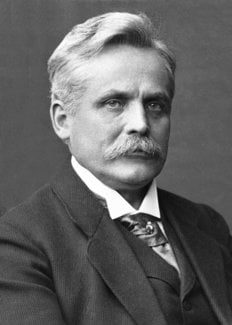
Wilhelm Wien was born on January 13, 1864 at Fischhausen, in East Prussia. He was the son of the landowner Carl Wien, and seemed destined for the life of a gentleman farmer, but an economic crisis and his own secret sense of vocation led him to University studies. When in 1866 his parents moved to Drachstein, in the Rastenburg district of East Prussia, Wien went to school in 1879 first at Rastenburg and later, from 1880 till 1882, at the City School at Heidelberg. After leaving school he went, in 1882, to the University of Göttingen to study mathematics and the natural sciences and in the same year also to the University of Berlin. From 1883 until 1885 he worked in the laboratory of Hermann von Helmholtz and in 1886 he took his doctorate with a thesis on his experiments on the diffraction of light on sections of metals and on the influence of materials on the colour of refracted light.
His studies were then interrupted by the illness of his father and, until 1890, he helped in the management of his father’s land. He was, however, able to spend, during this period, one semester with Helmholtz and in 1887 he did experiments on the permeability of metals to light and heat rays. When his father’s land was sold he returned to the laboratory of Helmholtz, who had been moved to, and had become President of, the Physikalisch-Technische Reichsanstalt, established for the study of industrial problems. Here he remained until 1896 when he was appointed Professor of Physics at Aix-la-Chapelle in succession to Philipp Lenard. In 1899, he was appointed Professor of Physics at the University of Giessen. In 1900 he became Professor of the same subject at Würzburg, in succession to W.C. Röntgen, and in this year he published his Lehrbuch der Hydrodynamik (Textbook of hydrodynamics).
In 1902 he was invited to succeed Ludwig Boltzmann as Professor of Physics at the University of Leipzig and in 1906 to succeed Drude as Professor of Physics at the University of Berlin; but he refused both these invitations.
In 1920 he was appointed Professor of Physics at Munich, where he remained throughout the rest of his life.
In addition to the early work already mentioned, Wien worked, at the Physikalisch-Technische Reichsanstalt, with Holborn on methods of measuring high temperatures with the Le Chatelier thermoelements and at the same time did theoretical work on thermodynamics, especially on the laws governing the radiation of heat.
In 1893 he announced the law which states that the wavelength changes with the temperature, a law which later became the law of displacement.
In 1894 he published a paper on temperature and the entropy of radiation, in which the terms temperature and entropy were extended to radiation in empty space. In this work he was led to define an ideal body, which he called the black body, which completely absorbs all radiations. In 1896 he published the formula of Wien, which was the result of work undertaken to find a formula for the composition of the radiation of such a black body. Later it was proved that this formula is valid only for the short waves, but Wien’s work enabled Max Planck to resolve the problem of radiation in thermal equilibrium by means of quantum physics. For this work Wien was awarded the Nobel Prize for Physics for 1911. An interesting point about it is that this theoretical work came from an Institute devoted to technical problems and it led to new techniques for illumination and the measurement of high temperatures.
When Wien moved, in 1896, to Aix-la-Chapelle to succeed Lenard, he found there a laboratory equipped for the study of electrical discharges in vacuo and in 1897 he began to work on the nature of cathode rays. Using a very high vacuum tube with a Lenard window, he confirmed the discovery that dean Perrin had made two years earlier, that cathode rays are composed of rapidly-moving, negatively-charged particles (electrons). And then, almost at the same time as Sir J.J. Thomson in Cambridge, but by a different method, he measured the relation of the electric charge on these particles to their mass and found, as Thomson did, that they are about two thousand times lighter than the atoms of hydrogen.
In 1898 Wien studied the canal rays discovered by Goldstein and concluded that they were the positive equivalent of the negatively-charged cathode rays. He measured their deviation by magnetic and electric fields and concluded that they are composed of positively-charged particles never heavier than electrons.
The method used by Wien resulted some 20 years later in the spectrography of masses, which has made possible the precise measurement of the masses of various atoms and their isotopes, necessary for the calculation of the energies released by nuclear reactions. In 1900 Wien published a theoretical paper on the possibility of an electromagnetic basis for mechanics. Subsequently he did further work on the canal rays, showing, in 1912, that, if the pressure is not extremely weak, these rays lose and regain, by collision with atoms of residual gas, their electric charge along their course of travel. In 1918 he published further work on these rays on the measurement of the progressive decrease of their luminosity after they leave the cathode and from these experiments he deduced what classical physics calls the decay of the luminous vibrations in the atoms, which corresponds in quantum physics to the limited duration of excited states of atoms.
In this, and other, respects Wien’s work contributed to the transition from Newtonian to quantum physics. As Max von Laue wrote of him, his “immortal glory” was that “he led us to the very gates of quantum physics”.
Wien was a member of the Academies of Sciences of Berlin, Göttingen, Vienna, Stockholm, Christiania and Washington, and an Honorary member of the Physical Society of Frankfurt-on-Main.
In 1898 he married Luise Mehler of Aix-la-Chapelle. They had four children. He died in Munich on August 30, 1928.
This autobiography/biography was written at the time of the award and first published in the book series Les Prix Nobel. It was later edited and republished in Nobel Lectures. To cite this document, always state the source as shown above.
The Nobel Foundation's copyright has expired.