Gustaf Dalén – Banquet speech
As the Laureate was unable to be present at the Nobel Banquet in Stockholm, December 10, 1912, the speech was held by his brother, A. Dalén (in Swedish)
Eders K. Höghet!
Mina damer och herrar! Då min broder, ingenjör Dalén, som erhållit årets Nobelpris i fysik, tyvärr af sjukdom varit hindrad att närvara vid prisutdelningen i dag, har jag haft den äran att å hans vägnar mottaga priset.
Af samma anledning är det, som jag nu anhåller att vid detta festliga tillfälle få bringa en hälsning från honom och att här få framföra hans tack till K. Vetenskapsakademien för den utmärkelse, hvarmed akademien belönat hans arbete.
Särskildt ber jag att fä rikta mitt tack till akademiens här närvarande preses för det varma erkännande, han i sitt nyss hållna tal ägnat detta arbete.
Det är i allmänhet svårt att säkert tolka en annan persons känslor, och jag vill ej heller här försöka att återgifva, hvad min bror kände, när han erhöll underrättelsen, att ett Nobelpris tilldelats honom.
Så mycket anser jag mig dock böra säga, att utmärkelsen i hög grad gladde honom och att den i sin mån bidragit till att hålla hans mod uppe efter den svåra olycka, som drabbat honom. Jag tror mig ock med visshet kunna försäkra, att den i framtiden för honom skall vara en kraftig sporre till fortsatt arbete på det område, där han hittills verkat, och där hans sträfvanden nu krönts med ett Nobelpris.
Med dessa enkla ord, mina damer och herrar, ber jag alltså att få framföra den frånvarande Nobelpristagarens tack.
The Nobel Foundation's copyright has expired.Gustaf Dalén – Nobel Lecture
No Lecture was delivered by Mr. N.G. Dalén.
Gustaf Dalén – Documentary
Gustaf Dalén – Nominations
Gustaf Dalén – Other resources
Links to other sites
Gustaf Dalén – Photo gallery
Gustaf Dalén and his bicycle in a studio photo from 1895. The bike was at the time Gustaf Dalén's favourite object, and he saw a great potential for its technical development and improvement, for example the brake mechanics.
Source: AGA AB, Lidingö, history archive
Photographer unknown
Public domain via Wikimedia Commons
Portrait of Gustaf Dalén, 1926.
Source: Reportagefoto
Photographer unknown
Public domain via Wikimedia Commons
Gustaf Dalén and his wife Elma outside their home Villa Ekbacken at Lidingö, Stockholm, Sweden, 1937.
Photographer unknown
Public domain via Wikimedia Commons


Award ceremony speech
Presentation Speech by Professor H.G. Söderbaum, President of the Royal Swedish Academy of Sciences, on December 10, 1912
Your Majesty, Your Royal Highnesses, Ladies and Gentlemen.
The Royal Academy of Sciences believes it is acting in strict accordance with Alfred Nobel’s will in awarding the Physics Prize to Chief Engineer Gustaf Dalén in recognition of his remarkable invention of automatic valves designed to be used in combination with gas accumulators in lighthouses and light-buoys.
The ever-growing use of maritime communication creates an increased demand for navigational safety devices. Amongst these devices lighthouses and light-buoys are of great importance, and their number has become several times greater during the last few decades. At the same time efforts have been made to find ways of making their lights more powerful and their different lights more easily distinguishable. As far as possible, work has been directed towards finding a system which would regulate these lights automatically. This is a very important point, for no country is wealthy enough to maintain a continuous inspection of all its necessary lighting equipment.
In Sweden, a country with a long coastline and large archipelagos, the problem of a reliable and fairly inexpensive lighting organisation has for a long time been more pressing than elsewhere.
About 1895, for the first time it was discovered how to prepare acetylene from calcium carbide on a commercial scale. Acetylene is a gaseous hydrocarbon which, when burnt, produces an extremely bright and white light.
The first attempt to use this gas for lighting in lighthouses did not have very satisfactory results. The petroleum gas in use for similar purposes up to this time had been compressed and enclosed in large iron containers. It was found extremely dangerous to treat acetylene in the same manner, as this gas, when under the pressure of one or more atmospheres, explodes at the slightest shock. It was also attempted to store calcium carbide in lightbuoys and to let the acetylene escape under the action of water supplied automatically. Unfortunately this method proved to be inconvenient, not very reliable, and unusable in cold weather.
In 1896, two French chemists, Claude and Hess, discovered that acetone possesses the property of dissolving large quantities of acetylene. This solution is not explosive. However, it cannot be used as it is to store acetylene, because, even if the container is filled to the brim with a saturated solution under high pressure, the volume of the liquid is reduced by consumption or by cooling, and explosive acetylene gas is produced in the space above the surface of the liquid.
It was then discovered that its explosive nature disappears if the acetylene solution is compressed in a porous mass. Numerous unsuccessful attempts were made to prepare such a porous mass which would be sufficiently resistant and elastic to withstand the shocks encountered in transportation, without cracking and crumbling and thus producing cavities filled with explosive acetylene gas.
The credit for the eventual discovery of such a mass, called aga or porous substance, belongs to Gustaf Dalén.
By a complicated and carefully developed process, this substance is enclosed in steel containers which thus become practical accumulators for the acetylene gas. The porous mass in the container is half-filled with acetone, and acetylene is then introduced by compressing it to a pressure of ten atmospheres. Under this pressure, and at a temperature of 15° C, the container contains one hundred times its own volume of acetylene. The container is then ready for supplying to a lighthouse or light-buoy the acetylene necessary for lighting.
The advantage of this arrangement would not be great if the acetylene light had to burn uninterruptedly. On the one hand, this form of lighting would be quite costly, and, on the other hand, it would be difficult to distinguish the lights of various lighthouses from one another and from other lightsources. True, several methods of producing an intermittent light were already known. For example, the flame can be surrounded by moving screens, or the lighting device itself can be made to rotate. But such arrangements need continual inspection and consequently involve considerable expense.
Where compressed petroleum gas was used as the source of light, eclipsing or flashing lighting devices had also been constructed using the escaping gas as motive power. The flashes lasted 5 to 7 seconds, which was perhaps necessary because of the weak light output of petroleum gas. But with the intense brightness of acetylene light, such a long flash becomes unnecessary. Furthermore, long flashes offer insufficient variation of the signal. Accordingly the big lighthouses have generally replaced them with lights giving flashes lasting from 1/10 to 3/10 of a second.
It was about 1904 that Dalén started to study this problem. With a petroleum gas apparatus it was impossible to divide one litre of gas into more than fifty flashes. So Dalén constructed an apparatus, based on an entirely new principle, which by instantaneous opening and closing of the gas pipe, enabled one litre of gas to provide several thousand very rapid but distinct flashes. After a considerable trial period, this ingenious device proved to be extremely reliable. Dalén then provided a brilliant solution for the supplementary problems arising from the use of aga light in the lighthouse service, and an ever increasing number of lighthouses and light-buoys in Sweden have been adapted to this form of lighting. The burner is fitted with a small permanent flame which, in the most usual arrangement, lights a flash every three seconds lasting 3/10 of a second.
In 1907 Dalén crowned his achievement with a further refinement by designing a kind of valve, called the “solar valve”, which extinguishes the light at sunrise and relights it when night falls. This valve is controlled by four metal rods enclosed in a glass tube. The lower one is blackened, while the others are gilded and highly polished. Daylight is absorbed by the blackened rod which is heated and consequently expands, closing the gas valve. As the daylight decreases, the black rod reaches the temperature of the other three rods: it contracts and allows the gas valve to reopen.
The device can be regulated in such a way as to act with more or less sensitivity. To be on the safe side, it is usually regulated so that it lights as soon as mist or clouds cover the sun.
The solar valve combined with an intermittent light produces a saving of gas of 93 per cent, and even greater economy might be achieved by prolonging the periods between the flashes.
The use of aga light facilitates the placing of lighthouses and lightbuoys in the most inaccessible places such as archipelagos and seas with dangerous reefs. With the use of one or more of the easily transportable gas accumulators, such lights can give their warning or guiding signals for a whole year or more without the need of inspection or the fear of failure.
The result is an entirely new standard of safety in navigation and an enormous economy. For example, one shoal in Swedish waters previously required a lightship costing approximately 200,000 Kronor and maintained at a cost of about 25,000 Kronor a year. Now, in many cases, navigation is adequately served by establishing an aga buoy with optical and audiosignalling apparatus, the cost of which is 9,000 Kronor, and the annual maintenance of which costs about 60 Kronor.
Most of the maritime nations have now started to install these Dalén devices, and they are to be found operating from Spitzberg, the Varanger Fjord, Iceland and Alaska in the north, to the Straits of Magellan and Kerguelen Island in the south. The annual benefit to navigation can be expressed in terms of saving of thousands of human lives and of hundreds of millions of Kronor.
The aga flame has proved to be extremely useful in other fields, such as the lighting of railway coaches, railway signalling apparatus, car head-lights, soldering, the casting and cutting of metals and so on.
The Academy of Sciences recognizes the true value of all these applications and wishes to emphasize those which contribute to the progress of navigation, because it is uncontestably these that have rendered the greatest benefit to humanity.
The sciences that were especially favoured in the will of the great explosives technician Alfred Nobel, i.e. Physics, Chemistry, and Medicine, have one common feature of involving and sometimes demanding the sacrifice of the experimenter’s personal safety. We all know that this year’s Physics Prize winner was the victim of a serious accident which prevents him from being here to receive the award from the hands of his King.
He is represented by his brother, Professor Albin Dalén, of the Caroline Institute. Professor, when handing over to your brother the medal and the diploma, I beg you also to convey to him from the Royal Academy of Sciences, our sincere congratulations on the distinction he has merited, and our best wishes for a complete and speedy recovery.
The Nobel Prize in Physics 1912
Gustaf Dalén – Biographical
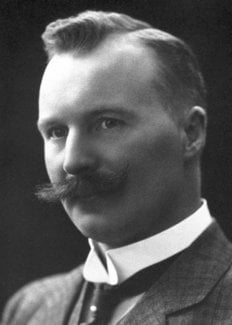
Nils Gustaf Dalén was born at Stenstorp in Skaraborg, Sweden on November 30, 1869, the son of a farmer. After his preliminary education, he entered a School of Agriculture to study dairy farming but he was later advised by Gustaf de Laval, who recognized his natural gift for mechanics, to seek a technical education. He prepared himself for the Chalmers Institute at Gothenburg and gained admission in 1892. He graduated as an engineer in 1896 and spent a year in Switzerland, studying under Professor Stodola at the Eidgenössisches Polytechnikum.
On his return to Sweden, Dalén carried out some research at Gothenburg and set up as a consulting engineer. He became Technical Chief of the Svenska Karbid- och Acetylen A.B. (Swedish Carbide and Acetylene, Ltd.) in 1901 and he later joined the Gas Accumulator Company where he became Chief Engineer in 1906. In 1909, the company was reorganized as Svenska Aktiebolaget Gasaccumulator (AGA) (Swedish Gas Accumulator Ltd.) with Dalén as Managing Director.
Dalén’s inventiveness first showed in his early days on his father’s farm when he built a threshing machine powered by an old spinning wheel. He contrived a device to indicate the butterfat content of milk and thereby made his contact with de Laval. On completion of his advanced education, he worked on the construction of a hot-air turbine and related air compressors and pumps. He also invented a pasteurization apparatus and a milking machine.
In 1901, Dalén’s company purchased the patent rights of the French invention of dissolved acetylene and he began his work on automatic flashing beacons for lighthouses. His subsequent invention of the sun-valve, which causes a beacon to light automatically at dusk and extinguish itself at dawn, enabled lighthouses to function perfectly and unattended for periods of up to a year. His invention of cylinder filled with a porous mass of asbestos and diatomaceous earth for storage of acetylene reduced considerably the hazards in handling this material and its use in welding became safe. He also invented a mixer for providing a constant and correct balance of gas and air for use in the incandescent mantle and a device for removing broken mantles and replacing them by new ones.
In 1912, whilst testing safety devices on cylinders of acetylene in an outdoor location, and when satisfactory safety precautions had been taken, a sudden explosion seriously injured Dalén and caused the loss of his eyesight. He recovered from his other injuries and overcoming his great incapacity, continued his researches. He was awarded the contract for lighting the Panama Canal and later turned to the field of thermal technics to invent a stove, now in universal use, which maintains cooking heat for 24 hours using only eight pounds of coal.
Dalén’s writings were few, but he left his mark in a practical way by the provision of light, and therefore safety, for the benefit of travellers by land, sea and air.
Amongst the many distinctions conferred upon Dalén are membership of the Swedish Royal Academy of Sciences, 1913, and the Academy of Science and Engineering, 1919. He was made Honorary Doctor of Lund University in 1918 and received the Morehead Medal of the International Acetylene Association. He took part in debates at the National Society of Economics and served on the Lidingö City Council for almost twenty years.
Dalén married Elma Persson in 1901. They had two sons and two daughters. Their eldest son, Gunnar, qualified as an engineer and followed his father as a Director of AGA; their younger son, Anders, became a Doctor of Medicine; Gustaf’s brother Albin, a famous ophthalmologist, was a Professor at the Caroline Institute.
Dalén died on December 9, 1937, in his villa at Lidingö.
This autobiography/biography was written at the time of the award and first published in the book series Les Prix Nobel. It was later edited and republished in Nobel Lectures. To cite this document, always state the source as shown above.
The Nobel Foundation's copyright has expired.