Louis Néel – Nominations
Hannes Alfvén – Nominations
Hannes Alfvén – Nobel Lecture
Nobel Lecture, December 11, 1970
Plasma Physics, Space Research and the Origin of the Solar System
Read the Nobel Lecture
Pdf 53 kB
Louis Néel – Banquet speech
Louis Néel’s speech at the Nobel Banquet in Stockholm, December 10, 1970 (in French)
Sire, Altesses Royales, Mesdames, Messieurs,
Je suis heureux d’avoir ici l’occasion de remercier l’Académie Royale des Sciences de Suède pour la distinction qui ma été accordée et qui, par mon intermédiaire, honore la Physique française et en particulier l’Ecole française de Magnétisme : Pierre Curie qui le premier fit un classement précis des substances magnétiques, Paul Langevin auquel on doit la théorie du para et du diamagnétisme, Pierre Weiss et sa théorie du ferromagnétisme.
Seules restaient incomprises les propriétés de la plus ancienne des substances magnétiques connues : la magnétite ou pierre d’aimant qui attiré l’attention des curieux depuis quatre mille ans. J’ai eu la chance de combler cette lacune et d’expliquer ces propriétés, avec la notion de ferromagnétisme.
Mais j’avais été précédé dans cette voie, au XIIème siècle, par Pierre de Maricourt, auteur en 1269 du premier traité sérieux sur les aimants. Après avoir lu son œuvre, on peut faire trois remarques.
D’abord qu’en matière scientifique, on a souvent des prédécesseurs beaucoup plus anciens qu’on ne le pense a priori.
En second lieu que la liaison Université-Industrie dont on parle becaucoup aujourd’hui est en réalité très ancienne puisque la lettre de Pierre de Maricourt se préoccupait principalement des applications du magnétisme aux boussoles et aux compas de marine, pour la navigation.
En dernier lieu, je remarquerai que Pierre de Maricourt se faisait appeler aussi Peter Peregrinus ou Pierre le Pélerin, ce qui pouvait faire allusion à une croisade en terre sainte, mais ce qui me rappelle aussi qu’au Moyen Age les savants étaient de grands voyageurs et passaient facilement d’une université européenne à une autre.
Puisse l’exemple de cette ancienne coopération européenne, facilitée de nos jours par Alfred Nobel, dépasser le cadre de la recherche scientifique et s’étendre à beaucoup d’autres domaines.
Louis Néel – Nobel Lecture
Nobel Lecture, December 11, 1970
Magnetism and the Local Molecular Field
Read the Nobel Lecture
Pdf 8.09 MB
Hannes Alfvén – Banquet speech
Hannes Alfvén’s speech at the Nobel Banquet in Stockholm, December 10, 1970
Ers Majestät, Era Kungliga Högheter, Mina Damer och Herrar,
I raden av tacktalare skall jag utnyttja den färdighet, som i hela vår grupp endast Ulf von Euler och jag besitter, den att kunna tala svenska. Jag vill på svenska uttala ett varmt tack till många vänner, som finns här, och många vänner, som inte finns här. Det är särskilt två grupper, som jag vänder mig till. Det är mina vänner, kolleger och medarbetare vid Tekniska Högskolan, som har utfört det mesta av det arbete, som i dag har prisbelönats, under de trettio år minus tre dagar, som jag har haft förmånen att få arbeta på Tekniska Högskolan. Det är också mina vänner och kolleger inom Kungliga Vetenskapsakademien, som har fattat detta för mig och mina medarbetare högst behagliga beslut. Tack skall Ni ha allihopa.
Hannes Alfvén – Other resources
Links to other sites
Hannes Alfven Papers, 1945-1991 from US San Diego
Award ceremony speech
Presentation Speech by Professor Torsten Gustafsson, member of the Royal Swedish Academy of Sciences
Your Majesty, Your Royal Highnesses, Ladies and Gentlemen.
From the sun, there blows a wind so hot that its atoms are split into electrically-charged particles, electrons and ions. They are attracted by the earth’s magnetic field and the electrons follow the lines of force and produce the aurora borealis. This wind is one example of a plasma, an electrically-conducting gas with such remarkable properties that one, in addition to the wellknown states of matter, solid, liquid and gaseous, has now, in the last fifty years, recognised it as a fourth. It is the most common state of matter in the universe. It was the most important state at the time of the creation of the solar and planetary systems; it is found in interstellar space, in fusion reactors and in welding apparatus.
Alfvén introduced into discussion of the aurora the fundamental idea that plasma, even in space, has a magnetic field associated with it.
In this way, he was led to study the general question of the significance of magnetic fields in the movements of plasmas. The magnetic field forces the positive and negative charges to move in different directions, giving rise to electric currents. The interaction of these currents produces mechanical forces, which can completely change the plasma’s direction and speed. In particular, Alfvén discovered the existence of hitherto unsuspected magneto-hydrodynamical waves, the so-called Alfvén waves.
In cosmic physics, Alfvén’s fundamental contribution has been the introduction of the magneticfield offorce and the application of magneto-hydrodynamics. Prior to his work, one simply did not take these forces into consideration: through him, they have found widespread application in astrophysical problems, particularly in studying that phase of the development of the solar system in which the planets and satellites were created. Thus, the sun’s rotation and the regular pattern of the planetary orbits can be explained by the idea that hydro-magnetic waves from the sun flowed along magnetic lines of force and transferred rotational energy to the planets when they were in the early stages of formation.
Furthermore, magneto-hydrodynamics is important in discussing the problem of how the central body in a plasma cloud can develop into a sun and system of planets, or in investigations of stability conditions for a plasma consisting of electrons and ions moving at relativistic velocities interacting with cosmic fields. This is of interest in connection with both supernovae and the powerful eruptions recently found to occur in the centre of the Milky Way.
Alfvén’s contributions to clarify the physical properties of plasmas have been considerable. Particularly important have been those works which form the bases of fusion research in different parts of the world. These works are important independently of how a fusion reactor can be built. The problem of containing a plasma at temperatures of millions of degrees in a magnetic field is related to Alfvén’s concept of frozen lines of magnetic force. The plasma flowing in the bottle must not collapse like a breaking wave. Knowledge of the properties of Alfvén waves has been of extreme assistance in finding currents with the stability required.
Professor Alfvén. You have created magneto-hydrodynamics. Its development, in which you have played the major role, has shown the significance of this new branch of physics, both on the cosmic scale as well as here on earth.
On behalf of the Royal Academy of Science, it is my pleasure to congratulate you on your Nobel Prize in Physics.
About two thousand years ago, the first magnetic compass was made in China by stroking a piece of iron with a lump of magnetite. Such a compass always arouses much surprise, from the child who asks about the invisible force which aligns it along the north-south axis, to the scientist, who here confronts one of the very difficult problems of physics.
Three states of magnetism have long been recognised, die-, para- and ferromagnetism. In the two former, the elementary magnets of the atoms behave independently of one another when subjected to a magnetic field. However, in ferromagnetism, which is many times stronger, they are aligned collectively, which makes the understanding of the physics much more difficult.
The first scientist who tried to explain magnetism was Ampere with his hypothesis about elementary currents. In 1907, Pierre Weiss found that there must be a special kind of force which aligned the elementary magnets, although he could not identify it. In his doctor’s thesis in 1911. Niels Bohr showed that magnetism could not be caused by currents originating from the classical motion of electrical charges, but that something completely new was needed. Using the new ideas of atomic physics, Heisenberg in 1928 was able to give a qualitative explanation of the aligning force occurring in ferromagnetics. To these three types of magnetism, Néel in 1932 added a fourth, anti-ferromagnetism. He found that for certain crystals adjacent elementary magnets could align themselves anti-parallel and not parallel as in ferro-magnetic materials. He deduced the existence of anew variant of the force postulated by Weiss and presented a model for crystals which are built up from two interlaced lattices with equally strong magnetic fields acting in opposite directions. Anti-ferromagnetism is an ordered state with important properties. Thus, Néel showed that the magnetic state should disappear at a temperature now known as the Néel point, in analogy with the Curie point. Similarly, other remarkable observations in the physics of the solid state were explained.
In 1948, Néel made another fundamental discovery with his explanation of the strong magnetism found in the ferrite materials, of which magnetite is one. He generalized his earlier assumption by assuming that the lattices could be of different strengths and could produce external fields. In magnetite, with three atoms of iron and four of oxygen, the effects of two of the iron atoms cancel out while the third gives rise to the magnetic field. It is remarkable that magnetite which in the hands of the Chinese was used to produce the first compass, is in fact not ferromagnetic, but, in Néel’s terminology, ferrimagnetic.
Néel could present an accurate description of the behaviour of the new synthetic magnetic materials and so explain hitherto puzzling experimental observations. These developments have been of considerable technical importance, e.g. in computer memories and in high-frequency techniques.
Néel has made many other contributions, such as investigations in the theory of magnetic domains and the discovery of the effect found in small particles, called super-paramagnetism.
Professor Néel. I have attempted to describe your major discoveries which follow in the great French tradition of studies of magnetic phenomena.
I have particularly emphasised your discoveries of anti-ferro- and ferrimagnetism which have been of such importance in the shaping of modern theories of magnetism.
I have the pleasure and the honour to convey to you the most sincere congratulations of the Royal Academy of Science.
Professor Alfvén, Professor Néel. I invite you to receive the Nobel Prize in Physics from the hands of His Majesty the King.
The Nobel Prize in Physics 1970
Hannes Alfvén – Biographical
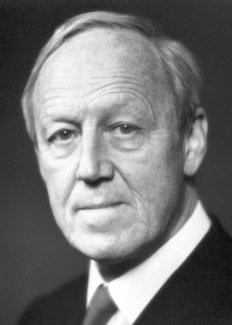
Hannes Olof Gösta Alfvén was born in Norrköping, Sweden, in 1908. His parents Johannes Alfvén and Anna-Clara Romanus were both practising physicians. Hannes Alfvén studied at Uppsala University from 1926, he obtained the degree of doctor of philosophy in 1934, in this same year he was appointed lecturer in physics at Uppsala University. In 1937 he became research physicist at the Nobel Institute for Physics in Stockholm, in 1940 he was appointed Professor in the Theory of Electricity at the Royal Institute of Technology in Stockholm, Professor of Electronics in 1945, and Professor of Plasma Physics in 1963. Since 1967 he is visiting professor of Physics at the University of California at San Diego.
In 1935 Hannes Alfvén married Kerstin Maria Erikson, they have five children: Cecilia, Inger, Gösta, Reidun and Berenike.
Professor Alfvén published a number of papers in physics and astrophysics, and the following monographs: Cosmical Electrodynamics, 1948; Origin of the Solar System, 1956; and together with C.-G. Fälthammar, Cosmical Electrodynamics, Fundamental Principles, 1963.
This autobiography/biography was written at the time of the award and first published in the book series Les Prix Nobel. It was later edited and republished in Nobel Lectures. To cite this document, always state the source as shown above.
Hannes Alfvén died on April 2, 1995.